Rhode Island: Right-of-way and turning — Part 4 Practice Test
Questions in this part include: “What does the manual say about taking the right-of-way for granted?”
Independent educational site · not affiliated with any government agency or DMV
Ready? Test yourself
- Instant feedback with an explanation
- Every answer cites its source in the manual
- Your best score is saved on this device
- Keyboard: press 1 to 4 to answer and Enter for the next question
Questions are original and based on the official manual "Rhode Island Driver’s Manual" (April 2024), Rhode Island Division of Motor Vehicles (DMV).
All 17 questions in this practice test
Take the test above first, then use this list to study. Tap “Show answer” to see the correct answer and explanation.
Show the questions and answersHide the questions
-
On multiple lane highways, which lane does the law require you to use to pass?
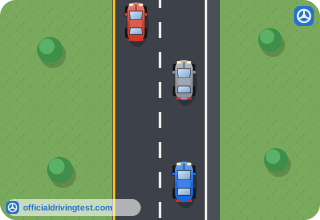
- The right lane
- The breakdown lane
- The left lane
- Whichever lane is open
Show answer
Correct answer: The left lane
The law requires the left lane for passing and the right lane for through traffic or normal driving.
Source: Rhode Island Driver’s Manual (April 2024), page 34
-
When another vehicle is passing you, what should you do?
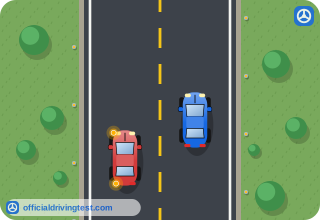
- Speed up so the other driver passes quickly
- Reduce your speed a little and keep to the right
- Move to the left lane to give more room
- Hold the same speed and stay in the middle of the lane
Show answer
Correct answer: Reduce your speed a little and keep to the right
You slow down a little and keep right so the other driver can pass safely.
Source: Rhode Island Driver’s Manual (April 2024), page 34
-
What are blind spots?
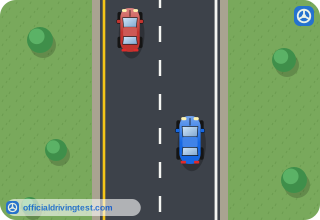
- Areas that cannot be seen through the windshield at night
- Areas that are hidden by road signs near an intersection
- Areas behind the vehicle that are visible only through the rear window
- Areas that cannot be seen in your rear or side-view mirrors
Show answer
Correct answer: Areas that cannot be seen in your rear or side-view mirrors
The manual defines blind spots as areas you cannot see in the rear or side-view mirrors.
Source: Rhode Island Driver’s Manual (April 2024), page 34
-
Before making a lane change or passing maneuver, what must a motorist check?
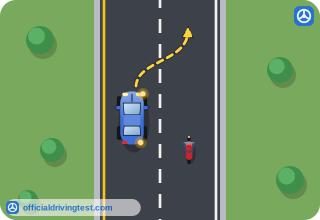
- Over his or her shoulder, to view areas the mirrors cannot show
- Only the rear-view mirror, because it shows the whole lane
- Only the side mirrors and the speedometer
- The vehicle ahead of the car being passed, with no need to look back
Show answer
Correct answer: Over his or her shoulder, to view areas the mirrors cannot show
A motorist must look over a shoulder to see the areas the mirrors do not show.
Source: Rhode Island Driver’s Manual (April 2024), page 34
-
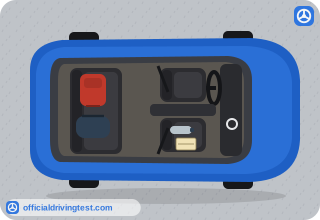
Why does the manual say to avoid placing packages or other large items in the back seat or on the rear window ledge?
- They could block the view of the speedometer
- They could make the vehicle too heavy to stop
- They could cause a blind spot
- They could be thrown against the windshield
Show answer
Correct answer: They could cause a blind spot
Large items in the back seat or on the rear window ledge can create a blind spot.
Source: Rhode Island Driver’s Manual (April 2024), page 34
-
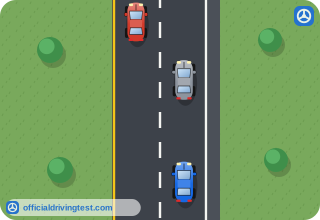
Which turn signal do you give to let the driver ahead or behind you know that you will be pulling out to pass?
- A right turn signal
- A left turn signal
- The hazard lights
- No signal until you are beside the other vehicle
Show answer
Correct answer: A left turn signal
To pass on the left, the first step is to give a left turn signal.
Source: Rhode Island Driver’s Manual (April 2024), page 34
-
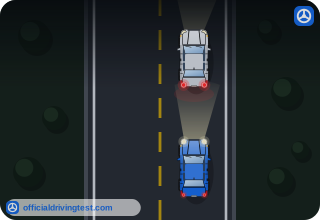
At night, what might it be necessary to do to warn the driver in front of you that you intend to pass?
- Switch off your headlights for a few seconds
- Turn on your hazard lights until you have passed
- Keep your high beams on until you are back in your lane
- Blink your headlights from low beam to high beam and back
Show answer
Correct answer: Blink your headlights from low beam to high beam and back
The manual says it might be necessary to blink from low beam to high beam and back to low beam.
Source: Rhode Island Driver’s Manual (April 2024), page 34
-
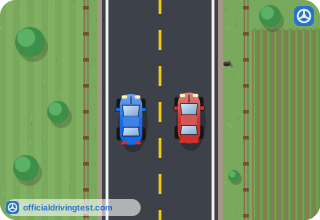
When you have safely passed the vehicle, which signal should you activate?
- Your right turn signal
- Your left turn signal
- Your hazard lights
- No signal, because the pass is finished
Show answer
Correct answer: Your right turn signal
After passing, you activate your right turn signal before returning to the right side.
Source: Rhode Island Driver’s Manual (April 2024), page 34
-
How far past the vehicle you are passing should you go before returning to the right side of the road?
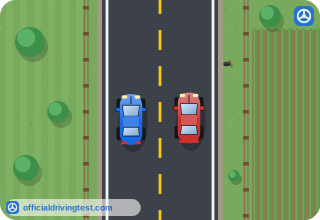
- Far enough to see the whole front bumper of the passed vehicle in your side mirror
- At least one full car length beyond the passed vehicle
- Far enough to see the tires of the passed vehicle on the pavement in your inside rear-view mirror
- Far enough that the passed vehicle is out of sight in your mirrors
Show answer
Correct answer: Far enough to see the tires of the passed vehicle on the pavement in your inside rear-view mirror
You should see the tires of the passed vehicle on the pavement in your inside rear-view mirror before returning.
Source: Rhode Island Driver’s Manual (April 2024), page 34
-
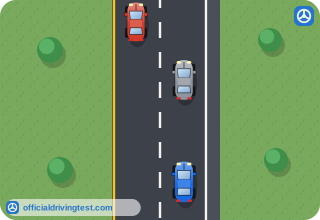
In general, on which side should you pass other vehicles?
- On the right
- On the left
- On whichever side has more room
- On the side away from oncoming traffic
Show answer
Correct answer: On the left
The manual says that, in general, vehicles should be passed only on the left.
Source: Rhode Island Driver’s Manual (April 2024), page 34
-
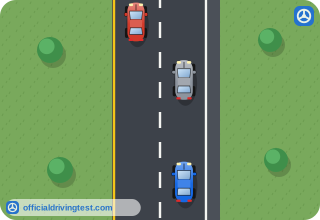
How many vehicles does the manual say you may pass at one time?
- Up to two
- As many as you can pass safely
- Up to three on a straight road
- Never more than one
Show answer
Correct answer: Never more than one
The manual says never to pass more than one vehicle.
Source: Rhode Island Driver’s Manual (April 2024), page 34
-
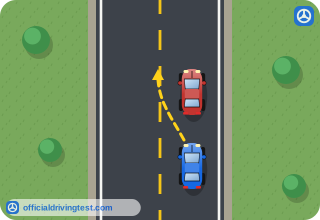
May you travel over the posted speed to pass a vehicle?
- No, never travel over the posted speed to pass
- Yes, if you return to the right lane quickly
- Yes, but only on a multiple lane highway
- Yes, by up to 5 miles per hour
Show answer
Correct answer: No, never travel over the posted speed to pass
The manual says never to travel over the posted speed to pass a vehicle.
Source: Rhode Island Driver’s Manual (April 2024), page 34
-
In which situation may a driver pass on the right of another vehicle?
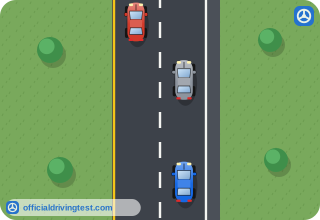
- When the motor vehicle ahead is driving below the speed limit
- When the road ahead curves to the right
- When the motor vehicle ahead is making or about to make a left turn
- When the driver can use the shoulder to get around
Show answer
Correct answer: When the motor vehicle ahead is making or about to make a left turn
Passing on the right is allowed only in listed cases, including when the vehicle ahead is making or about to make a left turn.
Source: Rhode Island Driver’s Manual (April 2024), page 34
-
Under what conditions may you drive off the pavement or main traveled portion of the road to pass a motor vehicle?
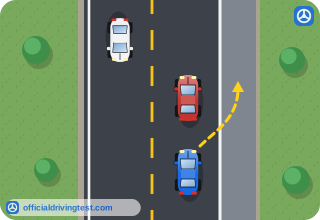
- When the vehicle ahead is slow
- Under no conditions
- When you are on a one-way road
- When no vehicles are coming
Show answer
Correct answer: Under no conditions
The manual says that under no conditions can you drive off the pavement or main traveled portion of the road to pass.
Source: Rhode Island Driver’s Manual (April 2024), page 34
-
What does the manual say about taking the right-of-way for granted?
- Always take it, because the law grants it to you in every case
- Never do it; the law grants it, but the other driver may not, so yield
- Take it only when the other driver is looking at you
- Take it only on multiple lane highways, not on local roads
Show answer
Correct answer: Never do it; the law grants it, but the other driver may not, so yield
The law grants right-of-way, but the other driver may not, so you should yield to the other driver.
Source: Rhode Island Driver’s Manual (April 2024), page 36
-
In which direction do roundabouts direct traffic around the center island?
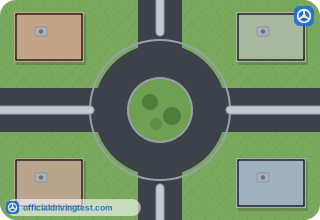
- Clockwise
- Counterclockwise
- Straight across
- Back and forth
Show answer
Correct answer: Counterclockwise
Roundabouts send traffic counterclockwise around a center island.
Source: Rhode Island Driver’s Manual (April 2024), page 40
-
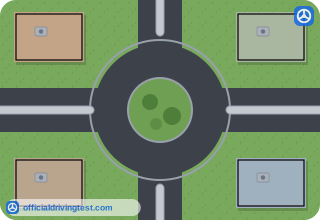
What is the purpose of a roundabout's circular intersection?
- To speed up traffic by removing all speed limits
- To make every driver stop at stop signs
- To give drivers a place to park near an intersection
- To slow traffic while reducing delays in traffic movement
Show answer
Correct answer: To slow traffic while reducing delays in traffic movement
The circular design slows traffic while cutting delays.
Source: Rhode Island Driver’s Manual (April 2024), page 40