Rhode Island: Emergencies and collisions — Part 5 Practice Test
Questions in this part include: “Which of these may help avoid the effects of carbon monoxide poisoning?” · “Which information should you record about the other driver after a collision?”
Independent educational site · not affiliated with any government agency or DMV
Ready? Test yourself
- Instant feedback with an explanation
- Every answer cites its source in the manual
- Your best score is saved on this device
- Keyboard: press 1 to 4 to answer and Enter for the next question
Questions are original and based on the official manual "Rhode Island Driver’s Manual" (April 2024), Rhode Island Division of Motor Vehicles (DMV).
All 19 questions in this practice test
Take the test above first, then use this list to study. Tap “Show answer” to see the correct answer and explanation.
Show the questions and answersHide the questions
-
Which of these may help avoid the effects of carbon monoxide poisoning?
- Idling your vehicle with the windows closed for a long time
- Checking your tire pressure every week
- Changing the battery once a year
- Having your exhaust system checked periodically
Show answer
Correct answer: Having your exhaust system checked periodically
The manual says to have the exhaust system checked periodically and not to idle for long with the windows closed.
Source: Rhode Island Driver’s Manual (April 2024), page 47
-
What may untreated carbon monoxide poisoning cause?
- A mild headache only
- Death
- Temporary loss of hearing
- Permanent loss of vision
Show answer
Correct answer: Death
The manual says carbon monoxide poisoning may cause death if it is untreated.
Source: Rhode Island Driver’s Manual (April 2024), page 47
-
After a collision, what must you do at the scene?
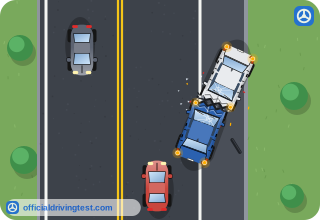
- Remain and make your identity known
- Leave and report the collision later by phone
- Remain only if someone is injured
- Leave once the other driver has your insurance details
Show answer
Correct answer: Remain and make your identity known
The manual tells drivers to stay at the scene and identify themselves to any interested person.
Source: Rhode Island Driver’s Manual (April 2024), page 65
-
What does the manual say is imposed on drivers who leave the scene of a collision without properly identifying themselves?
- A written warning only
- A small fine only
- Severe penalties
- Nothing, if no one was hurt
Show answer
Correct answer: Severe penalties
The manual says severe penalties are imposed on drivers who leave the scene (hit and run) without identifying themselves.
Source: Rhode Island Driver’s Manual (April 2024), page 65
-
To whom should you report all collisions immediately?
- The nearest state or local police
- Your insurance company
- The nearest DMV office
- The Department of Transportation
Show answer
Correct answer: The nearest state or local police
The manual says to report all collisions immediately to the nearest state or local police.
Source: Rhode Island Driver’s Manual (April 2024), page 65
-
What should you do after a collision if personal injury is involved?
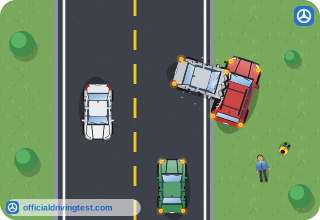
- Move the injured people into your vehicle
- Wait for the other driver to call for help
- Drive to the nearest hospital yourself
- Request rescue assistance
Show answer
Correct answer: Request rescue assistance
The manual lists requesting rescue assistance as the step to take when someone is injured.
Source: Rhode Island Driver’s Manual (April 2024), page 65
-
In the event of a minor collision, what does the manual say to do if possible?
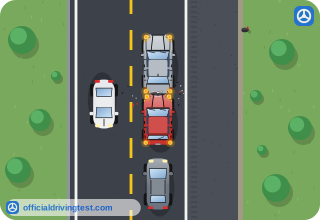
- Leave the vehicle in the travel lane until the police arrive
- Drive your vehicle to the side of the roadway and notify the police
- Drive away and report it the next day
- Wait for a tow truck before calling anyone
Show answer
Correct answer: Drive your vehicle to the side of the roadway and notify the police
For a minor collision the manual says to move the vehicle off to the side of the road, if possible, and notify the police.
Source: Rhode Island Driver’s Manual (April 2024), page 65
-
If you collide with or damage a parked vehicle, what must you do?
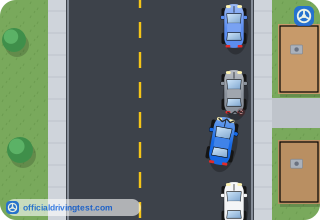
- Leave only your phone number on the windshield
- Attach a written note with your name and address
- Drive away if the damage is not visible
- Wait at least an hour for the owner to return
Show answer
Correct answer: Attach a written note with your name and address
The manual requires a written note with your name and address attached securely to the parked vehicle or property, and you must also report the collision to the police.
Source: Rhode Island Driver’s Manual (April 2024), page 65
-
A police report is required for a collision if the property damage is over what amount?
- $500
- $2,500
- $5,000
- $1,000
Show answer
Correct answer: $1,000
The manual's list of cases that need a police report includes property damage over $1,000.
Source: Rhode Island Driver’s Manual (April 2024), page 65
-
Which of these situations is listed as requiring a police report?
- You hit a domesticated animal
- Your vehicle breaks down on the shoulder
- Another driver honks at you at a green light
- An officer gives you a verbal warning
Show answer
Correct answer: You hit a domesticated animal
The manual says a police report is required if you hit a domesticated animal, along with injuries, damage over $1,000 and hitting an unattended vehicle.
Source: Rhode Island Driver’s Manual (April 2024), page 65
-
If a collision happens on an interstate highway, what should you note as part of its exact location?
- The number of lanes at the location
- The posted speed limit at that spot
- The nearest mile marker number
- The name of the nearest town
Show answer
Correct answer: The nearest mile marker number
The manual says to note the house number nearest the collision or, on an interstate highway, the nearest mile marker number.
Source: Rhode Island Driver’s Manual (April 2024), page 65
-
Which information should you record about the other driver after a collision?
- Insurance carrier and policy number
- Employer and work phone number
- Date of birth and Social Security number
- Date the vehicle was purchased
Show answer
Correct answer: Insurance carrier and policy number
The manual lists the other driver's name, address, license, insurance carrier and policy number, and registration state and number.
Source: Rhode Island Driver’s Manual (April 2024), page 65
-
What does the manual say about getting the other driver's information after a collision?
- Only the driver who was not at fault may ask for it
- Only the police may collect it
- It is your right and the other driver's right to get it
- It is optional and may be refused
Show answer
Correct answer: It is your right and the other driver's right to get it
The manual states that you and the other driver each have the right to get this information.
Source: Rhode Island Driver’s Manual (April 2024), page 65
-
Whose names and addresses should you record after a collision?
- Only the people who were in your own vehicle
- All witnesses and the persons in the other vehicle
- Only the other driver and the police officer
- Only the officers who respond to the scene
Show answer
Correct answer: All witnesses and the persons in the other vehicle
The manual says to record the names and addresses of everyone who witnessed the collision as well as the people in the other vehicle.
Source: Rhode Island Driver’s Manual (April 2024), page 65
-
Which of these should you record if a police officer arrives at the scene of a collision?
- The officer's home address
- The name of the officer's supervisor
- The make of the patrol car
- The name of the police officer
Show answer
Correct answer: The name of the police officer
The manual lists the name of the police officer at the scene, if one arrives, among the details to record.
Source: Rhode Island Driver’s Manual (April 2024), page 65
-
Which of these is listed as a common cause of motor vehicle collisions?
- Driving with the headlights on in daylight
- Signaling a turn too early
- Keeping a three-second following distance
- Not looking when driving away from the curb
Show answer
Correct answer: Not looking when driving away from the curb
Not looking when driving away from the curb appears in the manual's list of the most common causes of collisions.
Source: Rhode Island Driver’s Manual (April 2024), page 65
-
In the manual's list of common causes of collisions, what is driving too close to the vehicle in front of you called?
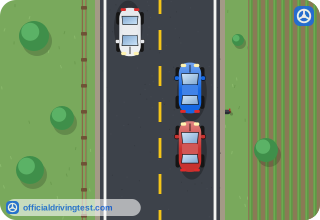
- Weaving
- Tailgating
- Merging
- Hydroplaning
Show answer
Correct answer: Tailgating
The list names driving too close to the vehicle in front of you as tailgating.
Source: Rhode Island Driver’s Manual (April 2024), page 65
-
In the manual's list of common causes of collisions, driving to the left of the centerline is described as what?
- An improper lane change at an intersection
- An illegal U-turn on a divided highway
- Driving on the wrong side of the road
- Passing on the shoulder of the road
Show answer
Correct answer: Driving on the wrong side of the road
The list describes driving to the left of the centerline as driving on the wrong side of the road.
Source: Rhode Island Driver’s Manual (April 2024), page 65
-
The manual lists the duty to stop in a collision resulting in personal injury or death. What does it label a violation of that duty?
- A felony
- A civil infraction
- A court appearance only
- A misdemeanor
Show answer
Correct answer: A felony
The violations list labels failing to stop after a collision with personal injury or death a felony.
Source: Rhode Island Driver’s Manual (April 2024), page 66