Rhode Island: Emergencies and collisions — Part 2 Practice Test
Questions in this part include: “What kind of escape path should you choose when your accelerator is stuck?” · “How does the steering change when power is lost by engine failure?”
Independent educational site · not affiliated with any government agency or DMV
Ready? Test yourself
- Instant feedback with an explanation
- Every answer cites its source in the manual
- Your best score is saved on this device
- Keyboard: press 1 to 4 to answer and Enter for the next question
Questions are original and based on the official manual "Rhode Island Driver’s Manual" (April 2024), Rhode Island Division of Motor Vehicles (DMV).
All 20 questions in this practice test
Take the test above first, then use this list to study. Tap “Show answer” to see the correct answer and explanation.
Show the questions and answersHide the questions
-
If a tire fails, what does the manual say your task is?
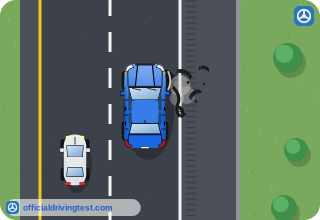
- To stop in the lane right away
- To drive to safety
- To brake as hard as you can
- To repair the tire quickly
Show answer
Correct answer: To drive to safety
The manual says the failed tire is already a total loss, so your task is to drive to safety.
Source: Rhode Island Driver’s Manual (April 2024), page 43
-
If a tire fails, how should you hold the steering wheel?
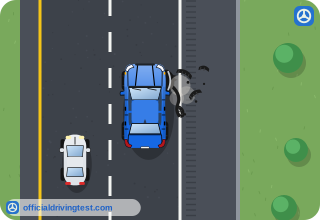
- Loosely with one hand
- Lightly with your fingertips
- With one hand while you brake
- Firmly with two hands
Show answer
Correct answer: Firmly with two hands
The first step for a blowout or flat tire is to grip the steering wheel firmly with two hands.
Source: Rhode Island Driver’s Manual (April 2024), page 43
-
Right after a tire blows out, what should you do about the brake?
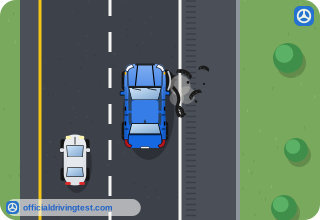
- Brake hard at once to stop as quickly as possible
- Pump the brake pedal rapidly until you stop
- Do not brake; ease up on the accelerator and let the vehicle slow
- Brake gently with your left foot while you steer the vehicle
Show answer
Correct answer: Do not brake; ease up on the accelerator and let the vehicle slow
Braking can make the vehicle swerve, so the manual says to ease off the accelerator and not brake.
Source: Rhode Island Driver’s Manual (April 2024), page 43
-
After a blowout, what should you turn on as soon as possible?
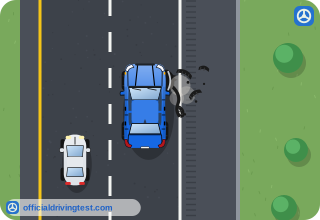
- Your hazard warning lights
- Your high beams
- Your fog lights
- Your windshield wipers
Show answer
Correct answer: Your hazard warning lights
The manual says to turn on the hazard warning lights as soon as possible after tire failure.
Source: Rhode Island Driver’s Manual (April 2024), page 44
-
After a blowout, how should you leave the roadway once you reach a safe place?
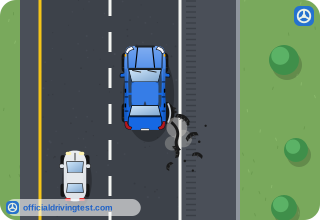
- Brake hard as you pull off the roadway
- Accelerate smoothly onto the shoulder
- Coast off the roadway without using any brakes
- Drive off the roadway slowly, braking gently
Show answer
Correct answer: Drive off the roadway slowly, braking gently
The last step for a blowout is to drive off the roadway slowly and brake gently.
Source: Rhode Island Driver’s Manual (April 2024), page 44
-
If your accelerator pedal sticks to the floor, what should you try first?
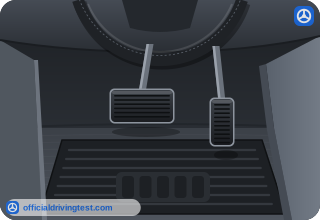
- Turn off the ignition right away
- Kick the side of the pedal once or twice to jar it free
- Shift into reverse and apply the brake
- Pump the brake pedal until the engine finally stops
Show answer
Correct answer: Kick the side of the pedal once or twice to jar it free
The first step is to kick the side of the accelerator once or twice to try to jar it free.
Source: Rhode Island Driver’s Manual (April 2024), page 44
-
What should you do at the same time as you apply the brake when the accelerator is stuck?
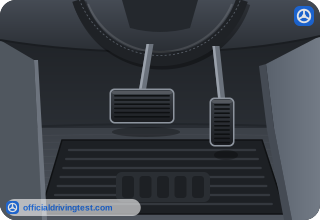
- Shift the car to park
- Shift the car to neutral
- Shift the car to reverse
- Turn off the ignition
Show answer
Correct answer: Shift the car to neutral
With a stuck accelerator the manual says to shift to neutral at the same time you apply the brake.
Source: Rhode Island Driver’s Manual (April 2024), page 44
-
What kind of escape path should you choose when your accelerator is stuck?
- One that leads to the center of the next lane
- One that follows the vehicle ahead of you
- One that leads toward the nearest intersection
- One that leads to an open zone off the roadway
Show answer
Correct answer: One that leads to an open zone off the roadway
The manual says to choose an escape path to an open zone off the roadway and keep braking.
Source: Rhode Island Driver’s Manual (April 2024), page 44
-
What happens when you shift to neutral while the accelerator is stuck?
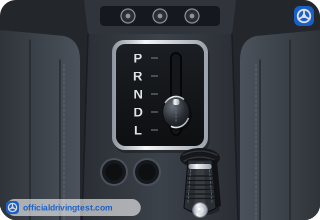
- The engine races, but power is removed from the drive wheels
- The engine stops and the steering wheel locks
- The accelerator pedal frees itself by itself
- The brakes lose all of their power assist right away
Show answer
Correct answer: The engine races, but power is removed from the drive wheels
In neutral the engine will race, but the drive wheels no longer receive power, which may help you avoid a collision.
Source: Rhode Island Driver’s Manual (April 2024), page 44
-
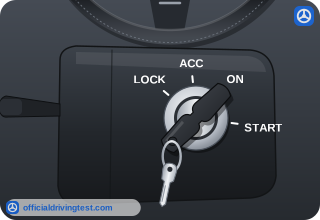
When should you turn off the ignition after your accelerator sticks?
- As soon as the pedal sticks
- Before you shift to neutral
- Once you are off the roadway
- Right after you kick the pedal
Show answer
Correct answer: Once you are off the roadway
The manual's last step says to turn off the ignition once you are off the roadway.
Source: Rhode Island Driver’s Manual (April 2024), page 44
-
If your engine suddenly shuts off or sputters while you are driving, what should you do when it first happens?
- Brake hard and stop in the lane
- Turn the ignition off and coast
- Shift to reverse and steer slowly to the curb
- Shift to neutral and try to restart the vehicle
Show answer
Correct answer: Shift to neutral and try to restart the vehicle
The manual says to shift to neutral and try to restart the vehicle when the engine first sputters or stops.
Source: Rhode Island Driver’s Manual (April 2024), page 44
-
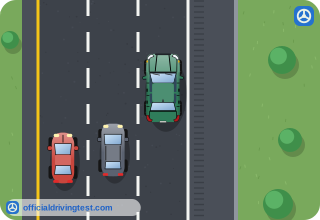
If your engine fails and you begin moving out of traffic, what should you turn on, and what should you not do?
- Turn on the high beams and brake gently
- Turn on the hazard flashers and do not brake
- Turn on the hazard flashers and brake firmly
- Turn on the interior light and do not steer
Show answer
Correct answer: Turn on the hazard flashers and do not brake
The manual says to turn on the hazard flashers and not to brake when the engine fails.
Source: Rhode Island Driver’s Manual (April 2024), page 44
-
How does the steering change when power is lost by engine failure?
- It becomes easier
- It does not change
- It becomes harder
- It locks completely
Show answer
Correct answer: It becomes harder
The manual says steering will be harder when power is lost by engine failure.
Source: Rhode Island Driver’s Manual (April 2024), page 44
-
If the engine will not start and you have pulled to the side of the road, what should you do with the hood and the hazard flashers?
- Raise the hood and leave the hazard flashers on
- Keep the hood down and turn the hazard flashers off
- Raise the hood and turn the hazard flashers off
- Keep the hood down and turn on the high beams
Show answer
Correct answer: Raise the hood and leave the hazard flashers on
After stopping at the side of the road the manual says to raise the hood and leave the hazard flashers on.
Source: Rhode Island Driver’s Manual (April 2024), page 44
-
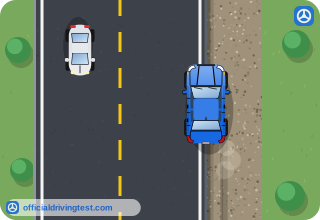
When returning to the roadway after driving off the shoulder, how should you hold the steering wheel?
- Firmly, on the top half with both hands
- Loosely, on the bottom half with one hand
- Lightly, with only your fingertips
- On the bottom half with both hands
Show answer
Correct answer: Firmly, on the top half with both hands
The off-road recovery steps begin with holding the wheel firmly on the top half with both hands.
Source: Rhode Island Driver’s Manual (April 2024), page 44
-
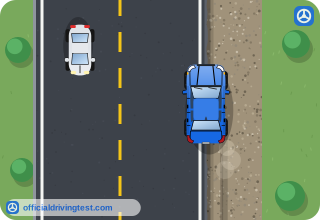
What does a greater drop-off between the roadway and the shoulder require?
- A higher speed on the shoulder
- Harder braking before you turn
- A greater amount of steering control
- A lighter grip on the wheel
Show answer
Correct answer: A greater amount of steering control
The manual says the greater the drop-off, the more steering control you need.
Source: Rhode Island Driver’s Manual (April 2024), page 44
-
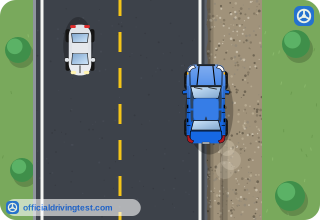
What should you do with the accelerator and the brake when you are recovering from driving off the road?
- Brake firmly and keep the accelerator pressed
- Ease up on the accelerator and avoid braking, if possible
- Accelerate hard to climb back onto the pavement
- Brake and accelerate alternately to keep control
Show answer
Correct answer: Ease up on the accelerator and avoid braking, if possible
The manual says to ease up on the accelerator, let the vehicle slow gradually and avoid braking if possible.
Source: Rhode Island Driver’s Manual (April 2024), page 44
-
During off-road recovery, how should you position your vehicle before returning to the roadway?
- Parallel to the roadway, fully on the shoulder
- Angled away from the roadway
- Fully off the shoulder and stopped
- So that it straddles the roadway edge
Show answer
Correct answer: So that it straddles the roadway edge
The manual says to position the vehicle so it straddles the roadway edge.
Source: Rhode Island Driver’s Manual (April 2024), page 44
-
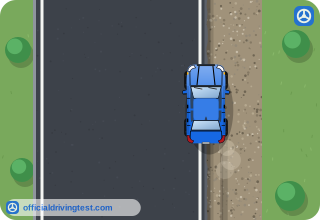
Where should you choose to return to the roadway after driving off it?
- Where the drop-off to the shoulder is greatest
- Where the shoulder is narrowest
- Where the shoulder is nearest the level of the roadway
- Right where your vehicle left the roadway
Show answer
Correct answer: Where the shoulder is nearest the level of the roadway
A shoulder that is close to the roadway's level makes returning easier, so the manual says to select such a place.
Source: Rhode Island Driver’s Manual (April 2024), page 44
-
Before you return to the roadway during off-road recovery, what should you do?
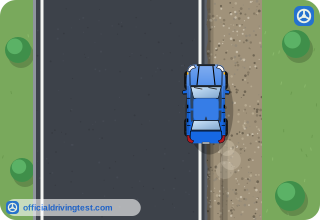
- Check for traffic, signal and check your blind spot
- Sound the horn and return immediately
- Stop completely and wait for another driver to pass
- Flash your headlights and return
Show answer
Correct answer: Check for traffic, signal and check your blind spot
The manual says to check for traffic, signal, check your blind spot and then return to the roadway.
Source: Rhode Island Driver’s Manual (April 2024), page 44