Rhode Island: Emergencies and collisions — Part 4 Practice Test
Questions in this part include: “When can carbon monoxide poisoning occur, according to the manual?” · “What can let carbon monoxide enter the inside of a vehicle?”
Independent educational site · not affiliated with any government agency or DMV
Ready? Test yourself
- Instant feedback with an explanation
- Every answer cites its source in the manual
- Your best score is saved on this device
- Keyboard: press 1 to 4 to answer and Enter for the next question
Questions are original and based on the official manual "Rhode Island Driver’s Manual" (April 2024), Rhode Island Division of Motor Vehicles (DMV).
All 19 questions in this practice test
Take the test above first, then use this list to study. Tap “Show answer” to see the correct answer and explanation.
Show the questions and answersHide the questions
-
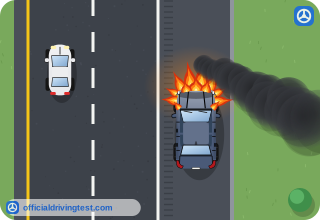
If a vehicle fire is out of control, how far away should you move?
- At least 10 feet
- At least 25 feet
- At least 100 feet
- At least 50 feet
Show answer
Correct answer: At least 100 feet
A fuel fire can cause the fuel tank to explode, so the manual says to move at least 100 feet away.
Source: Rhode Island Driver’s Manual (April 2024), page 46
-
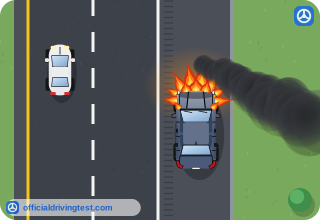
What does the manual say about trying to put out a vehicle fire that is out of control?
- Use water from a nearby source to put it out
- Do not attempt to put out the fire
- Cover the engine with a blanket
- Put it out only if you stay upwind
Show answer
Correct answer: Do not attempt to put out the fire
For an out-of-control fire the manual says to move away and not to try to put it out.
Source: Rhode Island Driver’s Manual (April 2024), page 46
-
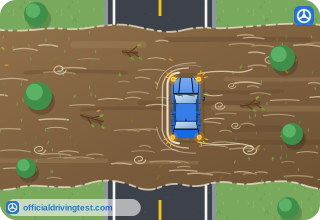
If your vehicle drives into water or stalls in a rain-swollen roadway, what should you do immediately?
- Open the driver's door
- Turn the ignition off and wait
- Dial 911 from inside the vehicle
- Remove your seat belt
Show answer
Correct answer: Remove your seat belt
Removing your seat belt is the first step the manual lists for a vehicle in water.
Source: Rhode Island Driver’s Manual (April 2024), page 46
-
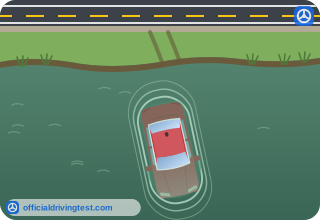
If your vehicle has power windows and is in water, when should you open a window?
- After the vehicle has stopped sinking in the water
- After you have called 911
- Before the water damages the electrical system
- Only after the passengers are out
Show answer
Correct answer: Before the water damages the electrical system
The manual says to open the window before the water damages the electrical system.
Source: Rhode Island Driver’s Manual (April 2024), page 46
-
When your vehicle is in water, what does the manual say to do about children in the rear seat?
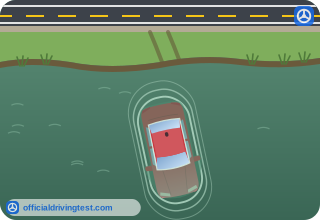
- Help them out of seat belts and restraints, asking older children to help the younger
- Leave them buckled in the rear seat until the vehicle stops moving in the water
- Send the youngest child out of the window alone first
- Ask them to wait inside the vehicle while you swim for help
Show answer
Correct answer: Help them out of seat belts and restraints, asking older children to help the younger
The manual says to help children out of the rear belts and restraints and to ask older children to assist the younger ones.
Source: Rhode Island Driver’s Manual (April 2024), page 46
-
After you get out of a vehicle that has driven into water, where does the manual say to move?
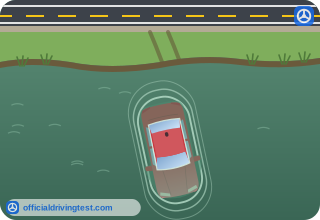
- Under the vehicle's rear bumper
- Into the water to swim to shore
- Back into the front seat
- To the roof of the vehicle
Show answer
Correct answer: To the roof of the vehicle
Moving to the roof keeps you as dry as possible, and the vehicle can float like a boat for a short time.
Source: Rhode Island Driver’s Manual (April 2024), page 46
-
Once you are on the roof of a vehicle that is in water, what should you do?
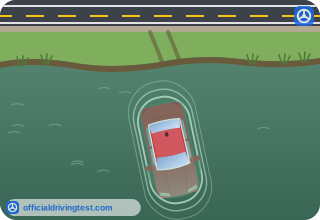
- Swim to shore right away
- Call 911 and locate the nearest dry land
- Climb back in to retrieve your phone
- Wait for the vehicle to stop floating
Show answer
Correct answer: Call 911 and locate the nearest dry land
The manual says to call 911 and find the nearest dry land once you are on the roof.
Source: Rhode Island Driver’s Manual (April 2024), page 46
-
Why should you avoid opening your door when your vehicle is in water?
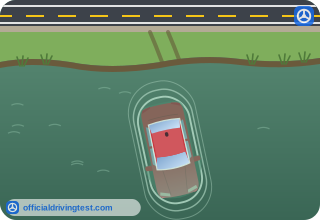
- The door will lock itself and trap everyone inside the vehicle
- Water will fill the inside and could flip the vehicle onto its roof
- The airbags will deploy and block the exit
- The open door will let the vehicle sink faster
Show answer
Correct answer: Water will fill the inside and could flip the vehicle onto its roof
Opening the door lets water fill the vehicle, which could cause it to flip onto its roof.
Source: Rhode Island Driver’s Manual (April 2024), page 46
-
If your vehicle sinks before you can get out, where should you go?
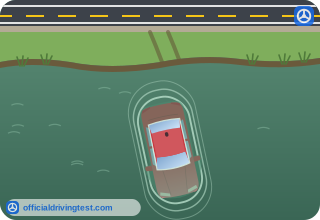
- Into the trunk
- Under the dashboard
- Stay in the driver's seat
- Into the rear seat
Show answer
Correct answer: Into the rear seat
The engine's weight sinks the vehicle nose first, so a pocket of air may remain in the rear.
Source: Rhode Island Driver’s Manual (April 2024), page 46
-
What must you never do after leaving a vehicle that is in water?
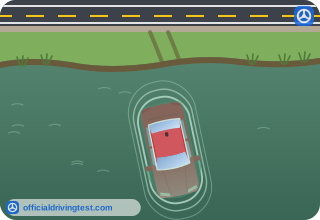
- Re-enter the vehicle to gather possessions
- Move to the roof of the vehicle
- Call 911 for help
- Look for the nearest area of dry land
Show answer
Correct answer: Re-enter the vehicle to gather possessions
The manual says never to re-enter the vehicle to gather possessions.
Source: Rhode Island Driver’s Manual (April 2024), page 46
-
What is another name for black ice?
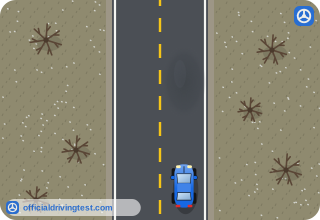
- Clear frost
- Invisible ice
- Frozen fog
- Slush
Show answer
Correct answer: Invisible ice
The manual says black ice is also known as invisible ice and roads that seem dry may be slippery.
Source: Rhode Island Driver’s Manual (April 2024), page 46
-
Which of these is listed as an increased area for black ice?
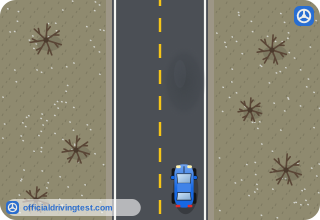
- Sunny stretches
- Dry gravel roads
- Shady areas
- Open parking fields
Show answer
Correct answer: Shady areas
The manual lists intersections, off-ramps, bridges and shady areas as places where black ice is more likely.
Source: Rhode Island Driver’s Manual (April 2024), page 46
-
What braking advice does the manual give for winter driving?
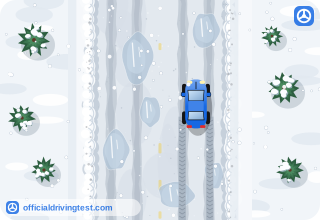
- Brake early, brake slowly, and never slam on the brakes
- Brake late and hard so you stop in less distance
- Brake only at the last moment before a stop
- Brake suddenly and then release the pedal
Show answer
Correct answer: Brake early, brake slowly, and never slam on the brakes
The manual says to brake early, slowly and correctly, and never to slam on the brakes.
Source: Rhode Island Driver’s Manual (April 2024), page 46
-
Why does the manual say never to drive in the rain or snow with your cruise control on?
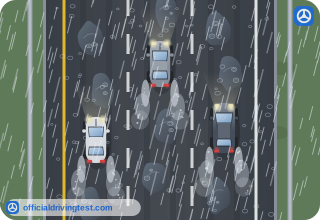
- If the car hydroplanes, it will speed up and you will lose control
- The cruise control will turn off the anti-lock brakes
- The cruise control will drain the battery much faster than normal
- The cruise control will stop the wipers from working
Show answer
Correct answer: If the car hydroplanes, it will speed up and you will lose control
If the cruise control is on when the tires lose contact with the pavement, the car speeds up and you lose control.
Source: Rhode Island Driver’s Manual (April 2024), page 47
-
When can carbon monoxide poisoning occur, according to the manual?
- Only in hot weather when the air conditioner is on
- Only when you drive for a long time on the highway at night
- Anytime, but especially in cold weather with all windows closed
- Only when the engine is idling inside a garage
Show answer
Correct answer: Anytime, but especially in cold weather with all windows closed
The manual says it can occur anytime but is most likely in cold weather with the windows closed.
Source: Rhode Island Driver’s Manual (April 2024), page 47
-
Which of these may be a symptom of carbon monoxide poisoning?
- Ringing in your ears
- Feeling dizzy
- Itchy skin
- A sore throat
Show answer
Correct answer: Feeling dizzy
The manual says yawning, feeling dizzy or feeling nauseous may be symptoms of the poisoning.
Source: Rhode Island Driver’s Manual (April 2024), page 47
-
What can let carbon monoxide enter the inside of a vehicle?
- A cracked windshield
- Worn brake pads
- Low tire pressure
- A leaking muffler
Show answer
Correct answer: A leaking muffler
The manual says a leaking muffler can allow escaping carbon monoxide to enter the interior.
Source: Rhode Island Driver’s Manual (April 2024), page 47
-
What does the manual say about the smell of carbon monoxide fumes?
- The fumes smell like burning rubber
- The fumes have a sweet smell
- The fumes are odorless
- The fumes smell strongly of gasoline
Show answer
Correct answer: The fumes are odorless
Carbon monoxide is odorless, so you cannot rely on smell to detect it.
Source: Rhode Island Driver’s Manual (April 2024), page 47
-
What does the manual say is the only cure for carbon monoxide poisoning in a vehicle?
- Open your windows and let fresh air circulate inside
- Turn the heater up to its maximum setting
- Keep the windows closed and use the defroster
- Drive faster with all of the vents closed
Show answer
Correct answer: Open your windows and let fresh air circulate inside
The manual says the only cure is to open the windows and let fresh air circulate inside the vehicle.
Source: Rhode Island Driver’s Manual (April 2024), page 47