Rhode Island: Emergency vehicles, police stops and work zones — Part 1 Practice Test
Questions in this part include: “If an officer stops you at nighttime, what are you required to do with the interior lights?” · “At night, when an officer stops you, what should you do with your headlights?”
Independent educational site · not affiliated with any government agency or DMV
Ready? Test yourself
- Instant feedback with an explanation
- Every answer cites its source in the manual
- Your best score is saved on this device
- Keyboard: press 1 to 4 to answer and Enter for the next question
Questions are original and based on the official manual "Rhode Island Driver’s Manual" (April 2024), Rhode Island Division of Motor Vehicles (DMV).
All 18 questions in this practice test
Take the test above first, then use this list to study. Tap “Show answer” to see the correct answer and explanation.
Show the questions and answersHide the questions
-
If an emergency vehicle is approaching on a highway, what should you do?
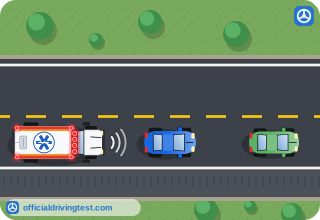
- Pull over to the left, stop, and wait for it to pass
- Pull over to the right, stop, and wait for it to pass
- Speed up and move into the left lane
- Slow down but keep driving in your lane
Show answer
Correct answer: Pull over to the right, stop, and wait for it to pass
You should pull over to the right, stop and wait for the emergency vehicle to pass.
Source: Rhode Island Driver’s Manual (April 2024), page 36
-
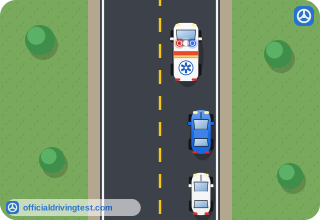
Before you re-enter the flow of traffic after an emergency vehicle has passed, what should you do?
- Sound your horn and pull out in front of the next vehicle
- Wait for the emergency vehicle to be out of sight and then pull out without signaling
- Turn on your hazard lights and merge into the nearest lane
- Turn on your turn signal and glance over your shoulder for another emergency vehicle
Show answer
Correct answer: Turn on your turn signal and glance over your shoulder for another emergency vehicle
The manual says to signal and glance over your shoulder for another emergency vehicle before proceeding.
Source: Rhode Island Driver’s Manual (April 2024), page 36
-
How far behind emergency vehicles does the manual say to drive?
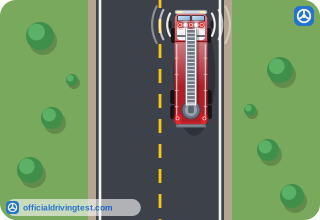
- 500 feet
- 100 feet
- 300 feet
- 1,000 feet
Show answer
Correct answer: 500 feet
The manual says to always drive 500 feet behind emergency vehicles.
Source: Rhode Island Driver’s Manual (April 2024), page 36
-
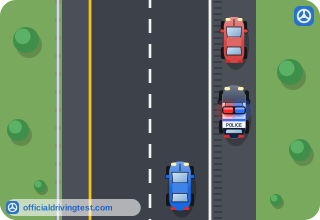
Under the Move Over Law, what must you do on an interstate or roadway with multiple lanes of travel in the same direction when you approach a designated vehicle?
- Stop completely until the designated vehicle has left the area
- Keep your lane and sound your horn to warn the vehicle
- Move over only if the vehicle has its siren turned on
- Move over by changing lanes away from the vehicle when it is safe
Show answer
Correct answer: Move over by changing lanes away from the vehicle when it is safe
You must change lanes away from the designated vehicle as soon as it is safe to do so.
Source: Rhode Island Driver’s Manual (April 2024), page 36
-
Under the Move Over Law, what must you do if you are not able to safely move over?
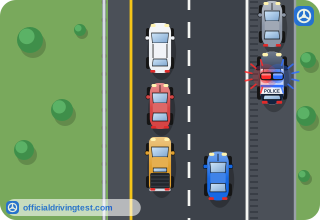
- Slow down
- Speed up and pass the vehicle
- Stop in the travel lane
- Change lanes toward the vehicle
Show answer
Correct answer: Slow down
If you cannot safely move over, you must slow down.
Source: Rhode Island Driver’s Manual (April 2024), page 36
-
If an officer stops you at nighttime, what are you required to do with the interior lights?
- Turn them off and keep the headlights on
- Turn all lights off, headlights included
- Turn them on and leave them on
- Flash them twice, then turn them off
Show answer
Correct answer: Turn them on and leave them on
If an officer stops you at night, the manual says you are required to turn the interior lights on.
Source: Rhode Island Driver’s Manual (April 2024), page 67
-
At night, when an officer stops you, what should you do with your headlights?
- Leave them on
- Turn them off
- Switch to high beams
- Switch to parking lights
Show answer
Correct answer: Leave them on
The manual says to leave the headlights on, for safety reasons.
Source: Rhode Island Driver’s Manual (April 2024), page 67
-
What should a motorist do on seeing flashing emergency lights or hearing sirens?
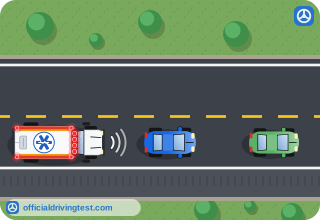
- Slow down and stay in the lane
- Pull to the left side of the road and stop
- Stop where you are, even in an intersection
- Pull over to a safe location to the right and stop
Show answer
Correct answer: Pull over to a safe location to the right and stop
The manual says to pull over to a safe place on the right and stop, then return to the travel lane once the emergency has passed.
Source: Rhode Island Driver’s Manual (April 2024), page 67
-
When an officer is stopping you, which signal does the manual say to turn on as you begin to slow down?
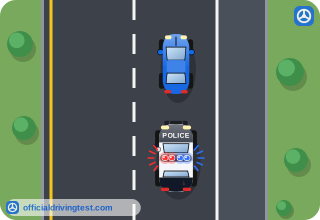
- Your left directional
- Your right directional
- Your high beams
- No signal until you are fully stopped
Show answer
Correct answer: Your right directional
The manual says to turn on your right directional and begin slowing down before pulling to the right.
Source: Rhode Island Driver’s Manual (April 2024), page 67
-
Where should you stop when an officer pulls you over?
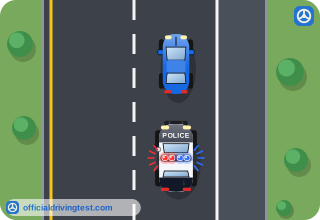
- In the middle of the travel lane so the officer can see you
- As far right as possible, without blocking traffic or a driveway
- On the left shoulder of the road
- In front of the nearest driveway
Show answer
Correct answer: As far right as possible, without blocking traffic or a driveway
The manual says to pull to the right as far as possible and not to obstruct traffic or block anyone's driveway.
Source: Rhode Island Driver’s Manual (April 2024), page 67
-
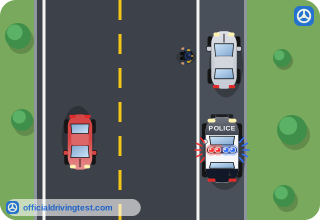
After you have pulled over and stopped for an officer, what should you do with your engine?
- Leave it running
- Leave it idling in neutral
- Rev it so the officer knows you have stopped
- Turn it off
Show answer
Correct answer: Turn it off
The manual says that once you have stopped, you should turn the engine off.
Source: Rhode Island Driver’s Manual (April 2024), page 67
-
After stopping for an officer and turning off the engine, what does the manual say to begin doing?
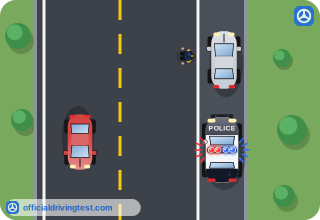
- Putting your window down
- Getting out of the vehicle
- Taking out your documents
- Unbuckling your safety belt
Show answer
Correct answer: Putting your window down
The manual says to begin lowering the window, anticipating the officer's arrival.
Source: Rhode Island Driver’s Manual (April 2024), page 67
-
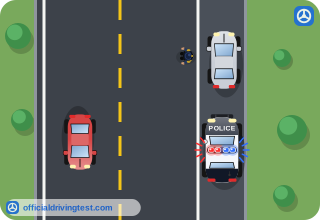
When an officer stops you, when should you take off your safety belt?
- As soon as the vehicle comes to a stop
- After you turn off the engine and open the window
- Only when the officer directs you to do so
- When you hand over your license
Show answer
Correct answer: Only when the officer directs you to do so
The manual says not to take your safety belt off until the officer directs you to.
Source: Rhode Island Driver’s Manual (April 2024), page 67
-
Where should you keep your hands when an officer stops you?
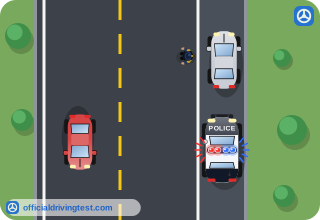
- Both hands visible on the steering wheel
- Folded in your lap, below the window
- Behind your head, fingers interlaced
- In your pockets, out of the way
Show answer
Correct answer: Both hands visible on the steering wheel
The manual says to keep both hands visible on the steering wheel.
Source: Rhode Island Driver’s Manual (April 2024), page 67
-
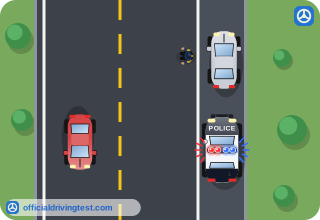
What should you tell your passengers to do during a stop by an officer?
- Get out of the vehicle and stand aside
- Look away from the officer and stay quiet
- Put their hands where the officer can see them
- Take out their identification right away
Show answer
Correct answer: Put their hands where the officer can see them
The manual tells you to have passengers put their hands where the officer can see them.
Source: Rhode Island Driver’s Manual (April 2024), page 67
-
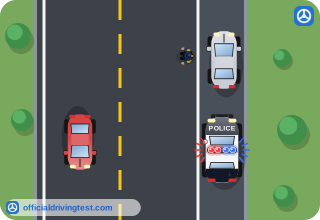
During a stop, when should you exit your vehicle?
- As soon as you stop
- Only if the officer asks you to
- When you see the officer approach
- When you want to hand over your documents
Show answer
Correct answer: Only if the officer asks you to
The manual says not to exit your vehicle unless the officer asks you to.
Source: Rhode Island Driver’s Manual (April 2024), page 67
-
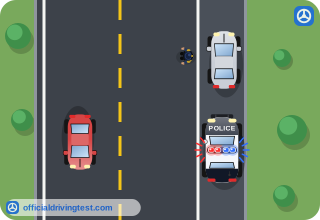
When may you reach for your documents during a traffic stop?
- As soon as the vehicle stops
- When the officer reaches your window
- After the officer returns to the patrol car
- Only after the officer directs you to
Show answer
Correct answer: Only after the officer directs you to
The manual says not to anticipate the officer's request and not to reach for any documents until directed.
Source: Rhode Island Driver’s Manual (April 2024), page 67
-
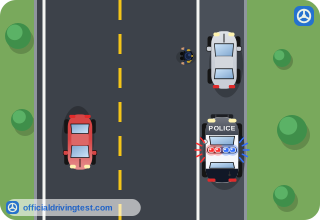
Which action should you and your passengers avoid during a stop by an officer?
- Keeping your hands where the officer can see them
- Staying seated in the vehicle
- Waiting for the officer's instructions
- Sudden movements, like leaning toward the glove box
Show answer
Correct answer: Sudden movements, like leaning toward the glove box
The manual says you and your passengers should never make sudden movements or gestures, such as reaching under the seat or leaning toward the glove box.
Source: Rhode Island Driver’s Manual (April 2024), page 67