North Carolina: Right of way & turning
Intersections, turning, roundabouts, passing and funeral processions. Split into 4 shorter tests so you're not stuck in one long quiz.
Independent educational site · not affiliated with any government agency or DMV
Choose a part
Right of way & turning — Part 1
Questions in this part include: “During which hours does the manual say school buses are generally operating, so drivers should be especially careful?”
StartRight of way & turning — Part 2
Questions in this part include: “What does the horn signal do to the driver of the vehicle you are passing?”
StartRight of way & turning — Part 3
Questions in this part include: “If you increase speed and fail to give way to a passing vehicle, when will you be charged with a misdemeanor?”
StartRight of way & turning — Part 4
Questions in this part include: “At what speeds does the modern roundabout require vehicles to travel?”
StartAll 78 Right of way & turning questions with answers
Choose a part above to take a practice test, or study every question and answer here.
Show the questions and answersHide the questions
-
During which hours does the manual say school buses are generally operating, so drivers should be especially careful?
- 7-9 a.m. and 2-4 p.m.
- 6-8 a.m. and 5-7 p.m.
- 9-11 a.m. and 12-2 p.m.
- 10 a.m.-12 noon and 4-6 p.m.
Show answer
Correct answer: 7-9 a.m. and 2-4 p.m.
The manual says school buses are generally operating from 7 to 9 a.m. and 2 to 4 p.m., so drivers should be especially careful.
Source: North Carolina Driver Handbook (Revised May 2025), page 47 · Open this page in the manual (Manual page 47)
-
When a school bus displays its mechanical stop signal or flashing red lights to receive or discharge passengers, when may the driver of a vehicle approaching the bus pass?
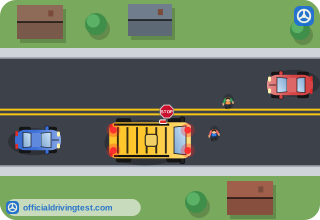
- After the bus has been stopped with its red lights on for 30 seconds
- As soon as the last child has stepped out of the road onto the curb
- After the stop signal is withdrawn, the red lights are off and the bus is moving
- After you sound your horn and check that no children are near the bus
Show answer
Correct answer: After the stop signal is withdrawn, the red lights are off and the bus is moving
The manual says the driver must stop and not attempt to pass until the mechanical stop signal is withdrawn, the flashing red lights are turned off and the bus has started to move.
Source: North Carolina Driver Handbook (Revised May 2025), page 47 · Open this page in the manual (Manual page 47)
-
On a two-lane roadway, a school bus stops for passengers. Which traffic must stop?
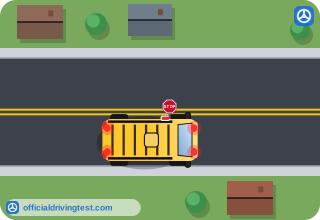
- Only traffic following the bus
- All traffic from both directions
- Only traffic approaching the bus from the front
- No traffic has to stop if the bus is on the shoulder
Show answer
Correct answer: All traffic from both directions
The manual says on a two-lane roadway, when a school bus stops for passengers all traffic from both directions must stop.
Source: North Carolina Driver Handbook (Revised May 2025), page 47 · Open this page in the manual (Manual page 47)
-
On a two-lane roadway with a center turning lane, a school bus stops for passengers. Which traffic must stop?
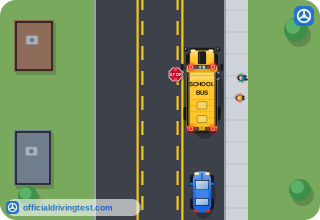
- Only traffic following the bus
- Only traffic in the center turning lane
- Only traffic in the bus's lane
- All traffic from both directions
Show answer
Correct answer: All traffic from both directions
The manual says on a two-lane roadway with a center turning lane, all traffic from both directions must stop when a school bus stops for passengers.
Source: North Carolina Driver Handbook (Revised May 2025), page 48 · Open this page in the manual (Manual page 48)
-
On a four-lane roadway without a median separation, a school bus stops for passengers. Which traffic must stop?
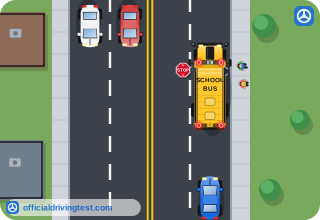
- All traffic from both directions
- Only traffic following the bus
- Only traffic in the two lanes on the bus's side
- Only traffic in the lane next to the bus
Show answer
Correct answer: All traffic from both directions
The manual says on a four-lane roadway without a median separation, all traffic from both directions must stop when a school bus stops for passengers.
Source: North Carolina Driver Handbook (Revised May 2025), page 48 · Open this page in the manual (Manual page 48)
-
On a divided highway of four lanes or more with a median separation, a school bus stops for passengers. Which traffic must stop?
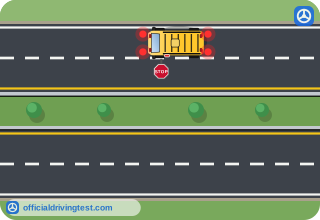
- All traffic from both directions
- Only traffic approaching the bus from the front
- Only traffic following the bus
- No traffic has to stop
Show answer
Correct answer: Only traffic following the bus
The manual says on a divided highway of four lanes or more with a median separation, only traffic following the bus must stop.
Source: North Carolina Driver Handbook (Revised May 2025), page 48 · Open this page in the manual (Manual page 48)
-
On a roadway of four lanes or more with a center turning lane, a school bus stops for passengers. Which traffic must stop?
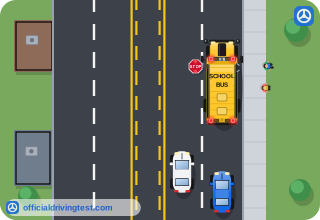
- All traffic from both directions
- Only traffic following the bus
- Only traffic in the center turning lane
- No traffic has to stop
Show answer
Correct answer: Only traffic following the bus
The manual says on a roadway of four lanes or more with a center turning lane, only traffic following the bus must stop.
Source: North Carolina Driver Handbook (Revised May 2025), page 48 · Open this page in the manual (Manual page 48)
-
What must every vehicle in a funeral procession have on?
- Its headlights only, with the hazard warning signals off
- Its headlights, and its hazard warning signals if so equipped
- Its parking lights only, to avoid confusing other drivers
- Its hazard warning signals only, with the headlights off
Show answer
Correct answer: Its headlights, and its hazard warning signals if so equipped
Every vehicle in a funeral procession must have its headlights on, and the hazard warning signals too if the vehicle has them.
Source: North Carolina Driver Handbook (Revised May 2025), page 52 · Open this page in the manual (Manual page 52)
-
What must the operator of the lead vehicle in a funeral procession do at intersections?
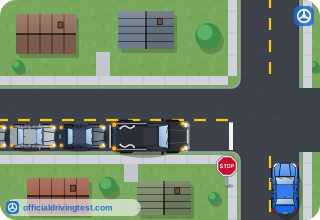
- Ignore red lights while the hazard signals are flashing
- Stop only for signals that show a red light
- Follow the signals only when no other vehicles are near
- Comply with all traffic-control signals
Show answer
Correct answer: Comply with all traffic-control signals
The lead vehicle's operator must comply with all traffic-control signals.
Source: North Carolina Driver Handbook (Revised May 2025), page 52 · Open this page in the manual (Manual page 52)
-
When may all vehicles in a funeral procession proceed through an intersection without stopping, while using extra care?
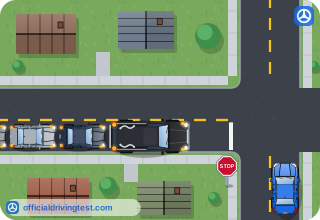
- Whenever the last vehicle in the procession has its headlights on
- Whenever the drivers in the procession decide that traffic is clear
- When directed to do so by a law enforcement officer or funeral director
- Whenever the procession has more than ten vehicles in it
Show answer
Correct answer: When directed to do so by a law enforcement officer or funeral director
The vehicles may proceed without stopping when the lead vehicle has crossed lawfully, when directed by an officer or funeral director, or when led by a law enforcement vehicle.
Source: North Carolina Driver Handbook (Revised May 2025), page 52 · Open this page in the manual (Manual page 52)
-
On which side of the road must vehicles in a funeral procession be driven?
- The right side of the road
- The left side of the road
- The center of the road
- Either side, depending on traffic
Show answer
Correct answer: The right side of the road
All vehicles in a funeral procession must be driven on the right side of the road.
Source: North Carolina Driver Handbook (Revised May 2025), page 52 · Open this page in the manual (Manual page 52)
-
A driver going the opposite direction of a funeral procession chooses to yield to it. How must the driver do so?
- By stopping in the middle of the roadway with the hazard lights on
- By moving into the lane the procession is using
- By speeding up to pass the procession before it arrives
- By reducing speed, or by stopping completely off the roadway
Show answer
Correct answer: By reducing speed, or by stopping completely off the roadway
The driver may yield by reducing speed or by stopping completely off the roadway, so other drivers can continue without leaving their lane.
Source: North Carolina Driver Handbook (Revised May 2025), page 52 · Open this page in the manual (Manual page 52)
-
When may a driver traveling in the same direction as a funeral procession pass it?
- When the procession is moving slower than the posted speed limit
- When the highway has two or more marked lanes in its direction
- When the driver sounds the horn before passing
- When the driver can see 500 feet of clear road ahead
Show answer
Correct answer: When the highway has two or more marked lanes in its direction
Passing a funeral procession in the same direction is allowed only where the highway is marked for two or more lanes moving that way.
Source: North Carolina Driver Handbook (Revised May 2025), page 52 · Open this page in the manual (Manual page 52)
-
What must a driver not in a funeral procession never knowingly do?
- Follow the last vehicle in the procession
- Drive between vehicles in the procession
- Stop at a red light near the procession
- Drive on the right side of the road
Show answer
Correct answer: Drive between vehicles in the procession
The manual says a driver shall not knowingly drive between vehicles in a funeral procession.
Source: North Carolina Driver Handbook (Revised May 2025), page 52 · Open this page in the manual (Manual page 52)
-
A funeral procession is proceeding through a red light. You are not in the procession and you face a green light. When may you enter the intersection?
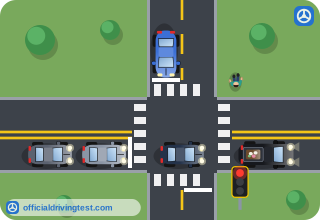
- Whenever the vehicles in the procession are moving slowly and have headlights on
- Whenever you sound the horn to warn the procession's drivers first
- Whenever the light stays green while the procession passes through
- Only if it can be done safely and without crossing the procession's path
Show answer
Correct answer: Only if it can be done safely and without crossing the procession's path
A driver not in the procession shall not enter the intersection even on a green light unless it can be done safely without crossing the procession's path.
Source: North Carolina Driver Handbook (Revised May 2025), page 52 · Open this page in the manual (Manual page 52)
-
Driving on the left side of the road is legal only in some cases. Which is one of them?
- On one-way streets and while passing
- On two-lane roads at night
- When the right lane is crowded with traffic
- When you are driving below the speed limit
Show answer
Correct answer: On one-way streets and while passing
The manual says left-side driving is legal only in some cases, such as on one-way streets and while passing.
Source: North Carolina Driver Handbook (Revised May 2025), page 52 · Open this page in the manual (Manual page 52)
-
For right turns, where should you stay?
- Toward the center of the lane, so you have room to swing wide into the turn
- Close to the right edge, so no other vehicle can move between you and the curb
- Beside the vehicle in the next lane, so no one can pass you during the turn
- Wherever there is the most space, even if other vehicles can enter the gap
Show answer
Correct answer: Close to the right edge, so no other vehicle can move between you and the curb
Staying close to the right edge keeps another vehicle from moving between your vehicle and the curb.
Source: North Carolina Driver Handbook (Revised May 2025), page 54 · Open this page in the manual (Manual page 54)
-
How should you handle your speed for a right turn?
- Maintain full speed until you have completed the turn
- Speed up before the turn, then brake sharply in it
- Coast without braking or accelerating throughout the turn
- Reduce speed before the turn, then accelerate slightly
Show answer
Correct answer: Reduce speed before the turn, then accelerate slightly
The manual says to reduce the vehicle's speed before making the turn and then accelerate slightly.
Source: North Carolina Driver Handbook (Revised May 2025), page 54 · Open this page in the manual (Manual page 54)
-
Which vehicles are especially hard to see during a turn?
- Trucks and buses
- Vans and pickup trucks
- Motorcycles and bicycles
- School buses and taxis
Show answer
Correct answer: Motorcycles and bicycles
Motorcycles and bicycles are especially hard to see during a turn, so signal and look before turning.
Source: North Carolina Driver Handbook (Revised May 2025), page 54 · Open this page in the manual (Manual page 54)
-
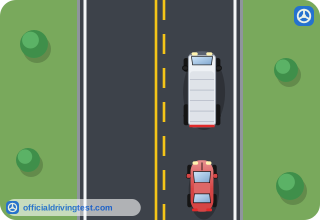
Before you pass, what should you do first?
- Speed up to close the gap to the vehicle ahead
- Move into the left lane immediately and then look
- Turn on your high-beam headlights to warn the driver
- Look ahead and behind to determine when it is safe to pass
Show answer
Correct answer: Look ahead and behind to determine when it is safe to pass
The first step in passing is to look ahead and behind to determine when it is safe to pass.
Source: North Carolina Driver Handbook (Revised May 2025), page 55 · Open this page in the manual (Manual page 55)
-
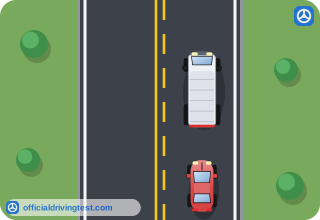
Why should you signal before passing?
- To tell the driver ahead that they must pull onto the shoulder
- To alert the drivers ahead and behind you so they can plan their moves
- To let the driver ahead know you will slow down behind them
- To warn oncoming traffic that you are about to speed up
Show answer
Correct answer: To alert the drivers ahead and behind you so they can plan their moves
Signaling alerts the drivers ahead and behind you of your intention so they can plan accordingly.
Source: North Carolina Driver Handbook (Revised May 2025), page 55 · Open this page in the manual (Manual page 55)
-
What does the horn signal do to the driver of the vehicle you are passing?
- Requires that driver to stop on the shoulder until you pass
- Gives that driver permission to speed up and race you
- Places that driver under a legal obligation to help you pass
- Has no legal effect on the driver being passed
Show answer
Correct answer: Places that driver under a legal obligation to help you pass
The horn signal places the driver of the vehicle you are passing under a legal obligation to help you pass.
Source: North Carolina Driver Handbook (Revised May 2025), page 55 · Open this page in the manual (Manual page 55)
-
By law, how far to the left of the vehicle being passed must the passing driver pass?
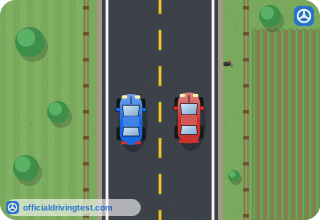
- At least two feet
- At least one foot
- At least five feet
- At least ten feet
Show answer
Correct answer: At least two feet
The law requires the passing driver to pass at least two feet to the left of the vehicle being passed.
Source: North Carolina Driver Handbook (Revised May 2025), page 55 · Open this page in the manual (Manual page 55)
-
When have you NOT passed safely?
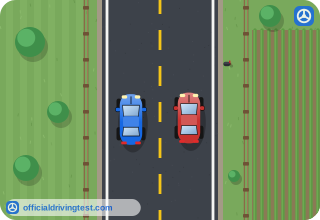
- When the vehicle you passed must slow down to allow you back into your lane
- When you have to signal a second time before returning to your lane
- When you use the horn more than once while passing the vehicle
- When the passed vehicle is still visible in your rear-view mirror
Show answer
Correct answer: When the vehicle you passed must slow down to allow you back into your lane
The manual says you have not passed safely if the vehicle you passed must slow down to let you back into your correct lane.
Source: North Carolina Driver Handbook (Revised May 2025), page 55 · Open this page in the manual (Manual page 55)
-
You cannot pass safely unless you can see far enough ahead to do what?
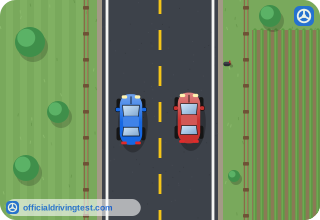
- Reach the next intersection before the vehicle you pass
- Stay in the passing lane until the next exit or turn
- Get back to your original lane before you meet oncoming traffic
- Read the next sign posted along the road ahead of you
Show answer
Correct answer: Get back to your original lane before you meet oncoming traffic
You must be able to see far enough ahead to return to your original lane before meeting oncoming traffic.
Source: North Carolina Driver Handbook (Revised May 2025), page 55 · Open this page in the manual (Manual page 55)
-
On any curve or hill, passing is always unsafe and usually illegal if the driver cannot see at least how far ahead?
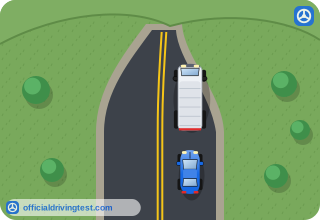
- 200 feet
- 500 feet
- 300 feet
- 1,000 feet
Show answer
Correct answer: 500 feet
Passing is unsafe on a curve or hill where the driver cannot see at least 500 feet ahead.
Source: North Carolina Driver Handbook (Revised May 2025), page 55 · Open this page in the manual (Manual page 55)
-
Which is a place where passing is always unsafe and usually illegal?
- Wherever there is a broken white line between two lanes
- Wherever the vehicle ahead is traveling below the speed limit
- Wherever the road has two or more lanes in your direction
- Wherever there is a solid yellow line in the driver's lane
Show answer
Correct answer: Wherever there is a solid yellow line in the driver's lane
A solid yellow line in the driver's lane is one of the places where passing is always unsafe and usually illegal.
Source: North Carolina Driver Handbook (Revised May 2025), page 55 · Open this page in the manual (Manual page 55)
-
In which situation is passing always unsafe and usually illegal?
- On a one-way street with all lanes moving the same way
- On a straight, dry road with a clear view ahead
- Wherever there is a double-solid yellow line
- In a lane set aside for right turns
Show answer
Correct answer: Wherever there is a double-solid yellow line
The manual lists a double-solid yellow line as a place where passing is always unsafe and usually illegal.
Source: North Carolina Driver Handbook (Revised May 2025), page 55 · Open this page in the manual (Manual page 55)
-
Which is a place where passing is always unsafe and usually illegal?
- At a crosswalk where a vehicle has stopped to let people cross
- On a one-way street where all lanes move in the same direction
- In a lane set aside for right turns on a wide road
- On a straight, dry road with a clear view of the road ahead
Show answer
Correct answer: At a crosswalk where a vehicle has stopped to let people cross
Passing is unsafe and usually illegal at intersections or crosswalks where a vehicle has stopped to allow people to cross the street.
Source: North Carolina Driver Handbook (Revised May 2025), page 55 · Open this page in the manual (Manual page 55)
-
Where is passing always unsafe and usually illegal in cities and towns?
- On a straight road with 1,000 feet of clear view
- On a road with a broken yellow line in your lane
- On a wide road with two lanes in your direction
- At intersections
Show answer
Correct answer: At intersections
Passing is always unsafe and usually illegal at intersections in cities and towns and at railroad crossings.
Source: North Carolina Driver Handbook (Revised May 2025), page 55 · Open this page in the manual (Manual page 55)
-
Where in a rural area is passing always unsafe and usually illegal?
- On a rural road with a broken yellow line in your lane
- At marked intersections
- On a straight rural road with a clear view of 1,000 feet
- On a two-lane rural road with no other traffic in sight
Show answer
Correct answer: At marked intersections
The manual lists marked intersections in rural areas as a place where passing is always unsafe and usually illegal.
Source: North Carolina Driver Handbook (Revised May 2025), page 55 · Open this page in the manual (Manual page 55)
-
Passing on the right is:
- Legal on any road with a paved shoulder wide enough for a vehicle
- Against the law except in areas where it is specifically permitted
- Legal whenever the vehicle ahead is driving below the speed limit
- Legal on any road at speeds below 35 mph in cities and towns
Show answer
Correct answer: Against the law except in areas where it is specifically permitted
Passing on the right is against the law except where it is specifically permitted.
Source: North Carolina Driver Handbook (Revised May 2025), page 55 · Open this page in the manual (Manual page 55)
-
Why is passing on the right dangerous?
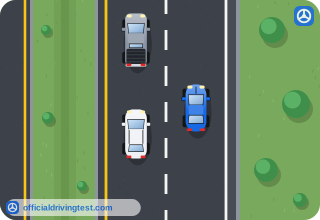
- It puts your vehicle directly in the path of oncoming traffic
- It makes the vehicle you are passing speed up unexpectedly
- It hides your vehicle from oncoming traffic in the opposite lane
- It places your vehicle on the blind side of the vehicle you are passing
Show answer
Correct answer: It places your vehicle on the blind side of the vehicle you are passing
Passing on the right puts you on the blind side, where the other vehicle could unexpectedly turn right or pull to the right.
Source: North Carolina Driver Handbook (Revised May 2025), page 55 · Open this page in the manual (Manual page 55)
-
On which type of highway is passing on the right allowed?
- Highways having at least two lanes traveling in each direction
- Two-lane highways that have a wide paved shoulder
- Two-lane roads where the vehicle ahead is slowing down
- Any highway with a broken yellow line in the driver's lane
Show answer
Correct answer: Highways having at least two lanes traveling in each direction
Passing on the right is an exception allowed on highways with at least two lanes traveling in each direction.
Source: North Carolina Driver Handbook (Revised May 2025), page 55 · Open this page in the manual (Manual page 55)
-
Where is passing on the right allowed?
- On any road where the vehicle ahead is driving below the speed limit
- On any two-way street where the right lane is empty of traffic
- On one-way streets where all lanes of traffic move in the same direction
- On any road when the driver ahead signals that you can pass
Show answer
Correct answer: On one-way streets where all lanes of traffic move in the same direction
Passing on the right is allowed on one-way streets where all lanes move in the same direction.
Source: North Carolina Driver Handbook (Revised May 2025), page 55 · Open this page in the manual (Manual page 55)
-
Which vehicle may you pass on the right?
- A vehicle stopped to let a pedestrian cross
- A vehicle turning right from the right lane
- A vehicle stopped behind a school bus with flashing red lights
- A vehicle that is in the left-turn lane
Show answer
Correct answer: A vehicle that is in the left-turn lane
Passing a vehicle that is in the left-turn lane is one of the allowed exceptions for passing on the right.
Source: North Carolina Driver Handbook (Revised May 2025), page 55 · Open this page in the manual (Manual page 55)
-
In which lane is passing on the right allowed?
- The paved shoulder of the road
- A lane set aside for right turns
- A lane next to a solid yellow center line
- A bicycle lane beside the roadway
Show answer
Correct answer: A lane set aside for right turns
The manual allows passing on the right when driving in a lane set aside for right turns.
Source: North Carolina Driver Handbook (Revised May 2025), page 55 · Open this page in the manual (Manual page 55)
-
On three-lane highways, where must you pass?
- Only in the right lane, where it is marked for passing in your direction
- In the center lane at any time, whether or not it is marked for passing
- In the center lane, where it is marked for passing in your direction
- In either outside lane at any time when no other vehicles are nearby
Show answer
Correct answer: In the center lane, where it is marked for passing in your direction
On three-lane highways you must not pass except in the center lane, and only where it is marked for passing in your direction.
Source: North Carolina Driver Handbook (Revised May 2025), page 55 · Open this page in the manual (Manual page 55)
-
If the driver of a passing vehicle blows the horn, what should you do?
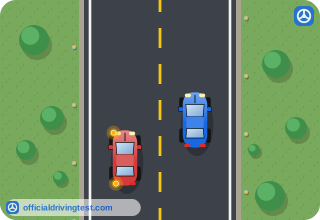
- Move to the right edge of the road
- Slow down and stop in your lane
- Flash your headlights in reply
- Move toward the center line to give more room
Show answer
Correct answer: Move to the right edge of the road
When the passing driver blows the horn you must help by moving to the right edge of the road.
Source: North Carolina Driver Handbook (Revised May 2025), page 55 · Open this page in the manual (Manual page 55)
-
When another vehicle is passing you, what must you never do?
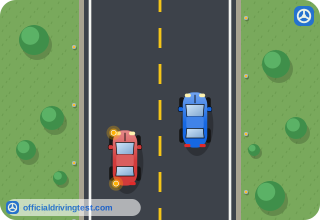
- Increase your speed
- Move to the right edge of the road
- Look in your mirrors
- Help the other driver to pass
Show answer
Correct answer: Increase your speed
The manual says that when you are being passed you must never increase your speed.
Source: North Carolina Driver Handbook (Revised May 2025), page 55 · Open this page in the manual (Manual page 55)
-
If you increase speed and fail to give way to a passing vehicle, when will you be charged with a misdemeanor?
- If the passing driver has to slow down for oncoming traffic
- Any time the passing driver has to blow the horn
- If a crash occurs resulting in bodily injury or property damage
- If the passing driver had to cross a solid yellow line
Show answer
Correct answer: If a crash occurs resulting in bodily injury or property damage
Failing to give way while speeding up is a misdemeanor if a crash results in bodily injury or property damage.
Source: North Carolina Driver Handbook (Revised May 2025), page 55 · Open this page in the manual (Manual page 55)
-
As you approach an interchange, what should you do?
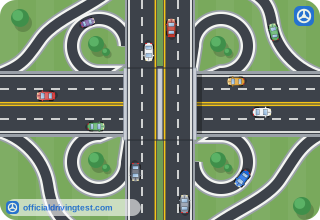
- Slow down and give careful attention to the signs that direct you
- Keep your speed the same and follow the vehicle ahead of you
- Speed up to merge before other traffic arrives
- Stop and wait until the road is clear of all traffic
Show answer
Correct answer: Slow down and give careful attention to the signs that direct you
At an interchange the method of turning may vary, so slow down and follow the signs about how to make the turn.
Source: North Carolina Driver Handbook (Revised May 2025), page 56 · Open this page in the manual (Manual page 56)
-
What is an intersection, according to the manual?
- Only a place where a traffic signal controls the roads
- Only a place where two paved roads meet at right angles
- Any place where a road ends at a parking area
- Any place where two or more roads meet or cross each other
Show answer
Correct answer: Any place where two or more roads meet or cross each other
An intersection is any place where two or more roads meet or cross each other.
Source: North Carolina Driver Handbook (Revised May 2025), page 56 · Open this page in the manual (Manual page 56)
-
What are specially designed intersections where roads cross each other at different levels called?
- Roundabouts
- Interchanges
- Crossovers
- Merge zones
Show answer
Correct answer: Interchanges
The manual calls intersections where roads cross at different levels interchanges.
Source: North Carolina Driver Handbook (Revised May 2025), page 56 · Open this page in the manual (Manual page 56)
-
Where do crashes occur most frequently?
- On curves
- At intersections
- On freeways
- In parking lots
Show answer
Correct answer: At intersections
Crashes occur most frequently at intersections, which the manual calls the most dangerous places on a street or highway.
Source: North Carolina Driver Handbook (Revised May 2025), page 57 · Open this page in the manual (Manual page 57)
-
What portion of fatal traffic crashes involving motor vehicles occurs at intersections?
- About one-tenth
- About one-fifth
- More than half
- More than one-third
Show answer
Correct answer: More than one-third
The manual says more than one-third of fatal traffic crashes involving motor vehicles occur at intersections.
Source: North Carolina Driver Handbook (Revised May 2025), page 57 · Open this page in the manual (Manual page 57)
-
On four-lane highways separated by a median of more than how many feet is each crossing a separate intersection?
- 30 feet
- 10 feet
- 20 feet
- 50 feet
Show answer
Correct answer: 30 feet
On four-lane highways separated by a median of more than 30 feet, each crossing constitutes a separate intersection.
Source: North Carolina Driver Handbook (Revised May 2025), page 57 · Open this page in the manual (Manual page 57)
-
What does the law require when you come to an intersection, even if you have the right of way?
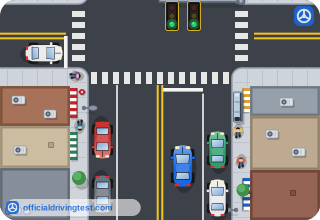
- Come to a complete stop
- Sound your horn
- Slow down
- Flash your headlights
Show answer
Correct answer: Slow down
The law requires you to slow down when you come to an intersection, even with the right of way.
Source: North Carolina Driver Handbook (Revised May 2025), page 57 · Open this page in the manual (Manual page 57)
-
At an intersection without traffic signs or signals, which vehicle has the right of way?
- The vehicle traveling on the wider road
- The vehicle that is going faster
- The vehicle that arrived from the left
- The vehicle already in the intersection
Show answer
Correct answer: The vehicle already in the intersection
The vehicle already in the intersection has the right of way ahead of any vehicle that has not yet entered.
Source: North Carolina Driver Handbook (Revised May 2025), page 57 · Open this page in the manual (Manual page 57)
-
At an intersection without signs or signals, two vehicles reach the intersection at the same time. Which has the right of way?
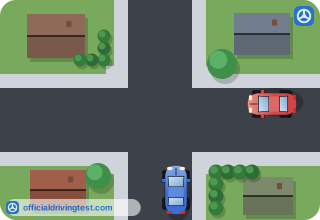
- The vehicle to the left
- The vehicle to the right
- The larger vehicle
- The vehicle going faster
Show answer
Correct answer: The vehicle to the right
When two or more vehicles reach an intersection at the same time, the vehicle to the right has the right of way.
Source: North Carolina Driver Handbook (Revised May 2025), page 57 · Open this page in the manual (Manual page 57)
-
A vehicle that has the right of way at an intersection may do what?
- Move straight ahead only, and never turn without stopping first
- Turn right or left without any signal, since it has the right of way
- Move straight ahead or, if legal and after signaling, turn right or left
- Stop in the intersection to let all other vehicles pass first
Show answer
Correct answer: Move straight ahead or, if legal and after signaling, turn right or left
A vehicle with the right of way may go straight or, if legal and after signaling, turn right or left.
Source: North Carolina Driver Handbook (Revised May 2025), page 57 · Open this page in the manual (Manual page 57)
-
What should you do even when you have the right of way at an intersection?
- Be careful to avoid hitting other vehicles and pedestrians
- Proceed without looking, since all other drivers must yield
- Honk to warn every other driver before you enter it
- Stop completely before entering the intersection every time
Show answer
Correct answer: Be careful to avoid hitting other vehicles and pedestrians
Even with the right of way, you must be careful to avoid hitting other vehicles and pedestrians.
Source: North Carolina Driver Handbook (Revised May 2025), page 57 · Open this page in the manual (Manual page 57)
-
Two facing vehicles approach an intersection at the same time. One is going straight and the other wants to turn left. Who has the right of way?
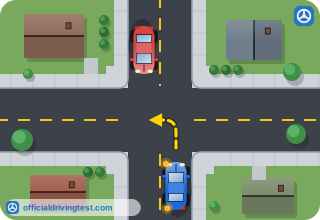
- The driver going straight ahead
- The driver turning left
- The driver on the wider road
- The driver who sounds the horn first
Show answer
Correct answer: The driver going straight ahead
The driver who wants to turn left must signal and wait until it is safe, so the driver going straight has the right of way.
Source: North Carolina Driver Handbook (Revised May 2025), page 57 · Open this page in the manual (Manual page 57)
-
What should you never do while moving straight ahead through an intersection?
- Use your turn signal
- Slow down
- Change lanes
- Look for pedestrians
Show answer
Correct answer: Change lanes
The manual says never to change lanes while moving straight ahead through an intersection.
Source: North Carolina Driver Handbook (Revised May 2025), page 57 · Open this page in the manual (Manual page 57)
-
When you approach an intersection with a stop sign, what must you do?
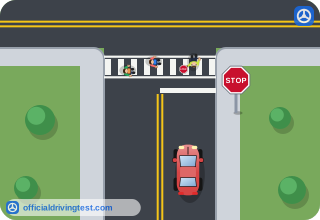
- Slow down and enter the intersection if no vehicle is in sight
- Come to a complete stop and yield to the traffic on the through-street
- Stop only if other traffic is on the through-street at that moment
- Come to a rolling stop and go ahead when the closest vehicle passes
Show answer
Correct answer: Come to a complete stop and yield to the traffic on the through-street
At a stop sign you must come to a complete stop and yield to traffic on the through-street, moving ahead only when you can proceed safely.
Source: North Carolina Driver Handbook (Revised May 2025), page 57 · Open this page in the manual (Manual page 57)
-
At an intersection with a traffic signal, when may you turn or move straight ahead?
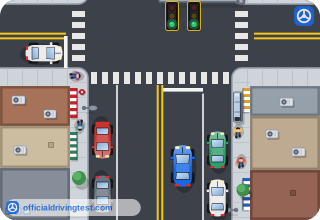
- As soon as the intersection looks clear
- Once other drivers begin to move
- When no pedestrians are in view
- When the signal permits you to do so
Show answer
Correct answer: When the signal permits you to do so
The manual says to wait until the signal permits you to turn or to move straight ahead.
Source: North Carolina Driver Handbook (Revised May 2025), page 57 · Open this page in the manual (Manual page 57)
-
When exiting a private driveway, what should you do?
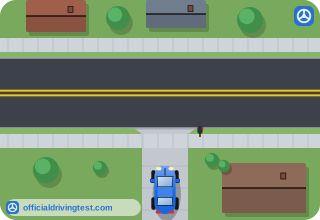
- Enter the road quickly to avoid blocking the driveway
- Yield only to vehicles, since pedestrians must wait
- Stop and yield to all other vehicles and pedestrians
- Stop only if traffic is approaching from your right
Show answer
Correct answer: Stop and yield to all other vehicles and pedestrians
When exiting a private driveway you must stop and yield to all other vehicles and pedestrians.
Source: North Carolina Driver Handbook (Revised May 2025), page 57 · Open this page in the manual (Manual page 57)
-
At unmarked intersections where it is hard to see in all directions, what should you do?
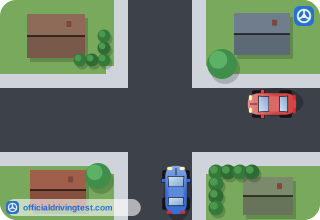
- Stop, and then move forward slowly and cautiously
- Proceed at your normal speed and watch the traffic to the right
- Slow down and honk your horn as you cross
- Stop and wait until all other drivers have crossed
Show answer
Correct answer: Stop, and then move forward slowly and cautiously
At unmarked intersections with poor visibility, stop and then move forward slowly and cautiously.
Source: North Carolina Driver Handbook (Revised May 2025), page 57 · Open this page in the manual (Manual page 57)
-
Why is the N.C. Department of Transportation constructing more roundabouts?
- To eliminate the need for any speed limits on the roads
- To replace all interstate interchanges within the state
- To increase the speed of traffic through busy intersections
- To improve safety for drivers, pedestrians and bicyclists
Show answer
Correct answer: To improve safety for drivers, pedestrians and bicyclists
The manual says NCDOT is constructing more roundabouts to improve safety for drivers, pedestrians and bicyclists.
Source: North Carolina Driver Handbook (Revised May 2025), page 58 · Open this page in the manual (Manual page 58)
-
Compared with traditional intersections with stop signs and traffic signals, what do roundabouts help reduce?
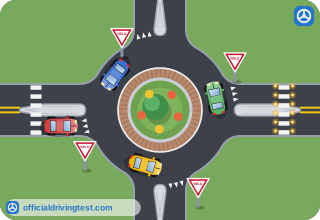
- The number of lanes needed
- Congestion and backups
- The width of the crosswalks
- The need for bicycle lanes
Show answer
Correct answer: Congestion and backups
Roundabouts help reduce the congestion and backups more typical of traditional intersections with stop signs and traffic signals.
Source: North Carolina Driver Handbook (Revised May 2025), page 58 · Open this page in the manual (Manual page 58)
-
Compared with waiting at a traffic signal, how does a driver generally enter a roundabout?
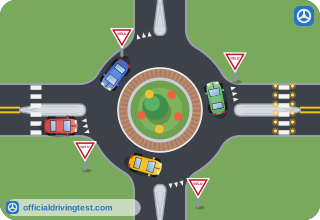
- More slowly
- More quickly
- At the same pace
- Only after a full stop
Show answer
Correct answer: More quickly
The manual says a driver generally enters the roundabout more quickly than if waiting at a traffic signal.
Source: North Carolina Driver Handbook (Revised May 2025), page 58 · Open this page in the manual (Manual page 58)
-
At what speeds does the modern roundabout require vehicles to travel?
- 5–10 mph
- 25–30 mph
- 35–40 mph
- 15–20 mph
Show answer
Correct answer: 15–20 mph
The modern roundabout requires vehicles to travel at lower speeds of 15–20 mph, making them safer than traffic circles.
Source: North Carolina Driver Handbook (Revised May 2025), page 58 · Open this page in the manual (Manual page 58)
-
What does a yellow roundabout ahead sign indicate?
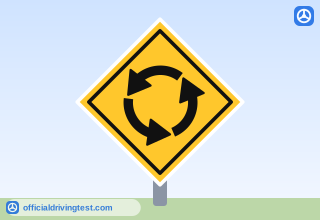
- You should slow down
- You must stop before you enter
- You must yield to trains ahead
- You are entering a one-way street
Show answer
Correct answer: You should slow down
As you approach a roundabout you will see a yellow roundabout ahead sign, indicating you should slow down.
Source: North Carolina Driver Handbook (Revised May 2025), page 59 · Open this page in the manual (Manual page 59)
-
Whom must drivers yield to when entering a roundabout?
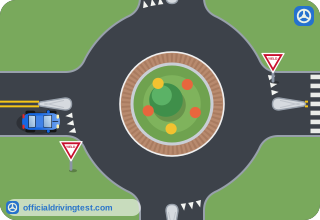
- Vehicles waiting to enter from the other approaches
- Only vehicles that are larger than your own
- Any vehicles or bicyclists already in the roundabout
- Only vehicles in the left lane of the roundabout
Show answer
Correct answer: Any vehicles or bicyclists already in the roundabout
Drivers yield to any vehicles or bicyclists already in the roundabout.
Source: North Carolina Driver Handbook (Revised May 2025), page 59 · Open this page in the manual (Manual page 59)
-
What is true of vehicles already in the roundabout?
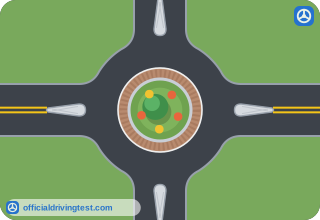
- They must yield to approaching vehicles
- They must stop before each exit
- They must let the largest vehicle go first
- They do not yield to approaching vehicles
Show answer
Correct answer: They do not yield to approaching vehicles
The manual says those already in the roundabout do not yield to approaching vehicles.
Source: North Carolina Driver Handbook (Revised May 2025), page 59 · Open this page in the manual (Manual page 59)
-
In which direction does everyone using a roundabout move?
- Clockwise
- Counterclockwise
- Toward the left side of the circle
- Whichever direction is shortest
Show answer
Correct answer: Counterclockwise
Everyone using the roundabout moves in a counterclockwise direction.
Source: North Carolina Driver Handbook (Revised May 2025), page 59 · Open this page in the manual (Manual page 59)
-
What should drivers use when exiting a roundabout?
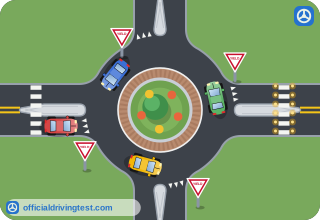
- Hazard flashers
- High-beam headlights
- Turn signals
- The horn
Show answer
Correct answer: Turn signals
Drivers should use turn signals when exiting a roundabout.
Source: North Carolina Driver Handbook (Revised May 2025), page 59 · Open this page in the manual (Manual page 59)
-
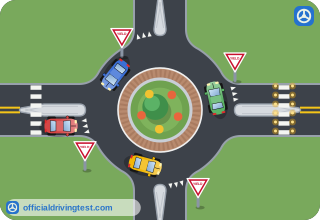
In a single-lane roundabout, how far around do you go to turn right at the next street?
- A quarter of the way around
- Halfway around
- Three-quarters of the way around
- All the way around
Show answer
Correct answer: A quarter of the way around
In a single-lane roundabout you go a quarter of the way around to turn right at the next street.
Source: North Carolina Driver Handbook (Revised May 2025), page 59 · Open this page in the manual (Manual page 59)
-
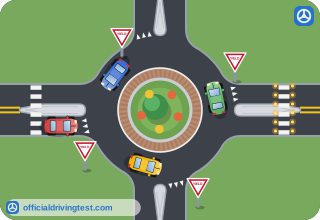
In a single-lane roundabout, how far around do you go to continue straight?
- A quarter of the way around
- Three-quarters of the way around
- Halfway around
- All the way around
Show answer
Correct answer: Halfway around
In a single-lane roundabout you go halfway around to continue straight.
Source: North Carolina Driver Handbook (Revised May 2025), page 59 · Open this page in the manual (Manual page 59)
-
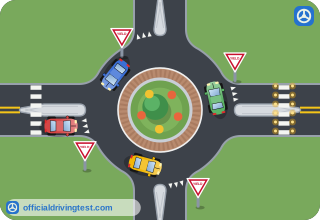
In a single-lane roundabout, how far around do you go before exiting to the right, instead of making a traditional left turn?
- A quarter of the way around
- Three-quarters of the way around
- Halfway around
- All the way around
Show answer
Correct answer: Three-quarters of the way around
Instead of a traditional left turn you go three-quarters of the way around before exiting to the right.
Source: North Carolina Driver Handbook (Revised May 2025), page 59 · Open this page in the manual (Manual page 59)
-
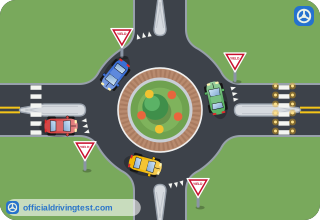
In a single-lane roundabout, how far around do you go to make a U-turn?
- A quarter of the way around
- Halfway around
- Three-quarters of the way around
- Full circle
Show answer
Correct answer: Full circle
To make a U-turn in a single-lane roundabout you go full circle.
Source: North Carolina Driver Handbook (Revised May 2025), page 59 · Open this page in the manual (Manual page 59)
-
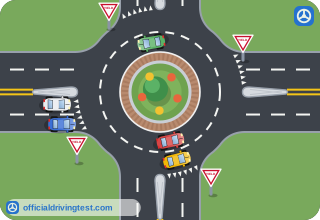
Before entering a multi-lane roundabout, how should you choose the appropriate lane?
- Follow the vehicle ahead of you into its lane
- Enter the right lane in every case
- Observe signs and pavement markings
- Stop and wait for the roundabout to be empty
Show answer
Correct answer: Observe signs and pavement markings
As you approach a multi-lane roundabout, observe signs and pavement markings to choose the appropriate lane before entering.
Source: North Carolina Driver Handbook (Revised May 2025), page 59 · Open this page in the manual (Manual page 59)
-
In a multi-lane roundabout, which lane are you typically in to exit right?
- The right lane
- The left lane
- The lane closest to the center
- Whichever lane is empty
Show answer
Correct answer: The right lane
Typically you will be in the right lane to exit right out of the roundabout.
Source: North Carolina Driver Handbook (Revised May 2025), page 59 · Open this page in the manual (Manual page 59)
-
In a multi-lane roundabout, which lane do you stay in to go straight through, make a left turn or make a U-turn?
- The right lane
- Any lane that is open
- Whichever lane is empty
- The left lane
Show answer
Correct answer: The left lane
The manual says you stay in the left lane to go straight through the roundabout or make a left turn or U-turn.
Source: North Carolina Driver Handbook (Revised May 2025), page 59 · Open this page in the manual (Manual page 59)
-
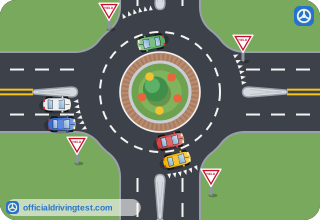
What should you not do while in a multi-lane roundabout?
- Use a turn signal
- Change lanes
- Yield to pedestrians
- Move counterclockwise
Show answer
Correct answer: Change lanes
The manual says not to change lanes while in the roundabout.
Source: North Carolina Driver Handbook (Revised May 2025), page 59 · Open this page in the manual (Manual page 59)
-
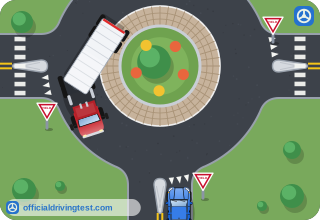
What is the concrete island in a roundabout that big trucks use to help them maneuver called?
- The lane divider
- The center median
- The yield island
- The truck apron
Show answer
Correct answer: The truck apron
The manual says big trucks should use the concrete island, called the truck apron, to help drivers maneuver around the roundabout.
Source: North Carolina Driver Handbook (Revised May 2025), page 59 · Open this page in the manual (Manual page 59)
-
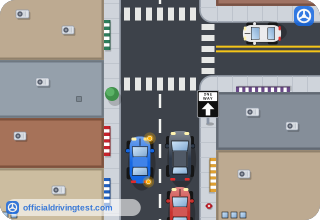
You intend to make a turn in the city but are not in the proper lane. What should you do?
- Cut across lanes if traffic is light
- Stop and back up to the last intersection
- Slow down and force your way into the proper lane
- Continue to the next intersection and turn there
Show answer
Correct answer: Continue to the next intersection and turn there
If you are not in the proper lane for a turn, continue to the next intersection and turn there.
Source: North Carolina Driver Handbook (Revised May 2025), page 63 · Open this page in the manual (Manual page 63)
-
On a one-way street, which lanes should you use for through-travel?
- The center lane(s)
- The outside lanes
- The left lane only
- The right lane only
Show answer
Correct answer: The center lane(s)
On a one-way street, use the center lane(s) for through-travel and the outside lanes for turning.
Source: North Carolina Driver Handbook (Revised May 2025), page 63 · Open this page in the manual (Manual page 63)