North Carolina: Right of way & turning — Part 3 Practice Test
Questions in this part include: “If you increase speed and fail to give way to a passing vehicle, when will you be charged with a misdemeanor?” · “On four-lane highways separated by a median of more than how many feet is each crossing a separate intersection?”
Independent educational site · not affiliated with any government agency or DMV
Ready? Test yourself
- Instant feedback with an explanation
- Every answer cites its source in the manual
- Your best score is saved on this device
Questions are original and based on the official manual "North Carolina Driver Handbook" (Revised May 2025), North Carolina Division of Motor Vehicles (NCDMV).
All 19 questions in this practice test
Take the test above first, then use this list to study. Tap “Show answer” to see the correct answer and explanation.
Show the questions and answersHide the questions
-
If you increase speed and fail to give way to a passing vehicle, when will you be charged with a misdemeanor?
- If the passing driver has to slow down for oncoming traffic
- Any time the passing driver has to blow the horn
- If a crash occurs resulting in bodily injury or property damage
- If the passing driver had to cross a solid yellow line
Show answer
Correct answer: If a crash occurs resulting in bodily injury or property damage
Failing to give way while speeding up is a misdemeanor if a crash results in bodily injury or property damage.
Source: North Carolina Driver Handbook (Revised May 2025), page 55 · Open this page in the manual (Manual page 55)
-
As you approach an interchange, what should you do?
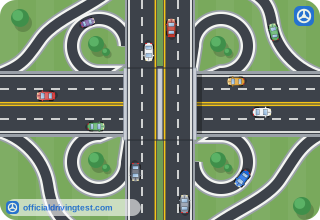
- Slow down and give careful attention to the signs that direct you
- Keep your speed the same and follow the vehicle ahead of you
- Speed up to merge before other traffic arrives
- Stop and wait until the road is clear of all traffic
Show answer
Correct answer: Slow down and give careful attention to the signs that direct you
At an interchange the method of turning may vary, so slow down and follow the signs about how to make the turn.
Source: North Carolina Driver Handbook (Revised May 2025), page 56 · Open this page in the manual (Manual page 56)
-
What is an intersection, according to the manual?
- Only a place where a traffic signal controls the roads
- Only a place where two paved roads meet at right angles
- Any place where a road ends at a parking area
- Any place where two or more roads meet or cross each other
Show answer
Correct answer: Any place where two or more roads meet or cross each other
An intersection is any place where two or more roads meet or cross each other.
Source: North Carolina Driver Handbook (Revised May 2025), page 56 · Open this page in the manual (Manual page 56)
-
What are specially designed intersections where roads cross each other at different levels called?
- Roundabouts
- Interchanges
- Crossovers
- Merge zones
Show answer
Correct answer: Interchanges
The manual calls intersections where roads cross at different levels interchanges.
Source: North Carolina Driver Handbook (Revised May 2025), page 56 · Open this page in the manual (Manual page 56)
-
Where do crashes occur most frequently?
- On curves
- At intersections
- On freeways
- In parking lots
Show answer
Correct answer: At intersections
Crashes occur most frequently at intersections, which the manual calls the most dangerous places on a street or highway.
Source: North Carolina Driver Handbook (Revised May 2025), page 57 · Open this page in the manual (Manual page 57)
-
What portion of fatal traffic crashes involving motor vehicles occurs at intersections?
- About one-tenth
- About one-fifth
- More than half
- More than one-third
Show answer
Correct answer: More than one-third
The manual says more than one-third of fatal traffic crashes involving motor vehicles occur at intersections.
Source: North Carolina Driver Handbook (Revised May 2025), page 57 · Open this page in the manual (Manual page 57)
-
On four-lane highways separated by a median of more than how many feet is each crossing a separate intersection?
- 30 feet
- 10 feet
- 20 feet
- 50 feet
Show answer
Correct answer: 30 feet
On four-lane highways separated by a median of more than 30 feet, each crossing constitutes a separate intersection.
Source: North Carolina Driver Handbook (Revised May 2025), page 57 · Open this page in the manual (Manual page 57)
-
What does the law require when you come to an intersection, even if you have the right of way?
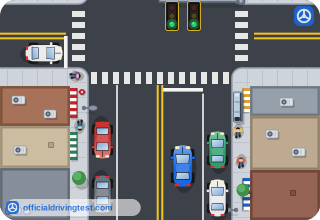
- Come to a complete stop
- Sound your horn
- Slow down
- Flash your headlights
Show answer
Correct answer: Slow down
The law requires you to slow down when you come to an intersection, even with the right of way.
Source: North Carolina Driver Handbook (Revised May 2025), page 57 · Open this page in the manual (Manual page 57)
-
At an intersection without traffic signs or signals, which vehicle has the right of way?
- The vehicle traveling on the wider road
- The vehicle that is going faster
- The vehicle that arrived from the left
- The vehicle already in the intersection
Show answer
Correct answer: The vehicle already in the intersection
The vehicle already in the intersection has the right of way ahead of any vehicle that has not yet entered.
Source: North Carolina Driver Handbook (Revised May 2025), page 57 · Open this page in the manual (Manual page 57)
-
At an intersection without signs or signals, two vehicles reach the intersection at the same time. Which has the right of way?
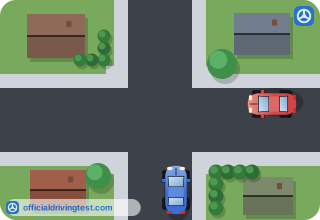
- The vehicle to the left
- The vehicle to the right
- The larger vehicle
- The vehicle going faster
Show answer
Correct answer: The vehicle to the right
When two or more vehicles reach an intersection at the same time, the vehicle to the right has the right of way.
Source: North Carolina Driver Handbook (Revised May 2025), page 57 · Open this page in the manual (Manual page 57)
-
A vehicle that has the right of way at an intersection may do what?
- Move straight ahead only, and never turn without stopping first
- Turn right or left without any signal, since it has the right of way
- Move straight ahead or, if legal and after signaling, turn right or left
- Stop in the intersection to let all other vehicles pass first
Show answer
Correct answer: Move straight ahead or, if legal and after signaling, turn right or left
A vehicle with the right of way may go straight or, if legal and after signaling, turn right or left.
Source: North Carolina Driver Handbook (Revised May 2025), page 57 · Open this page in the manual (Manual page 57)
-
What should you do even when you have the right of way at an intersection?
- Be careful to avoid hitting other vehicles and pedestrians
- Proceed without looking, since all other drivers must yield
- Honk to warn every other driver before you enter it
- Stop completely before entering the intersection every time
Show answer
Correct answer: Be careful to avoid hitting other vehicles and pedestrians
Even with the right of way, you must be careful to avoid hitting other vehicles and pedestrians.
Source: North Carolina Driver Handbook (Revised May 2025), page 57 · Open this page in the manual (Manual page 57)
-
Two facing vehicles approach an intersection at the same time. One is going straight and the other wants to turn left. Who has the right of way?
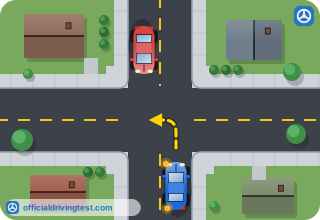
- The driver going straight ahead
- The driver turning left
- The driver on the wider road
- The driver who sounds the horn first
Show answer
Correct answer: The driver going straight ahead
The driver who wants to turn left must signal and wait until it is safe, so the driver going straight has the right of way.
Source: North Carolina Driver Handbook (Revised May 2025), page 57 · Open this page in the manual (Manual page 57)
-
What should you never do while moving straight ahead through an intersection?
- Use your turn signal
- Slow down
- Change lanes
- Look for pedestrians
Show answer
Correct answer: Change lanes
The manual says never to change lanes while moving straight ahead through an intersection.
Source: North Carolina Driver Handbook (Revised May 2025), page 57 · Open this page in the manual (Manual page 57)
-
When you approach an intersection with a stop sign, what must you do?
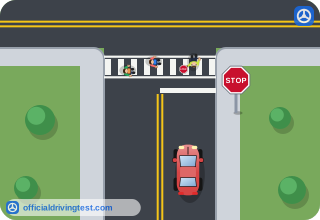
- Slow down and enter the intersection if no vehicle is in sight
- Come to a complete stop and yield to the traffic on the through-street
- Stop only if other traffic is on the through-street at that moment
- Come to a rolling stop and go ahead when the closest vehicle passes
Show answer
Correct answer: Come to a complete stop and yield to the traffic on the through-street
At a stop sign you must come to a complete stop and yield to traffic on the through-street, moving ahead only when you can proceed safely.
Source: North Carolina Driver Handbook (Revised May 2025), page 57 · Open this page in the manual (Manual page 57)
-
At an intersection with a traffic signal, when may you turn or move straight ahead?
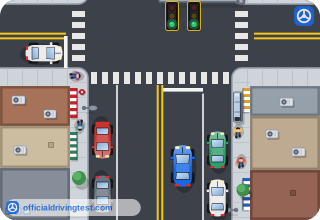
- As soon as the intersection looks clear
- Once other drivers begin to move
- When no pedestrians are in view
- When the signal permits you to do so
Show answer
Correct answer: When the signal permits you to do so
The manual says to wait until the signal permits you to turn or to move straight ahead.
Source: North Carolina Driver Handbook (Revised May 2025), page 57 · Open this page in the manual (Manual page 57)
-
When exiting a private driveway, what should you do?
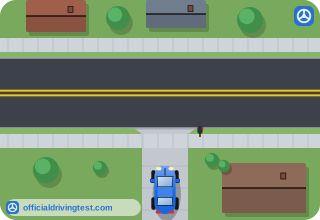
- Enter the road quickly to avoid blocking the driveway
- Yield only to vehicles, since pedestrians must wait
- Stop and yield to all other vehicles and pedestrians
- Stop only if traffic is approaching from your right
Show answer
Correct answer: Stop and yield to all other vehicles and pedestrians
When exiting a private driveway you must stop and yield to all other vehicles and pedestrians.
Source: North Carolina Driver Handbook (Revised May 2025), page 57 · Open this page in the manual (Manual page 57)
-
At unmarked intersections where it is hard to see in all directions, what should you do?
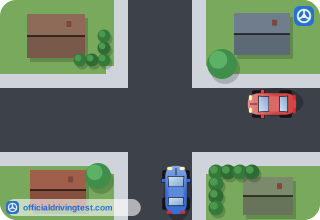
- Stop, and then move forward slowly and cautiously
- Proceed at your normal speed and watch the traffic to the right
- Slow down and honk your horn as you cross
- Stop and wait until all other drivers have crossed
Show answer
Correct answer: Stop, and then move forward slowly and cautiously
At unmarked intersections with poor visibility, stop and then move forward slowly and cautiously.
Source: North Carolina Driver Handbook (Revised May 2025), page 57 · Open this page in the manual (Manual page 57)
-
Why is the N.C. Department of Transportation constructing more roundabouts?
- To eliminate the need for any speed limits on the roads
- To replace all interstate interchanges within the state
- To increase the speed of traffic through busy intersections
- To improve safety for drivers, pedestrians and bicyclists
Show answer
Correct answer: To improve safety for drivers, pedestrians and bicyclists
The manual says NCDOT is constructing more roundabouts to improve safety for drivers, pedestrians and bicyclists.
Source: North Carolina Driver Handbook (Revised May 2025), page 58 · Open this page in the manual (Manual page 58)