North Carolina: Right of way & turning — Part 2 Practice Test
Questions in this part include: “What does the horn signal do to the driver of the vehicle you are passing?” · “On which type of highway is passing on the right allowed?”
Independent educational site · not affiliated with any government agency or DMV
Ready? Test yourself
- Instant feedback with an explanation
- Every answer cites its source in the manual
- Your best score is saved on this device
Questions are original and based on the official manual "North Carolina Driver Handbook" (Revised May 2025), North Carolina Division of Motor Vehicles (NCDMV).
All 20 questions in this practice test
Take the test above first, then use this list to study. Tap “Show answer” to see the correct answer and explanation.
Show the questions and answersHide the questions
-
Why should you signal before passing?
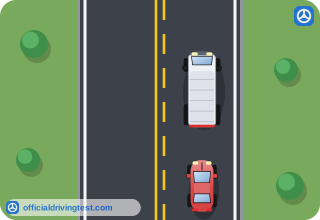
- To tell the driver ahead that they must pull onto the shoulder
- To alert the drivers ahead and behind you so they can plan their moves
- To let the driver ahead know you will slow down behind them
- To warn oncoming traffic that you are about to speed up
Show answer
Correct answer: To alert the drivers ahead and behind you so they can plan their moves
Signaling alerts the drivers ahead and behind you of your intention so they can plan accordingly.
Source: North Carolina Driver Handbook (Revised May 2025), page 55 · Open this page in the manual (Manual page 55)
-
What does the horn signal do to the driver of the vehicle you are passing?
- Requires that driver to stop on the shoulder until you pass
- Gives that driver permission to speed up and race you
- Places that driver under a legal obligation to help you pass
- Has no legal effect on the driver being passed
Show answer
Correct answer: Places that driver under a legal obligation to help you pass
The horn signal places the driver of the vehicle you are passing under a legal obligation to help you pass.
Source: North Carolina Driver Handbook (Revised May 2025), page 55 · Open this page in the manual (Manual page 55)
-
By law, how far to the left of the vehicle being passed must the passing driver pass?
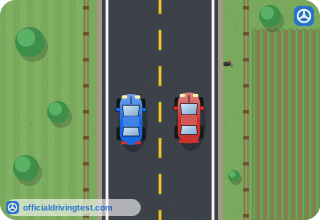
- At least two feet
- At least one foot
- At least five feet
- At least ten feet
Show answer
Correct answer: At least two feet
The law requires the passing driver to pass at least two feet to the left of the vehicle being passed.
Source: North Carolina Driver Handbook (Revised May 2025), page 55 · Open this page in the manual (Manual page 55)
-
When have you NOT passed safely?
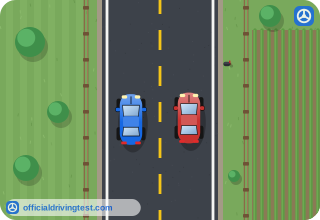
- When the vehicle you passed must slow down to allow you back into your lane
- When you have to signal a second time before returning to your lane
- When you use the horn more than once while passing the vehicle
- When the passed vehicle is still visible in your rear-view mirror
Show answer
Correct answer: When the vehicle you passed must slow down to allow you back into your lane
The manual says you have not passed safely if the vehicle you passed must slow down to let you back into your correct lane.
Source: North Carolina Driver Handbook (Revised May 2025), page 55 · Open this page in the manual (Manual page 55)
-
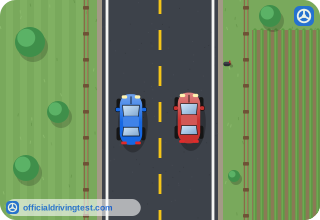
You cannot pass safely unless you can see far enough ahead to do what?
- Reach the next intersection before the vehicle you pass
- Stay in the passing lane until the next exit or turn
- Get back to your original lane before you meet oncoming traffic
- Read the next sign posted along the road ahead of you
Show answer
Correct answer: Get back to your original lane before you meet oncoming traffic
You must be able to see far enough ahead to return to your original lane before meeting oncoming traffic.
Source: North Carolina Driver Handbook (Revised May 2025), page 55 · Open this page in the manual (Manual page 55)
-
On any curve or hill, passing is always unsafe and usually illegal if the driver cannot see at least how far ahead?
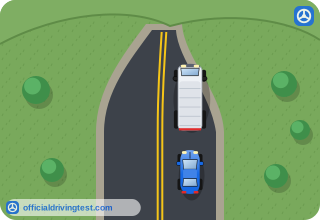
- 200 feet
- 500 feet
- 300 feet
- 1,000 feet
Show answer
Correct answer: 500 feet
Passing is unsafe on a curve or hill where the driver cannot see at least 500 feet ahead.
Source: North Carolina Driver Handbook (Revised May 2025), page 55 · Open this page in the manual (Manual page 55)
-
Which is a place where passing is always unsafe and usually illegal?
- Wherever there is a broken white line between two lanes
- Wherever the vehicle ahead is traveling below the speed limit
- Wherever the road has two or more lanes in your direction
- Wherever there is a solid yellow line in the driver's lane
Show answer
Correct answer: Wherever there is a solid yellow line in the driver's lane
A solid yellow line in the driver's lane is one of the places where passing is always unsafe and usually illegal.
Source: North Carolina Driver Handbook (Revised May 2025), page 55 · Open this page in the manual (Manual page 55)
-
In which situation is passing always unsafe and usually illegal?
- On a one-way street with all lanes moving the same way
- On a straight, dry road with a clear view ahead
- Wherever there is a double-solid yellow line
- In a lane set aside for right turns
Show answer
Correct answer: Wherever there is a double-solid yellow line
The manual lists a double-solid yellow line as a place where passing is always unsafe and usually illegal.
Source: North Carolina Driver Handbook (Revised May 2025), page 55 · Open this page in the manual (Manual page 55)
-
Which is a place where passing is always unsafe and usually illegal?
- At a crosswalk where a vehicle has stopped to let people cross
- On a one-way street where all lanes move in the same direction
- In a lane set aside for right turns on a wide road
- On a straight, dry road with a clear view of the road ahead
Show answer
Correct answer: At a crosswalk where a vehicle has stopped to let people cross
Passing is unsafe and usually illegal at intersections or crosswalks where a vehicle has stopped to allow people to cross the street.
Source: North Carolina Driver Handbook (Revised May 2025), page 55 · Open this page in the manual (Manual page 55)
-
Where is passing always unsafe and usually illegal in cities and towns?
- On a straight road with 1,000 feet of clear view
- On a road with a broken yellow line in your lane
- On a wide road with two lanes in your direction
- At intersections
Show answer
Correct answer: At intersections
Passing is always unsafe and usually illegal at intersections in cities and towns and at railroad crossings.
Source: North Carolina Driver Handbook (Revised May 2025), page 55 · Open this page in the manual (Manual page 55)
-
Where in a rural area is passing always unsafe and usually illegal?
- On a rural road with a broken yellow line in your lane
- At marked intersections
- On a straight rural road with a clear view of 1,000 feet
- On a two-lane rural road with no other traffic in sight
Show answer
Correct answer: At marked intersections
The manual lists marked intersections in rural areas as a place where passing is always unsafe and usually illegal.
Source: North Carolina Driver Handbook (Revised May 2025), page 55 · Open this page in the manual (Manual page 55)
-
Passing on the right is:
- Legal on any road with a paved shoulder wide enough for a vehicle
- Against the law except in areas where it is specifically permitted
- Legal whenever the vehicle ahead is driving below the speed limit
- Legal on any road at speeds below 35 mph in cities and towns
Show answer
Correct answer: Against the law except in areas where it is specifically permitted
Passing on the right is against the law except where it is specifically permitted.
Source: North Carolina Driver Handbook (Revised May 2025), page 55 · Open this page in the manual (Manual page 55)
-
Why is passing on the right dangerous?
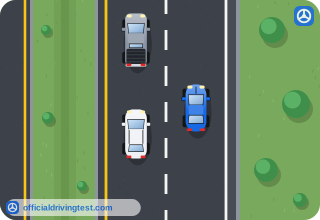
- It puts your vehicle directly in the path of oncoming traffic
- It makes the vehicle you are passing speed up unexpectedly
- It hides your vehicle from oncoming traffic in the opposite lane
- It places your vehicle on the blind side of the vehicle you are passing
Show answer
Correct answer: It places your vehicle on the blind side of the vehicle you are passing
Passing on the right puts you on the blind side, where the other vehicle could unexpectedly turn right or pull to the right.
Source: North Carolina Driver Handbook (Revised May 2025), page 55 · Open this page in the manual (Manual page 55)
-
On which type of highway is passing on the right allowed?
- Highways having at least two lanes traveling in each direction
- Two-lane highways that have a wide paved shoulder
- Two-lane roads where the vehicle ahead is slowing down
- Any highway with a broken yellow line in the driver's lane
Show answer
Correct answer: Highways having at least two lanes traveling in each direction
Passing on the right is an exception allowed on highways with at least two lanes traveling in each direction.
Source: North Carolina Driver Handbook (Revised May 2025), page 55 · Open this page in the manual (Manual page 55)
-
Where is passing on the right allowed?
- On any road where the vehicle ahead is driving below the speed limit
- On any two-way street where the right lane is empty of traffic
- On one-way streets where all lanes of traffic move in the same direction
- On any road when the driver ahead signals that you can pass
Show answer
Correct answer: On one-way streets where all lanes of traffic move in the same direction
Passing on the right is allowed on one-way streets where all lanes move in the same direction.
Source: North Carolina Driver Handbook (Revised May 2025), page 55 · Open this page in the manual (Manual page 55)
-
Which vehicle may you pass on the right?
- A vehicle stopped to let a pedestrian cross
- A vehicle turning right from the right lane
- A vehicle stopped behind a school bus with flashing red lights
- A vehicle that is in the left-turn lane
Show answer
Correct answer: A vehicle that is in the left-turn lane
Passing a vehicle that is in the left-turn lane is one of the allowed exceptions for passing on the right.
Source: North Carolina Driver Handbook (Revised May 2025), page 55 · Open this page in the manual (Manual page 55)
-
In which lane is passing on the right allowed?
- The paved shoulder of the road
- A lane set aside for right turns
- A lane next to a solid yellow center line
- A bicycle lane beside the roadway
Show answer
Correct answer: A lane set aside for right turns
The manual allows passing on the right when driving in a lane set aside for right turns.
Source: North Carolina Driver Handbook (Revised May 2025), page 55 · Open this page in the manual (Manual page 55)
-
On three-lane highways, where must you pass?
- Only in the right lane, where it is marked for passing in your direction
- In the center lane at any time, whether or not it is marked for passing
- In the center lane, where it is marked for passing in your direction
- In either outside lane at any time when no other vehicles are nearby
Show answer
Correct answer: In the center lane, where it is marked for passing in your direction
On three-lane highways you must not pass except in the center lane, and only where it is marked for passing in your direction.
Source: North Carolina Driver Handbook (Revised May 2025), page 55 · Open this page in the manual (Manual page 55)
-
If the driver of a passing vehicle blows the horn, what should you do?
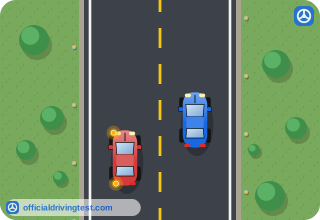
- Move to the right edge of the road
- Slow down and stop in your lane
- Flash your headlights in reply
- Move toward the center line to give more room
Show answer
Correct answer: Move to the right edge of the road
When the passing driver blows the horn you must help by moving to the right edge of the road.
Source: North Carolina Driver Handbook (Revised May 2025), page 55 · Open this page in the manual (Manual page 55)
-
When another vehicle is passing you, what must you never do?
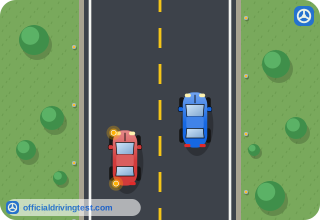
- Increase your speed
- Move to the right edge of the road
- Look in your mirrors
- Help the other driver to pass
Show answer
Correct answer: Increase your speed
The manual says that when you are being passed you must never increase your speed.
Source: North Carolina Driver Handbook (Revised May 2025), page 55 · Open this page in the manual (Manual page 55)