North Carolina: Right of way & turning — Part 1 Practice Test
Questions in this part include: “During which hours does the manual say school buses are generally operating, so drivers should be especially careful?” · “What must a driver not in a funeral procession never knowingly do?”
Independent educational site · not affiliated with any government agency or DMV
Ready? Test yourself
- Instant feedback with an explanation
- Every answer cites its source in the manual
- Your best score is saved on this device
Questions are original and based on the official manual "North Carolina Driver Handbook" (Revised May 2025), North Carolina Division of Motor Vehicles (NCDMV).
All 20 questions in this practice test
Take the test above first, then use this list to study. Tap “Show answer” to see the correct answer and explanation.
Show the questions and answersHide the questions
-
During which hours does the manual say school buses are generally operating, so drivers should be especially careful?
- 7-9 a.m. and 2-4 p.m.
- 6-8 a.m. and 5-7 p.m.
- 9-11 a.m. and 12-2 p.m.
- 10 a.m.-12 noon and 4-6 p.m.
Show answer
Correct answer: 7-9 a.m. and 2-4 p.m.
The manual says school buses are generally operating from 7 to 9 a.m. and 2 to 4 p.m., so drivers should be especially careful.
Source: North Carolina Driver Handbook (Revised May 2025), page 47 · Open this page in the manual (Manual page 47)
-
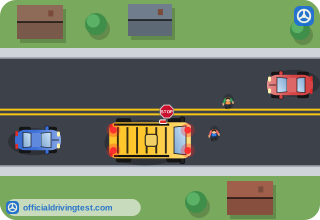
When a school bus displays its mechanical stop signal or flashing red lights to receive or discharge passengers, when may the driver of a vehicle approaching the bus pass?
- After the bus has been stopped with its red lights on for 30 seconds
- As soon as the last child has stepped out of the road onto the curb
- After the stop signal is withdrawn, the red lights are off and the bus is moving
- After you sound your horn and check that no children are near the bus
Show answer
Correct answer: After the stop signal is withdrawn, the red lights are off and the bus is moving
The manual says the driver must stop and not attempt to pass until the mechanical stop signal is withdrawn, the flashing red lights are turned off and the bus has started to move.
Source: North Carolina Driver Handbook (Revised May 2025), page 47 · Open this page in the manual (Manual page 47)
-
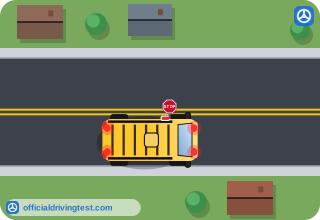
On a two-lane roadway, a school bus stops for passengers. Which traffic must stop?
- Only traffic following the bus
- All traffic from both directions
- Only traffic approaching the bus from the front
- No traffic has to stop if the bus is on the shoulder
Show answer
Correct answer: All traffic from both directions
The manual says on a two-lane roadway, when a school bus stops for passengers all traffic from both directions must stop.
Source: North Carolina Driver Handbook (Revised May 2025), page 47 · Open this page in the manual (Manual page 47)
-
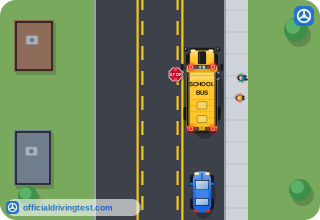
On a two-lane roadway with a center turning lane, a school bus stops for passengers. Which traffic must stop?
- Only traffic following the bus
- Only traffic in the center turning lane
- Only traffic in the bus's lane
- All traffic from both directions
Show answer
Correct answer: All traffic from both directions
The manual says on a two-lane roadway with a center turning lane, all traffic from both directions must stop when a school bus stops for passengers.
Source: North Carolina Driver Handbook (Revised May 2025), page 48 · Open this page in the manual (Manual page 48)
-
On a four-lane roadway without a median separation, a school bus stops for passengers. Which traffic must stop?
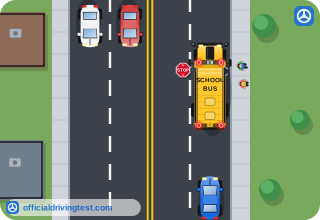
- All traffic from both directions
- Only traffic following the bus
- Only traffic in the two lanes on the bus's side
- Only traffic in the lane next to the bus
Show answer
Correct answer: All traffic from both directions
The manual says on a four-lane roadway without a median separation, all traffic from both directions must stop when a school bus stops for passengers.
Source: North Carolina Driver Handbook (Revised May 2025), page 48 · Open this page in the manual (Manual page 48)
-
On a divided highway of four lanes or more with a median separation, a school bus stops for passengers. Which traffic must stop?
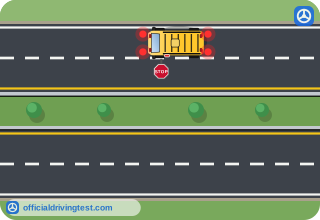
- All traffic from both directions
- Only traffic approaching the bus from the front
- Only traffic following the bus
- No traffic has to stop
Show answer
Correct answer: Only traffic following the bus
The manual says on a divided highway of four lanes or more with a median separation, only traffic following the bus must stop.
Source: North Carolina Driver Handbook (Revised May 2025), page 48 · Open this page in the manual (Manual page 48)
-
On a roadway of four lanes or more with a center turning lane, a school bus stops for passengers. Which traffic must stop?
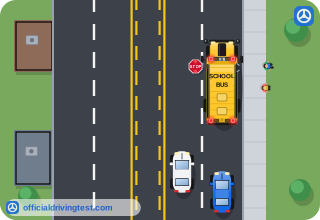
- All traffic from both directions
- Only traffic following the bus
- Only traffic in the center turning lane
- No traffic has to stop
Show answer
Correct answer: Only traffic following the bus
The manual says on a roadway of four lanes or more with a center turning lane, only traffic following the bus must stop.
Source: North Carolina Driver Handbook (Revised May 2025), page 48 · Open this page in the manual (Manual page 48)
-
What must every vehicle in a funeral procession have on?
- Its headlights only, with the hazard warning signals off
- Its headlights, and its hazard warning signals if so equipped
- Its parking lights only, to avoid confusing other drivers
- Its hazard warning signals only, with the headlights off
Show answer
Correct answer: Its headlights, and its hazard warning signals if so equipped
Every vehicle in a funeral procession must have its headlights on, and the hazard warning signals too if the vehicle has them.
Source: North Carolina Driver Handbook (Revised May 2025), page 52 · Open this page in the manual (Manual page 52)
-
What must the operator of the lead vehicle in a funeral procession do at intersections?
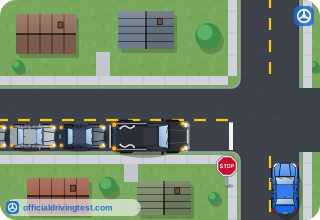
- Ignore red lights while the hazard signals are flashing
- Stop only for signals that show a red light
- Follow the signals only when no other vehicles are near
- Comply with all traffic-control signals
Show answer
Correct answer: Comply with all traffic-control signals
The lead vehicle's operator must comply with all traffic-control signals.
Source: North Carolina Driver Handbook (Revised May 2025), page 52 · Open this page in the manual (Manual page 52)
-
When may all vehicles in a funeral procession proceed through an intersection without stopping, while using extra care?
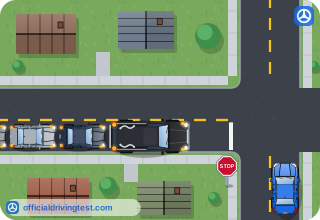
- Whenever the last vehicle in the procession has its headlights on
- Whenever the drivers in the procession decide that traffic is clear
- When directed to do so by a law enforcement officer or funeral director
- Whenever the procession has more than ten vehicles in it
Show answer
Correct answer: When directed to do so by a law enforcement officer or funeral director
The vehicles may proceed without stopping when the lead vehicle has crossed lawfully, when directed by an officer or funeral director, or when led by a law enforcement vehicle.
Source: North Carolina Driver Handbook (Revised May 2025), page 52 · Open this page in the manual (Manual page 52)
-
On which side of the road must vehicles in a funeral procession be driven?
- The right side of the road
- The left side of the road
- The center of the road
- Either side, depending on traffic
Show answer
Correct answer: The right side of the road
All vehicles in a funeral procession must be driven on the right side of the road.
Source: North Carolina Driver Handbook (Revised May 2025), page 52 · Open this page in the manual (Manual page 52)
-
A driver going the opposite direction of a funeral procession chooses to yield to it. How must the driver do so?
- By stopping in the middle of the roadway with the hazard lights on
- By moving into the lane the procession is using
- By speeding up to pass the procession before it arrives
- By reducing speed, or by stopping completely off the roadway
Show answer
Correct answer: By reducing speed, or by stopping completely off the roadway
The driver may yield by reducing speed or by stopping completely off the roadway, so other drivers can continue without leaving their lane.
Source: North Carolina Driver Handbook (Revised May 2025), page 52 · Open this page in the manual (Manual page 52)
-
When may a driver traveling in the same direction as a funeral procession pass it?
- When the procession is moving slower than the posted speed limit
- When the highway has two or more marked lanes in its direction
- When the driver sounds the horn before passing
- When the driver can see 500 feet of clear road ahead
Show answer
Correct answer: When the highway has two or more marked lanes in its direction
Passing a funeral procession in the same direction is allowed only where the highway is marked for two or more lanes moving that way.
Source: North Carolina Driver Handbook (Revised May 2025), page 52 · Open this page in the manual (Manual page 52)
-
What must a driver not in a funeral procession never knowingly do?
- Follow the last vehicle in the procession
- Drive between vehicles in the procession
- Stop at a red light near the procession
- Drive on the right side of the road
Show answer
Correct answer: Drive between vehicles in the procession
The manual says a driver shall not knowingly drive between vehicles in a funeral procession.
Source: North Carolina Driver Handbook (Revised May 2025), page 52 · Open this page in the manual (Manual page 52)
-
A funeral procession is proceeding through a red light. You are not in the procession and you face a green light. When may you enter the intersection?
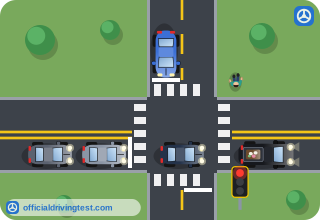
- Whenever the vehicles in the procession are moving slowly and have headlights on
- Whenever you sound the horn to warn the procession's drivers first
- Whenever the light stays green while the procession passes through
- Only if it can be done safely and without crossing the procession's path
Show answer
Correct answer: Only if it can be done safely and without crossing the procession's path
A driver not in the procession shall not enter the intersection even on a green light unless it can be done safely without crossing the procession's path.
Source: North Carolina Driver Handbook (Revised May 2025), page 52 · Open this page in the manual (Manual page 52)
-
Driving on the left side of the road is legal only in some cases. Which is one of them?
- On one-way streets and while passing
- On two-lane roads at night
- When the right lane is crowded with traffic
- When you are driving below the speed limit
Show answer
Correct answer: On one-way streets and while passing
The manual says left-side driving is legal only in some cases, such as on one-way streets and while passing.
Source: North Carolina Driver Handbook (Revised May 2025), page 52 · Open this page in the manual (Manual page 52)
-
For right turns, where should you stay?
- Toward the center of the lane, so you have room to swing wide into the turn
- Close to the right edge, so no other vehicle can move between you and the curb
- Beside the vehicle in the next lane, so no one can pass you during the turn
- Wherever there is the most space, even if other vehicles can enter the gap
Show answer
Correct answer: Close to the right edge, so no other vehicle can move between you and the curb
Staying close to the right edge keeps another vehicle from moving between your vehicle and the curb.
Source: North Carolina Driver Handbook (Revised May 2025), page 54 · Open this page in the manual (Manual page 54)
-
How should you handle your speed for a right turn?
- Maintain full speed until you have completed the turn
- Speed up before the turn, then brake sharply in it
- Coast without braking or accelerating throughout the turn
- Reduce speed before the turn, then accelerate slightly
Show answer
Correct answer: Reduce speed before the turn, then accelerate slightly
The manual says to reduce the vehicle's speed before making the turn and then accelerate slightly.
Source: North Carolina Driver Handbook (Revised May 2025), page 54 · Open this page in the manual (Manual page 54)
-
Which vehicles are especially hard to see during a turn?
- Trucks and buses
- Vans and pickup trucks
- Motorcycles and bicycles
- School buses and taxis
Show answer
Correct answer: Motorcycles and bicycles
Motorcycles and bicycles are especially hard to see during a turn, so signal and look before turning.
Source: North Carolina Driver Handbook (Revised May 2025), page 54 · Open this page in the manual (Manual page 54)
-
Before you pass, what should you do first?
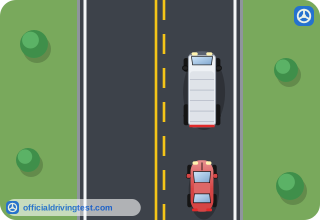
- Speed up to close the gap to the vehicle ahead
- Move into the left lane immediately and then look
- Turn on your high-beam headlights to warn the driver
- Look ahead and behind to determine when it is safe to pass
Show answer
Correct answer: Look ahead and behind to determine when it is safe to pass
The first step in passing is to look ahead and behind to determine when it is safe to pass.
Source: North Carolina Driver Handbook (Revised May 2025), page 55 · Open this page in the manual (Manual page 55)