New Hampshire: Signals and vehicle controls — Part 2 Practice Test
Questions in this part include: “During what period does New Hampshire law require every motor vehicle to display lighted lamps on the front?” · “When should drivers use the horn?”
Independent educational site · not affiliated with any government agency or DMV
Ready? Test yourself
- Instant feedback with an explanation
- Every answer cites its source in the manual
- Your best score is saved on this device
- Keyboard: press 1 to 4 to answer and Enter for the next question
Questions are original and based on the official manual "New Hampshire Driver’s Manual" (DSMV 360 (Rev. 11/25)), New Hampshire Division of Motor Vehicles (DMV).
All 19 questions in this practice test
Take the test above first, then use this list to study. Tap “Show answer” to see the correct answer and explanation.
Show the questions and answersHide the questions
-
Where should a driver's hands be placed on the steering wheel?
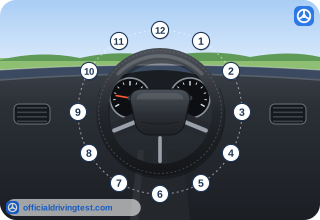
- At 9 and 3 o'clock, or 8 and 4 o'clock
- At 10 and 2 o'clock, or 11 and 1 o'clock
- At 12 and 6 o'clock
- Both hands together at the 12 o'clock position
Show answer
Correct answer: At 9 and 3 o'clock, or 8 and 4 o'clock
The manual says drivers' hands should be in the 9 o'clock and 3 o'clock, or the 8 o'clock and 4 o'clock positions.
Source: New Hampshire Driver’s Manual (DSMV 360 (Rev. 11/25)), page 14 · Open this page in the manual (Manual page 14)
-
While steering, where should a driver's knuckles and thumbs stay?
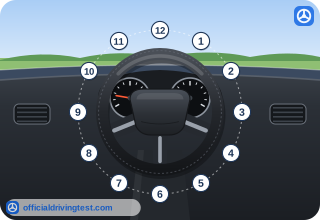
- On the inside of the wheel
- Hooked over the top of the wheel
- On the outside of the wheel
- Off the wheel when driving straight
Show answer
Correct answer: On the outside of the wheel
Knuckles and thumbs should stay on the outside of the wheel.
Source: New Hampshire Driver’s Manual (DSMV 360 (Rev. 11/25)), page 14 · Open this page in the manual (Manual page 14)
-
Which steering method may a driver use for greater steering inputs?
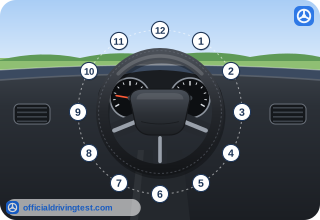
- Hand-to-hand steering
- Hand-over-hand steering
- One-handed steering
- Palm-of-hand steering
Show answer
Correct answer: Hand-over-hand steering
Drivers may use hand-to-hand steering for slight steering and hand-over-hand for greater steering inputs.
Source: New Hampshire Driver’s Manual (DSMV 360 (Rev. 11/25)), page 14 · Open this page in the manual (Manual page 14)
-
How far before a turn should drivers signal?
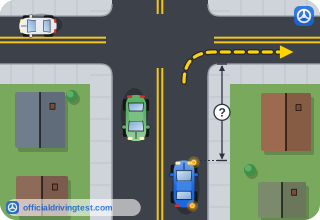
- At least 25 feet
- At least 50 feet
- At least 100 feet
- At least 200 feet
Show answer
Correct answer: At least 100 feet
Drivers should signal at least 100 feet before a turn.
Source: New Hampshire Driver’s Manual (DSMV 360 (Rev. 11/25)), page 15 · Open this page in the manual (Manual page 15)
-
How should a driver adjust the timing of the turn signal when it is raining, snowy or foggy?

- Use the turn signal later when turning
- Use the hazard flashers instead of the turn signal
- Use the turn signal at the usual time, with no change
- Use the turn signal sooner when turning
Show answer
Correct answer: Use the turn signal sooner when turning
Drivers should use the turn signal sooner when turning in rain, snow or fog, to allow other vehicles greater stopping distances.
Source: New Hampshire Driver’s Manual (DSMV 360 (Rev. 11/25)), page 15 · Open this page in the manual (Manual page 15)
-
In which situation must a driver use the appropriate turn signal?
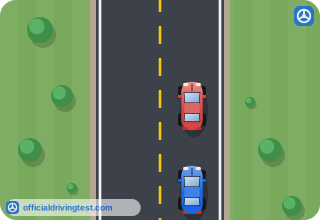
- Pulling away from a curb
- Driving straight ahead in the same lane
- Slowing for a stop sign in the same lane
- Staying in the same lane through an intersection
Show answer
Correct answer: Pulling away from a curb
Drivers must use the appropriate turn signal when pulling away from a curb, as well as when changing lanes, turning, entering or leaving a roadway, merging, pulling over and passing.
Source: New Hampshire Driver’s Manual (DSMV 360 (Rev. 11/25)), page 15 · Open this page in the manual (Manual page 15)
-
During what period does New Hampshire law require every motor vehicle to display lighted lamps on the front?
- From sunset to sunrise
- From 1 hour after sunset to 1 hour before sunrise
- From 1/2 hour after sunset to 1/2 hour before sunrise
- From 1/2 hour before sunset to 1/2 hour after sunrise
Show answer
Correct answer: From 1/2 hour after sunset to 1/2 hour before sunrise
The law requires lighted front lamps from 1/2 hour after sunset to 1/2 hour before sunrise, and whenever rain, snow or fog keeps persons and vehicles from being clearly seen at 1000 feet.
Source: New Hampshire Driver’s Manual (DSMV 360 (Rev. 11/25)), page 15 · Open this page in the manual (Manual page 15)
-
Headlights are also required whenever rain, snow or fog keeps persons and vehicles from being clearly discernible at what distance ahead?
- 250 feet
- 1000 feet
- 300 feet
- 750 feet
Show answer
Correct answer: 1000 feet
Lamps must be displayed whenever rain, snow or fog interferes so that persons and vehicles are not clearly discernible at a distance of 1000 feet ahead.
Source: New Hampshire Driver’s Manual (DSMV 360 (Rev. 11/25)), page 15 · Open this page in the manual (Manual page 15)
-
When headlights are required, how many lighted lamps on the front must a motor vehicle other than a motorcycle display?
- At least 1
- At least 3
- At least 4
- At least 2
Show answer
Correct answer: At least 2
New Hampshire law requires at least 2 lighted lamps on the front, but one suitable lighted lamp is enough on a motorcycle.
Source: New Hampshire Driver’s Manual (DSMV 360 (Rev. 11/25)), page 15 · Open this page in the manual (Manual page 15)
-
When headlights are required, how many lighted lamps on the front are sufficient for a motorcycle?
- One suitable lighted lamp
- At least 2 lighted lamps
- At least 3 lighted lamps
- None, if the motorcycle has reflectors
Show answer
Correct answer: One suitable lighted lamp
The law allows one suitable lighted lamp on the front of a motorcycle to be sufficient.
Source: New Hampshire Driver’s Manual (DSMV 360 (Rev. 11/25)), page 15 · Open this page in the manual (Manual page 15)
-
When should drivers use the horn?
- Whenever approaching an intersection
- Whenever passing another vehicle
- Only when needed to communicate with others
- Whenever another driver is following closely
Show answer
Correct answer: Only when needed to communicate with others
Drivers should only use the horn when it is needed to communicate with other road users, because using it inappropriately could scare or anger another road user.
Source: New Hampshire Driver’s Manual (DSMV 360 (Rev. 11/25)), page 15 · Open this page in the manual (Manual page 15)
-
When should drivers not use the horn?
- When a pedestrian or bicyclist begins to move into the driver's lane
- When near blind pedestrians or when approaching or near a horse
- When another driver crosses the center lane into the driver's lane of travel
- When a driver is unaware a vehicle is approaching while backing up
Show answer
Correct answer: When near blind pedestrians or when approaching or near a horse
Drivers should not use the horn when near blind pedestrians or when approaching or near a horse, as it may frighten the horse and cause a crash.
Source: New Hampshire Driver’s Manual (DSMV 360 (Rev. 11/25)), page 16 · Open this page in the manual (Manual page 16)
-
How should the horn normally be used?
- A long continuous blast
- Several short blasts in a row
- Two long blasts
- A light tap
Show answer
Correct answer: A light tap
A light tap on the horn should be all that is needed under normal circumstances.
Source: New Hampshire Driver’s Manual (DSMV 360 (Rev. 11/25)), page 16 · Open this page in the manual (Manual page 16)
-
In which situation may a driver want to give the horn a light tap?
- A pedestrian or bicyclist moves into the driver's lane
- A blind pedestrian is waiting at the roadside
- A horse is walking along the side of the road
- A vehicle ahead is slowing down to make a turn
Show answer
Correct answer: A pedestrian or bicyclist moves into the driver's lane
Drivers may want to give the horn a light tap when pedestrians or bicyclists begin to move into the lane they are travelling in. The horn should not be used near blind pedestrians or horses.
Source: New Hampshire Driver’s Manual (DSMV 360 (Rev. 11/25)), page 16 · Open this page in the manual (Manual page 16)
-
Before changing lanes, how should a driver check the blind spots?
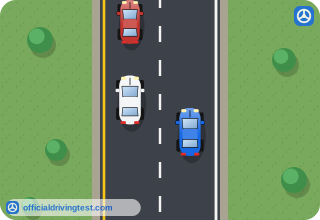
- By glancing at the side mirrors only
- By relying on a blind spot monitor alone
- By using head checks
- By signaling and moving over
Show answer
Correct answer: By using head checks
Before changing lanes, a driver should check all blind spots, the areas around the vehicle that cannot be seen, by using head checks.
Source: New Hampshire Driver’s Manual (DSMV 360 (Rev. 11/25)), page 16 · Open this page in the manual (Manual page 16)
-
Which area do mirrors and head checks not show when backing up?
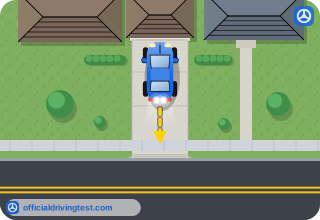
- The area beside the front doors
- The area immediately behind the vehicle
- The lane to the left of the vehicle
- The area in front of the hood
Show answer
Correct answer: The area immediately behind the vehicle
Mirrors and head checks should be used for backing, but they do not show the area immediately behind the vehicle.
Source: New Hampshire Driver’s Manual (DSMV 360 (Rev. 11/25)), page 17 · Open this page in the manual (Manual page 17)
-
How should a driver accelerate when backing up a vehicle?
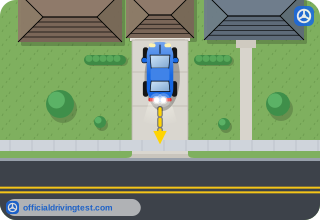
- Quickly to finish the maneuver sooner
- At a moderate speed, to keep traffic moving
- Sharply, then coast
- Gently and smoothly, keeping speed slow
Show answer
Correct answer: Gently and smoothly, keeping speed slow
When backing up, drivers should accelerate gently and smoothly, keeping speed slow, because the vehicle is much harder to steer while backing.
Source: New Hampshire Driver’s Manual (DSMV 360 (Rev. 11/25)), page 17 · Open this page in the manual (Manual page 17)
-
While backing up, in which direction should a driver steer?
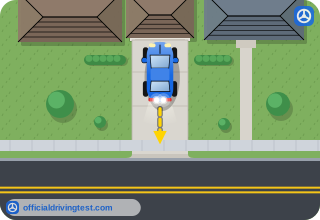
- Slightly in the direction the rear of the vehicle should move
- Slightly in the direction opposite to where the rear should move
- Hard in the direction the front of the vehicle should go
- Not at all; the wheel should be kept straight
Show answer
Correct answer: Slightly in the direction the rear of the vehicle should move
While backing, drivers should steer slightly in the direction the rear of the vehicle should move.
Source: New Hampshire Driver’s Manual (DSMV 360 (Rev. 11/25)), page 17 · Open this page in the manual (Manual page 17)
-
While backing up, how long should a driver continue looking to the rear?
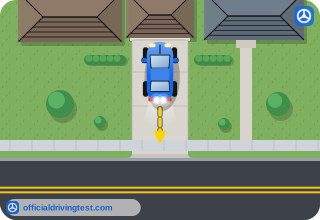
- Until the vehicle has moved 10 feet
- Until the rear wheels clear the curb
- Until coming to a complete stop
- Until the vehicle speed drops below 5 mph
Show answer
Correct answer: Until coming to a complete stop
When backing, drivers should continue looking to the rear until coming to a complete stop.
Source: New Hampshire Driver’s Manual (DSMV 360 (Rev. 11/25)), page 17 · Open this page in the manual (Manual page 17)