New Hampshire: Exam Simulator
40 random questions from every topic, like a mini exam.
Independent educational site · not affiliated with any government agency or DMV
Ready? Test yourself
Like the real test: 40 questions; pass with 32 correct.
- Instant feedback with an explanation
- Every answer cites its source in the manual
- Your best score is saved on this device
- Keyboard: press 1 to 4 to answer and Enter for the next question
Questions are original and based on the official manual "New Hampshire Driver’s Manual" (DSMV 360 (Rev. 11/25)), New Hampshire Division of Motor Vehicles (DMV).
Sample questions
The exam simulator picks 40 random questions from every topic each time you start. Here are a few examples.
Show the questions and answersHide the questions
-
Under New Hampshire law, which applicants for a driver's license must first complete an approved driver education program?
- Individuals 16 or 17 years of age
- Individuals 18 to 20 years of age
- Only individuals under 16 years of age
- Only individuals who failed the road test
Show answer
Correct answer: Individuals 16 or 17 years of age
The manual says all individuals 16 or 17 years of age who wish to apply for a driver's license must first complete an approved driver education program.
Source: New Hampshire Driver’s Manual (DSMV 360 (Rev. 11/25)), page 1 · Open this page in the manual (Manual page 1)
-
How often does the manual recommend that drivers have the tire pressure checked?
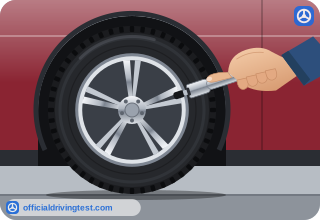
- Once a week
- Once a month
- Every 6 months
- Once a year
Show answer
Correct answer: Once a month
The manual recommends having the tire pressure checked once a month.
Source: New Hampshire Driver’s Manual (DSMV 360 (Rev. 11/25)), page 11 · Open this page in the manual (Manual page 11)
-
What are pavement markings?
- Signs on poles beside the road that show the rules
- Lines, arrows, words, or symbols painted on the roadway
- Lights that show when to stop or turn
- Hand signals given by workers and officers
Show answer
Correct answer: Lines, arrows, words, or symbols painted on the roadway
Pavement markings are lines, arrows, words, or symbols painted on the roadway to give a driver directions or warnings.
Source: New Hampshire Driver’s Manual (DSMV 360 (Rev. 11/25)), page 23 · Open this page in the manual (Manual page 23)
-
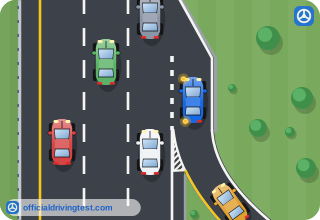
On an entrance or acceleration ramp, who should drivers yield the right-of-way to?
- Drivers waiting behind them on the ramp
- Whichever driver is going faster
- Drivers already on the interstate highway
- Drivers in the largest vehicles
Show answer
Correct answer: Drivers already on the interstate highway
Drivers should yield the right-of-way to drivers already on a limited access or interstate highway, on the entrance or acceleration ramp.
Source: New Hampshire Driver’s Manual (DSMV 360 (Rev. 11/25)), page 14 · Open this page in the manual (Manual page 14)
-
Who is responsible for making sure a parked vehicle is not causing a driving hazard?
- The local police
- The driver
- The road owner
- The state
Show answer
Correct answer: The driver
Drivers are responsible for making sure that their vehicle is not causing a driving hazard when it is parked.
Source: New Hampshire Driver’s Manual (DSMV 360 (Rev. 11/25)), page 27 · Open this page in the manual (Manual page 27)
-
What do the shape, color, symbols, and words of a traffic sign give a driver?
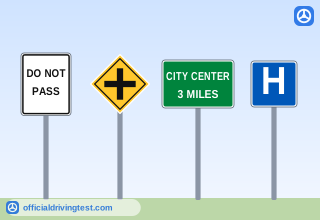
- Clues to the type of information the sign provides
- The exact speed limit in every lane of the road
- Permission to ignore other traffic control devices
- The name of the agency that put the sign up
Show answer
Correct answer: Clues to the type of information the sign provides
The shape, color, symbols, and words of traffic signs give clues to the type of information they provide.
Source: New Hampshire Driver’s Manual (DSMV 360 (Rev. 11/25)), page 20 · Open this page in the manual (Manual page 20)
-
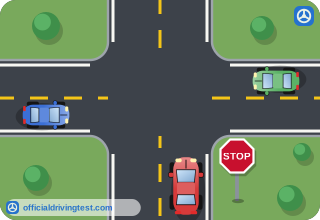
At a stop sign with no stop line and no crosswalk, where must a driver stop?
- At the center of the intersection
- Just past the near edge of the intersection
- Before entering the intersection
- After entering the intersection far enough to see
Show answer
Correct answer: Before entering the intersection
If there is no stop line or crosswalk, the driver must come to a full stop before entering the intersection.
Source: New Hampshire Driver’s Manual (DSMV 360 (Rev. 11/25)), page 21 · Open this page in the manual (Manual page 21)
-
According to the manual, what must a driver do when a police officer directing traffic gives a signal that differs from a traffic light or sign?
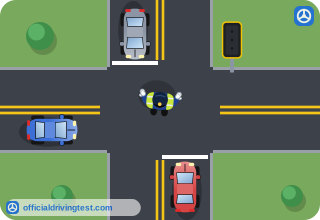
- Obey the officer, who overrules any traffic light or sign
- Obey the traffic light or sign, which overrules the officer
- Follow whichever one lets the driver keep moving
- Stop and wait until the officer leaves the intersection
Show answer
Correct answer: Obey the officer, who overrules any traffic light or sign
A police officer directing traffic overrules any traffic light or sign and must be obeyed.
Source: New Hampshire Driver’s Manual (DSMV 360 (Rev. 11/25)), page 20 · Open this page in the manual (Manual page 20)
-
Under New Hampshire law, when no traffic control device or police officer directs otherwise, which driver yields at an intersection?
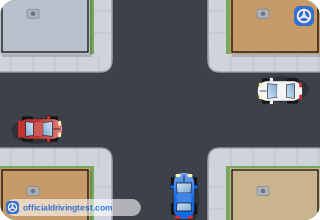
- The driver approaching or entering on the right yields to the vehicle on the left
- The driver in the larger vehicle yields to the smaller vehicle
- The faster driver yields to the slower driver
- The driver approaching or entering on the left yields to the vehicle on the right
Show answer
Correct answer: The driver approaching or entering on the left yields to the vehicle on the right
RSA 265:28 says the driver approaching or entering an intersection on the left must yield to the vehicle on the right, unless a traffic control device or police officer directs otherwise.
Source: New Hampshire Driver’s Manual (DSMV 360 (Rev. 11/25)), page 14 · Open this page in the manual (Manual page 14)
-
What does a crossbuck (X) indicate?
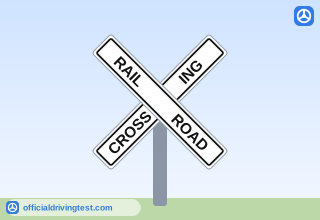
- Where a railroad crossing is
- A school crossing ahead
- A pedestrian crossing ahead
- A crossroad ahead
Show answer
Correct answer: Where a railroad crossing is
The crossbuck (X) indicates where a railroad crossing is.
Source: New Hampshire Driver’s Manual (DSMV 360 (Rev. 11/25)), page 21 · Open this page in the manual (Manual page 21)