New Hampshire: 30 Hardest Driving Test Questions
Questions that need a second thought, picked for close numbers, exceptions and easy-to-confuse rules. Take your time.
Independent educational site · not affiliated with any government agency or DMV
Ready? Test yourself
- Instant feedback with an explanation
- Every answer cites its source in the manual
- Your best score is saved on this device
- Keyboard: press 1 to 4 to answer and Enter for the next question
Questions are original and based on the official manual "New Hampshire Driver’s Manual" (DSMV 360 (Rev. 11/25)), New Hampshire Division of Motor Vehicles (DMV).
All 30 questions in this practice test
Take the test above first, then use this list to study. Tap “Show answer” to see the correct answer and explanation.
Show the questions and answersHide the questions
-
What is the minimum speed a driver may drive on an interstate highway, unless road and weather conditions make it unsafe?
- 25 mph
- 35 mph
- 45 mph
- 55 mph
Show answer
Correct answer: 45 mph
The minimum speed on an interstate highway is 45 mph, unless road and weather conditions are so bad that this speed is unsafe.
Source: New Hampshire Driver’s Manual (DSMV 360 (Rev. 11/25)), page 15 · Open this page in the manual (Manual page 15)
-
What must pedestrians facing a steady red arrow signal do, unless a pedestrian signal directs otherwise?
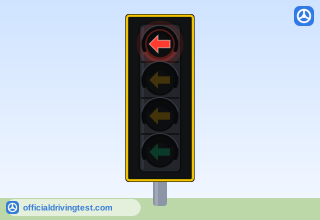
- Cross quickly before it changes
- Not enter the roadway
- Cross if no vehicle is turning
- Walk only on the far side
Show answer
Correct answer: Not enter the roadway
Unless otherwise directed by a pedestrian signal, pedestrians facing a steady red arrow signal shall not enter the roadway.
Source: New Hampshire Driver’s Manual (DSMV 360 (Rev. 11/25)), page 20 · Open this page in the manual (Manual page 20)
-
Under New Hampshire law, when no traffic control device or police officer directs otherwise, which driver yields at an intersection?
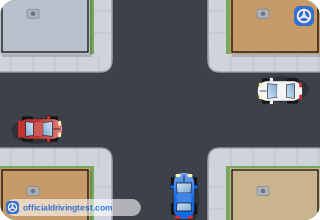
- The driver approaching or entering on the right yields to the vehicle on the left
- The driver in the larger vehicle yields to the smaller vehicle
- The faster driver yields to the slower driver
- The driver approaching or entering on the left yields to the vehicle on the right
Show answer
Correct answer: The driver approaching or entering on the left yields to the vehicle on the right
RSA 265:28 says the driver approaching or entering an intersection on the left must yield to the vehicle on the right, unless a traffic control device or police officer directs otherwise.
Source: New Hampshire Driver’s Manual (DSMV 360 (Rev. 11/25)), page 14 · Open this page in the manual (Manual page 14)
-
A driver intends to turn left within an intersection or into a driveway. Which vehicles must the driver yield to?
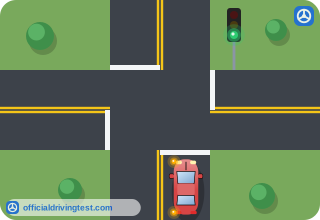
- Oncoming vehicles in the intersection or so close as to be an immediate hazard
- Only vehicles that are stopped and waiting to enter the intersection from a side road
- Vehicles from behind that are travelling in the same direction in the same lane
- None, because a driver turning left always has the right-of-way
Show answer
Correct answer: Oncoming vehicles in the intersection or so close as to be an immediate hazard
RSA 265:29 requires a driver turning left to yield to any vehicle approaching from the opposite direction that is within the intersection or so close as to constitute an immediate hazard.
Source: New Hampshire Driver’s Manual (DSMV 360 (Rev. 11/25)), page 14 · Open this page in the manual (Manual page 14)
-
What kind of white cane marks a visually impaired pedestrian who has the right of way while crossing the street?
- A white cane with a red tip
- A white cane with a green tip
- A white cane with a yellow tip
- A white cane with a blue tip
Show answer
Correct answer: A white cane with a red tip
Pedestrians have the right of way when visually impaired and crossing the street guided by a service animal or carrying a white cane with a red tip.
Source: New Hampshire Driver’s Manual (DSMV 360 (Rev. 11/25)), page 36 · Open this page in the manual (Manual page 36)
-
According to the manual, what is the lowest Blood Alcohol Concentration (BAC) level that can affect a driver’s ability to drive?
- .05%
- .02%
- .08%
- .10%
Show answer
Correct answer: .02%
The manual says a BAC level as low as .02% can affect a driver’s ability to drive.
Source: New Hampshire Driver’s Manual (DSMV 360 (Rev. 11/25)), page 8 · Open this page in the manual (Manual page 8)
-
How far behind a large vehicle can its huge blind spot extend?
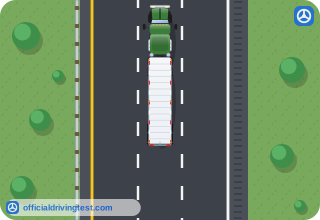
- Up to 50 feet
- Up to 100 feet
- Up to 500 feet
- Up to 200 feet
Show answer
Correct answer: Up to 200 feet
Large vehicles have huge blind spots directly behind them that extend up to 200 feet.
Source: New Hampshire Driver’s Manual (DSMV 360 (Rev. 11/25)), page 39 · Open this page in the manual (Manual page 39)
-
By how much does the stopping distance of a vehicle increase when its speed is doubled?
- 2 times
- 4 times
- 3 times
- 8 times
Show answer
Correct answer: 4 times
The stopping distance of a vehicle increases 4 times when the speed of the vehicle is doubled.
Source: New Hampshire Driver’s Manual (DSMV 360 (Rev. 11/25)), page 16 · Open this page in the manual (Manual page 16)
-
May a driver under 18 use a mobile telephone with a hands-free device while driving a motor vehicle?
- Yes, if the telephone is hands-free
- Yes, but only when temporarily stopped in traffic
- Yes, if the call is to a parent or guardian
- No, whether hands-free or not
Show answer
Correct answer: No, whether hands-free or not
Drivers under 18 may not use a cellular or mobile telephone or other mobile electronic device while driving or temporarily stopped in traffic, whether hands-free or not, except to report an emergency to the enhanced 911 system or any public safety agency.
Source: New Hampshire Driver’s Manual (DSMV 360 (Rev. 11/25)), page 4 · Open this page in the manual (Manual page 4)
-
At least how far in any direction must drivers stop from a school bus stopped with its red lights flashing?
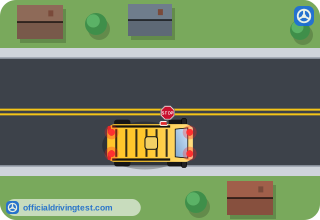
- 10 feet
- 50 feet
- 100 feet
- 25 feet
Show answer
Correct answer: 25 feet
Drivers must stop at least 25 feet in any direction from a school bus stopped with its red lights flashing or its stop arm extended.
Source: New Hampshire Driver’s Manual (DSMV 360 (Rev. 11/25)), page 27 · Open this page in the manual (Manual page 27)
-
The New Hampshire law on hand-held mobile electronic devices applies to a driver of a moving vehicle and also when the vehicle is in what situation?
- Halted in traffic for a traffic control device
- Parked in a lot with the engine turned off
- Stopped in a parking space at a store
- Pulled over to the side of a rural road
Show answer
Correct answer: Halted in traffic for a traffic control device
The law covers a driver while driving a moving motor vehicle or temporarily halted in traffic for a traffic control device or other momentary delay.
Source: New Hampshire Driver’s Manual (DSMV 360 (Rev. 11/25)), page 7 · Open this page in the manual (Manual page 7)
-
After 24 hours without sleep, driver performance mimics which Blood Alcohol Concentration (BAC)?
- 0.03%
- 0.10%
- 0.06%
- 0.20%
Show answer
Correct answer: 0.10%
The manual says that after 24 hours without sleep, performance mimics a BAC of 0.10%.
Source: New Hampshire Driver’s Manual (DSMV 360 (Rev. 11/25)), page 7 · Open this page in the manual (Manual page 7)
-
During what period does New Hampshire law require every motor vehicle to display lighted lamps on the front?
- From sunset to sunrise
- From 1 hour after sunset to 1 hour before sunrise
- From 1/2 hour after sunset to 1/2 hour before sunrise
- From 1/2 hour before sunset to 1/2 hour after sunrise
Show answer
Correct answer: From 1/2 hour after sunset to 1/2 hour before sunrise
The law requires lighted front lamps from 1/2 hour after sunset to 1/2 hour before sunrise, and whenever rain, snow or fog keeps persons and vehicles from being clearly seen at 1000 feet.
Source: New Hampshire Driver’s Manual (DSMV 360 (Rev. 11/25)), page 15 · Open this page in the manual (Manual page 15)
-
Headlights are also required whenever rain, snow or fog keeps persons and vehicles from being clearly discernible at what distance ahead?
- 250 feet
- 1000 feet
- 300 feet
- 750 feet
Show answer
Correct answer: 1000 feet
Lamps must be displayed whenever rain, snow or fog interferes so that persons and vehicles are not clearly discernible at a distance of 1000 feet ahead.
Source: New Hampshire Driver’s Manual (DSMV 360 (Rev. 11/25)), page 15 · Open this page in the manual (Manual page 15)
-
How close may a driver follow a fire truck that is sounding a siren or operating flashing lights?
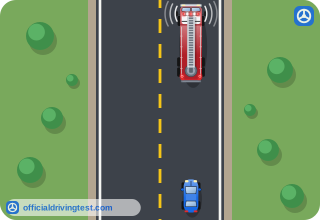
- No closer than 500 feet
- No closer than 100 feet
- No closer than 250 feet
- No closer than 1,000 feet
Show answer
Correct answer: No closer than 500 feet
Drivers must not follow a fire truck closer than 500 feet when it is sounding a siren or operating flashing lights.
Source: New Hampshire Driver’s Manual (DSMV 360 (Rev. 11/25)), page 40 · Open this page in the manual (Manual page 40)
-
An accident report must be filed with the DMV if the combined property damage totals more than what amount?
- $500
- $1,000
- $2,500
- $5,000
Show answer
Correct answer: $1,000
A report must be filed if there is a fatality, injuries or combined property damage of more than $1,000.
Source: New Hampshire Driver’s Manual (DSMV 360 (Rev. 11/25)), page 32 · Open this page in the manual (Manual page 32)
-
How far in front of and behind a broken-down vehicle should emergency flares or reflectors be placed, if available?
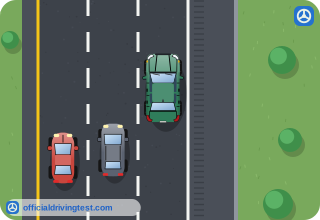
- 200 feet
- 50 feet
- 100 feet
- 500 feet
Show answer
Correct answer: 200 feet
If available, drivers should place emergency flares or reflectors 200 feet in front of and behind the vehicle.
Source: New Hampshire Driver’s Manual (DSMV 360 (Rev. 11/25)), page 35 · Open this page in the manual (Manual page 35)
-
Which school bus is an exception to the requirement that anyone less than 18 be restrained by a safety belt or child safety seat?
- One under 10,000 pounds that has safety belts
- One weighing in excess of 10,000 pounds
- One carrying fewer than 20 students
- One less than 5 years old
Show answer
Correct answer: One weighing in excess of 10,000 pounds
The manual exempts a school bus weighing in excess of 10,000 pounds, or one weighing less than 10,000 pounds not manufactured with safety belts.
Source: New Hampshire Driver’s Manual (DSMV 360 (Rev. 11/25)), page 12 · Open this page in the manual (Manual page 12)
-
A child must be secured in a child passenger restraint until reaching what age and height?
- 7 years old and 57 inches
- 10 years old and 70 inches
- 5 years old and 36 inches
- 12 years old and 48 inches
Show answer
Correct answer: 7 years old and 57 inches
The manual requires a child less than 7 years old and less than 57 inches in height to be in a child passenger restraint.
Source: New Hampshire Driver’s Manual (DSMV 360 (Rev. 11/25)), page 12 · Open this page in the manual (Manual page 12)
-
Which vehicles does the law require to stop before any railroad crossing, even with no sign of a train?
- Passenger buses and trucks carrying flammable or hazardous material
- All passenger vehicles that carry more than one person inside
- Any truck carrying a load over 10,000 pounds in weight
- Only school buses and vehicles used by emergency crews
Show answer
Correct answer: Passenger buses and trucks carrying flammable or hazardous material
The law requires buses that carry passengers and trucks carrying flammable or hazardous material to stop before any railroad crossing, even if there is no sign of a train coming.
Source: New Hampshire Driver’s Manual (DSMV 360 (Rev. 11/25)), page 22 · Open this page in the manual (Manual page 22)
-
What does the manual say about automobile insurance in New Hampshire?
- Every driver must carry automobile insurance at all times
- Insurance is required only on interstate highways
- Insurance is required only for vehicles registered in New Hampshire
- There is no mandatory law, so a driver may drive without insurance
Show answer
Correct answer: There is no mandatory law, so a driver may drive without insurance
The manual says New Hampshire has no mandatory insurance law, so a driver may drive a vehicle in the state without insurance.
Source: New Hampshire Driver’s Manual (DSMV 360 (Rev. 11/25)), page 32 · Open this page in the manual (Manual page 32)
-
During the first six months of holding a Youth Operator license, how many passengers under 25 who are not family members may a driver under 18 carry without a licensed, responsible adult age 25 or older?
- None
- Two at most
- One at most
- Three at most
Show answer
Correct answer: One at most
A driver under 18 may not carry more than one non-family passenger under 25 in the first six months unless accompanied by a licensed, responsible adult at least 25.
Source: New Hampshire Driver’s Manual (DSMV 360 (Rev. 11/25)), page 4 · Open this page in the manual (Manual page 4)
-
A Youth Operator license holder under 18 shall NOT operate a motor vehicle between which hours?
- 1:00 am and 4:00 am
- 11:00 pm and 5:00 am
- 12:00 midnight and 5:00 am
- 1:00 am and 6:00 am
Show answer
Correct answer: 1:00 am and 4:00 am
A Youth Operator under 18 may not operate a motor vehicle between 1:00 am and 4:00 am.
Source: New Hampshire Driver’s Manual (DSMV 360 (Rev. 11/25)), page 4 · Open this page in the manual (Manual page 4)
-
Parking is illegal, even if unmarked, within how many feet of a fire station driveway entrance on the opposite side of the street?
- 25 feet
- 50 feet
- 75 feet
- 100 feet
Show answer
Correct answer: 75 feet
It is illegal to park within 75 feet of the driveway entrance to any fire station on the opposite side of the street.
Source: New Hampshire Driver’s Manual (DSMV 360 (Rev. 11/25)), page 28 · Open this page in the manual (Manual page 28)
-
Parking is illegal, even if unmarked, within how many feet of the nearest rail of a railroad crossing?
- 10 feet
- 50 feet
- 25 feet
- 100 feet
Show answer
Correct answer: 50 feet
It is illegal to park within 50 feet of the nearest rail of a railroad crossing.
Source: New Hampshire Driver’s Manual (DSMV 360 (Rev. 11/25)), page 28 · Open this page in the manual (Manual page 28)
-
When a train or railroad vehicle is approaching a crossing, a driver must stop behind the stop line or how far from the nearest rail of the track?
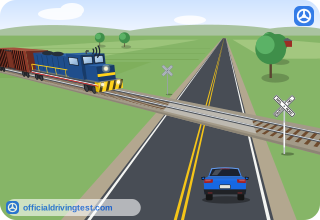
- Not less than 5 feet and not more than 10 feet
- Not less than 25 feet and not more than 100 feet
- Not less than 50 feet and not more than 150 feet
- Not less than 15 feet and not more than 50 feet
Show answer
Correct answer: Not less than 15 feet and not more than 50 feet
A driver must stop behind the stop line or not less than 15 feet, nor more than 50 feet from the nearest rail of the track.
Source: New Hampshire Driver’s Manual (DSMV 360 (Rev. 11/25)), page 22 · Open this page in the manual (Manual page 22)
-
Under ideal conditions, a loaded truck with good tires and properly adjusted brakes traveling at 55 mph needs at least how many feet to come to a complete stop?
- 335 feet
- 235 feet
- 285 feet
- 435 feet
Show answer
Correct answer: 335 feet
A loaded truck with good tires and properly adjusted brakes, under ideal conditions, traveling at 55 mph requires a minimum of 335 feet before coming to a complete stop.
Source: New Hampshire Driver’s Manual (DSMV 360 (Rev. 11/25)), page 39 · Open this page in the manual (Manual page 39)
-
Outside business, urban residence and rural residence districts, what are the maximum speed limits in other locations, apart from the listed exceptions?
- 40 or 50 miles per hour
- 45 or 55 miles per hour
- 50 or 60 miles per hour
- 40 or 60 miles per hour
Show answer
Correct answer: 45 or 55 miles per hour
In other locations the maximum speed limit is 45 or 55 miles per hour, except for the higher limits on certain divided highways.
Source: New Hampshire Driver’s Manual (DSMV 360 (Rev. 11/25)), page 15 · Open this page in the manual (Manual page 15)
-
For a first offense of Driving or Operating Under Influence of Drugs or Liquor, driving privileges may be lost for what period?
- 9 months to 2 years
- 30 days to 6 months
- 6 months to 1 year
- 3 to 5 years
Show answer
Correct answer: 9 months to 2 years
The manual says a first offense may bring a loss of driving privileges for 9 months to 2 years.
Source: New Hampshire Driver’s Manual (DSMV 360 (Rev. 11/25)), page 9 · Open this page in the manual (Manual page 9)
-
When does the lower speed limit in a posted school zone apply?
- From 45 minutes before school opening until the opening, and from the closing until 45 minutes after it
- From 30 minutes before school opening until the opening, and from the closing until 30 minutes after it
- From 15 minutes before school opening until the opening, and from the closing until 15 minutes after it
- From 1 hour before school opening until the opening, and from the closing until 1 hour after it
Show answer
Correct answer: From 45 minutes before school opening until the opening, and from the closing until 45 minutes after it
The school zone limit applies from 45 minutes before school opening until the school opening, and from the school closing until 45 minutes after school closing.
Source: New Hampshire Driver’s Manual (DSMV 360 (Rev. 11/25)), page 15 · Open this page in the manual (Manual page 15)