Nevada: Emergencies and bad weather — Part 4 Practice Test
Questions in this part include: “When does the handbook say you should be especially cautious about flood dangers?” · “Which information must you exchange with the other drivers involved in a crash?”
Independent educational site · not affiliated with any government agency or DMV
Ready? Test yourself
- Instant feedback with an explanation
- Every answer cites its source in the manual
- Your best score is saved on this device
- Keyboard: press 1 to 4 to answer and Enter for the next question
Questions are original and based on the official manual "Nevada Driver's Handbook" (March 2024 (DMV 700)), Nevada Department of Motor Vehicles.
All 16 questions in this practice test
Take the test above first, then use this list to study. Tap “Show answer” to see the correct answer and explanation.
Show the questions and answersHide the questions
-
What should you do if you encounter a flooded roadway?
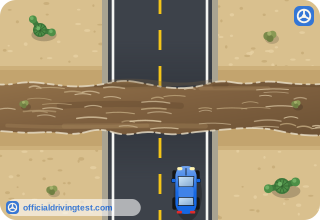
- Do not drive through it; turn around and seek an alternate route or wait until the water subsides
- Drive through slowly in a low gear, keeping the engine speed steady to avoid stalling
- Drive around it on the shoulder if the water looks shallow
- Follow another vehicle through the water
Show answer
Correct answer: Do not drive through it; turn around and seek an alternate route or wait until the water subsides
The handbook says not to attempt to drive through a flooded roadway; turn around and seek an alternate route or wait until the water subsides.
Source: Nevada Driver's Handbook (March 2024 (DMV 700)), page 59 · Open this page in the manual (Manual page 59)
-
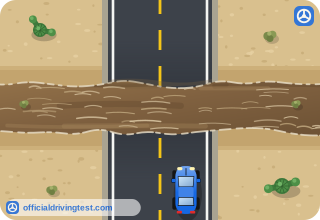
Why should you not drive through floodwater that looks like only a few inches of water?
- Floodwater is always deeper in the middle of the road than at the edges
- Shallow floodwater always drains away within minutes
- It is difficult to tell the depth, and the road may have washed away underneath
- Most flooded roads are closed by law
Show answer
Correct answer: It is difficult to tell the depth, and the road may have washed away underneath
It is difficult to determine the depth of floodwaters, and you have no idea if the road has washed away underneath.
Source: Nevada Driver's Handbook (March 2024 (DMV 700)), page 59 · Open this page in the manual (Manual page 59)
-
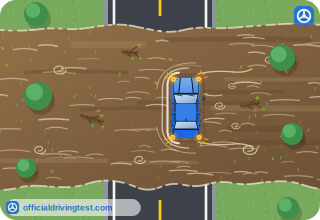
If your vehicle stalls in rising flood water, what should you do if you can safely do so?
- Keep restarting the engine until it runs, then drive on
- Abandon it immediately and seek higher ground
- Drive forward into deeper water to look for firmer road surface
- Back up slowly into the flowing water to turn around
Show answer
Correct answer: Abandon it immediately and seek higher ground
If your vehicle stalls in rising flood water and you can safely do so, abandon it immediately and seek higher ground.
Source: Nevada Driver's Handbook (March 2024 (DMV 700)), page 59 · Open this page in the manual (Manual page 59)
-
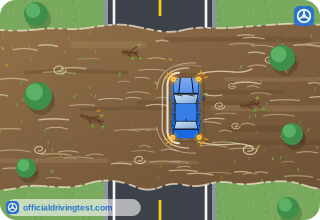
Why do deaths often occur in floods involving vehicles?
- People drive too slowly through shallow water
- People stop in the middle of the road to wait
- People often leave their vehicles too early and are swept away by the deep water
- People mistakenly believe that vehicles provide protection from rising, swiftly moving waters
Show answer
Correct answer: People mistakenly believe that vehicles provide protection from rising, swiftly moving waters
Deaths often occur because people mistakenly believe that vehicles provide protection from rising, swiftly moving waters.
Source: Nevada Driver's Handbook (March 2024 (DMV 700)), page 59 · Open this page in the manual (Manual page 59)
-
When does the handbook say you should be especially cautious about flood dangers?
- At night
- At noon
- In bright sunlight
- When roads are dry
Show answer
Correct answer: At night
It is harder to recognize flood dangers at night, so be especially cautious then.
Source: Nevada Driver's Handbook (March 2024 (DMV 700)), page 60 · Open this page in the manual (Manual page 60)
-
If you come upon rapidly rising waters while driving, what should you do?
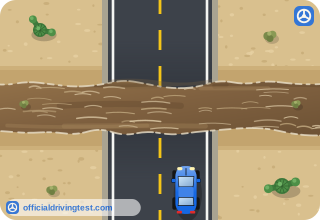
- Keep driving to the nearest low spot beside a stream or flood control channel
- Stop beside a creek and wait for the water to pass
- Turn around, find another route and move to higher ground away from streams and creeks
- Drive through quickly to get to the other side
Show answer
Correct answer: Turn around, find another route and move to higher ground away from streams and creeks
If you come upon rapidly rising waters, turn around and find another route and move to higher ground away from streams, creeks and flood control channels.
Source: Nevada Driver's Handbook (March 2024 (DMV 700)), page 60 · Open this page in the manual (Manual page 60)
-
If your route is blocked by floodwaters or barricades, what should you do?
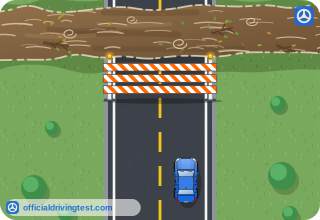
- Drive around the barricades if the water looks shallow
- Find another route and never drive around the barricades
- Move the barricades aside and continue
- Wait beside the barricades for water to drop
Show answer
Correct answer: Find another route and never drive around the barricades
Barricades are put up by local officials to protect people from unsafe roads, so find another route and never drive around them.
Source: Nevada Driver's Handbook (March 2024 (DMV 700)), page 60 · Open this page in the manual (Manual page 60)
-
When are the wheels of a trailer more likely to lock up and make the trailer swing around?
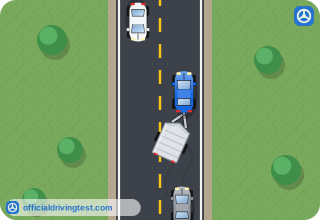
- When the trailer is fully loaded with cargo
- When the trailer is parked at the curb
- When the trailer is empty or lightly loaded
- Only when driving at very low speeds
Show answer
Correct answer: When the trailer is empty or lightly loaded
Trailer wheel lockup and swinging, often called a trailer jackknife, is more likely when the trailer is empty or lightly loaded.
Source: Nevada Driver's Handbook (March 2024 (DMV 700)), page 74 · Open this page in the manual (Manual page 74)
-
What is the earliest and best way to recognize that a trailer has started to skid?
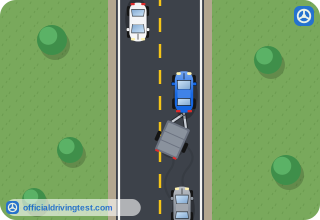
- Feeling the steering wheel go light
- Seeing it in your mirrors
- Listening for tire noise
- Waiting for a warning light
Show answer
Correct answer: Seeing it in your mirrors
The earliest and best way to recognize that the trailer has started to skid is by seeing it in your mirrors.
Source: Nevada Driver's Handbook (March 2024 (DMV 700)), page 74 · Open this page in the manual (Manual page 74)
-
When should you check the mirrors to make sure the trailer is staying where it should?
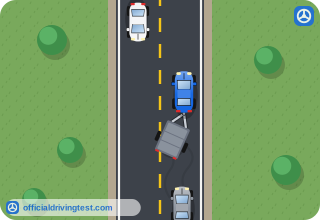
- Only when the trailer is empty
- Only when backing up
- Only after the trailer has swung out
- Any time the brakes are applied hard
Show answer
Correct answer: Any time the brakes are applied hard
Any time the brakes are applied hard, check the mirrors to make sure the trailer is staying where it should.
Source: Nevada Driver's Handbook (March 2024 (DMV 700)), page 74 · Open this page in the manual (Manual page 74)
-
What is very difficult to do once the trailer swings out of your lane?
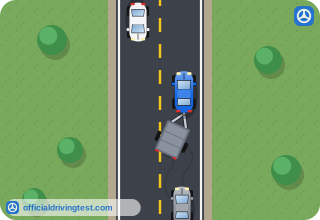
- Prevent a jackknife
- See the trailer in your mirrors
- Release the brakes
- Signal your intentions
Show answer
Correct answer: Prevent a jackknife
Once the trailer swings out of your lane, it is very difficult to prevent a jackknife.
Source: Nevada Driver's Handbook (March 2024 (DMV 700)), page 74 · Open this page in the manual (Manual page 74)
-
If the trailer starts to skid, what should you do with the brakes?
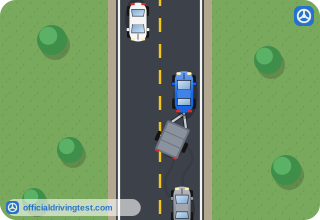
- Apply the trailer hand brake to straighten the rig
- Brake harder until the trailer stops
- Release the brakes to get traction back
- Pump the trailer hand brake repeatedly
Show answer
Correct answer: Release the brakes to get traction back
Release the brakes to get traction back; once the trailer wheels grip the road again, the trailer will start to follow the vehicle and straighten out.
Source: Nevada Driver's Handbook (March 2024 (DMV 700)), page 74 · Open this page in the manual (Manual page 74)
-
Why should you not use the trailer hand brake to straighten out a skidding rig?
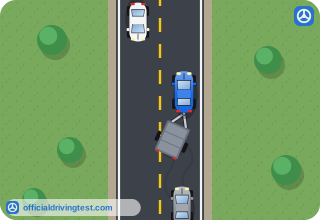
- The hand brake is too weak to have any effect on a trailer
- The brakes on the trailer wheels caused the skid in the first place
- The hand brake works only when the trailer is empty
- The hand brake should always be applied first in a skid
Show answer
Correct answer: The brakes on the trailer wheels caused the skid in the first place
Using the trailer hand brake is the wrong thing to do, since the brakes on the trailer wheels caused the skid in the first place.
Source: Nevada Driver's Handbook (March 2024 (DMV 700)), page 74 · Open this page in the manual (Manual page 74)
-
After a fender bender with only vehicle or property damage, no injuries, and a vehicle that can be moved safely, what should you do?
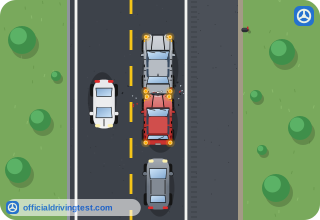
- Leave the vehicle in the traffic lane until the police arrive
- Move to a location that does not obstruct traffic and return to the scene
- Drive home and report the crash to your insurance company
- Move the vehicle and leave without exchanging information
Show answer
Correct answer: Move to a location that does not obstruct traffic and return to the scene
With only property damage and a vehicle that can be moved safely, you should move to a location that does not obstruct traffic and return to the scene.
Source: Nevada Driver's Handbook (March 2024 (DMV 700)), page 76 · Open this page in the manual (Manual page 76)
-
Which information must you exchange with the other drivers involved in a crash?
- Name, address, Social Security number and the name of your employer
- Name, telephone number, date of birth and license plate number only
- Name and address only, if no one was injured in the crash
- Name, address, driver license number, registration and insurance information
Show answer
Correct answer: Name, address, driver license number, registration and insurance information
You must exchange your name, address, driver license number, registration and insurance information with the other drivers.
Source: Nevada Driver's Handbook (March 2024 (DMV 700)), page 76 · Open this page in the manual (Manual page 76)
-
If a crash involves an unattended vehicle or other property, how may you give the owner your name, address, driver license number, registration and insurance information?
- In person or by leaving a note
- Only by calling the owner's insurance company
- Only by reporting it to the DMV within 24 hours
- By leaving the information with a neighbor
Show answer
Correct answer: In person or by leaving a note
If the crash involves an unattended vehicle or property, you must give the owner this information either in person or by leaving a note.
Source: Nevada Driver's Handbook (March 2024 (DMV 700)), page 76 · Open this page in the manual (Manual page 76)