Nevada: Emergencies and bad weather — Part 1 Practice Test
Questions in this part include: “If you stay with your car after car trouble, who will stop to help you?” · “Where does the handbook direct you for specific information on skid recovery?”
Independent educational site · not affiliated with any government agency or DMV
Ready? Test yourself
- Instant feedback with an explanation
- Every answer cites its source in the manual
- Your best score is saved on this device
- Keyboard: press 1 to 4 to answer and Enter for the next question
Questions are original and based on the official manual "Nevada Driver's Handbook" (March 2024 (DMV 700)), Nevada Department of Motor Vehicles.
All 17 questions in this practice test
Take the test above first, then use this list to study. Tap “Show answer” to see the correct answer and explanation.
Show the questions and answersHide the questions
-
How should you use four-wheel ABS in an emergency stop?
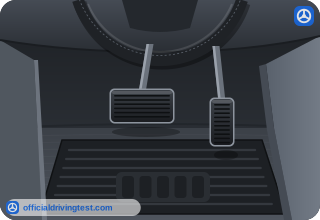
- Pump the brake pedal quickly while steering
- Press the brake pedal lightly and release it repeatedly
- Brake hard once, then release and steer
- Push the brake pedal down hard, hold it, and steer
Show answer
Correct answer: Push the brake pedal down hard, hold it, and steer
With four-wheel ABS, all drivers must do is brake and steer: push the brake pedal down hard, hold it down firmly and steer where you want the car to go.
Source: Nevada Driver's Handbook (March 2024 (DMV 700)), page 40 · Open this page in the manual (Manual page 40)
-
Why should you not pump the brakes yourself when your car has four-wheel ABS?
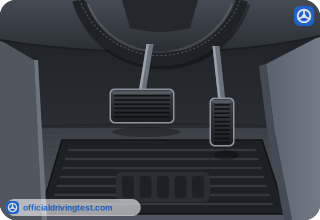
- ABS pumps the brakes automatically, much faster than you can
- Pumping would make the brake pads overheat and fade
- Pumping the pedal is only allowed on rear-wheel ABS
- Pumping the pedal wears out the ABS computer too quickly
Show answer
Correct answer: ABS pumps the brakes automatically, much faster than you can
In an emergency, four-wheel ABS pumps the brakes automatically at a much faster rate than the driver ever could.
Source: Nevada Driver's Handbook (March 2024 (DMV 700)), page 40 · Open this page in the manual (Manual page 40)
-
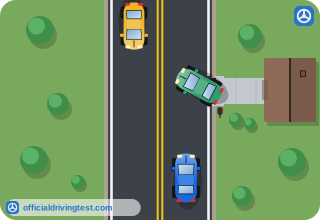
What can happen if you turn the steering wheel hard or jerk it too far during an emergency stop with ABS?
- The ABS will turn itself off for the rest of the trip
- The front brakes will lock while the rear brakes release
- You may end up on the shoulder or in the emergency stopping lane
- The tires will heat up and lose their grip on dry road
Show answer
Correct answer: You may end up on the shoulder or in the emergency stopping lane
Jerking the wheel too far can cause the vehicle to end up in the emergency stopping lane or on the shoulder of the road.
Source: Nevada Driver's Handbook (March 2024 (DMV 700)), page 40 · Open this page in the manual (Manual page 40)
-
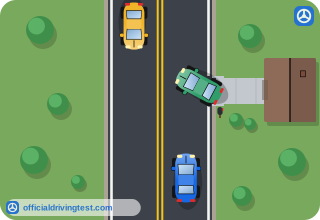
When should you steer back into your original lane after avoiding a hazard?
- After you have come to a complete stop
- As soon as the hazard is cleared
- Only after you have checked your speedometer
- After the ABS symbol on the dashboard turns off
Show answer
Correct answer: As soon as the hazard is cleared
Drivers should steer back into the original lane as soon as the hazard is cleared.
Source: Nevada Driver's Handbook (March 2024 (DMV 700)), page 40 · Open this page in the manual (Manual page 40)
-
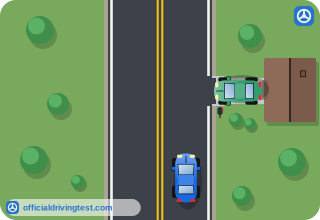
When you decide where to steer around a hazard during emergency braking, what should you check?
- That your hazard lights are on
- That your headlights are on high beam
- That your seat belt is fastened
- That traffic is clear
Show answer
Correct answer: That traffic is clear
Drivers should check that traffic is clear when they decide where to steer.
Source: Nevada Driver's Handbook (March 2024 (DMV 700)), page 40 · Open this page in the manual (Manual page 40)
-
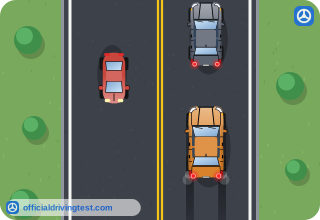
With rear-wheel ABS, what should you do if the front wheels lock and you lose steering control?
- Press the brake pedal harder until the front wheels release
- Let up on the brake just enough to let the front wheels roll
- Release the brake pedal completely and keep it released
- Shift to neutral and let the vehicle coast to a stop
Show answer
Correct answer: Let up on the brake just enough to let the front wheels roll
The front wheels can still lock with rear-wheel ABS, so you should let up on the brake pedal just enough for the front wheels to start rolling again and regain steering control.
Source: Nevada Driver's Handbook (March 2024 (DMV 700)), page 40 · Open this page in the manual (Manual page 40)
-
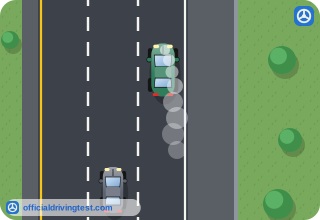
If you have car trouble, what should you do?
- Stop in your lane and wait for a trooper to arrive
- Continue driving slowly in the right lane until the problem clears up
- Move to the shoulder or emergency stopping area as soon as you safely can
- Pull into the nearest lane and wait for a tow truck to find you
Show answer
Correct answer: Move to the shoulder or emergency stopping area as soon as you safely can
With car trouble, you move to the shoulder or emergency stopping area as soon as you safely can.
Source: Nevada Driver's Handbook (March 2024 (DMV 700)), page 50 · Open this page in the manual (Manual page 50)
-
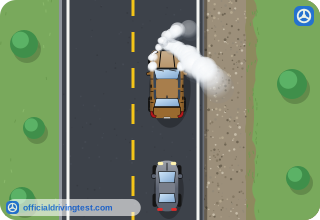
If you have car trouble and move to the shoulder, what should you turn on to warn other traffic?
- Your high-beam headlights
- Your four-way flashers
- Your turn signal
- Your windshield wipers
Show answer
Correct answer: Your four-way flashers
You turn on your four-way flashers to warn other traffic.
Source: Nevada Driver's Handbook (March 2024 (DMV 700)), page 50 · Open this page in the manual (Manual page 50)
-
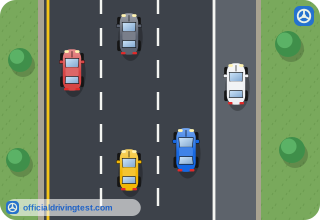
If possible, where is it better to stay when you have car trouble on a freeway?
- Walking along the freeway to find a telephone nearby
- Standing behind your car on the side nearest traffic
- Sitting in the lane next to the front of your car
- In or near your car, on the far side from passing traffic
Show answer
Correct answer: In or near your car, on the far side from passing traffic
If possible, it is better to stay in or near your car on the far side from passing traffic, because walking along a freeway is dangerous.
Source: Nevada Driver's Handbook (March 2024 (DMV 700)), page 50 · Open this page in the manual (Manual page 50)
-
If you stay with your car after car trouble, who will stop to help you?
- A DMV driver examiner
- A highway department maintenance crew
- A Nevada Highway Patrol trooper
- A towing company driver
Show answer
Correct answer: A Nevada Highway Patrol trooper
If you stay with your car, a Nevada Highway Patrol trooper will stop to help you.
Source: Nevada Driver's Handbook (March 2024 (DMV 700)), page 50 · Open this page in the manual (Manual page 50)
-
When may you stop on a freeway?
- Only for an emergency
- To check a map or phone
- To let a passenger out
- To rest when you feel tired
Show answer
Correct answer: Only for an emergency
The handbook says do not stop on a freeway except for an emergency.
Source: Nevada Driver's Handbook (March 2024 (DMV 700)), page 50 · Open this page in the manual (Manual page 50)
-
What does skidding mean?
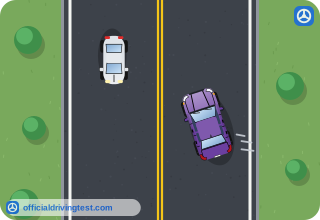
- Your vehicle’s tires have lost traction
- Your vehicle’s brakes have overheated
- Your vehicle’s engine has stalled
- Your vehicle’s steering has failed
Show answer
Correct answer: Your vehicle’s tires have lost traction
Skidding means your vehicle’s tires have lost traction.
Source: Nevada Driver's Handbook (March 2024 (DMV 700)), page 57 · Open this page in the manual (Manual page 57)
-
Where does skidding usually happen?
- On dry pavement only
- On fresh concrete only
- On ice or packed snow
- On dirt roads only
Show answer
Correct answer: On ice or packed snow
Skidding usually happens on ice or packed snow, but it can also occur on wet pavement or gravel roads.
Source: Nevada Driver's Handbook (March 2024 (DMV 700)), page 57 · Open this page in the manual (Manual page 57)
-
Where does the handbook direct you for specific information on skid recovery?
- A tow truck driver
- Your vehicle owner’s manual
- The posted speed limit signs
- A driving instructor only
Show answer
Correct answer: Your vehicle owner’s manual
Different braking and steering systems respond differently, so the handbook says to consult your vehicle owner’s manual for skid recovery.
Source: Nevada Driver's Handbook (March 2024 (DMV 700)), page 57 · Open this page in the manual (Manual page 57)
-
What does the handbook call the best source of information on mechanical system failures?
- A tow truck driver
- The posted road signs
- Other drivers on the road
- Your vehicle owner’s manual
Show answer
Correct answer: Your vehicle owner’s manual
Vehicle features and procedures vary greatly, so the owner’s manual is the best source for information on mechanical system failures.
Source: Nevada Driver's Handbook (March 2024 (DMV 700)), page 57 · Open this page in the manual (Manual page 57)
-
What does the handbook say to do in all emergencies?
- Stay calm and use common sense
- Stop immediately in the lane
- Sound your horn continuously
- Speed up to leave the danger
Show answer
Correct answer: Stay calm and use common sense
In all emergencies the handbook says to stay calm and use common sense.
Source: Nevada Driver's Handbook (March 2024 (DMV 700)), page 57 · Open this page in the manual (Manual page 57)
-
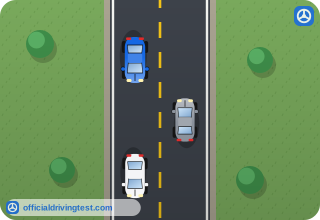
If your brakes fail, what should you try first?
- Shifting into park
- Turning off the ignition
- Pumping the brake pedal
- Steering onto the shoulder
Show answer
Correct answer: Pumping the brake pedal
When the brakes fail, the handbook says to try pumping the brake pedal first.
Source: Nevada Driver's Handbook (March 2024 (DMV 700)), page 58 · Open this page in the manual (Manual page 58)