Nevada: Emergencies and bad weather — Part 3 Practice Test
Questions in this part include: “Which of these is named as a major factor in crashes where a vehicle runs off the highway?” · “According to the handbook, how little water can cause a driver to lose control of a car?”
Independent educational site · not affiliated with any government agency or DMV
Ready? Test yourself
- Instant feedback with an explanation
- Every answer cites its source in the manual
- Your best score is saved on this device
- Keyboard: press 1 to 4 to answer and Enter for the next question
Questions are original and based on the official manual "Nevada Driver's Handbook" (March 2024 (DMV 700)), Nevada Department of Motor Vehicles.
All 17 questions in this practice test
Take the test above first, then use this list to study. Tap “Show answer” to see the correct answer and explanation.
Show the questions and answersHide the questions
-
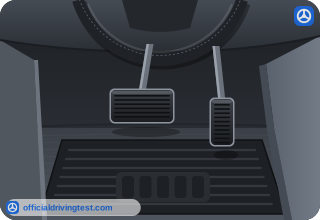
You lost steering control but your car continues to hold the lane. How should you use the brakes?
- Brake quickly using maximum pressure
- Do not use the brakes at all
- Pump the brakes rapidly
- Slow down and then gently apply the brakes
Show answer
Correct answer: Slow down and then gently apply the brakes
If your car continues to hold the lane, slow down and then gently apply the brakes and use four-way flashers.
Source: Nevada Driver's Handbook (March 2024 (DMV 700)), page 58 · Open this page in the manual (Manual page 58)
-
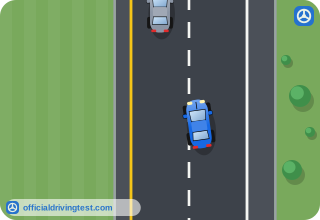
After a steering failure, your vehicle heads off the road or toward another vehicle or a pedestrian. What should you do?
- Apply the brakes quickly using maximum pressure
- Ease off the brakes and let the vehicle coast to a stop
- Gently tap the brakes
- Keep your foot off the pedals
Show answer
Correct answer: Apply the brakes quickly using maximum pressure
If the vehicle heads off the road or toward another vehicle or a pedestrian, apply the brakes quickly using maximum pressure.
Source: Nevada Driver's Handbook (March 2024 (DMV 700)), page 58 · Open this page in the manual (Manual page 58)
-
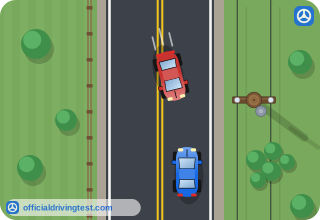
If you see a vehicle coming toward you in your lane, what should you do?
- Stop in your lane, turn on your four-way flashers and wait for the other vehicle to move
- Speed up and steer into the left lane to pass the vehicle
- Slow down, sound your horn, flash your headlights and pull as far to the right as you safely can
- Brake hard and steer into the lane the other vehicle left
Show answer
Correct answer: Slow down, sound your horn, flash your headlights and pull as far to the right as you safely can
The handbook says to slow down, sound your horn, flash your headlights and pull as far to the right as you safely can.
Source: Nevada Driver's Handbook (March 2024 (DMV 700)), page 58 · Open this page in the manual (Manual page 58)
-
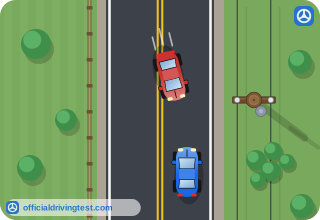
Why should you not swing into the lane an approaching vehicle has left?
- Traffic in that lane will usually be traveling much faster than the vehicle you just avoided
- The other driver may suddenly realize his or her mistake and turn back into the proper lane
- That lane is reserved for vehicles that are passing
- Vehicles in that lane have the right-of-way over you
Show answer
Correct answer: The other driver may suddenly realize his or her mistake and turn back into the proper lane
The other driver may suddenly turn back into the proper lane, so do not swing into the lane the vehicle left.
Source: Nevada Driver's Handbook (March 2024 (DMV 700)), page 58 · Open this page in the manual (Manual page 58)
-
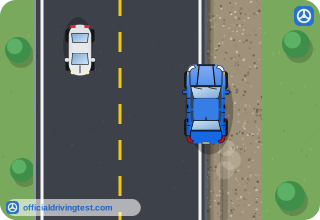
If you are forced off the road or drift onto the shoulder, what should you do with the accelerator?
- Press it harder to return quickly
- Hold it steady
- Tap it repeatedly
- Take your foot off it
Show answer
Correct answer: Take your foot off it
The handbook says to take your foot off the accelerator and, if you brake, to do so carefully.
Source: Nevada Driver's Handbook (March 2024 (DMV 700)), page 59 · Open this page in the manual (Manual page 59)
-
After your vehicle runs off the pavement onto the shoulder, how should you return to the road?
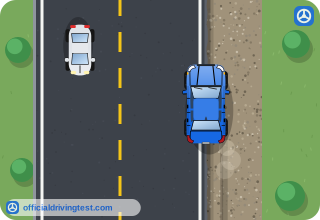
- Stay on the shoulder until you have the vehicle completely under control, then gently ease back onto the road
- Steer sharply back onto the pavement as soon as you can
- Brake hard and swerve back onto the pavement as soon as you see that the road is clear of traffic
- Stop on the shoulder and wait for a tow truck
Show answer
Correct answer: Stay on the shoulder until you have the vehicle completely under control, then gently ease back onto the road
Do not swerve back onto the pavement; stay on the shoulder until the vehicle is under control and then gently ease back onto the road.
Source: Nevada Driver's Handbook (March 2024 (DMV 700)), page 59 · Open this page in the manual (Manual page 59)
-
Which of these is named as a major factor in crashes where a vehicle runs off the highway?
- Wide road shoulders
- Bright street lighting
- Driver fatigue
- Dry pavement
Show answer
Correct answer: Driver fatigue
Driver fatigue, inattention and speeding are all major factors in these single-vehicle crashes.
Source: Nevada Driver's Handbook (March 2024 (DMV 700)), page 59 · Open this page in the manual (Manual page 59)
-
What is a blowout?
- When an engine overheats
- When a tire suddenly loses air
- When brakes suddenly lock
- When headlights suddenly go out
Show answer
Correct answer: When a tire suddenly loses air
A blowout is when a tire suddenly loses air, and it can throw a vehicle out of control.
Source: Nevada Driver's Handbook (March 2024 (DMV 700)), page 59 · Open this page in the manual (Manual page 59)
-
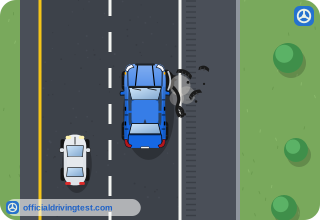
How should you slow down after a tire blowout?
- Press the brake pedal firmly as soon as the tire goes flat
- Shift into park until the car stops
- Turn off the engine at once
- Ease up on the gas pedal and do not hit the brakes
Show answer
Correct answer: Ease up on the gas pedal and do not hit the brakes
After a blowout, ease up on the gas pedal to slow down and do not hit the brakes.
Source: Nevada Driver's Handbook (March 2024 (DMV 700)), page 59 · Open this page in the manual (Manual page 59)
-
After a blowout, when may you gently use the brakes to stop?
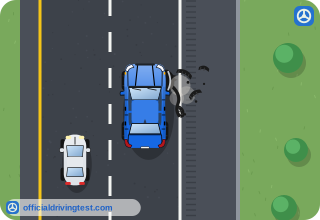
- When you are sure the vehicle is under control and you have slowed down
- As soon as you feel the tire lose air
- Immediately, while the vehicle is still swerving and before you have slowed down
- Only after the vehicle stops by itself
Show answer
Correct answer: When you are sure the vehicle is under control and you have slowed down
Once the vehicle is under control and you have slowed down, gently use the brakes to stop.
Source: Nevada Driver's Handbook (March 2024 (DMV 700)), page 59 · Open this page in the manual (Manual page 59)
-
After a blowout, once your vehicle is safely off the roadway, how should you warn other drivers?
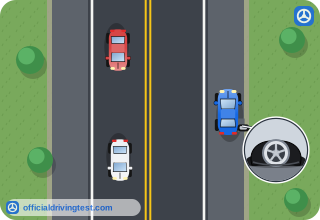
- Use high beams
- Sound the horn continuously
- Use parking lights or flashers
- Turn off all lights
Show answer
Correct answer: Use parking lights or flashers
Make sure the vehicle is safely off the roadway and use parking lights or flashers to warn other drivers.
Source: Nevada Driver's Handbook (March 2024 (DMV 700)), page 59 · Open this page in the manual (Manual page 59)
-
If your vehicle is disabled, how many wheels should be off the roadway, if possible?
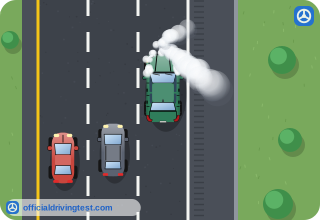
- The two right wheels only
- All four wheels
- The two left wheels only
- Only the front wheels
Show answer
Correct answer: All four wheels
The handbook says that, if possible, you should get all four wheels off the roadway.
Source: Nevada Driver's Handbook (March 2024 (DMV 700)), page 59 · Open this page in the manual (Manual page 59)
-
How should you warn other drivers about a disabled vehicle?
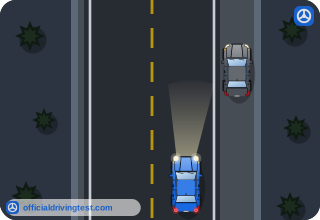
- Use only your high-beam headlights
- Sound the horn repeatedly
- Wave at passing vehicles
- Use parking lights, flashers or flares
Show answer
Correct answer: Use parking lights, flashers or flares
The handbook says to use parking lights, flashers or flares to warn other drivers.
Source: Nevada Driver's Handbook (March 2024 (DMV 700)), page 59 · Open this page in the manual (Manual page 59)
-
During which months does the handbook say flash flooding occurs particularly in Nevada?
- The summer months
- The winter months
- The autumn months
- The months of January and February
Show answer
Correct answer: The summer months
Nevada’s dry climate creates an ideal situation for flash flooding, particularly during the summer months.
Source: Nevada Driver's Handbook (March 2024 (DMV 700)), page 59 · Open this page in the manual (Manual page 59)
-
According to the handbook, how little water can cause a driver to lose control of a car?
- About 1 foot
- About 3 feet
- Less than 1 inch
- About 4 feet
Show answer
Correct answer: Less than 1 inch
Less than 1 inch of water can cause a driver to lose control of his or her car.
Source: Nevada Driver's Handbook (March 2024 (DMV 700)), page 59 · Open this page in the manual (Manual page 59)
-
According to the handbook, most vehicles can float in how much water?
- 4 feet or less
- 2 feet or less
- 5 feet or less
- 6 feet or less
Show answer
Correct answer: 2 feet or less
Most vehicles can float in 2 feet of water or less.
Source: Nevada Driver's Handbook (March 2024 (DMV 700)), page 59 · Open this page in the manual (Manual page 59)
-
Cars traveling at a high rate of speed can be pushed off the road by only how much water?
- 18 inches
- 3 feet
- 4 feet
- 6 inches
Show answer
Correct answer: 6 inches
Cars traveling at a high rate of speed can be pushed off the road by only 6 inches of water.
Source: Nevada Driver's Handbook (March 2024 (DMV 700)), page 59 · Open this page in the manual (Manual page 59)