Nevada: Emergency vehicles, work zones and police stops — Part 1 Practice Test
Questions in this part include: “What shape are most signs used in highway and street work areas?” · “What happens to traffic fines for violations in work zones?”
Independent educational site · not affiliated with any government agency or DMV
Ready? Test yourself
- Instant feedback with an explanation
- Every answer cites its source in the manual
- Your best score is saved on this device
- Keyboard: press 1 to 4 to answer and Enter for the next question
Questions are original and based on the official manual "Nevada Driver's Handbook" (March 2024 (DMV 700)), Nevada Department of Motor Vehicles.
All 19 questions in this practice test
Take the test above first, then use this list to study. Tap “Show answer” to see the correct answer and explanation.
Show the questions and answersHide the questions
-
An emergency vehicle using a siren and red lights is approaching. What must you do?
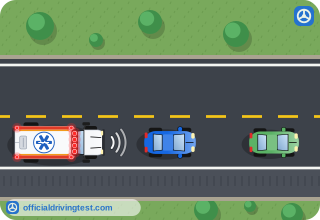
- Speed up and clear the intersection before it arrives
- Stop in the lane you are in and wait for it to pass
- Drive to the right edge of the road and stop until it has passed
- Pull onto the left edge of the road and keep moving slowly
Show answer
Correct answer: Drive to the right edge of the road and stop until it has passed
You must yield to an emergency vehicle using a siren and red lights by driving to the right edge of the road and stopping until it has passed.
Source: Nevada Driver's Handbook (March 2024 (DMV 700)), page 29 · Open this page in the manual (Manual page 29)
-
When yielding to an emergency vehicle using a siren and red lights, where must you never stop?
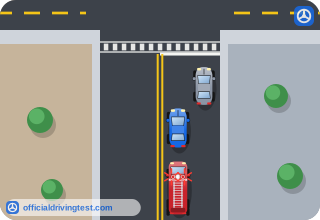
- In an intersection
- At the right edge of the road
- Beside the curb on your right
- Behind a parked vehicle
Show answer
Correct answer: In an intersection
When yielding to an emergency vehicle, never stop in an intersection.
Source: Nevada Driver's Handbook (March 2024 (DMV 700)), page 29 · Open this page in the manual (Manual page 29)
-
What shape are most signs used in highway and street work areas?
- Diamond-shaped
- Octagonal
- Round
- Pentagon-shaped
Show answer
Correct answer: Diamond-shaped
Construction and maintenance signs warn drivers of possible danger in or near work areas, and most of them are diamond-shaped.
Source: Nevada Driver's Handbook (March 2024 (DMV 700)), page 30 · Open this page in the manual (Manual page 30)
-
What are cones, drums, and barricades used for in work areas?
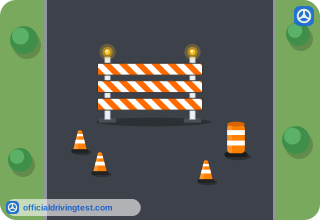
- To mark where work crews are allowed to park their vehicles
- To show drivers the permanent speed limit of the road
- To alert drivers and guide them safely through work areas
- To tell drivers that the work area has already ended
Show answer
Correct answer: To alert drivers and guide them safely through work areas
Cones, drums, and barricades alert drivers and guide them safely through work areas.
Source: Nevada Driver's Handbook (March 2024 (DMV 700)), page 30 · Open this page in the manual (Manual page 30)
-
For night work, what may cones, drums, and barricades be equipped with?
- Speed radar displays
- Warning lights
- Loudspeakers
- Pedestrian signals
Show answer
Correct answer: Warning lights
For night work, cones, drums, and barricades may be equipped with warning lights.
Source: Nevada Driver's Handbook (March 2024 (DMV 700)), page 30 · Open this page in the manual (Manual page 30)
-
When cones, drums, posted signs, or construction flaggers are in a work area, what must drivers do?
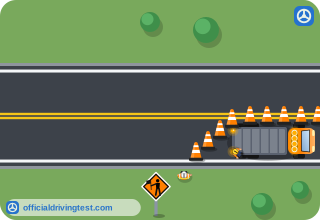
- Follow the posted signs but ignore any flaggers who are present
- Maintain normal speed unless a police officer is present
- Stop completely and wait for the cones to be removed
- Slow down and follow the direction of the posted signs and any flaggers
Show answer
Correct answer: Slow down and follow the direction of the posted signs and any flaggers
Drivers must slow down and follow the direction of the posted signs and any construction flaggers who may be present.
Source: Nevada Driver's Handbook (March 2024 (DMV 700)), page 30 · Open this page in the manual (Manual page 30)
-
What happens to traffic fines for violations in work zones?
- They are increased
- They are waived for a first violation
- They stay the same as elsewhere
- They apply only at night
Show answer
Correct answer: They are increased
Violations in work zones result in increased traffic fines.
Source: Nevada Driver's Handbook (March 2024 (DMV 700)), page 30 · Open this page in the manual (Manual page 30)
-
An emergency vehicle is approaching with its siren sounding and its lights flashing. What must you immediately do?
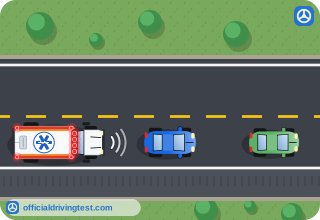
- Slow down and keep driving in your lane until it has passed
- Stop where you are, even if you are inside an intersection
- Drive to the right side of the road, clear of any intersection, and stop
- Pull to the left side of the road and wait with your emergency flashers on
Show answer
Correct answer: Drive to the right side of the road, clear of any intersection, and stop
You must immediately drive to the right side of the road, clear of any intersection, and stop until the emergency vehicle has passed.
Source: Nevada Driver's Handbook (March 2024 (DMV 700)), page 34 · Open this page in the manual (Manual page 34)
-
What should you do when you see red lights flashing in your rearview mirror?
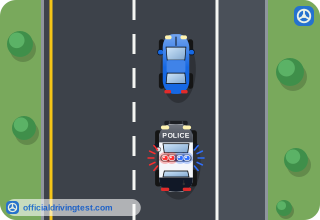
- Slow down and keep driving to the next exit
- Speed up to reach a safe place first
- Stop in the lane you are in and wait
- Pull over and stop
Show answer
Correct answer: Pull over and stop
When you see red lights flashing in the rearview mirror, you should pull over and stop.
Source: Nevada Driver's Handbook (March 2024 (DMV 700)), page 43 · Open this page in the manual (Manual page 43)
-
When stopped by law enforcement, where should you stop your vehicle?
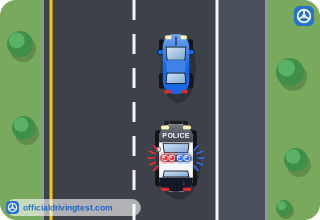
- As far out of the lane of traffic as possible
- In your lane, with your flashers turned on
- On the nearest cross street, out of view
- Beside the officer's vehicle in the next lane
Show answer
Correct answer: As far out of the lane of traffic as possible
Drivers who are stopped are encouraged to stop as far out of the lane of traffic as possible.
Source: Nevada Driver's Handbook (March 2024 (DMV 700)), page 43 · Open this page in the manual (Manual page 43)
-
What may happen if you leave your vehicle when stopped by law enforcement?
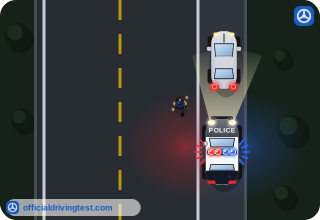
- You will automatically lose your driving privilege
- The officer will be required to give you a warning
- You and the officer are put in danger from nearby traffic
- Your vehicle will be towed from the roadside
Show answer
Correct answer: You and the officer are put in danger from nearby traffic
If you leave the vehicle, you subject yourself and the officer to danger from nearby traffic, so you should stay in your vehicle.
Source: Nevada Driver's Handbook (March 2024 (DMV 700)), page 43 · Open this page in the manual (Manual page 43)
-
If you are stopped by law enforcement at night, what are you encouraged to do?
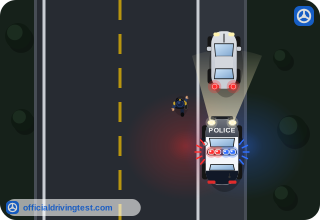
- Turn off your headlights and engine
- Turn on the interior light
- Turn on your high beams
- Get out and wave a flashlight
Show answer
Correct answer: Turn on the interior light
If stopped at night, turn on the interior light, because good lighting assists good communication.
Source: Nevada Driver's Handbook (March 2024 (DMV 700)), page 43 · Open this page in the manual (Manual page 43)
-
While stopped by law enforcement, where should you keep your hands?
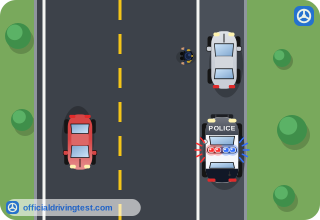
- In your lap, out of the officer's sight
- Near the glove box so you can reach your papers
- Reaching in the glove box for your documents
- In plain view, preferably on the steering wheel
Show answer
Correct answer: In plain view, preferably on the steering wheel
Keep your hands in plain view at all times, preferably on the steering wheel, and avoid sudden movements.
Source: Nevada Driver's Handbook (March 2024 (DMV 700)), page 43 · Open this page in the manual (Manual page 43)
-
What should you do before reaching for your license, registration and proof of insurance when stopped by an officer?
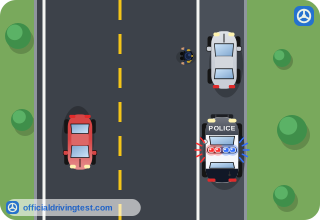
- Wait for the officer to ask for them
- Hand them out the window as soon as you stop
- Place them on the dashboard right away
- Reach for them while the officer walks up
Show answer
Correct answer: Wait for the officer to ask for them
You should wait for the officer to request your license, registration and evidence of insurance.
Source: Nevada Driver's Handbook (March 2024 (DMV 700)), page 43 · Open this page in the manual (Manual page 43)
-
What are officers trained to do first when they stop a driver?
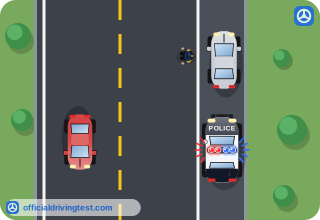
- Explain why the driver was stopped
- Ask where the driver is going
- Ask for identification
- Ask the driver to step out
Show answer
Correct answer: Ask for identification
Officers are trained to ask for identification first and explain why the driver was stopped second.
Source: Nevada Driver's Handbook (March 2024 (DMV 700)), page 43 · Open this page in the manual (Manual page 43)
-
How should you present the paperwork an officer requests?
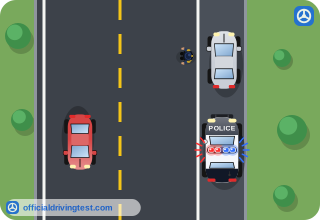
- Only after the officer tells you the reason
- Promptly and without an argument
- After you ask to see the officer's badge
- Only after you have explained your driving
Show answer
Correct answer: Promptly and without an argument
You should extend the courtesy by presenting the requested paperwork promptly and without an argument.
Source: Nevada Driver's Handbook (March 2024 (DMV 700)), page 43 · Open this page in the manual (Manual page 43)
-
If you think a citation was wrongly issued, what is the proper procedure?
- Argue the citation with the officer at the roadside
- Ask the DMV to cancel it at your next office visit
- Ignore it and wait for the officer to call you
- Request a hearing through the court system
Show answer
Correct answer: Request a hearing through the court system
Don't argue the citation with the officer; the proper procedure is to request a hearing through the court system or attend the hearing for which you received notification.
Source: Nevada Driver's Handbook (March 2024 (DMV 700)), page 43 · Open this page in the manual (Manual page 43)
-
How are highway work zones identified?
- With blue signs and white cones
- With green signs and red flares
- With yellow signs and red lights
- With orange signs, cones and barrels
Show answer
Correct answer: With orange signs, cones and barrels
Work zones are identified with orange signs, cones and barrels.
Source: Nevada Driver's Handbook (March 2024 (DMV 700)), page 60 · Open this page in the manual (Manual page 60)
-
Why should you use extra caution when approaching cars ahead of you in a work zone?
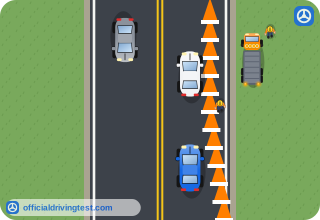
- They may be stopped
- They may be speeding up
- They may be turning around
- They may be passing you
Show answer
Correct answer: They may be stopped
Cars in a work zone sometimes must come to a complete stop, so cars ahead may be stopped.
Source: Nevada Driver's Handbook (March 2024 (DMV 700)), page 60 · Open this page in the manual (Manual page 60)