Michigan: Emergencies and special situations
Skids, breakdowns, bad weather, and being stopped by police. Split into 5 shorter tests so you're not stuck in one long quiz.
Independent educational site · not affiliated with any government agency or DMV
Choose a part
Emergencies and special situations — Part 1
Questions in this part include: “Which of the following is NOT allowed on a Michigan freeway?”
StartEmergencies and special situations — Part 2
Questions in this part include: “At what point must you notify police after a crash involving only property damage?”
StartEmergencies and special situations — Part 3
Questions in this part include: “On a freeway entrance ramp, you should watch for which signs?”
StartEmergencies and special situations — Part 4
Questions in this part include: “What happens if you leave the scene of a crash you were involved in?”
StartEmergencies and special situations — Part 5
Questions in this part include: “Which of the following should you NOT rely on to avoid hitting deer?”
StartAll 81 Emergencies and special situations questions with answers
Choose a part above to take a practice test, or study every question and answer here.
Show the questions and answersHide the questions
-
According to an NHTSA estimate cited in the manual, what percentage of all traffic fatalities are caused by aggressive driving behaviors?
- 25%
- 40%
- 66%
- 90%
Show answer
Correct answer: 66%
The manual cites an NHTSA estimate that 66 percent of all traffic fatalities are caused by aggressive driving behaviors.
Source: What Every Driver Must Know (October 2025), page 59 · Open this page in the manual (Manual page 59)
-
Which of the following is NOT allowed on a Michigan freeway?
- A car towing a trailer
- A moped
- A commercial truck
- A motorcycle with a 300 cc engine
Show answer
Correct answer: A moped
Pedestrians, small motorcycles of 124 cc or less, mopeds, bicycles, all-terrain vehicles and slow-moving vehicles are not allowed on freeways; larger motorcycles are permitted.
Source: What Every Driver Must Know (October 2025), page 60 · Open this page in the manual (Manual page 60)
-
On a two-lane freeway, which lane should you normally drive in?
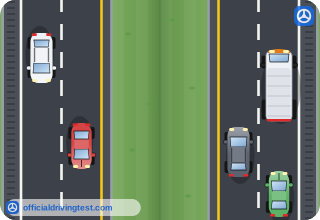
- The left lane at all times
- The right lane, except when passing or in a few other cases
- Whichever lane has less traffic, with no restrictions
- The left lane only during rush hour
Show answer
Correct answer: The right lane, except when passing or in a few other cases
On a two-lane freeway, drive in the right lane except when passing, exiting to the left, allowing another vehicle to merge, when the lanes are heavily congested, or when emergency vehicles or construction workers are on the shoulders.
Source: What Every Driver Must Know (October 2025), page 61 · Open this page in the manual (Manual page 61)
-
If you must stop on a freeway during an emergency, what should you do?
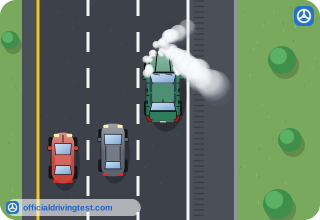
- Stop immediately in your current lane and turn on your hazard flashers
- Turn on hazard flashers, slow down gradually and pull fully off the pavement
- Reverse slowly to the nearest exit
- Stop only on the left shoulder, since it is safer from traffic
Show answer
Correct answer: Turn on hazard flashers, slow down gradually and pull fully off the pavement
Never stop on a freeway except for an emergency; if you must, turn on hazard flashers, slow down gradually, and pull all the way off the pavement.
Source: What Every Driver Must Know (October 2025), page 61 · Open this page in the manual (Manual page 61)
-
What should you do if you miss your freeway exit?
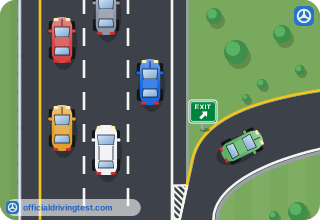
- Use the median crossover if traffic allows
- Carefully back up to the exit
- Continue to the next exit and return the way you came
- Stop on the shoulder and wait for a gap in traffic to cross
Show answer
Correct answer: Continue to the next exit and return the way you came
Drivers who miss their exit should never back up, turn around, or use a median crossover, but instead continue to the next exit and return.
Source: What Every Driver Must Know (October 2025), page 61 · Open this page in the manual (Manual page 61)
-
On a long freeway trip, how often does the manual recommend taking a 10-minute break if you feel tired?
- Every 30 minutes
- At least every two hours
- Only once you reach your destination
- Every four hours
Show answer
Correct answer: At least every two hours
If you feel tired, stop and take a 10-minute break at least every two hours, rather than relying on coffee or 'stay awake' drugs.
Source: What Every Driver Must Know (October 2025), page 62 · Open this page in the manual (Manual page 62)
-
If an oncoming vehicle drifts into your lane, what does the manual recommend as an escape route?
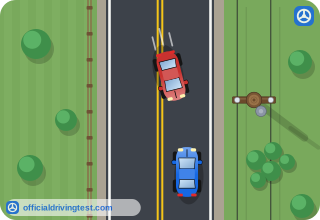
- Steer sharply left into the oncoming lane
- Look for an escape route on the right edge of the road
- Accelerate to pass the oncoming vehicle quickly
- Stop immediately, regardless of traffic behind you
Show answer
Correct answer: Look for an escape route on the right edge of the road
Look for an escape route on the right edge of the road, and avoid the left, since the other driver may return to their proper lane.
Source: What Every Driver Must Know (October 2025), page 62 · Open this page in the manual (Manual page 62)
-
When is a road most slippery after rain begins?
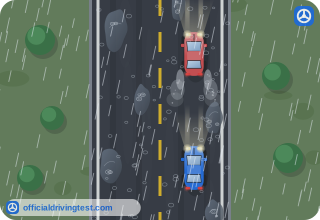
- After several hours of steady rain
- During the first half hour, before oil washes away
- Only during the final minutes of the storm
- Roads are equally slippery throughout the rainstorm
Show answer
Correct answer: During the first half hour, before oil washes away
Roads are most slippery during the first half hour of rain, because oil dropped from vehicles has not yet washed away.
Source: What Every Driver Must Know (October 2025), page 62 · Open this page in the manual (Manual page 62)
-
What is hydroplaning?
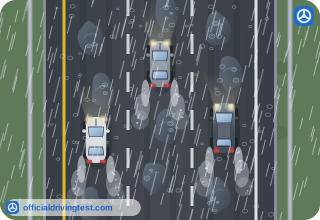
- When your brakes overheat in wet weather
- When your tires ride on top of the water on a wet road
- When your headlights reflect off wet pavement
- When your engine stalls due to water in the fuel line
Show answer
Correct answer: When your tires ride on top of the water on a wet road
Hydroplaning occurs when your tires ride on top of the water on a wet road instead of gripping the pavement, which can cause a loss of control.
Source: What Every Driver Must Know (October 2025), page 62 · Open this page in the manual (Manual page 62)
-
What should you do if you see safety barricades blocking a flooded road?
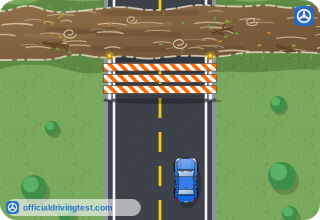
- Drive around them carefully at low speed
- Never drive around them; the road may be washed away
- Follow another vehicle through if it makes it across
- Move the barricades yourself if no one is watching
Show answer
Correct answer: Never drive around them; the road may be washed away
Never drive around barricades at a flooded road; they are placed there because the road may be unsafe or washed out.
Source: What Every Driver Must Know (October 2025), page 63 · Open this page in the manual (Manual page 63)
-
If fog becomes so thick that you cannot see the road at all, what should you do?
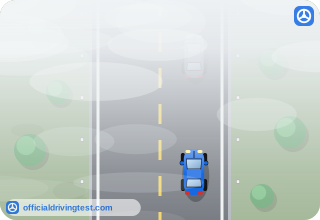
- Turn on your high beams and keep driving slowly
- Pull off the road, turn on four-way flashers, and wait
- Stop in your travel lane with regular headlights on
- Speed up to get through the fog bank quickly
Show answer
Correct answer: Pull off the road, turn on four-way flashers, and wait
If fog becomes so thick you cannot see at all, pull off the road, turn on your four-way emergency flashers, and wait for the fog to lift.
Source: What Every Driver Must Know (October 2025), page 63 · Open this page in the manual (Manual page 63)
-
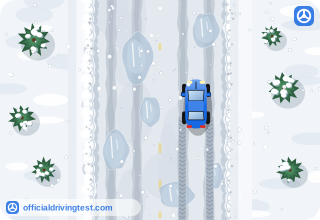
In a vehicle with standard (non-anti-lock) brakes, how should you brake to help prevent a skid?
- Pump the brakes rapidly and repeatedly
- Brake steadily without locking the wheels
- Apply the parking brake first
- Brake as hard as possible immediately
Show answer
Correct answer: Brake steadily without locking the wheels
To prevent a skid in a vehicle with standard brakes, use steady pressure without locking the wheels, which keeps the wheels turning and maintains steering control.
Source: What Every Driver Must Know (October 2025), page 63 · Open this page in the manual (Manual page 63)
-
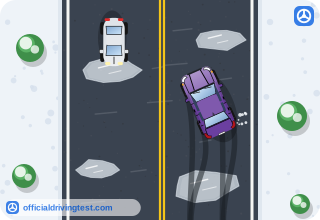
If your vehicle begins to skid, what is the first thing you should do?
- Turn the wheel sharply away from the skid
- Shift into a lower gear immediately
- Take your foot off the accelerator
- Apply the brakes firmly
Show answer
Correct answer: Take your foot off the accelerator
If your vehicle begins skidding, the first recommended step is to take your foot off the accelerator.
Source: What Every Driver Must Know (October 2025), page 63 · Open this page in the manual (Manual page 63)
-
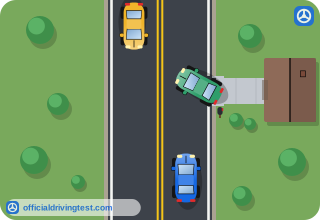
In a vehicle equipped with anti-lock brakes (ABS), how should you brake in an emergency stop?
- Pump the brake pedal in short bursts
- Apply hard, firm pressure from the start until you stop
- Apply light, intermittent pressure to avoid vibration
- Release the brake fully if you feel any pulsation
Show answer
Correct answer: Apply hard, firm pressure from the start until you stop
With anti-lock brakes, apply hard, firm pressure from the start and maintain it until you stop; feeling vibration or pulsation is normal.
Source: What Every Driver Must Know (October 2025), page 63 · Open this page in the manual (Manual page 63)
-
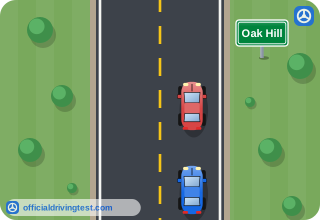
What following distance does the manual recommend under normal conditions, and how much should it increase in adverse conditions?
- There is no recommended following-distance guideline
- 1 second normally, up to 2 seconds in adverse conditions
- 3 to 4 seconds normally, up to 6 seconds or more in adverse conditions
- 10 seconds normally, with no change needed in adverse conditions
Show answer
Correct answer: 3 to 4 seconds normally, up to 6 seconds or more in adverse conditions
The recommended following distance is 3 to 4 seconds under normal conditions, increasing to 6 seconds or more at higher speeds or in adverse conditions.
Source: What Every Driver Must Know (October 2025), page 64 · Open this page in the manual (Manual page 64)
-
How far ahead does the manual recommend you look down the road to spot potential hazards?
- 5-10 seconds ahead
- 20-30 seconds ahead
- 1 full minute ahead
- Only as far as your headlights reach
Show answer
Correct answer: 20-30 seconds ahead
Looking 20-30 seconds down the road helps drivers spot hazards early and avoid last-second reactions.
Source: What Every Driver Must Know (October 2025), page 64 · Open this page in the manual (Manual page 64)
-
When must you turn on your headlights, according to the manual's general rule?
- Only after full darkness has set in
- From one half-hour after sunset until one half-hour before sunrise
- Only when driving on freeways at night
- Headlights are optional wherever streetlights are present
Show answer
Correct answer: From one half-hour after sunset until one half-hour before sunrise
Headlights must be turned on one half-hour after sunset until one half-hour before sunrise, and at other times when visibility is reduced.
Source: What Every Driver Must Know (October 2025), page 64 · Open this page in the manual (Manual page 64)
-
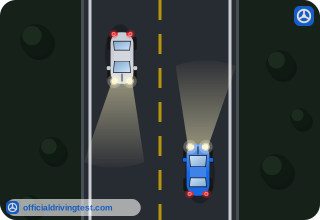
Within what distance of an oncoming vehicle is it illegal to use or flash your high-beam headlights?
- 100 feet
- 500 feet
- 1,000 feet
- 2,500 feet
Show answer
Correct answer: 500 feet
It is illegal to use or even flash high-beam headlights within 500 feet of an oncoming vehicle.
Source: What Every Driver Must Know (October 2025), page 64 · Open this page in the manual (Manual page 64)
-
At what point must you notify police after a crash involving only property damage?
- Any amount of visible damage
- When damage exceeds $1,000
- When damage exceeds $5,000
- Only if a vehicle needs to be towed
Show answer
Correct answer: When damage exceeds $1,000
Notify police if there are injuries, or if property damage exceeds $1,000.
Source: What Every Driver Must Know (October 2025), page 65 · Open this page in the manual (Manual page 65)
-
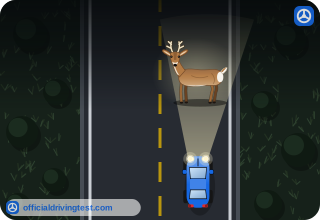
If a collision with a deer becomes unavoidable, what does the manual recommend?
- Steer toward the shoulder immediately without braking
- Swerve sharply to avoid the deer, even if it means leaving your lane
- Stay in your lane, brake firmly, and hold the wheel with both hands
- Accelerate to pass the deer safely
Show answer
Correct answer: Stay in your lane, brake firmly, and hold the wheel with both hands
Do not veer for a deer: stay in your lane, brake firmly, hold the wheel with both hands, and come to a controlled stop.
Source: What Every Driver Must Know (October 2025), page 65 · Open this page in the manual (Manual page 65)
-
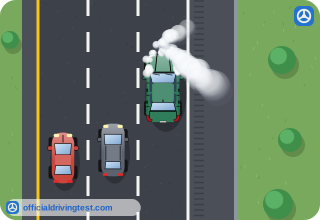
If your car becomes disabled on the road, what does the manual recommend?
- Leave the vehicle in the travel lane and wait for police
- Get out immediately and stand behind the vehicle to warn others
- Pull far off the road, use four-way flashers, and stay buckled inside
- Leave the vehicle and walk to find a phone
Show answer
Correct answer: Pull far off the road, use four-way flashers, and stay buckled inside
If your vehicle becomes disabled, pull as far off the traveled roadway as possible, activate your four-way emergency lights, and stay inside with your seat belt fastened.
Source: What Every Driver Must Know (October 2025), page 67 · Open this page in the manual (Manual page 67)
-
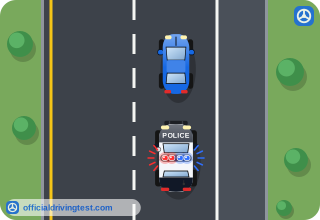
When a law enforcement officer signals you to pull over, what should you do?
- Wait until you reach your destination before stopping
- Stop immediately in your current lane regardless of traffic
- Pull off to the right when safe and keep both hands on the wheel
- Exit your vehicle right away to speak with the officer
Show answer
Correct answer: Pull off to the right when safe and keep both hands on the wheel
Pull off on the right side of the road as soon as it is safe, stay in the car with your seat belt on, and keep both hands empty and visible on the steering wheel.
Source: What Every Driver Must Know (October 2025), page 67 · Open this page in the manual (Manual page 67)
-
Before driving unsupervised, a teen driver practices first on the driver education range, then with:
- A friend with any license
- Any adult passenger
- Parents, guardians or a designated licensed adult 21 or older
- No one, as no supervision is required after the range
Show answer
Correct answer: Parents, guardians or a designated licensed adult 21 or older
Teen drivers practice first on the range, then with parents, guardians, or another designated licensed adult 21 or older.
Source: What Every Driver Must Know (October 2025), page 59 · Open this page in the manual (Manual page 59)
-
Which of the following describes aggressive driving behavior?
- Yielding to pedestrians
- Speeding, tailgating and weaving
- Signaling before every lane change
- Driving at the speed limit
Show answer
Correct answer: Speeding, tailgating and weaving
Aggressive drivers run stop signs and red lights, speed, tailgate, weave, pass illegally, and may make improper gestures.
Source: What Every Driver Must Know (October 2025), page 59 · Open this page in the manual (Manual page 59)
-
What is "road rage"?
- A type of traffic ticket
- Driving well above the posted speed limit
- Using a weapon or vehicle to assault a driver
- Any minor traffic violation
Show answer
Correct answer: Using a weapon or vehicle to assault a driver
Road rage occurs when a situation escalates and a weapon or the vehicle itself is used to assault another driver.
Source: What Every Driver Must Know (October 2025), page 59 · Open this page in the manual (Manual page 59)
-
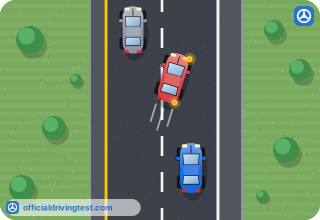
If another driver makes an ill-advised merge or turn in front of you, what does the manual recommend?
- Follow closely to teach them a lesson
- Flash your high beams repeatedly
- Speed up to block them
- Slow down and give them room
Show answer
Correct answer: Slow down and give them room
If you see a driver making an ill-advised merge or turn, slow down and give them room rather than getting angry.
Source: What Every Driver Must Know (October 2025), page 60 · Open this page in the manual (Manual page 60)
-
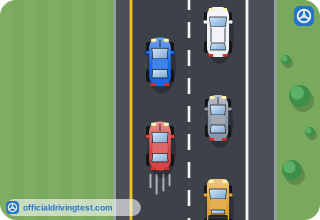
If you are passing in the left lane and someone begins tailgating you, you should:
- Stay in the left lane to block them
- Brake suddenly
- Speed up to stay ahead of them
- Move right when safe and let them pass
Show answer
Correct answer: Move right when safe and let them pass
If you are passing in the left lane and someone tailgates you, move back into the right lane when safe and let faster traffic move ahead.
Source: What Every Driver Must Know (October 2025), page 60 · Open this page in the manual (Manual page 60)
-
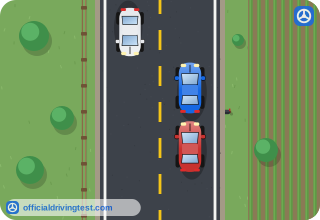
If another driver is tailgating you, the manual recommends that you:
- Speed up until they back off
- Pull over and let them pass
- Brake suddenly to warn them
- Ignore it and maintain your speed
Show answer
Correct answer: Pull over and let them pass
If other drivers tailgate you, pull over and let them pass, rather than having them behind you where you can't see them.
Source: What Every Driver Must Know (October 2025), page 60 · Open this page in the manual (Manual page 60)
-
If you are confronted by an aggressive driver, you should:
- Stop your vehicle immediately, wherever you are
- Return the gestures
- Make eye contact and assert yourself
- Try to get out of the way, avoid eye contact, ignore gestures, and call police if safe
Show answer
Correct answer: Try to get out of the way, avoid eye contact, ignore gestures, and call police if safe
If confronted by an aggressive driver, get out of the way, avoid eye contact, ignore gestures, and call police if safe.
Source: What Every Driver Must Know (October 2025), page 60 · Open this page in the manual (Manual page 60)
-
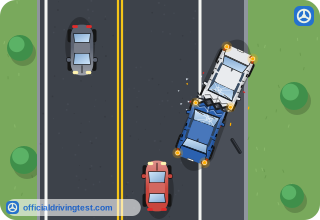
If an aggressive driver who confronted you crashes farther down the road, you should:
- Ignore it and continue your trip
- Drive away without stopping
- Pull the driver from the vehicle yourself
- Stop a safe distance away and wait for police
Show answer
Correct answer: Stop a safe distance away and wait for police
Stop a safe distance from the crash scene, wait for police to arrive, and report the driving behavior you witnessed.
Source: What Every Driver Must Know (October 2025), page 60 · Open this page in the manual (Manual page 60)
-
Compared to other portions of the road, intersections:
- Are safer than freeways
- Have the lowest crash rates on the road
- Are only dangerous at night
- Have the most deaths and serious injuries
Show answer
Correct answer: Have the most deaths and serious injuries
Crashes at intersections result in more traffic fatalities and serious injuries than any other portion of the road.
Source: What Every Driver Must Know (October 2025), page 60 · Open this page in the manual (Manual page 60)
-
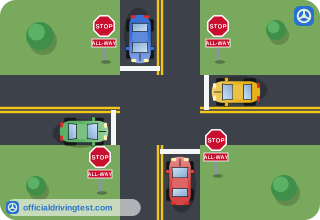
If you're not sure what another driver at an intersection is going to do, the safest approach is to:
- Honk and proceed
- Let them go first
- Proceed first to avoid confusion
- Flash your headlights and proceed
Show answer
Correct answer: Let them go first
Anytime you are not sure what other drivers are going to do, be safe and let them go first.
Source: What Every Driver Must Know (October 2025), page 60 · Open this page in the manual (Manual page 60)
-
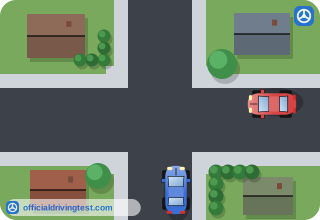
At an intersection where your view is blocked by trees, buildings, or snow piles, you should:
- Honk continuously while proceeding
- Proceed at normal speed
- Edge forward slowly until you can see
- Reverse away from the intersection
Show answer
Correct answer: Edge forward slowly until you can see
Edge forward slowly until you can see past whatever is blocking your view.
Source: What Every Driver Must Know (October 2025), page 60 · Open this page in the manual (Manual page 60)
-
On a freeway entrance ramp, you should watch for which signs?
- No signs are posted on freeway entrance ramps
- Speed limit, "Do Not Enter" and "Wrong Way" signs
- Only speed limit signs
- Only "Wrong Way" signs
Show answer
Correct answer: Speed limit, "Do Not Enter" and "Wrong Way" signs
Look for "Do Not Enter" and "Wrong Way" signs and speed limit signs on an entrance ramp.
Source: What Every Driver Must Know (October 2025), page 60 · Open this page in the manual (Manual page 60)
-
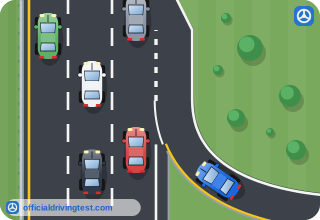
When entering a freeway, you should:
- Stop at the end of the entrance ramp until traffic clears
- Signal, check mirrors, glance over your shoulder, and yield
- Enter at any speed since freeway traffic must yield to you
- Count on other drivers to let you in
Show answer
Correct answer: Signal, check mirrors, glance over your shoulder, and yield
Signal, check mirrors and glance over your shoulder, choose a safe space, and yield the right of way to freeway traffic; do not count on others to let you in.
Source: What Every Driver Must Know (October 2025), page 61 · Open this page in the manual (Manual page 61)
-
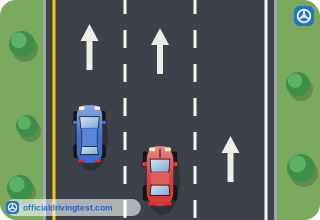
On a freeway with three or more lanes in the same direction, you:
- Must always drive in the left lane
- May drive in any lane
- Must always drive in the right lane
- May only use the left lane to exit
Show answer
Correct answer: May drive in any lane
On a freeway with three or more lanes, you may drive in any lane; if at or near the minimum speed limit, stay in the lane with slower traffic.
Source: What Every Driver Must Know (October 2025), page 61 · Open this page in the manual (Manual page 61)
-
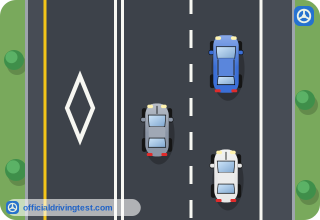
Regarding High Occupancy Vehicle (HOV) lanes, which is TRUE?
- They require exactly 3 occupants at all times
- They are closed to motorcycles at all times
- They are always restricted to buses only
- They require 2 or more occupants only in peak hours
Show answer
Correct answer: They require 2 or more occupants only in peak hours
HOV lanes require 2+ occupants during peak hours but are open to all motorists outside those hours; motorcycles may use them at any time.
Source: What Every Driver Must Know (October 2025), page 61 · Open this page in the manual (Manual page 61)
-
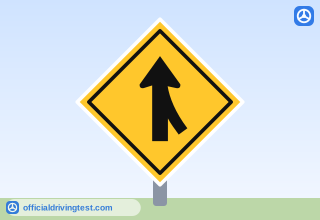
When you see a 'Merge' sign near a freeway entrance, you should:
- Stop on the freeway
- Speed up to prevent others from merging
- Ignore it since it only applies to entering traffic
- Watch for merging vehicles and adjust speed or change lanes
Show answer
Correct answer: Watch for merging vehicles and adjust speed or change lanes
Merge signs alert you to traffic entering the freeway; adjust your speed or move safely into another lane to help them merge.
Source: What Every Driver Must Know (October 2025), page 61 · Open this page in the manual (Manual page 61)
-
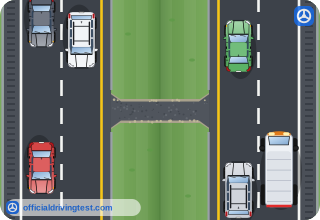
Who may use the crossover lane in a freeway median?
- Motorcycles only
- Carpool vehicles
- Any driver who missed their exit
- Emergency and MDOT vehicles
Show answer
Correct answer: Emergency and MDOT vehicles
Never use the crossover lane in the median, even if you miss your exit: it is for emergency and Michigan Department of Transportation vehicles. The road-sign section also names law enforcement and maintenance vehicles.
Source: What Every Driver Must Know (October 2025), page 61 · Open this page in the manual (Manual page 61)
-
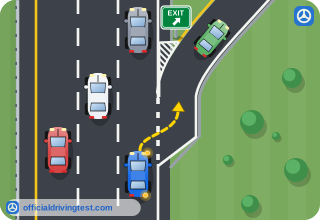
When exiting a freeway, you should:
- Stop at the start of the exit ramp
- Slow down once fully in the deceleration lane
- Maintain freeway speed through the entire ramp
- Slow down while still on the freeway
Show answer
Correct answer: Slow down once fully in the deceleration lane
Wait until you are fully in the deceleration lane before slowing down gradually, and obey the posted exit ramp speed limit.
Source: What Every Driver Must Know (October 2025), page 61 · Open this page in the manual (Manual page 61)
-
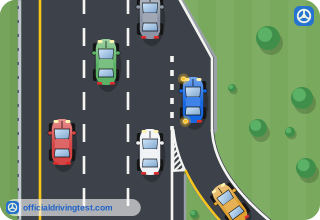
Under Michigan law (MCL 257.649(7)), when merging onto a marked merging highway, the merging vehicle must:
- Stop completely before merging
- Have the right of way over all traffic already on the highway
- Only merge if no other vehicle is present anywhere on the highway
- Yield to traffic that is an immediate hazard and adjust its speed
Show answer
Correct answer: Yield to traffic that is an immediate hazard and adjust its speed
State law says the merging vehicle must yield to traffic close enough to be an immediate hazard and adjust its speed to merge safely; this applies whether entering or exiting a freeway.
Source: What Every Driver Must Know (October 2025), page 61 · Open this page in the manual (Manual page 61)
-
Cruise control is best suited for use:
- While towing heavy loads
- In parking lots
- In heavy city traffic
- In rural, low-traffic areas
Show answer
Correct answer: In rural, low-traffic areas
Cruise control is best suited for use in rural areas where there is not much traffic.
Source: What Every Driver Must Know (October 2025), page 62 · Open this page in the manual (Manual page 62)
-
What cancels a cruise control setting?
- Turning the steering wheel
- Nothing can cancel it once set
- Accelerating
- Depressing the brake pedal
Show answer
Correct answer: Depressing the brake pedal
Acceleration does not cancel the cruise control setting - depressing the brake pedal will.
Source: What Every Driver Must Know (October 2025), page 62 · Open this page in the manual (Manual page 62)
-
Using cruise control is NOT recommended:
- During daylight hours on dry, clear roads
- When driving at or below the posted speed limit
- In heavy traffic, near many ramps, or on slippery roads
- On long, straight rural highways with light traffic
Show answer
Correct answer: In heavy traffic, near many ramps, or on slippery roads
Cruise control is not recommended in heavy traffic, near many exit/entrance ramps, or when roads are slippery; most vehicle manufacturers also do not recommend it when towing heavy loads.
Source: What Every Driver Must Know (October 2025), page 62 · Open this page in the manual (Manual page 62)
-
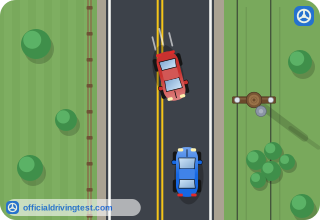
If an oncoming vehicle drifts into your lane and there is time, you should:
- Close your eyes
- Accelerate past it
- Flash your high beams only
- Tap the horn to warn the driver
Show answer
Correct answer: Tap the horn to warn the driver
If there is time, tap the horn to warn the other driver.
Source: What Every Driver Must Know (October 2025), page 62 · Open this page in the manual (Manual page 62)
-
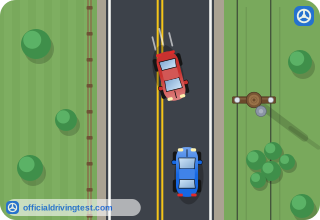
If your vehicle does NOT have anti-lock brakes and an oncoming vehicle is in your lane, you should:
- Apply the parking brake instead
- Avoid braking and swerve to the left
- Pump the brakes rapidly
- Brake hard, but do not lock the wheels
Show answer
Correct answer: Brake hard, but do not lock the wheels
Brake hard, but do not lock the wheels if your vehicle does not have anti-lock brakes.
Source: What Every Driver Must Know (October 2025), page 62 · Open this page in the manual (Manual page 62)
-
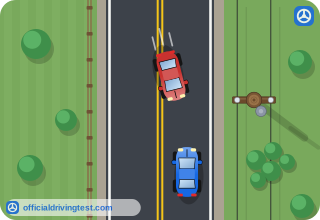
If you cannot stop before hitting an oncoming vehicle, you should:
- Accelerate to get past it faster
- Turn the wheel as sharply as possible
- Close your eyes and brake
- Steer around it, turning no more than needed
Show answer
Correct answer: Steer around it, turning no more than needed
If you cannot stop before hitting another vehicle, try to steer around it, and do not turn more than needed to avoid a crash.
Source: What Every Driver Must Know (October 2025), page 62 · Open this page in the manual (Manual page 62)
-
In cold weather, which parts of the road freeze before the rest of the road surface?
- Freeway on-ramps and exits
- Bridges and underpasses
- Parking lots and driveways
- Intersections and crosswalks
Show answer
Correct answer: Bridges and underpasses
In cold weather, bridges and underpasses freeze before the road does.
Source: What Every Driver Must Know (October 2025), page 62 · Open this page in the manual (Manual page 62)
-
Before winter, you should make sure your antifreeze is:
- Replaced with plain water for the winter season
- Only checked every two years
- Strong and fresh enough to prevent freezing and rust
- Diluted with extra water to make it last longer
Show answer
Correct answer: Strong and fresh enough to prevent freezing and rust
Make sure the antifreeze is strong enough to prevent freezing of the engine and fresh enough to prevent rust.
Source: What Every Driver Must Know (October 2025), page 62 · Open this page in the manual (Manual page 62)
-
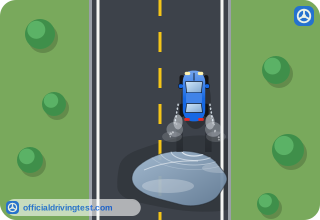
After driving through deep water, your brakes may become wet. What should you do?
- Turn off the engine and wait for them to dry
- Continue driving normally; wet brakes work the same
- Pull the parking brake repeatedly
- Slow down and gently push the pedal until they work properly
Show answer
Correct answer: Slow down and gently push the pedal until they work properly
Test your brakes after driving through deep water; slow down and gently push the brake pedal until they work properly again.
Source: What Every Driver Must Know (October 2025), page 62 · Open this page in the manual (Manual page 62)
-
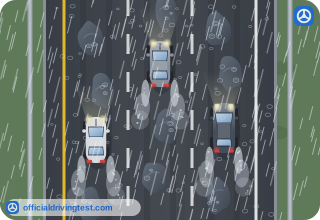
Which of the following contributes to hydroplaning?
- Driving slowly on dry, clean pavement
- Worn tires, low tire pressure, or driving too fast
- New tires inflated to the correct tire pressure
- Using cruise control
Show answer
Correct answer: Worn tires, low tire pressure, or driving too fast
Worn tires, low tire pressure or driving too fast contribute to hydroplaning.
Source: What Every Driver Must Know (October 2025), page 62 · Open this page in the manual (Manual page 62)
-
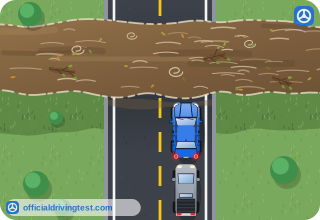
If there are no barricades at a flooded road, what does the manual suggest?
- Wait for another driver to test it first
- Always drive through regardless
- Consider finding an alternate route
- Drive through at normal speed
Show answer
Correct answer: Consider finding an alternate route
If there are no barricades at a flooded road, consider finding an alternate route; deep water can damage your vehicle's engine.
Source: What Every Driver Must Know (October 2025), page 63 · Open this page in the manual (Manual page 63)
-
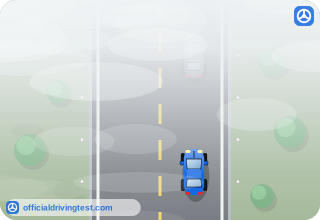
When driving in fog, you should:
- Follow the vehicle ahead closely to see the road
- Turn off your headlights
- Use low-beam headlights and be prepared to stop quickly
- Use your high beams for maximum visibility
Show answer
Correct answer: Use low-beam headlights and be prepared to stop quickly
Drive slowly in fog, turn on your low-beam headlights, and be prepared to stop quickly.
Source: What Every Driver Must Know (October 2025), page 63 · Open this page in the manual (Manual page 63)
-
In cold weather, drivers should be alert and listen for:
- Only emergency vehicles
- Only pedestrians
- Only other cars
- Snowmobiles, and watch for trail or crosswalk signs along the roadway
Show answer
Correct answer: Snowmobiles, and watch for trail or crosswalk signs along the roadway
In cold weather, be alert and listen for snowmobiles, and watch for trail or crosswalk signs along the roadway.
Source: What Every Driver Must Know (October 2025), page 63 · Open this page in the manual (Manual page 63)
-
When driving on snow or a slippery road, you should:
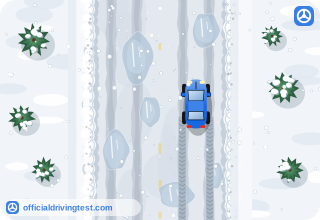
- Test your brakes lightly
- Brake as hard as possible immediately
- Avoid using your brakes entirely
- Pump the accelerator
Show answer
Correct answer: Test your brakes lightly
Test your vehicle's brakes lightly to get a feel for the road.
Source: What Every Driver Must Know (October 2025), page 63 · Open this page in the manual (Manual page 63)
-
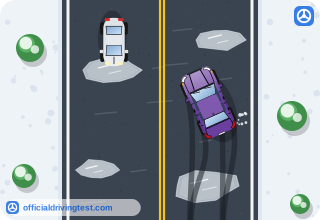
Most skids happen when a driver:
- Uses low-beam headlights in the rain
- Turns too quickly or stops suddenly
- Uses cruise control on dry roads
- Drives too slowly on a dry road
Show answer
Correct answer: Turns too quickly or stops suddenly
Most skids happen when a driver tries to turn too quickly or stops suddenly on slippery pavement.
Source: What Every Driver Must Know (October 2025), page 63 · Open this page in the manual (Manual page 63)
-
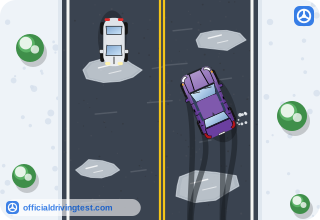
If your vehicle begins skidding, after taking your foot off the accelerator, you should:
- Turn the steering wheel as far as it will go
- Apply the parking brake immediately
- Accelerate to regain traction
- Point the front wheels where you want to go
Show answer
Correct answer: Point the front wheels where you want to go
Turn the front wheels only enough to keep them pointed where you want to go, and be prepared for a secondary skid in the opposite direction.
Source: What Every Driver Must Know (October 2025), page 63 · Open this page in the manual (Manual page 63)
-
Your stopping distance can be affected by:
- Only the make of your vehicle
- Only the time of day when you are driving
- Fatigue, attention, road surface and weather
- Only the color of your vehicle
Show answer
Correct answer: Fatigue, attention, road surface and weather
Stopping distance can be affected by fatigue, attention, vehicle type and weight, tire/brake condition, road surface, and weather.
Source: What Every Driver Must Know (October 2025), page 64 · Open this page in the manual (Manual page 64)
-
To make a smooth stop on wet pavement, you should:
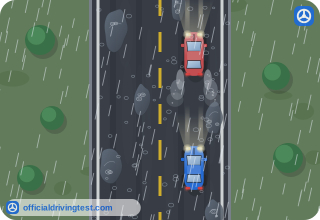
- Increase pressure gradually, then reduce it just before you stop
- Keep constant light pressure on the pedal the entire time
- Slam on the brakes hard at the last possible moment
- Pump the brakes rapidly throughout
Show answer
Correct answer: Increase pressure gradually, then reduce it just before you stop
On wet pavement, increase pressure on the brake pedal gradually and reduce it just before you stop for a smooth stop.
Source: What Every Driver Must Know (October 2025), page 64 · Open this page in the manual (Manual page 64)
-
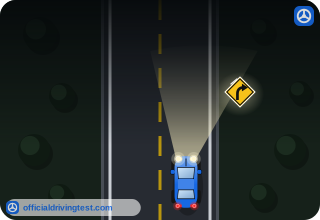
When driving at night, you should be able to:
- Rely on other drivers to warn you of hazards
- Only worry about stopping distance during the day
- Always drive at the speed limit regardless of visibility
- Stop within the clear distance you can see ahead
Show answer
Correct answer: Stop within the clear distance you can see ahead
You should be able to stop within the clear distance you can see ahead; drive within the range of your headlights.
Source: What Every Driver Must Know (October 2025), page 64 · Open this page in the manual (Manual page 64)
-
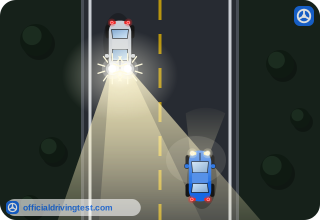
If an oncoming driver does not dim their high beams, you should:
- Close your eyes briefly
- Look directly at their headlights
- Keep your eyes on the right edge of the road ahead
- Flash your high beams repeatedly at them until they dim
Show answer
Correct answer: Keep your eyes on the right edge of the road ahead
Keep your eyes on the right edge of the road ahead; do not look directly into oncoming headlights, and a dirty windshield will make the glare worse.
Source: What Every Driver Must Know (October 2025), page 64 · Open this page in the manual (Manual page 64)
-
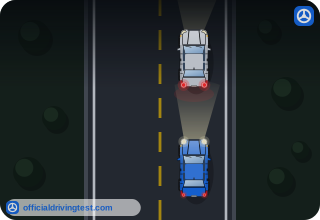
Why should you avoid using high beams when driving behind another vehicle?
- High beams do not work properly at low speeds
- It is only a courtesy, not a rule
- It saves fuel
- Bright light in their mirrors can be distracting
Show answer
Correct answer: Bright light in their mirrors can be distracting
Do not use high beams when behind other vehicles; bright lights shining in their rearview mirrors can be distracting.
Source: What Every Driver Must Know (October 2025), page 64 · Open this page in the manual (Manual page 64)
-
Headlights must be turned on any time there is not enough daylight to see people and vehicles clearly at:
- 50 feet
- 100 feet
- 1,000 feet
- 500 feet
Show answer
Correct answer: 500 feet
Headlights must be on any time there is not enough daylight to see people and vehicles clearly at 500 feet; it is illegal to use only parking lights when headlights are required.
Source: What Every Driver Must Know (October 2025), page 64 · Open this page in the manual (Manual page 64)
-
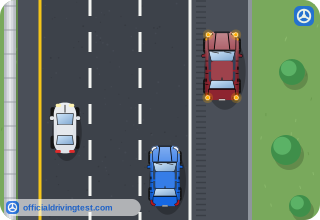
Generally, what is the safest thing to do if you are involved in a roadside emergency?
- Wave down passing vehicles from the road
- Try to fix the problem yourself in the traffic lane
- Get out and start walking to find help
- Stay in your car with your seat belt on until help arrives
Show answer
Correct answer: Stay in your car with your seat belt on until help arrives
Generally, the safest thing to do in a roadside emergency is to stay in your car, with your seat belt buckled, until help arrives.
Source: What Every Driver Must Know (October 2025), page 64 · Open this page in the manual (Manual page 64)
-
What happens if you leave the scene of a crash you were involved in?
- It is only a civil matter
- It is legal if you report it within a week
- It is illegal and punishable by fines, jail time or both
- There are no legal consequences if no one was hurt
Show answer
Correct answer: It is illegal and punishable by fines, jail time or both
Leaving the scene of a crash is against the law, punishable by fines, jail time or both; penalties increase if alcohol was involved or if there were injuries or fatalities.
Source: What Every Driver Must Know (October 2025), page 65 · Open this page in the manual (Manual page 65)
-
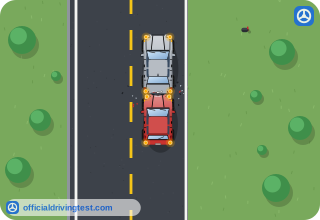
After a crash that does not involve serious injury or death, if the vehicle can be driven and it's safe, it should be:
- Abandoned at the scene
- Driven immediately to a repair shop
- Moved off the main roadway to the shoulder, median, or a nearby parking lot
- Left exactly where it stopped, blocking traffic, until police arrive
Show answer
Correct answer: Moved off the main roadway to the shoulder, median, or a nearby parking lot
Vehicles in crashes without serious injury or death should be moved from the main roadway to a safe location like the shoulder, median, or a nearby parking lot, if drivable and safe.
Source: What Every Driver Must Know (October 2025), page 65 · Open this page in the manual (Manual page 65)
-
After a crash, drivers involved should exchange:
- Nothing at all until the police arrive at the scene
- Only insurance company names
- Only their phone numbers, nothing else
- Names, addresses, license numbers, registration and insurance
Show answer
Correct answer: Names, addresses, license numbers, registration and insurance
Exchange names, addresses, driver's license numbers, registration and insurance information with the other drivers involved.
Source: What Every Driver Must Know (October 2025), page 65 · Open this page in the manual (Manual page 65)
-
If you hit a deer, you should report it to local law enforcement, the county sheriff, Michigan State Police, or the DNR, because:
- Only insurance companies need to know
- They can provide a permit to keep the deer
- It has no benefit to you
- It is required only if the deer survives
Show answer
Correct answer: They can provide a permit to keep the deer
If you hit a deer, report it to authorities, who can provide a permit to keep it.
Source: What Every Driver Must Know (October 2025), page 65 · Open this page in the manual (Manual page 65)
-
Which of the following should you NOT rely on to avoid hitting deer?
- Watching for deer crossing signs
- Deer whistles, flashing high beams, or honking
- Slowing down when you see one deer
- Staying especially alert at dawn and dusk
Show answer
Correct answer: Deer whistles, flashing high beams, or honking
Do not rely on gimmicks - deer whistles, flashing your high-beam headlights or honking your horn will not deter deer.
Source: What Every Driver Must Know (October 2025), page 65 · Open this page in the manual (Manual page 65)
-
According to the manual, when should you be especially alert for deer?
- Only on freeways, never on local roads
- Only in winter, when roads are icy
- At noon, in the summer months
- At dawn and dusk, and in fall and spring
Show answer
Correct answer: At dawn and dusk, and in fall and spring
Be especially alert for deer at dawn and dusk, and in fall and spring, though vehicle-deer crashes can occur at any time of the year.
Source: What Every Driver Must Know (October 2025), page 65 · Open this page in the manual (Manual page 65)
-
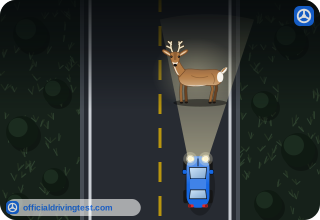
If a vehicle-deer crash is unavoidable, after coming to a controlled stop, you should:
- Reverse back onto the road
- Immediately restart and continue your trip
- Get out immediately to check on the deer
- Steer your vehicle well off the roadway
Show answer
Correct answer: Steer your vehicle well off the roadway
After coming to a controlled stop following an unavoidable deer collision, steer your vehicle well off the roadway.
Source: What Every Driver Must Know (October 2025), page 65 · Open this page in the manual (Manual page 65)
-
Most cars have at least how many blind spots that cannot be seen with the side-view mirrors?
- Four
- One, directly behind the vehicle
- None
- Two, to the left and right rear
Show answer
Correct answer: Two, to the left and right rear
Most cars have at least two blind spots, areas to the left and right rear of the vehicle that you cannot see with your side-view mirrors.
Source: What Every Driver Must Know (October 2025), page 66 · Open this page in the manual (Manual page 66)
-
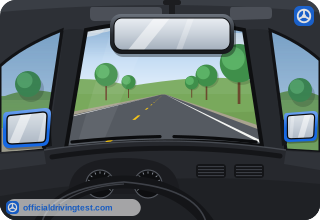
To minimize blind spots, your outside mirrors should be adjusted to:
- Show only the sky
- Show the interior of your own vehicle
- Match the inside rearview mirror exactly
- See the edges of your vehicle
Show answer
Correct answer: See the edges of your vehicle
Adjust the left and right outside mirrors to see the edges of the vehicle when seated in a normal driving position, to minimize blind spots.
Source: What Every Driver Must Know (October 2025), page 66 · Open this page in the manual (Manual page 66)
-
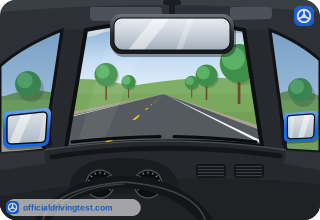
In the alternate blind-spot mirror adjustment method described in the manual, you should:
- Adjust mirrors while the vehicle is moving at freeway speed
- Only adjust the inside rearview mirror, never the outside ones
- Fold both mirrors in completely
- Lean left, then right, setting each mirror to barely show the rear edge
Show answer
Correct answer: Lean left, then right, setting each mirror to barely show the rear edge
Lean left to touch your head to the driver side window and adjust the left mirror to barely show the rear edge of the vehicle. Then lean right to position your head above the center console or in line with the rearview mirror, and adjust the right mirror to barely show the rear edge of the vehicle.
Source: What Every Driver Must Know (October 2025), page 66 · Open this page in the manual (Manual page 66)
-
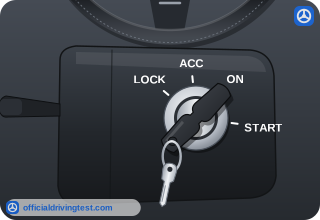
Why should you never turn the ignition to the 'lock' position while your vehicle is in motion?
- It has no real effect while you are driving
- The steering will lock and you could lose control
- It will trigger the alarm
- It will drain the battery
Show answer
Correct answer: The steering will lock and you could lose control
Never turn the ignition to the "lock" position while your vehicle is in motion - the steering will lock and you could lose control.
Source: What Every Driver Must Know (October 2025), page 66 · Open this page in the manual (Manual page 66)
-
If someone acting suspiciously approaches your vehicle, you should:
- Turn off your engine and wait
- Roll down your window to talk to them
- Get out to confront them
- Try to drive away or sound the horn
Show answer
Correct answer: Try to drive away or sound the horn
If someone acting suspiciously approaches your vehicle, try to drive away or sound the horn.
Source: What Every Driver Must Know (October 2025), page 66 · Open this page in the manual (Manual page 66)
-
Under Michigan law, is it allowed to use a mobile phone while driving to report an emergency?
- Only for passengers, never the driver
- Yes, it is allowed
- No, it is always illegal
- Only if the vehicle is parked
Show answer
Correct answer: Yes, it is allowed
Use of a mobile phone while driving to report emergencies is allowed under Michigan law.
Source: What Every Driver Must Know (October 2025), page 67 · Open this page in the manual (Manual page 67)
-
If a carjacker wants your vehicle, the manual advises you to:
- Argue with the carjacker
- Give it up without a fight
- Try to drive away at high speed
- Fight to keep the vehicle
Show answer
Correct answer: Give it up without a fight
If a carjacker wants the vehicle, give it up without a fight; a car can be replaced but personal safety is priceless.
Source: What Every Driver Must Know (October 2025), page 67 · Open this page in the manual (Manual page 67)
-
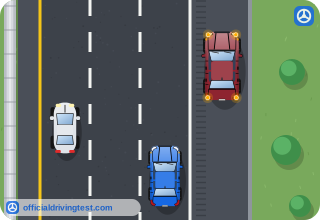
If you must leave a disabled vehicle and walk to safety, you should remember that:
- You should hitchhike instead
- It is dangerous and illegal to walk on the freeway
- You must walk in the travel lane, not the shoulder
- It is legal and safe to walk along any freeway
Show answer
Correct answer: It is dangerous and illegal to walk on the freeway
It is dangerous and illegal for a pedestrian to walk on the freeway.
Source: What Every Driver Must Know (October 2025), page 67 · Open this page in the manual (Manual page 67)
-
If you believe a traffic stop or the ticket you received was inappropriate, you should:
- Drive away without accepting the ticket
- Discuss it with the court, not the officer
- Refuse to sign the ticket
- Argue with the officer at the scene
Show answer
Correct answer: Discuss it with the court, not the officer
Cooperate with the officer's directions, and if you feel the stop or ticket is inappropriate, discuss the matter with the court, not the officer.
Source: What Every Driver Must Know (October 2025), page 67 · Open this page in the manual (Manual page 67)
-
Whose directions take priority over other traffic control devices?
- A road sign
- A traffic light
- A law enforcement officer's orders
- A construction worker's sign only
Show answer
Correct answer: A law enforcement officer's orders
Always obey a law enforcement officer's orders; an officer's directions take priority over other traffic control devices.
Source: What Every Driver Must Know (October 2025), page 67 · Open this page in the manual (Manual page 67)