Louisiana: Right-of-way and turning
Who yields at intersections, turning rules, turnabouts, roundabouts, scanning ahead and passing. Split into 6 shorter tests so you're not stuck in one long quiz.
Independent educational site · not affiliated with any government agency or DMV
Choose a part
Right-of-way and turning — Part 1
Questions in this part include: “Which of these is an effort to improve intersections and reduce crashes there?”
StartRight-of-way and turning — Part 2
Questions in this part include: “Searching to make sure other roadway users will not cross your travel path is especially important at which places?”
StartRight-of-way and turning — Part 3
Questions in this part include: “After you steer into the new lane when changing lanes, what should you do with your turn signal?”
StartRight-of-way and turning — Part 4
Questions in this part include: “You should not attempt to pass if you cannot see at least how far ahead?”
StartRight-of-way and turning — Part 5
Questions in this part include: “When making a left turn, when should you brake?”
StartRight-of-way and turning — Part 6
Questions in this part include: “What does the manual say the law does about the right-of-way?”
StartAll 115 Right-of-way and turning questions with answers
Choose a part above to take a practice test, or study every question and answer here.
Show the questions and answersHide the questions
-
Which of these is an effort to improve intersections and reduce crashes there?
- Narrower lanes at the stop line
- Higher speed limits on side streets
- Removing pavement markings
- Synchronized traffic signals
Show answer
Correct answer: Synchronized traffic signals
The manual lists exclusive turn lanes, roundabouts and synchronized traffic signals as efforts to improve intersections and reduce crashes there.
Source: Class D & E Driver’s Guide (Revised August 2025 (DPSMV2052 R08/25)), page 21 · Open this page in the manual (Manual page 21)
-
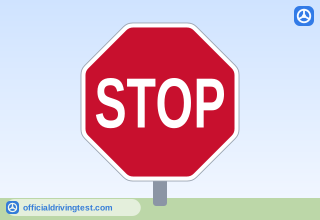
Where must you stop at a stop sign?
- Beyond the crosswalk, at the edge of the intersection
- In the middle of the crosswalk so you can see traffic
- Behind the stop line or crosswalk, if one is present
- Wherever you have the best view of traffic
Show answer
Correct answer: Behind the stop line or crosswalk, if one is present
You must stop behind the stop line or crosswalk, if one is present.
Source: Class D & E Driver’s Guide (Revised August 2025 (DPSMV2052 R08/25)), page 27 · Open this page in the manual (Manual page 27)
-
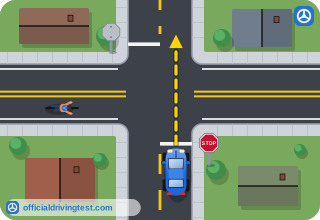
After you stop at a stop sign and look for crossing vehicles and pedestrians, when may you enter the intersection?
- As soon as other drivers see you
- When it is safe to do so
- When the vehicle behind you honks
- As soon as you have counted to three
Show answer
Correct answer: When it is safe to do so
After stopping and looking for crossing vehicles and pedestrians, you may enter the intersection when it is safe to do so.
Source: Class D & E Driver’s Guide (Revised August 2025 (DPSMV2052 R08/25)), page 27 · Open this page in the manual (Manual page 27)
-
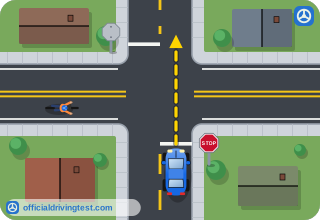
At a stop sign, in which directions must you look for crossing vehicles and pedestrians?
- Only to the left
- Only to the right
- Only straight ahead
- In all directions
Show answer
Correct answer: In all directions
At a stop sign you must look for crossing vehicles and pedestrians in all directions and yield the right-of-way.
Source: Class D & E Driver’s Guide (Revised August 2025 (DPSMV2052 R08/25)), page 27 · Open this page in the manual (Manual page 27)
-
What does a 4-WAY sign added to a stop sign tell you?
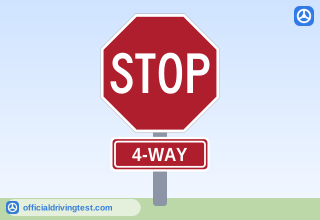
- All approaching traffic has a stop sign
- Four lanes of traffic are ahead
- The intersection has four traffic signals
- You must wait four seconds before going
Show answer
Correct answer: All approaching traffic has a stop sign
A 4-WAY sign may be added to the stop sign at intersections where all approaching traffic has a stop sign.
Source: Class D & E Driver’s Guide (Revised August 2025 (DPSMV2052 R08/25)), page 27 · Open this page in the manual (Manual page 27)
-
What does a yield sign mean you must do?
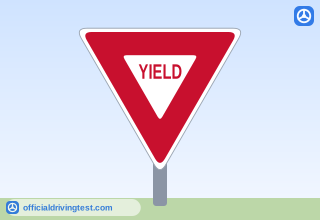
- Come to a complete stop and wait for the other driver to wave you on
- Slow down and let traffic with the right-of-way cross before you enter
- Speed up and enter before the other traffic reaches the intersection
- Stop only if you see another vehicle within sight of the sign
Show answer
Correct answer: Slow down and let traffic with the right-of-way cross before you enter
A yield sign means you must slow down and allow traffic that has the right-of-way to cross before entering.
Source: Class D & E Driver’s Guide (Revised August 2025 (DPSMV2052 R08/25)), page 27 · Open this page in the manual (Manual page 27)
-
Who may use a lane marked with a Shared Center Lane Left Turn Only sign?
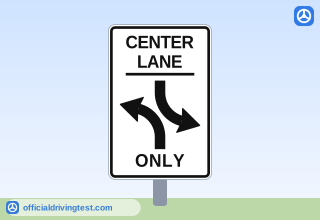
- Through traffic only
- Vehicles passing slower traffic
- Left-turning vehicles from one direction only
- Left-turning vehicles from either direction
Show answer
Correct answer: Left-turning vehicles from either direction
The lane is reserved for left-turning vehicles from either direction and is not to be used for through traffic or passing other vehicles.
Source: Class D & E Driver’s Guide (Revised August 2025 (DPSMV2052 R08/25)), page 27 · Open this page in the manual (Manual page 27)
-
What does a NO TURN ON RED sign tell you?
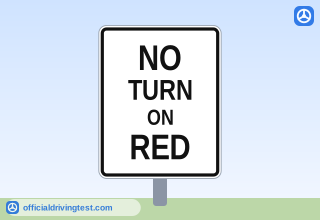
- You may turn right on red after stopping and yielding to pedestrians
- You may turn right only when the light is yellow
- You may not turn right during the red light
- You may turn right only if no vehicle is within sight
Show answer
Correct answer: You may not turn right during the red light
When a NO TURN ON RED sign is posted you may not turn right during the red light and must wait for the traffic signal to turn green.
Source: Class D & E Driver’s Guide (Revised August 2025 (DPSMV2052 R08/25)), page 28 · Open this page in the manual (Manual page 28)
-
A traffic light is red and there is no NO TURN ON RED sign. What may you do after stopping at the stop line and checking for traffic and pedestrians?
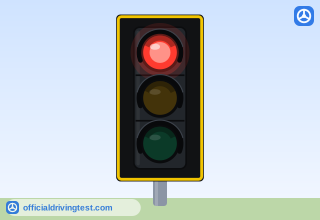
- Turn left on red from any street
- Drive straight through the intersection
- Make a U-turn
- Turn right on red
Show answer
Correct answer: Turn right on red
If there is no NO TURN ON RED sign, after stopping at the stop line and checking for traffic and pedestrians, you may turn right on red.
Source: Class D & E Driver’s Guide (Revised August 2025 (DPSMV2052 R08/25)), page 28 · Open this page in the manual (Manual page 28)
-
According to a DO NOT BLOCK INTERSECTION sign, when must you not enter an intersection?
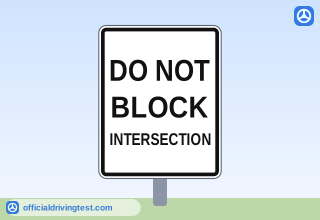
- When traffic does not allow you to clear it completely
- When the traffic light has just turned green
- When another vehicle is waiting to turn behind you
- When you plan to turn right at the intersection
Show answer
Correct answer: When traffic does not allow you to clear it completely
You must not enter an intersection if traffic conditions do not permit you to clear the intersection completely.
Source: Class D & E Driver’s Guide (Revised August 2025 (DPSMV2052 R08/25)), page 28 · Open this page in the manual (Manual page 28)
-
What does a DO NOT BLOCK INTERSECTION sign tell you not to do in the intersection?
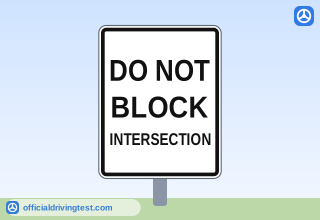
- Drive through on a green light
- Turn right when the way is clear
- Stop, stand or park at any time
- Enter when the light is green and traffic is moving
Show answer
Correct answer: Stop, stand or park at any time
A DO NOT BLOCK INTERSECTION sign tells you not to stop, stand or park at any time in the intersection.
Source: Class D & E Driver’s Guide (Revised August 2025 (DPSMV2052 R08/25)), page 28 · Open this page in the manual (Manual page 28)
-
What must you do when turning left at a signal with a LEFT TURN YIELD ON GREEN sign?
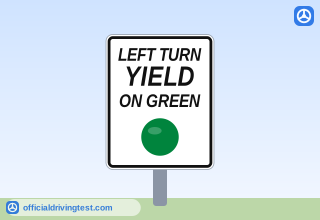
- Wait for a green arrow
- Yield to oncoming traffic
- Stop and turn only when the signal is red
- Turn ahead of oncoming vehicles
Show answer
Correct answer: Yield to oncoming traffic
A LEFT TURN YIELD ON GREEN sign tells you that a left turn is permitted, but you must yield to oncoming traffic.
Source: Class D & E Driver’s Guide (Revised August 2025 (DPSMV2052 R08/25)), page 28 · Open this page in the manual (Manual page 28)
-
When may you turn left at a steady green traffic light?
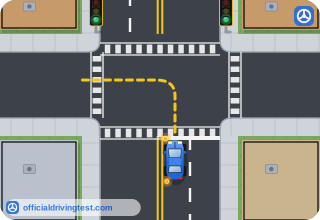
- Only when the intersection is clear, and you yield to oncoming traffic
- At any time, because oncoming traffic must stop for a green light
- Only if a green arrow is also lit and no sign prohibits the turn
- Only after coming to a complete stop and waiting for a green arrow
Show answer
Correct answer: Only when the intersection is clear, and you yield to oncoming traffic
Turning left at a steady green light means you may turn only when the intersection is clear, and you should always yield to the oncoming traffic flow and pedestrians.
Source: Class D & E Driver’s Guide (Revised August 2025 (DPSMV2052 R08/25)), page 33 · Open this page in the manual (Manual page 33)
-
At a red light with no sign prohibiting a right turn on red, what must you do before turning right?
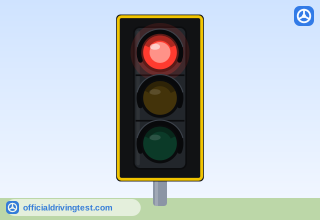
- Stop, then turn after yielding to traffic, including pedestrians
- Slow down and turn if no other vehicle is in the intersection
- Wait for a green arrow before turning, even if no sign prohibits it
- Turn without stopping if the crosswalk is empty of pedestrians
Show answer
Correct answer: Stop, then turn after yielding to traffic, including pedestrians
If no sign prohibits it, you may turn right on red after stopping and yielding to traffic, including pedestrians.
Source: Class D & E Driver’s Guide (Revised August 2025 (DPSMV2052 R08/25)), page 34 · Open this page in the manual (Manual page 34)
-
When may some left turns be permitted on red?
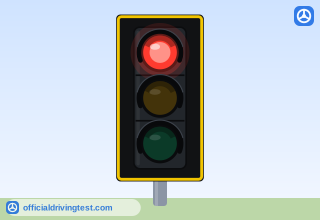
- When moving from a two-way street onto a one-way street
- When moving from a one-way street onto a two-way street
- When moving from a one-way street onto another one-way street
- When no vehicle is visible in either direction
Show answer
Correct answer: When moving from a one-way street onto another one-way street
The manual says some left turns may be permitted on red when moving from a one-way street onto another one-way street.
Source: Class D & E Driver’s Guide (Revised August 2025 (DPSMV2052 R08/25)), page 34 · Open this page in the manual (Manual page 34)
-
Where a left turn on red is permitted, what must you yield to?
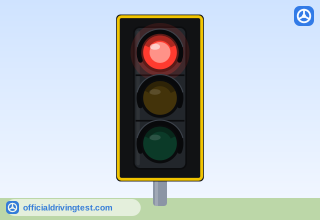
- Only oncoming traffic coming toward you in the opposite lane
- Only pedestrians who are in a marked crosswalk in front of you
- Only vehicles that are also turning right on red from the side
- All traffic and pedestrians crossing in front or to the side
Show answer
Correct answer: All traffic and pedestrians crossing in front or to the side
When turning left on red where permitted, you must yield to all traffic and pedestrians crossing in front or to the side of your vehicle.
Source: Class D & E Driver’s Guide (Revised August 2025 (DPSMV2052 R08/25)), page 34 · Open this page in the manual (Manual page 34)
-
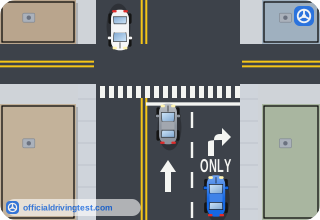
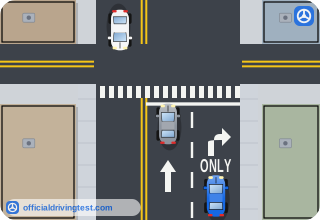
You are in a lane that requires you to turn, but you want to go straight ahead. What does the manual say you must do?
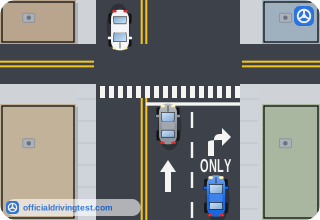
- Go ahead and make the turn
- Stop and wait until you can change lanes safely
- Change lanes quickly before you reach the intersection
- Back up to the previous intersection and change lanes
Show answer
Correct answer: Go ahead and make the turn
If you stop and wait for a chance to change lanes you are blocking traffic, so you must go ahead and make the turn.
Source: Class D & E Driver’s Guide (Revised August 2025 (DPSMV2052 R08/25)), page 37 · Open this page in the manual (Manual page 37)
-
After being forced to turn from a lane when you wanted to go straight, how can you return to the street you want?
- Make a U-turn in the middle of the intersection
- Stop in the lane until traffic clears
- Drive around the block and return to that street
- Back up into the intersection
Show answer
Correct answer: Drive around the block and return to that street
The manual says to drive around the block and return to the street you want, then continue your trip safely without creating a hazardous situation.
Source: Class D & E Driver’s Guide (Revised August 2025 (DPSMV2052 R08/25)), page 37 · Open this page in the manual (Manual page 37)
-
Why should you not suddenly change lanes if you are in a lane that requires you to turn?
- Lane changes are not allowed within an intersection
- Other drivers will not expect you to change lanes suddenly
- Other drivers always speed up when they see a turn signal
- Your vehicle may lose traction if it changes lanes
Show answer
Correct answer: Other drivers will not expect you to change lanes suddenly
The manual notes that other drivers will not expect you to suddenly change lanes, and drivers behind you will not expect a sudden stop.
Source: Class D & E Driver’s Guide (Revised August 2025 (DPSMV2052 R08/25)), page 37 · Open this page in the manual (Manual page 37)
-
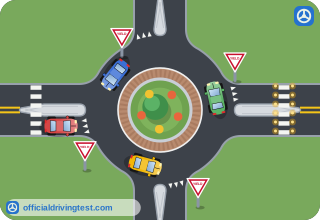
What are roundabouts?
- Rectangular intersections with traffic lights
- Three-way intersections without stop signs
- Divided highways that join with an exit ramp
- Circular intersections
Show answer
Correct answer: Circular intersections
Roundabouts are circular intersections that reduce traffic congestion and conflicts that are often the cause of crashes at traditional intersections.
Source: Class D & E Driver’s Guide (Revised August 2025 (DPSMV2052 R08/25)), page 37 · Open this page in the manual (Manual page 37)
-
According to the manual, roundabouts reduce what that is often the cause of crashes at traditional intersections?
- Traffic noise and exhaust fumes
- Pedestrian crossings and bicycle lanes
- Traffic congestion and conflicts
- The need for any traffic signs
Show answer
Correct answer: Traffic congestion and conflicts
Roundabouts reduce traffic congestion and conflicts that are often the cause of crashes at traditional intersections.
Source: Class D & E Driver’s Guide (Revised August 2025 (DPSMV2052 R08/25)), page 37 · Open this page in the manual (Manual page 37)
-
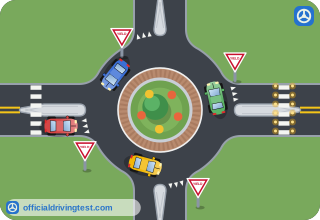
In a roundabout, traffic yields to which traffic?
- The circulation traffic
- The traffic waiting behind you
- The largest vehicle
- The traffic that arrived first at the entrance
Show answer
Correct answer: The circulation traffic
In a roundabout, traffic yields to the circulation traffic, and the vehicle in the roundabout has the right of way.
Source: Class D & E Driver’s Guide (Revised August 2025 (DPSMV2052 R08/25)), page 37 · Open this page in the manual (Manual page 37)
-
What does the manual say about stopping once you are inside a roundabout?
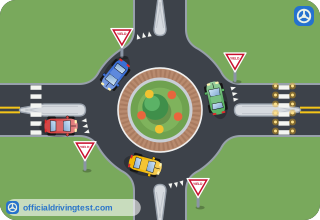
- You should stop and wait if another vehicle is waiting to enter
- You should stop if you are unsure which exit to take
- You should stop briefly to check traffic before leaving
- You should never stop
Show answer
Correct answer: You should never stop
The manual says never to stop once inside the roundabout.
Source: Class D & E Driver’s Guide (Revised August 2025 (DPSMV2052 R08/25)), page 37 · Open this page in the manual (Manual page 37)
-
What should you look for to know where to exit a roundabout?
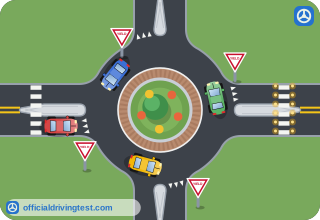
- Stop lines on the pavement
- Destination signs
- The color of the center island
- The direction the car ahead signals
Show answer
Correct answer: Destination signs
The manual says to look for destination signs and exit in that direction.
Source: Class D & E Driver’s Guide (Revised August 2025 (DPSMV2052 R08/25)), page 37 · Open this page in the manual (Manual page 37)
-
Searching to make sure other roadway users will not cross your travel path is especially important at which places?
- Straight rural roads with no side streets
- Long stretches of interstate with no ramps
- Intersections and highway-railroad grade crossings
- Roads with no other traffic in sight
Show answer
Correct answer: Intersections and highway-railroad grade crossings
At any time other vehicles or pedestrians may cross or enter your travel path, which is especially true at intersections and highway-railroad grade crossings.
Source: Class D & E Driver’s Guide (Revised August 2025 (DPSMV2052 R08/25)), page 62 · Open this page in the manual (Manual page 62)
-
What does the manual say an intersection is?
- Only a place where two public roads cross with a traffic signal
- Any place where traffic flow merges or crosses
- Only a place where two numbered highways meet
- Any place where a road ends at a stop sign
Show answer
Correct answer: Any place where traffic flow merges or crosses
Intersections are any place where traffic flow merges or crosses, including cross streets, side streets, driveways, shopping center lanes and parking lot entrances.
Source: Class D & E Driver’s Guide (Revised August 2025 (DPSMV2052 R08/25)), page 62 · Open this page in the manual (Manual page 62)
-
Before entering an intersection, in which directions should you look for approaching vehicles and crossing pedestrians?
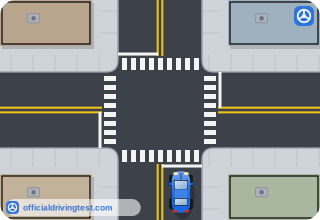
- Only to the front and the right
- Only to the left and the rear
- To the front and the rear
- To the front, left and right
Show answer
Correct answer: To the front, left and right
Before entering an intersection, you look to the front, left and right for approaching vehicles and crossing pedestrians.
Source: Class D & E Driver’s Guide (Revised August 2025 (DPSMV2052 R08/25)), page 62 · Open this page in the manual (Manual page 62)
-
If you are stopped at an intersection, how should you look before entering it?
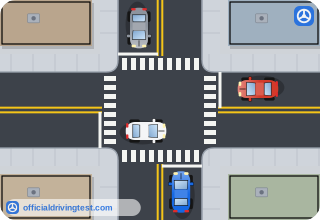
- Left, right and left again
- Right, left and right again
- Left and right once each
- Straight ahead only
Show answer
Correct answer: Left, right and left again
If you are stopped, you look left, right and left again before entering the intersection.
Source: Class D & E Driver’s Guide (Revised August 2025 (DPSMV2052 R08/25)), page 62 · Open this page in the manual (Manual page 62)
-
Why should you look to the front, left and right at an intersection even if other traffic has a red light or a stop sign?
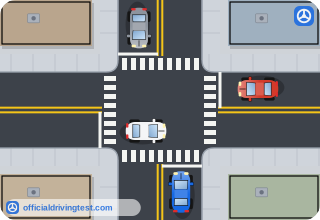
- Red lights and stop signs do not apply to cross traffic
- Cross traffic always has the right-of-way
- Some drivers may not obey signals or signs, or may not see them
- Traffic signals at intersections are often switched off
Show answer
Correct answer: Some drivers may not obey signals or signs, or may not see them
You should not rely on signals or signs to tell you that no one will cross in front of you, because some drivers may not obey them or may not see them.
Source: Class D & E Driver’s Guide (Revised August 2025 (DPSMV2052 R08/25)), page 62 · Open this page in the manual (Manual page 62)
-
When is searching for cross traffic at an intersection especially important?
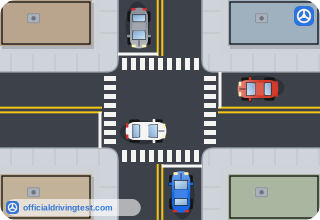
- Only when the traffic light is flashing
- Just after the light has turned green
- Only when there is a stop sign instead of a light
- Just after the light has turned yellow
Show answer
Correct answer: Just after the light has turned green
This searching technique is especially important just after the light has turned green, because people on the cross street are most likely to hurry through before the light changes to red.
Source: Class D & E Driver’s Guide (Revised August 2025 (DPSMV2052 R08/25)), page 62 · Open this page in the manual (Manual page 62)
-
Why should you make sure the travel path is clear all the way through an intersection before you enter it?
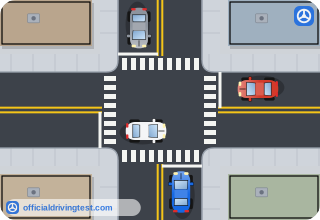
- So you can drive through without signaling
- So you can change lanes inside the intersection
- So you can speed up after the light turns green
- So you will not block the intersection if you stop
Show answer
Correct answer: So you will not block the intersection if you stop
You make sure the path is clear all the way through and you can clearly see crossing traffic so you will not block the intersection if you have to stop.
Source: Class D & E Driver’s Guide (Revised August 2025 (DPSMV2052 R08/25)), page 62 · Open this page in the manual (Manual page 62)
-
At an intersection, your stopped vehicle's view of the cross street is blocked. What should you do?
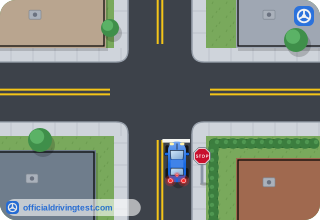
- Edge forward slowly until you can see
- Honk your horn and drive across
- Wait for the cross traffic to wave you through
- Accelerate quickly to clear the intersection
Show answer
Correct answer: Edge forward slowly until you can see
If you are stopped and your view of traffic or a cross street is blocked, you edge forward slowly until you can see.
Source: Class D & E Driver’s Guide (Revised August 2025 (DPSMV2052 R08/25)), page 62 · Open this page in the manual (Manual page 62)
-
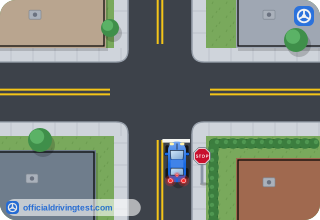
Why does edging forward slowly help when your view of the cross street is blocked?
- It lets you turn without using a signal
- It keeps cross traffic from seeing your brake lights
- Crossing drivers can see the front of your vehicle first
- It lets you claim the right-of-way
Show answer
Correct answer: Crossing drivers can see the front of your vehicle first
By moving forward slowly, crossing drivers can see the front of your vehicle before you can see them, which gives them a chance to slow down and warn you.
Source: Class D & E Driver’s Guide (Revised August 2025 (DPSMV2052 R08/25)), page 62 · Open this page in the manual (Manual page 62)
-
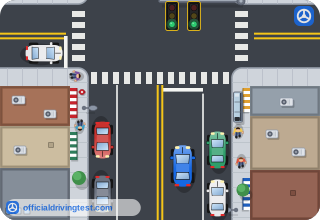
Whenever there is a lot of activity along the side of the road, what is there a good chance of?
- Traffic ahead will speed up quickly
- Someone will cross or enter the road
- The road will narrow
- The speed limit will change
Show answer
Correct answer: Someone will cross or enter the road
Whenever there is a lot of activity along the side of the road, there is a good chance that someone will cross or enter the road.
Source: Class D & E Driver’s Guide (Revised August 2025 (DPSMV2052 R08/25)), page 62 · Open this page in the manual (Manual page 62)
-
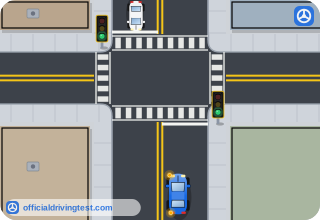
When turning left at an intersection, what should you do to be ready to turn?
- Stop short of the crosswalk
- Stay well back from the intersection
- Move to the right lane first
- Pull into the intersection
Show answer
Correct answer: Pull into the intersection
When turning left at an intersection, you pull into the intersection to be ready to turn left.
Source: Class D & E Driver’s Guide (Revised August 2025 (DPSMV2052 R08/25)), page 62 · Open this page in the manual (Manual page 62)
-
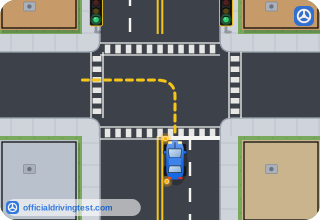
Before turning left across oncoming traffic, what should you look for?
- A safe gap in the traffic
- A vehicle ahead to follow through the turn
- A green arrow for all lanes
- An empty lane to your right
Show answer
Correct answer: A safe gap in the traffic
Before turning left across oncoming traffic, you look for a safe gap in the traffic.
Source: Class D & E Driver’s Guide (Revised August 2025 (DPSMV2052 R08/25)), page 62 · Open this page in the manual (Manual page 62)
-
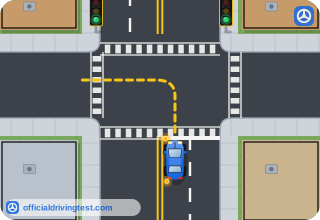
When turning left, which traffic must you yield to?
- Only oncoming vehicles that are going straight ahead
- Only oncoming vehicles turning right
- Oncoming vehicles going straight ahead or turning right
- Only vehicles behind you
Show answer
Correct answer: Oncoming vehicles going straight ahead or turning right
When turning left you must yield to oncoming vehicles going straight ahead or turning right.
Source: Class D & E Driver’s Guide (Revised August 2025 (DPSMV2052 R08/25)), page 63 · Open this page in the manual (Manual page 63)
-
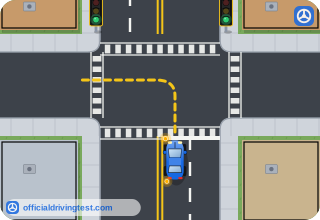
Before turning left, you search to be sure of what?
- That the driver behind you has enough room to pass you on the right
- That nothing in the travel path could leave you stranded in oncoming traffic
- That the oncoming lane has a green arrow for left turns
- That no vehicles are parked along the curb on the far side
Show answer
Correct answer: That nothing in the travel path could leave you stranded in oncoming traffic
Before turning left you search for vehicles or pedestrians in the travel path that could leave your vehicle stranded in the path of oncoming traffic.
Source: Class D & E Driver’s Guide (Revised August 2025 (DPSMV2052 R08/25)), page 63 · Open this page in the manual (Manual page 63)
-
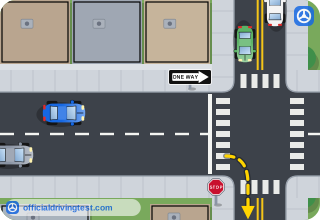
Before turning right, what should you make sure of?
- No traffic is approaching from your right and no oncoming traffic is going straight
- No vehicle is following you and no pedestrians are waiting at the curb
- The oncoming lanes are empty for at least 500 feet in both directions
- No traffic approaching from your left and no oncoming vehicle turning left into your path
Show answer
Correct answer: No traffic approaching from your left and no oncoming vehicle turning left into your path
Before turning right, you make sure there is no traffic approaching from your left and no oncoming traffic turning left into your path.
Source: Class D & E Driver’s Guide (Revised August 2025 (DPSMV2052 R08/25)), page 63 · Open this page in the manual (Manual page 63)
-
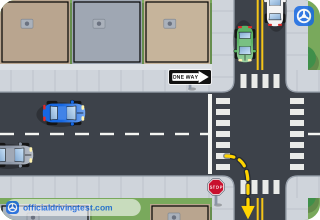
What must you search for before you begin turning right?
- Pedestrians crossing
- A railroad crossing sign
- A left-turn lane
- Vehicles parked ahead
Show answer
Correct answer: Pedestrians crossing
You must not begin turning right without searching for pedestrians crossing.
Source: Class D & E Driver’s Guide (Revised August 2025 (DPSMV2052 R08/25)), page 63 · Open this page in the manual (Manual page 63)
-
Before changing lanes, where must you check for traffic?
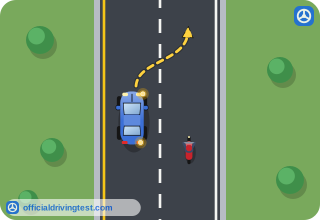
- In the lane you want to enter and behind your vehicle
- Only in the lane you are leaving and the oncoming lanes
- Only ahead of your vehicle in your own lane
- Only in the lane you want to enter
Show answer
Correct answer: In the lane you want to enter and behind your vehicle
Prior to changing lanes, you must check for traffic in the lane you want to enter and behind your vehicle.
Source: Class D & E Driver’s Guide (Revised August 2025 (DPSMV2052 R08/25)), page 63 · Open this page in the manual (Manual page 63)
-
How do you check your blind spots before changing lanes?
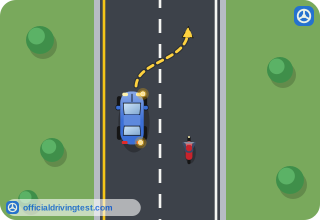
- Look only in your rearview mirror and side mirrors
- Look over your shoulder in the direction you plan to move
- Lean forward and watch your outside mirrors closely
- Wait until the other driver signals to you
Show answer
Correct answer: Look over your shoulder in the direction you plan to move
You check your blind spots by turning your head and looking over your shoulder in the direction you plan to move.
Source: Class D & E Driver’s Guide (Revised August 2025 (DPSMV2052 R08/25)), page 63 · Open this page in the manual (Manual page 63)
-
While checking traffic to the sides, rear or over your shoulder, why should you not look too long at any one time?
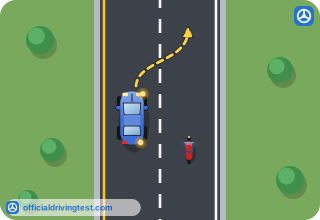
- Your turn signal could turn off
- Your mirrors could move out of position
- Traffic behind you could slow down
- Traffic ahead of you could stop suddenly
Show answer
Correct answer: Traffic ahead of you could stop suddenly
Traffic ahead of you could stop suddenly while you are checking traffic to the sides, rear or over your shoulder.
Source: Class D & E Driver’s Guide (Revised August 2025 (DPSMV2052 R08/25)), page 63 · Open this page in the manual (Manual page 63)
-
When changing lanes, what size gap in traffic should you identify before you signal and look again in the direction of the lane change?
- A 4 to 5 second gap
- A 1 to 2 second gap
- A 7 to 8 second gap
- A 10 to 12 second gap
Show answer
Correct answer: A 4 to 5 second gap
When changing lanes you identify a 4 to 5 second gap in traffic, signal, and look again in the direction of the lane change.
Source: Class D & E Driver’s Guide (Revised August 2025 (DPSMV2052 R08/25)), page 63 · Open this page in the manual (Manual page 63)
-
After you steer into the new lane when changing lanes, what should you do with your turn signal?
- Leave it on until the next intersection
- Flash it twice more
- Cancel it
- Leave it on for the next 5 seconds
Show answer
Correct answer: Cancel it
The lane-change steps end with adjusting speed, steering into the lane and canceling the turn signal.
Source: Class D & E Driver’s Guide (Revised August 2025 (DPSMV2052 R08/25)), page 63 · Open this page in the manual (Manual page 63)
-
What does the manual say to do about turning around on a busy street?
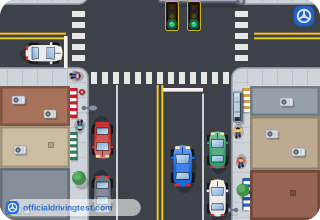
- Do it quickly at the first break in traffic
- Do it only at an intersection with a signal
- Back up into the nearest driveway
- Avoid it; circling an entire city block is better
Show answer
Correct answer: Avoid it; circling an entire city block is better
You should try to avoid turning around on a busy street, and it is better to circle an entire city block.
Source: Class D & E Driver’s Guide (Revised August 2025 (DPSMV2052 R08/25)), page 66 · Open this page in the manual (Manual page 66)
-
When turning around on a narrow street in light traffic, where should you stop first?
- Close to the right edge of the pavement
- In the center of the street
- Close to the left edge of the pavement
- On the left shoulder
Show answer
Correct answer: Close to the right edge of the pavement
The first step in turning around on a narrow street is to stop close to the right edge of the pavement.
Source: Class D & E Driver’s Guide (Revised August 2025 (DPSMV2052 R08/25)), page 66 · Open this page in the manual (Manual page 66)
-
When turning around on a narrow street, how should you check traffic behind you?
- Look only in your rearview mirror and side mirrors
- Look over your right shoulder only, not left
- Look over your left shoulder, not just in your mirror
- Sound your horn and listen for traffic
Show answer
Correct answer: Look over your left shoulder, not just in your mirror
You look over your left shoulder and check traffic behind you, and you do not depend on your rear view mirror alone; the street must be clear both ahead and behind.
Source: Class D & E Driver’s Guide (Revised August 2025 (DPSMV2052 R08/25)), page 66 · Open this page in the manual (Manual page 66)
-
What should you do with your signal before turning around on a narrow street?
- Signal for a right turn
- Signal for a left turn
- Turn on your hazard lights
- Use no signal because traffic is light
Show answer
Correct answer: Signal for a left turn
After stopping near the right edge and checking traffic, you signal for a left turn and then follow the steps for the turn-around.
Source: Class D & E Driver’s Guide (Revised August 2025 (DPSMV2052 R08/25)), page 66 · Open this page in the manual (Manual page 66)
-
When is a three-point turnabout the right way to turn around?
- Only when the road is too narrow for a U-turn and you cannot go around the block
- Whenever you miss your turn on a busy road with several lanes
- Whenever you want to turn around on a road with three or more lanes
- Only when a traffic officer directs you to turn the vehicle around
Show answer
Correct answer: Only when the road is too narrow for a U-turn and you cannot go around the block
The manual says to use a three-point turnabout only when the road or street is too narrow to make a U-turn and you cannot go around the block.
Source: Class D & E Driver’s Guide (Revised August 2025 (DPSMV2052 R08/25)), page 67 · Open this page in the manual (Manual page 67)
-
On what kind of roadway should a three-point turnabout only be used?
- A roadway with four or more lanes
- A one-way street with three lanes
- A two-lane roadway
- A divided highway with a wide median
Show answer
Correct answer: A two-lane roadway
The manual says a three-point turnabout should only be used on a two-lane roadway.
Source: Class D & E Driver’s Guide (Revised August 2025 (DPSMV2052 R08/25)), page 67 · Open this page in the manual (Manual page 67)
-
Which way of turning your vehicle around does the manual call the most difficult and dangerous?
- A U-turn at an intersection
- A three-point turnabout
- Backing into a driveway
- Going around the block
Show answer
Correct answer: A three-point turnabout
The manual describes the three-point turnabout as the most difficult and dangerous way to perform a turnabout.
Source: Class D & E Driver’s Guide (Revised August 2025 (DPSMV2052 R08/25)), page 67 · Open this page in the manual (Manual page 67)
-
Which turn signal do you activate first when you start a three-point turnabout?
- The left turn signal
- The hazard flashers
- No signal until the car is in reverse
- The right turn signal
Show answer
Correct answer: The right turn signal
To start a three-point turnabout you activate the right turn signal to show you are pulling off to the right side of the road.
Source: Class D & E Driver’s Guide (Revised August 2025 (DPSMV2052 R08/25)), page 67 · Open this page in the manual (Manual page 67)
-
In a three-point turnabout, after checking traffic and your blind spot, how do you steer to cross to the other side of the road?
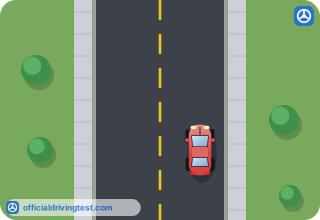
- Turn hard right to the other side of the road and stop
- Turn slightly left and keep rolling into the new lane
- Turn hard left to the other side of the road and stop
- Turn hard left and drive straight into the new lane
Show answer
Correct answer: Turn hard left to the other side of the road and stop
In the second step of the turnabout you turn hard left to the other side of the road and stop once you reach it.
Source: Class D & E Driver’s Guide (Revised August 2025 (DPSMV2052 R08/25)), page 67 · Open this page in the manual (Manual page 67)
-
In a three-point turnabout, once you are on the other side of the road, you place the vehicle in reverse and turn which way?
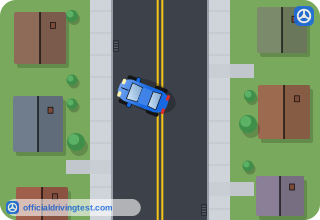
- Hard right to the other side of the road
- Hard left to the other side of the road
- Straight back along the edge of the road
- Hard right and drive forward into the lane
Show answer
Correct answer: Hard right to the other side of the road
In reverse you check traffic and blind spots, then turn hard right to the other side of the road and stop.
Source: Class D & E Driver’s Guide (Revised August 2025 (DPSMV2052 R08/25)), page 67 · Open this page in the manual (Manual page 67)
-
In a three-point turnabout, how do you check your blind spots while the vehicle is in reverse?
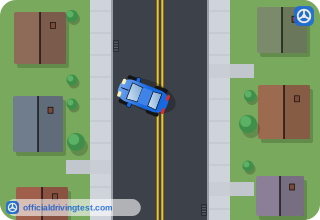
- Only by looking in the rearview mirror
- Only over your left shoulder
- Only by looking in the side mirrors
- To both sides by looking over your shoulder
Show answer
Correct answer: To both sides by looking over your shoulder
The manual says to check blind spots to both sides by looking over your shoulder before backing across the road.
Source: Class D & E Driver’s Guide (Revised August 2025 (DPSMV2052 R08/25)), page 67 · Open this page in the manual (Manual page 67)
-
At the end of a three-point turnabout, where do you drive?
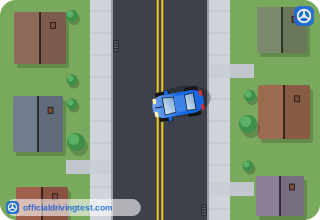
- Forward into the left lane of traffic heading in the new direction
- Forward into the right lane of traffic heading in the new direction
- Straight back into the lane you started in
- Forward, stopping on the shoulder before entering traffic
Show answer
Correct answer: Forward into the right lane of traffic heading in the new direction
The last step is to turn hard left and drive forward into the right lane of traffic heading in the new direction.
Source: Class D & E Driver’s Guide (Revised August 2025 (DPSMV2052 R08/25)), page 67 · Open this page in the manual (Manual page 67)
-
After completing a three-point turnabout, what should you make sure of before driving straight in the new direction?
- That your parking brake is set
- That your turn signal has cancelled
- That your hazard flashers are on
- That your windows are fully down
Show answer
Correct answer: That your turn signal has cancelled
The manual tells you to check traffic and make sure your turn signal has cancelled before continuing straight.
Source: Class D & E Driver’s Guide (Revised August 2025 (DPSMV2052 R08/25)), page 67 · Open this page in the manual (Manual page 67)
-
When may you move from one lane to another?
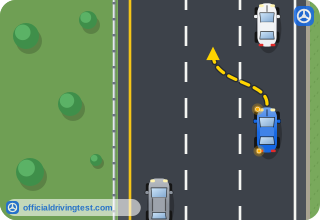
- Only when you are certain you can do so safely
- As soon as your turn signal is on
- Whenever the other lane is moving faster
- Whenever there is a gap behind the next vehicle
Show answer
Correct answer: Only when you are certain you can do so safely
The guide says never to move from one lane to another until you are certain you can do so safely.
Source: Class D & E Driver’s Guide (Revised August 2025 (DPSMV2052 R08/25)), page 87 · Open this page in the manual (Manual page 87)
-
Which mirrors does the guide say to check before changing lanes?
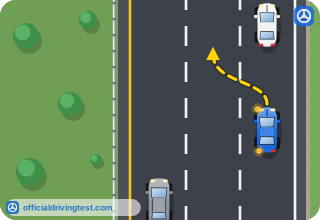
- Only your rear view mirror
- Only the side mirror on the side you are moving toward
- Your rear view and side mirrors
- None, if your turn signal is on
Show answer
Correct answer: Your rear view and side mirrors
The guide’s lane-changing rules start with checking your rear view and side mirrors.
Source: Class D & E Driver’s Guide (Revised August 2025 (DPSMV2052 R08/25)), page 87 · Open this page in the manual (Manual page 87)
-
Before changing lanes, besides checking your mirrors and blind spot, what else should you check for?
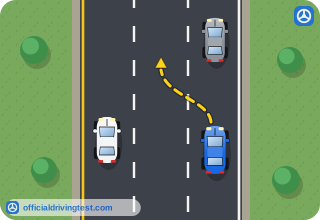
- Whether the lane ahead has fewer vehicles than yours
- Police officers stopped in the lane next to yours
- The speed limit posted for the lane you will enter
- Other drivers who may also be moving into the same lane
Show answer
Correct answer: Other drivers who may also be moving into the same lane
The guide’s lane-changing rules include checking for other drivers who may also be moving into the same lane.
Source: Class D & E Driver’s Guide (Revised August 2025 (DPSMV2052 R08/25)), page 87 · Open this page in the manual (Manual page 87)
-
Why should you look carefully behind you before changing lanes?
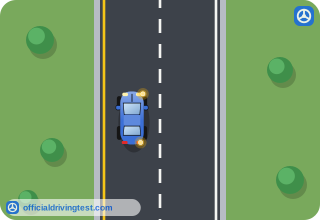
- Someone may be passing you
- A police car may be following you
- A school bus may be stopped behind you
- Your turn signal may have gone off
Show answer
Correct answer: Someone may be passing you
The guide says to look carefully behind you before changing lanes because someone may be passing you.
Source: Class D & E Driver’s Guide (Revised August 2025 (DPSMV2052 R08/25)), page 88 · Open this page in the manual (Manual page 88)
-
You should not attempt to pass if you cannot see at least how far ahead?
- An eighth of a mile
- Half a mile
- A quarter mile
- One mile
Show answer
Correct answer: A quarter mile
The guide says that if you cannot see at least a quarter mile ahead, you should not attempt to pass.
Source: Class D & E Driver’s Guide (Revised August 2025 (DPSMV2052 R08/25)), page 88 · Open this page in the manual (Manual page 88)
-
According to the guide, what is the best scenario for attempting a pass?
- A foggy morning on a long, flat, and clear stretch of road
- A clear, sunny day on a long, flat, and clear stretch of road
- A clear day on a short hill with a curve ahead
- A clear night on a long road with no other traffic
Show answer
Correct answer: A clear, sunny day on a long, flat, and clear stretch of road
The guide calls a clear, sunny day on a long, flat, and clear stretch of road the best scenario for attempting a pass.
Source: Class D & E Driver’s Guide (Revised August 2025 (DPSMV2052 R08/25)), page 88 · Open this page in the manual (Manual page 88)
-
If you are about to miss your exit or turn, what should you do about changing lanes?
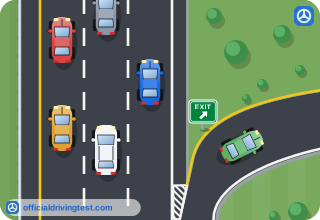
- Change lanes quickly while your signal is on, then slow down
- Stop in the lane until traffic lets you move over safely
- Back up slowly along the shoulder to the exit you missed
- Do not rush a lane change; take the next exit and turn around
Show answer
Correct answer: Do not rush a lane change; take the next exit and turn around
The guide says you should never make a hurried or unsafe lane change, because you can always take the next exit and turn around.
Source: Class D & E Driver’s Guide (Revised August 2025 (DPSMV2052 R08/25)), page 88 · Open this page in the manual (Manual page 88)
-
If a car is in your blind spot in the lane you want to move into, what should you do?
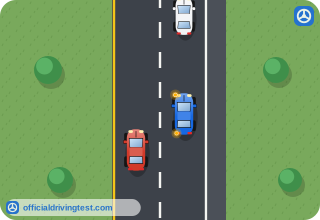
- Speed up or slow down until there is enough space
- Sound your horn so the driver moves out of the way
- Move over slowly so the other driver will see you
- Stop in your lane and wait for the car to pass
Show answer
Correct answer: Speed up or slow down until there is enough space
The guide says to speed up or slow down until there is enough space for you to change lanes, using your mirrors multiple times.
Source: Class D & E Driver’s Guide (Revised August 2025 (DPSMV2052 R08/25)), page 88 · Open this page in the manual (Manual page 88)
-
If speeding up or slowing down to make space for a lane change would put you or others in danger, what should you do?
- Change lanes anyway with your signal on
- Use your horn and change lanes
- Wait to change lanes
- Brake hard to open a gap
Show answer
Correct answer: Wait to change lanes
The guide says that if you would have to speed up or slow down so much that it puts you or others in danger, you should wait to change lanes.
Source: Class D & E Driver’s Guide (Revised August 2025 (DPSMV2052 R08/25)), page 88 · Open this page in the manual (Manual page 88)
-
What does the guide say about forcing your way into a lane?
- Do it only if your signal has been on for 100 feet
- Never do it; it is dangerous for you and other drivers
- Do it only when the other driver is going slower
- Do it only when you have the right of way
Show answer
Correct answer: Never do it; it is dangerous for you and other drivers
The guide says never to force your way into a lane because the maneuver is dangerous for both you and other drivers.
Source: Class D & E Driver’s Guide (Revised August 2025 (DPSMV2052 R08/25)), page 88 · Open this page in the manual (Manual page 88)
-
A car in the lane you want to move into is approaching at a faster speed than you are traveling. What should you do?
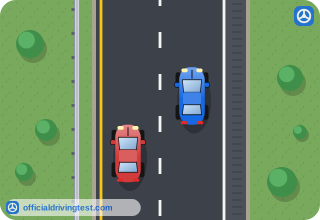
- Speed up and move in front of the car quickly
- Use your horn and move in front of the car
- Slow down and move in front of the car
- Wait for it to pass, then make the lane change
Show answer
Correct answer: Wait for it to pass, then make the lane change
The guide says to wait for the faster car to pass and then change lanes, because the driver might not have enough time to slow down behind you.
Source: Class D & E Driver’s Guide (Revised August 2025 (DPSMV2052 R08/25)), page 88 · Open this page in the manual (Manual page 88)
-
Where is changing lanes dangerous and illegal?
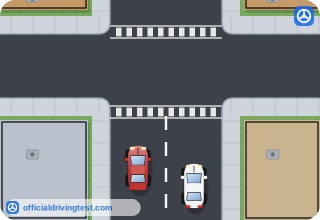
- While driving through or approaching an intersection
- On a road with only one lane in each direction
- While driving on a road with a posted minimum speed
- On a road that has no posted speed limit
Show answer
Correct answer: While driving through or approaching an intersection
The guide says changing lanes while driving through an intersection or approaching an intersection is dangerous and illegal.
Source: Class D & E Driver’s Guide (Revised August 2025 (DPSMV2052 R08/25)), page 88 · Open this page in the manual (Manual page 88)
-
Many intersection collisions occur when drivers do what?
- Stop too far behind the stop line when waiting to cross
- Fail to use turn signals or do not know right-of-way laws
- Slow down too much before entering the intersection
- Wait for the signal to turn green before they move
Show answer
Correct answer: Fail to use turn signals or do not know right-of-way laws
The guide says many intersection collisions occur when drivers fail to use their turn signals or don’t know the right-of-way laws.
Source: Class D & E Driver’s Guide (Revised August 2025 (DPSMV2052 R08/25)), page 89 · Open this page in the manual (Manual page 89)
-
What does the guide say about having the right of way at an intersection?
- It guarantees that you may cross without slowing
- It means you do not need to use your signal
- It lets you cross even when a pedestrian is in the way
- It does not guarantee your safety
Show answer
Correct answer: It does not guarantee your safety
The guide says that having the right of way does not guarantee your safety, so you should slow down and be prepared to stop if necessary.
Source: Class D & E Driver’s Guide (Revised August 2025 (DPSMV2052 R08/25)), page 89 · Open this page in the manual (Manual page 89)
-
Before making a turn, what does the guide say to scan for?
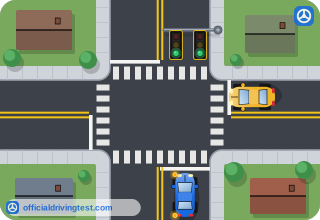
- Where other vehicles and pedestrians are, so the turn is safe
- Where the nearest police officer is parked along the street
- How many lanes the cross street has beyond the intersection
- Whether the traffic signal is about to change to red
Show answer
Correct answer: Where other vehicles and pedestrians are, so the turn is safe
The guide says to scan ahead and around you to see where other vehicles or pedestrians are and be sure it is safe to turn.
Source: Class D & E Driver’s Guide (Revised August 2025 (DPSMV2052 R08/25)), page 89 · Open this page in the manual (Manual page 89)
-
At least how far before making a turn does the law require you to signal and get into the proper lane?
- 50 feet
- 200 feet
- 100 feet
- 500 feet
Show answer
Correct answer: 100 feet
The guide says the law requires you to signal and get into the proper lane at least 100 feet before making a turn.
Source: Class D & E Driver’s Guide (Revised August 2025 (DPSMV2052 R08/25)), page 89 · Open this page in the manual (Manual page 89)
-
What is the correct order when preparing to turn?
- Move into the proper lane first and then signal
- Signal first and then move into the proper lane
- Slow down to a stop first and then signal
- Move into the proper lane first and then check for pedestrians
Show answer
Correct answer: Signal first and then move into the proper lane
The guide says to signal first and then move into the proper lane.
Source: Class D & E Driver’s Guide (Revised August 2025 (DPSMV2052 R08/25)), page 89 · Open this page in the manual (Manual page 89)
-
What does the guide say to do before making a turn, and in which lane should you finish it?
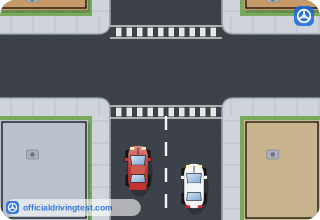
- Speed up before the turn and finish it in the nearest open lane
- Slow down before the turn and finish it in the left-most lane
- Stay at your speed and finish the turn wherever there is room
- Slow down before the turn and finish it in the proper lane
Show answer
Correct answer: Slow down before the turn and finish it in the proper lane
The guide says to slow down before making turns and always finish your turn in the proper lane.
Source: Class D & E Driver’s Guide (Revised August 2025 (DPSMV2052 R08/25)), page 89 · Open this page in the manual (Manual page 89)
-
What should you avoid before making a right turn?
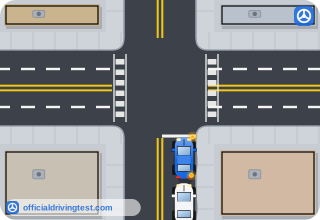
- Swinging left before making the turn
- Slowing down before making the turn
- Signaling before moving into the proper lane
- Looking at pedestrians in the crosswalk
Show answer
Correct answer: Swinging left before making the turn
The guide’s proper method for a right turn begins with avoiding swinging left before making the turn.
Source: Class D & E Driver’s Guide (Revised August 2025 (DPSMV2052 R08/25)), page 90 · Open this page in the manual (Manual page 90)
-
From which lane should you always turn right, unless lane markings indicate multiple lanes can be used?
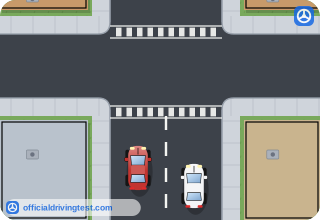
- The center lane
- The left most lane
- The right most lane
- Any lane with the fewest vehicles
Show answer
Correct answer: The right most lane
The guide says to always turn right from the right most lane or when lane markings indicate multiple lanes can be used for a right turn at the same time.
Source: Class D & E Driver’s Guide (Revised August 2025 (DPSMV2052 R08/25)), page 90 · Open this page in the manual (Manual page 90)
-
Why should you keep your wheels straight while waiting to make a left turn?
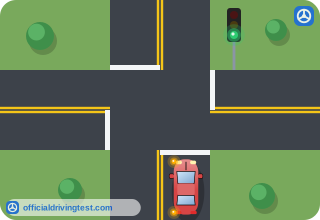
- So you can steer into the turn more quickly when traffic clears
- So you will not be pushed into traffic if you are hit from behind
- So your headlights do not shine into the eyes of oncoming drivers
- So other drivers can tell you intend to turn left
Show answer
Correct answer: So you will not be pushed into traffic if you are hit from behind
The guide says keeping your wheels straight prevents you from being pushed into traffic if you are hit from behind.
Source: Class D & E Driver’s Guide (Revised August 2025 (DPSMV2052 R08/25)), page 90 · Open this page in the manual (Manual page 90)
-
When making a left turn, when should you brake?
- After you start the turn
- In the middle of the intersection
- Only if another vehicle is coming
- Before beginning the turn
Show answer
Correct answer: Before beginning the turn
The guide says to brake prior to beginning the turn and use the appropriate lanes for turning.
Source: Class D & E Driver’s Guide (Revised August 2025 (DPSMV2052 R08/25)), page 90 · Open this page in the manual (Manual page 90)
-
What should you avoid when making a left turn?
- Cutting the corner so sharply that you are in front of someone approaching from the left
- Keeping your wheels straight while you wait to turn
- Slowing so much that your vehicle blocks traffic approaching from the right
- Keeping your wheels so straight that your vehicle stays in the left lane
Show answer
Correct answer: Cutting the corner so sharply that you are in front of someone approaching from the left
The guide says to avoid cutting the corner so sharply that your vehicle is in front of someone approaching from the left.
Source: Class D & E Driver’s Guide (Revised August 2025 (DPSMV2052 R08/25)), page 90 · Open this page in the manual (Manual page 90)
-
You meet another driver at an intersection and both of you signal left turns. How should each driver turn when it is safe?
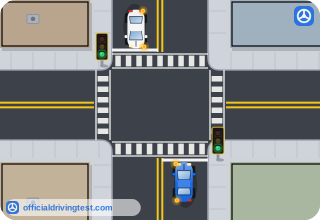
- In front of the other driver’s vehicle
- To the right of the center of the intersection
- To the left of the center of the intersection
- Straight through the center of the intersection
Show answer
Correct answer: To the left of the center of the intersection
The guide says that when it is safe, each driver should turn to the left of the center of the intersection.
Source: Class D & E Driver’s Guide (Revised August 2025 (DPSMV2052 R08/25)), page 90 · Open this page in the manual (Manual page 90)
-
At a 4-way intersection, what may you do from a lane that is marked as a left turn lane?
- Turn left or go straight
- Only turn left
- Turn left or turn right
- Go straight if the lane beside you is blocked
Show answer
Correct answer: Only turn left
The guide says that when a lane is marked as a left turn lane, you may only turn left from it.
Source: Class D & E Driver’s Guide (Revised August 2025 (DPSMV2052 R08/25)), page 90 · Open this page in the manual (Manual page 90)
-
At a 4-way intersection, how many lanes may be designated “left turn only”?
- Only one
- None; left turns are made from the through lanes
- Only the lane next to the center line
- More than one
Show answer
Correct answer: More than one
The guide says more than one lane may be designated as a “left turn only” lane.
Source: Class D & E Driver’s Guide (Revised August 2025 (DPSMV2052 R08/25)), page 90 · Open this page in the manual (Manual page 90)
-
You may not turn around on a hill or in a curve where your vehicle cannot be seen by drivers approaching from either direction within what distance?
- 500 feet
- 100 feet
- 200 feet
- 300 feet
Show answer
Correct answer: 500 feet
The guide says not to turn around on a hill or in a curve where your vehicle cannot be seen by other drivers approaching from either direction within 500 feet.
Source: Class D & E Driver’s Guide (Revised August 2025 (DPSMV2052 R08/25)), page 90 · Open this page in the manual (Manual page 90)
-
While using a shared center left turn lane, for what should you watch?
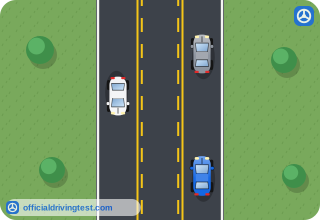
- Vehicles driving in reverse on the shoulder
- Cyclists riding on the sidewalk
- Vehicles pulling out of entrances and side streets
- Trucks parked in the center lane
Show answer
Correct answer: Vehicles pulling out of entrances and side streets
The guide says to watch for vehicles pulling out of entrances and side streets.
Source: Class D & E Driver’s Guide (Revised August 2025 (DPSMV2052 R08/25)), page 91 · Open this page in the manual (Manual page 91)
-
What must you do when using a shared center left turn lane?
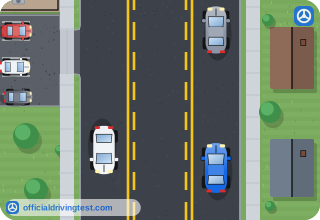
- Signal right, check your mirrors, and look over your right shoulder before entering
- Check ahead and mirrors, signal left, and look over your shoulder at your left blind spot
- Check your mirrors only, then steer quickly into the lane
- Signal left, then speed up before checking your left blind spot
Show answer
Correct answer: Check ahead and mirrors, signal left, and look over your shoulder at your left blind spot
The guide says to check for vehicles ahead, check mirrors, signal left and check your left blind spot by looking over your shoulder.
Source: Class D & E Driver’s Guide (Revised August 2025 (DPSMV2052 R08/25)), page 91 · Open this page in the manual (Manual page 91)
-
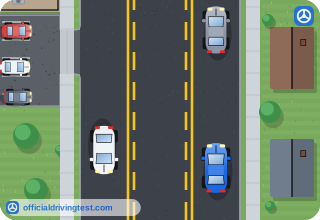
After steering smoothly into a shared center left turn lane, what should you choose?
- The shortest gap in the traffic coming from behind you
- A gap that lets you pass the vehicle ahead of you
- A gap in the traffic that is going the same way as you
- An appropriate gap in oncoming traffic to make the left turn
Show answer
Correct answer: An appropriate gap in oncoming traffic to make the left turn
The guide says to steer smoothly into the lane and choose an appropriate gap in oncoming traffic to make the left turn.
Source: Class D & E Driver’s Guide (Revised August 2025 (DPSMV2052 R08/25)), page 91 · Open this page in the manual (Manual page 91)
-
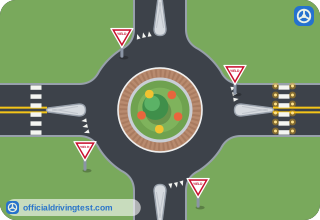
In which direction do vehicles travel around a roundabout or traffic circle?
- Counterclockwise
- Clockwise
- Either way, as the driver chooses
- Straight across the center island
Show answer
Correct answer: Counterclockwise
The guide says vehicles travel counterclockwise around a raised center island.
Source: Class D & E Driver’s Guide (Revised August 2025 (DPSMV2052 R08/25)), page 91 · Open this page in the manual (Manual page 91)
-
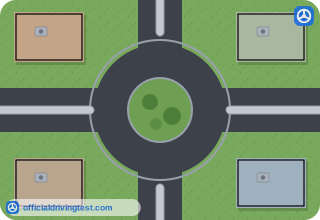
In a roundabout or traffic circle, who yields the right-of-way?
- Circulating traffic yields to entering traffic
- Vehicles in the outside lane yield to vehicles in the inside lane
- Entering traffic yields to circulating traffic
- Larger vehicles yield to smaller vehicles
Show answer
Correct answer: Entering traffic yields to circulating traffic
The guide says entering traffic yields the right-of-way to circulating traffic.
Source: Class D & E Driver’s Guide (Revised August 2025 (DPSMV2052 R08/25)), page 91 · Open this page in the manual (Manual page 91)
-
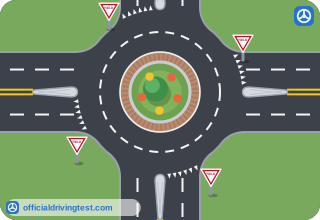
If there is more than one lane going in the same direction in a roundabout, what should you make sure of before entering?
- That you are in the left-most lane so you can pass slower traffic
- That you know where you want to go and are in the proper lane
- That you are in the lane with the fewest vehicles
- That you have stopped at the entrance for all traffic
Show answer
Correct answer: That you know where you want to go and are in the proper lane
The guide says to make sure you know where you want to go and are in the proper lane before entering.
Source: Class D & E Driver’s Guide (Revised August 2025 (DPSMV2052 R08/25)), page 91 · Open this page in the manual (Manual page 91)
-
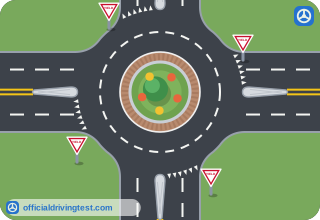
If there is more than one lane going in the same direction in a roundabout, what must you not do?
- Use your turn signal
- Yield to pedestrians
- Follow the pavement markings
- Change lanes or pass any vehicles
Show answer
Correct answer: Change lanes or pass any vehicles
The guide says that in a roundabout with more than one lane going the same way, you must not change lanes or pass any vehicles.
Source: Class D & E Driver’s Guide (Revised August 2025 (DPSMV2052 R08/25)), page 91 · Open this page in the manual (Manual page 91)
-
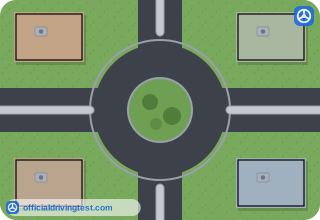
Besides traffic in the circle, whom must you yield to in a traffic circle or roundabout?
- Only pedestrians
- Pedestrians and bicyclists
- Only vehicles on your left
- Only vehicles that are leaving the circle
Show answer
Correct answer: Pedestrians and bicyclists
The guide says to yield to pedestrians and bicyclists in the traffic circle or roundabout.
Source: Class D & E Driver’s Guide (Revised August 2025 (DPSMV2052 R08/25)), page 92 · Open this page in the manual (Manual page 92)
-
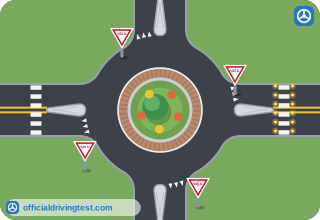
How do you enter a traffic circle?
- Enter to the left, and steer to the left in a clockwise direction
- Enter to the right, and steer to the right in a clockwise direction
- Enter straight, and steer to the right in a counterclockwise direction
- Enter to the right, but steer to the left in a counterclockwise direction
Show answer
Correct answer: Enter to the right, but steer to the left in a counterclockwise direction
The guide says to enter a traffic circle to the right, but steer to the left in a counterclockwise direction.
Source: Class D & E Driver’s Guide (Revised August 2025 (DPSMV2052 R08/25)), page 92 · Open this page in the manual (Manual page 92)
-
If you intend to turn right at a traffic circle or roundabout, when should you signal right?
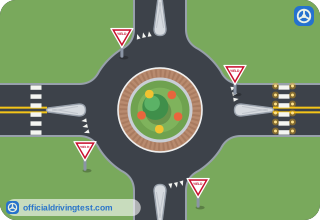
- While approaching and until you have exited
- Only after you have entered
- Only when you reach the exit
- Only while you are still approaching
Show answer
Correct answer: While approaching and until you have exited
The guide says to signal right while approaching and until you have exited the traffic circle or roundabout.
Source: Class D & E Driver’s Guide (Revised August 2025 (DPSMV2052 R08/25)), page 92 · Open this page in the manual (Manual page 92)
-
If you are going straight through a traffic circle or roundabout, what signal is needed while approaching?
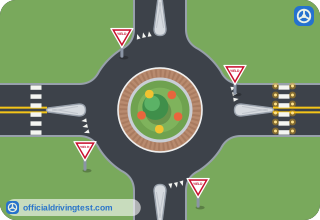
- A right turn signal
- A left turn signal
- No signal
- Your four-way flashers
Show answer
Correct answer: No signal
The guide says that if you are going straight through, no signal is needed while approaching.
Source: Class D & E Driver’s Guide (Revised August 2025 (DPSMV2052 R08/25)), page 92 · Open this page in the manual (Manual page 92)
-
If you intend to turn left at a traffic circle or roundabout, when do you signal “right” to take the exit?
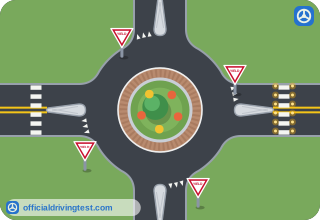
- As soon as you enter the circle
- After you have traveled three quarters of the way around
- After you have traveled one quarter of the way around
- After you have traveled half of the way around
Show answer
Correct answer: After you have traveled three quarters of the way around
The guide says that once you have traveled three quarters of the way around, you signal “right” to take the exit.
Source: Class D & E Driver’s Guide (Revised August 2025 (DPSMV2052 R08/25)), page 92 · Open this page in the manual (Manual page 92)
-
In a traffic circle or roundabout, what should you not do about large vehicles such as trucks and buses?
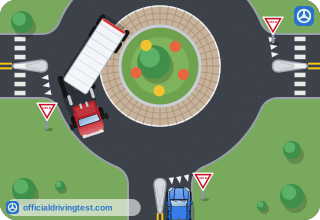
- Yield to them
- Signal near them
- Slow down for them
- Drive alongside them
Show answer
Correct answer: Drive alongside them
The guide says not to drive alongside large vehicles, such as trucks and buses, in a traffic circle or roundabout.
Source: Class D & E Driver’s Guide (Revised August 2025 (DPSMV2052 R08/25)), page 92 · Open this page in the manual (Manual page 92)
-
What does the manual say the law does about the right-of-way?
- It gives the right-of-way to the driver who arrived first
- It gives the right-of-way to the driver on the main road
- It says who must yield, but it does not give anyone the right-of-way
- It gives the right-of-way to the driver of the larger vehicle
Show answer
Correct answer: It says who must yield, but it does not give anyone the right-of-way
The law says who must yield the right-of-way to another roadway user; it does not give anyone the right-of-way.
Source: Class D & E Driver’s Guide (Revised August 2025 (DPSMV2052 R08/25)), page 93 · Open this page in the manual (Manual page 93)
-
Other drivers or pedestrians are not following the right-of-way rules, and the right-of-way belongs to you. What does the manual say to do?
- Insist on taking the right-of-way so they learn the rule
- Sound your horn until they yield
- Let them have the right-of-way
- Speed up and clear the intersection before they move
Show answer
Correct answer: Let them have the right-of-way
The manual says you should never insist on taking the right-of-way and should let others have it even if it belongs to you.
Source: Class D & E Driver’s Guide (Revised August 2025 (DPSMV2052 R08/25)), page 93 · Open this page in the manual (Manual page 93)
-
At a yield sign intersection, when may you proceed ahead?
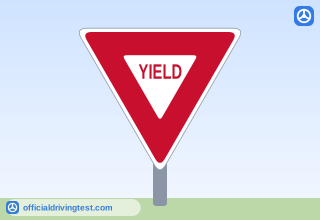
- Only when it will not interfere with approaching traffic
- As soon as you have slowed to a reasonable speed
- Once you have honked to warn approaching traffic
- As soon as the vehicles ahead of you have passed
Show answer
Correct answer: Only when it will not interfere with approaching traffic
At a yield sign intersection you slow down, stop if required, and proceed only when you will not interfere with approaching traffic.
Source: Class D & E Driver’s Guide (Revised August 2025 (DPSMV2052 R08/25)), page 93 · Open this page in the manual (Manual page 93)
-
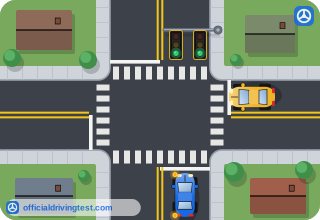
The driver making a left turn must yield the right-of-way to whom?
- Only oncoming motor vehicles, not bicyclists
- Traffic approaching from behind in the same lane
- Vehicles that are stopped behind the turning driver
- Oncoming traffic, including bicyclists
Show answer
Correct answer: Oncoming traffic, including bicyclists
A driver making a left turn must yield the right-of-way to oncoming traffic, including bicyclists.
Source: Class D & E Driver’s Guide (Revised August 2025 (DPSMV2052 R08/25)), page 93 · Open this page in the manual (Manual page 93)
-
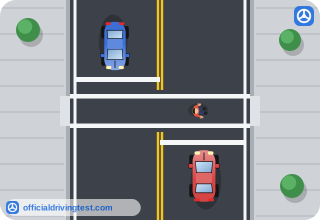
Where must you yield the right-of-way to pedestrians who are legally crossing the roadway on which you are driving?
- At marked crosswalks only
- At crosswalks controlled by traffic signals only
- At marked or unmarked crosswalks
- At crosswalks on roads with a posted speed limit under 25 mph
Show answer
Correct answer: At marked or unmarked crosswalks
The manual says you must yield to pedestrians legally crossing the roadway, at marked or unmarked crosswalks.
Source: Class D & E Driver’s Guide (Revised August 2025 (DPSMV2052 R08/25)), page 93 · Open this page in the manual (Manual page 93)
-
What must you do for a person who is using a guide dog for the visually impaired?
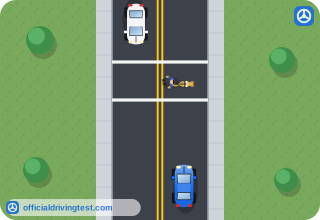
- Yield the right-of-way to the person
- Sound your horn so the person knows you are there
- Pass quickly on the left side of the person
- Slow down, but you are not required to yield
Show answer
Correct answer: Yield the right-of-way to the person
The manual lists persons using a guide dog for the visually impaired among those to whom you must yield the right-of-way.
Source: Class D & E Driver’s Guide (Revised August 2025 (DPSMV2052 R08/25)), page 93 · Open this page in the manual (Manual page 93)
-
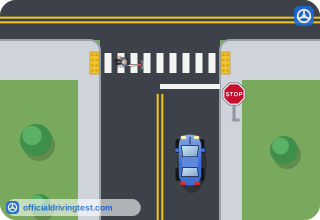
What must you do for a person who is using a white cane with or without a red tip?
- Flash your headlights to warn the person you are approaching
- Drive around the person, leaving a wide gap
- Stop only if the person steps off the curb
- Yield the right-of-way to the person
Show answer
Correct answer: Yield the right-of-way to the person
The manual lists persons using a white cane, with or without a red tip, among those to whom you must yield the right-of-way.
Source: Class D & E Driver’s Guide (Revised August 2025 (DPSMV2052 R08/25)), page 93 · Open this page in the manual (Manual page 93)
-
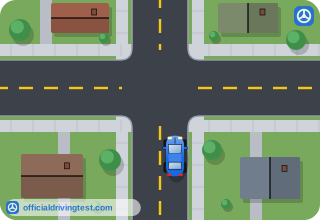
At an uncontrolled intersection, you must yield to which vehicles?
- Only vehicles approaching from your right side
- Only vehicles that are larger than yours
- Only vehicles that are traveling faster than you
- Vehicles that are already in the intersection
Show answer
Correct answer: Vehicles that are already in the intersection
The manual says you must yield at uncontrolled intersections where vehicles are already in the intersection.
Source: Class D & E Driver’s Guide (Revised August 2025 (DPSMV2052 R08/25)), page 93 · Open this page in the manual (Manual page 93)
-
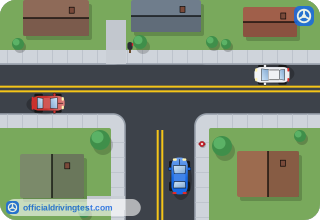
At a "T" intersection, you must yield to which vehicles?
- Vehicles on the road that ends at the intersection
- Vehicles on the through road
- Vehicles waiting in line behind you
- Only vehicles that are turning left
Show answer
Correct answer: Vehicles on the through road
The manual says that at "T" intersections you must yield to vehicles on the through road.
Source: Class D & E Driver’s Guide (Revised August 2025 (DPSMV2052 R08/25)), page 93 · Open this page in the manual (Manual page 93)
-
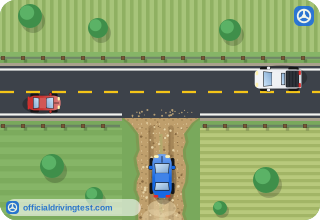
You are driving on an unpaved road that intersects with a paved road. What must you do?
- Proceed first, because the paved road must yield to you
- Speed up to cross before traffic on the paved road arrives
- Yield the right-of-way
- Stop only if you are turning left onto the paved road
Show answer
Correct answer: Yield the right-of-way
The manual says you must yield the right-of-way when driving on an unpaved road that intersects with a paved road.
Source: Class D & E Driver’s Guide (Revised August 2025 (DPSMV2052 R08/25)), page 93 · Open this page in the manual (Manual page 93)
-
What must you do when returning to the roadway after your car has been parked?
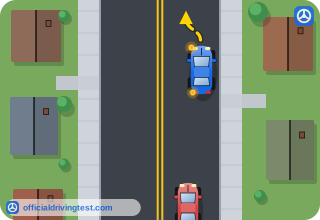
- Yield the right-of-way
- Enter the roadway at once, since moving traffic must make room
- Signal, and then traffic must yield to you
- Enter the roadway only when no vehicle is behind you
Show answer
Correct answer: Yield the right-of-way
The manual lists returning to the roadway after the car is parked among the times you must yield the right-of-way.
Source: Class D & E Driver’s Guide (Revised August 2025 (DPSMV2052 R08/25)), page 93 · Open this page in the manual (Manual page 93)
-
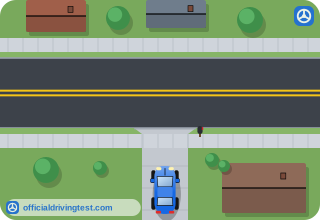
When you enter a road from a driveway, alley or roadside, whom must you yield to?
- Vehicles already on the main road
- Only vehicles approaching from your left
- Only vehicles that are turning into the driveway
- Vehicles that are stopped on the shoulder
Show answer
Correct answer: Vehicles already on the main road
The manual says that when entering a road from a driveway, alley or roadside you must yield to vehicles already on the main road.
Source: Class D & E Driver’s Guide (Revised August 2025 (DPSMV2052 R08/25)), page 93 · Open this page in the manual (Manual page 93)
-
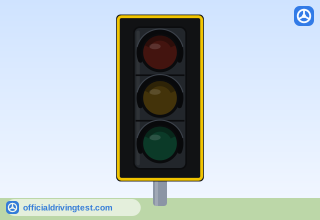
A traffic light at an intersection has malfunctioned. What does the intersection become?
- An uncontrolled intersection where no one has to stop
- A yield intersection for the road with more traffic
- An intersection where the larger vehicle goes first
- A 4-way stop intersection
Show answer
Correct answer: A 4-way stop intersection
The manual says that if a traffic light has malfunctioned, the intersection becomes a 4-way stop intersection.
Source: Class D & E Driver’s Guide (Revised August 2025 (DPSMV2052 R08/25)), page 93 · Open this page in the manual (Manual page 93)
-
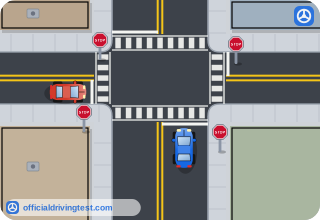
Two vehicles approach a controlled or 4-way stop intersection at the same time. Who must yield the right-of-way?
- The driver on the right yields to the vehicle on the left
- The driver on the left yields to the vehicle on the right
- The driver of the larger vehicle yields to the smaller one
- The driver traveling faster yields to the slower one
Show answer
Correct answer: The driver on the left yields to the vehicle on the right
When two vehicles approach an intersection at the same time, the driver on the left must yield the right-of-way to the vehicle on the right.
Source: Class D & E Driver’s Guide (Revised August 2025 (DPSMV2052 R08/25)), page 93 · Open this page in the manual (Manual page 93)
-
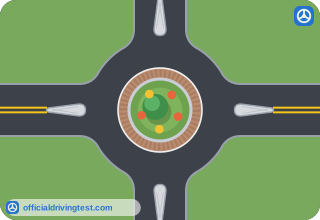
At a roundabout, entering traffic yields to what?
- The traffic waiting at the next entry
- Only vehicles that are about to exit
- The traffic in the circulating lane(s)
- Nothing, since entering traffic has the right-of-way
Show answer
Correct answer: The traffic in the circulating lane(s)
The manual says that at roundabouts, entering traffic yields to the circulating lane(s).
Source: Class D & E Driver’s Guide (Revised August 2025 (DPSMV2052 R08/25)), page 93 · Open this page in the manual (Manual page 93)
-
When you merge onto an interstate from an entrance ramp, who has the right of way?
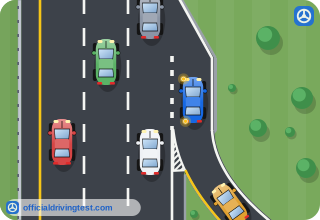
- Vehicles entering from the ramp
- Interstate traffic
- The driver who signals first
- Larger vehicles only
Show answer
Correct answer: Interstate traffic
The manual states that interstate traffic has the right of way.
Source: Class D & E Driver’s Guide (Revised August 2025 (DPSMV2052 R08/25)), page 100 · Open this page in the manual (Manual page 100)
-
How should you approach a rural intersection that is not controlled by yield or stop signs?
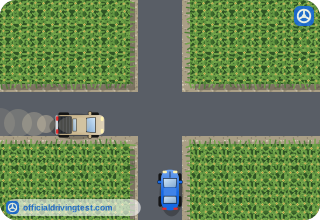
- Maintain your speed, since you have the right of way here
- Speed up to clear the intersection before others arrive
- Slow down and be prepared to stop for crossing or oncoming traffic
- Stop and wait for the other drivers to signal you to go
Show answer
Correct answer: Slow down and be prepared to stop for crossing or oncoming traffic
The manual says to slow down and be prepared to stop for crossing or oncoming traffic at an uncontrolled rural intersection.
Source: Class D & E Driver’s Guide (Revised August 2025 (DPSMV2052 R08/25)), page 104 · Open this page in the manual (Manual page 104)