Louisiana: Right-of-way and turning — Part 1 Practice Test
Questions in this part include: “Which of these is an effort to improve intersections and reduce crashes there?” · “What are roundabouts?”
Independent educational site · not affiliated with any government agency or DMV
Ready? Test yourself
- Instant feedback with an explanation
- Every answer cites its source in the manual
- Your best score is saved on this device
Questions are original and based on the official manual "Class D & E Driver’s Guide" (Revised August 2025 (DPSMV2052 R08/25)), Louisiana Office of Motor Vehicles.
All 20 questions in this practice test
Take the test above first, then use this list to study. Tap “Show answer” to see the correct answer and explanation.
Show the questions and answersHide the questions
-
Which of these is an effort to improve intersections and reduce crashes there?
- Narrower lanes at the stop line
- Higher speed limits on side streets
- Removing pavement markings
- Synchronized traffic signals
Show answer
Correct answer: Synchronized traffic signals
The manual lists exclusive turn lanes, roundabouts and synchronized traffic signals as efforts to improve intersections and reduce crashes there.
Source: Class D & E Driver’s Guide (Revised August 2025 (DPSMV2052 R08/25)), page 21 · Open this page in the manual (Manual page 21)
-
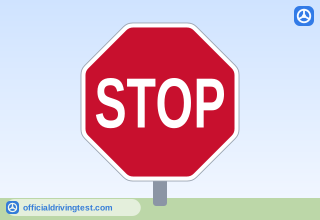
Where must you stop at a stop sign?
- Beyond the crosswalk, at the edge of the intersection
- In the middle of the crosswalk so you can see traffic
- Behind the stop line or crosswalk, if one is present
- Wherever you have the best view of traffic
Show answer
Correct answer: Behind the stop line or crosswalk, if one is present
You must stop behind the stop line or crosswalk, if one is present.
Source: Class D & E Driver’s Guide (Revised August 2025 (DPSMV2052 R08/25)), page 27 · Open this page in the manual (Manual page 27)
-
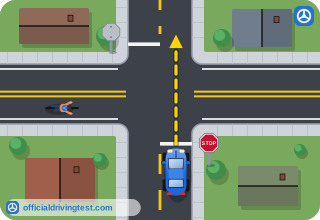
After you stop at a stop sign and look for crossing vehicles and pedestrians, when may you enter the intersection?
- As soon as other drivers see you
- When it is safe to do so
- When the vehicle behind you honks
- As soon as you have counted to three
Show answer
Correct answer: When it is safe to do so
After stopping and looking for crossing vehicles and pedestrians, you may enter the intersection when it is safe to do so.
Source: Class D & E Driver’s Guide (Revised August 2025 (DPSMV2052 R08/25)), page 27 · Open this page in the manual (Manual page 27)
-
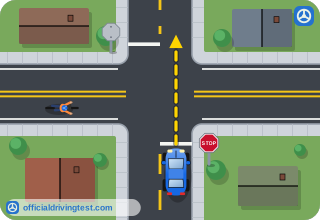
At a stop sign, in which directions must you look for crossing vehicles and pedestrians?
- Only to the left
- Only to the right
- Only straight ahead
- In all directions
Show answer
Correct answer: In all directions
At a stop sign you must look for crossing vehicles and pedestrians in all directions and yield the right-of-way.
Source: Class D & E Driver’s Guide (Revised August 2025 (DPSMV2052 R08/25)), page 27 · Open this page in the manual (Manual page 27)
-
What does a 4-WAY sign added to a stop sign tell you?
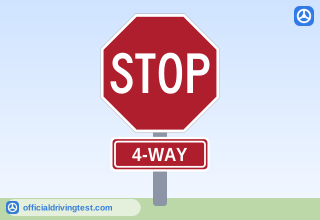
- All approaching traffic has a stop sign
- Four lanes of traffic are ahead
- The intersection has four traffic signals
- You must wait four seconds before going
Show answer
Correct answer: All approaching traffic has a stop sign
A 4-WAY sign may be added to the stop sign at intersections where all approaching traffic has a stop sign.
Source: Class D & E Driver’s Guide (Revised August 2025 (DPSMV2052 R08/25)), page 27 · Open this page in the manual (Manual page 27)
-
What does a yield sign mean you must do?
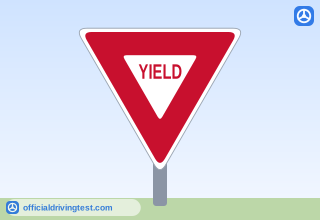
- Come to a complete stop and wait for the other driver to wave you on
- Slow down and let traffic with the right-of-way cross before you enter
- Speed up and enter before the other traffic reaches the intersection
- Stop only if you see another vehicle within sight of the sign
Show answer
Correct answer: Slow down and let traffic with the right-of-way cross before you enter
A yield sign means you must slow down and allow traffic that has the right-of-way to cross before entering.
Source: Class D & E Driver’s Guide (Revised August 2025 (DPSMV2052 R08/25)), page 27 · Open this page in the manual (Manual page 27)
-
Who may use a lane marked with a Shared Center Lane Left Turn Only sign?
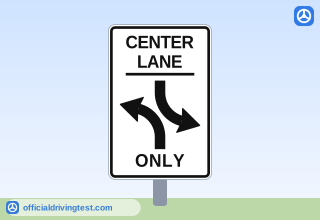
- Through traffic only
- Vehicles passing slower traffic
- Left-turning vehicles from one direction only
- Left-turning vehicles from either direction
Show answer
Correct answer: Left-turning vehicles from either direction
The lane is reserved for left-turning vehicles from either direction and is not to be used for through traffic or passing other vehicles.
Source: Class D & E Driver’s Guide (Revised August 2025 (DPSMV2052 R08/25)), page 27 · Open this page in the manual (Manual page 27)
-
What does a NO TURN ON RED sign tell you?
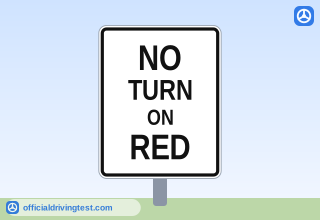
- You may turn right on red after stopping and yielding to pedestrians
- You may turn right only when the light is yellow
- You may not turn right during the red light
- You may turn right only if no vehicle is within sight
Show answer
Correct answer: You may not turn right during the red light
When a NO TURN ON RED sign is posted you may not turn right during the red light and must wait for the traffic signal to turn green.
Source: Class D & E Driver’s Guide (Revised August 2025 (DPSMV2052 R08/25)), page 28 · Open this page in the manual (Manual page 28)
-
A traffic light is red and there is no NO TURN ON RED sign. What may you do after stopping at the stop line and checking for traffic and pedestrians?
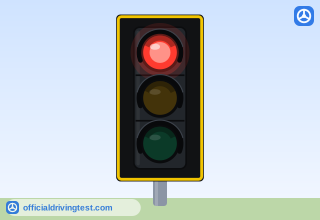
- Turn left on red from any street
- Drive straight through the intersection
- Make a U-turn
- Turn right on red
Show answer
Correct answer: Turn right on red
If there is no NO TURN ON RED sign, after stopping at the stop line and checking for traffic and pedestrians, you may turn right on red.
Source: Class D & E Driver’s Guide (Revised August 2025 (DPSMV2052 R08/25)), page 28 · Open this page in the manual (Manual page 28)
-
According to a DO NOT BLOCK INTERSECTION sign, when must you not enter an intersection?
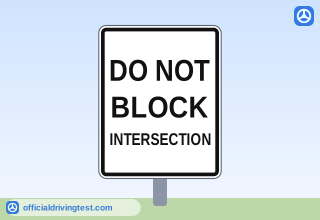
- When traffic does not allow you to clear it completely
- When the traffic light has just turned green
- When another vehicle is waiting to turn behind you
- When you plan to turn right at the intersection
Show answer
Correct answer: When traffic does not allow you to clear it completely
You must not enter an intersection if traffic conditions do not permit you to clear the intersection completely.
Source: Class D & E Driver’s Guide (Revised August 2025 (DPSMV2052 R08/25)), page 28 · Open this page in the manual (Manual page 28)
-
What does a DO NOT BLOCK INTERSECTION sign tell you not to do in the intersection?
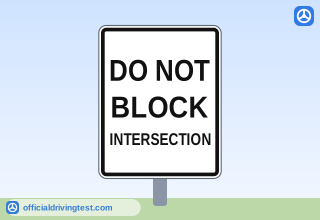
- Drive through on a green light
- Turn right when the way is clear
- Stop, stand or park at any time
- Enter when the light is green and traffic is moving
Show answer
Correct answer: Stop, stand or park at any time
A DO NOT BLOCK INTERSECTION sign tells you not to stop, stand or park at any time in the intersection.
Source: Class D & E Driver’s Guide (Revised August 2025 (DPSMV2052 R08/25)), page 28 · Open this page in the manual (Manual page 28)
-
What must you do when turning left at a signal with a LEFT TURN YIELD ON GREEN sign?
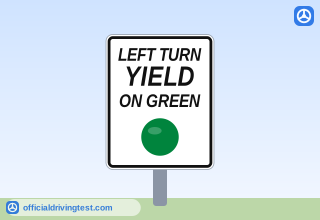
- Wait for a green arrow
- Yield to oncoming traffic
- Stop and turn only when the signal is red
- Turn ahead of oncoming vehicles
Show answer
Correct answer: Yield to oncoming traffic
A LEFT TURN YIELD ON GREEN sign tells you that a left turn is permitted, but you must yield to oncoming traffic.
Source: Class D & E Driver’s Guide (Revised August 2025 (DPSMV2052 R08/25)), page 28 · Open this page in the manual (Manual page 28)
-
When may you turn left at a steady green traffic light?
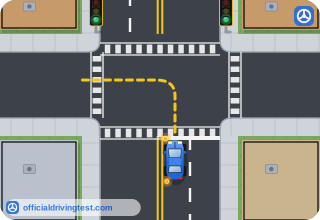
- Only when the intersection is clear, and you yield to oncoming traffic
- At any time, because oncoming traffic must stop for a green light
- Only if a green arrow is also lit and no sign prohibits the turn
- Only after coming to a complete stop and waiting for a green arrow
Show answer
Correct answer: Only when the intersection is clear, and you yield to oncoming traffic
Turning left at a steady green light means you may turn only when the intersection is clear, and you should always yield to the oncoming traffic flow and pedestrians.
Source: Class D & E Driver’s Guide (Revised August 2025 (DPSMV2052 R08/25)), page 33 · Open this page in the manual (Manual page 33)
-
At a red light with no sign prohibiting a right turn on red, what must you do before turning right?
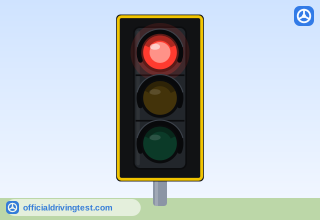
- Stop, then turn after yielding to traffic, including pedestrians
- Slow down and turn if no other vehicle is in the intersection
- Wait for a green arrow before turning, even if no sign prohibits it
- Turn without stopping if the crosswalk is empty of pedestrians
Show answer
Correct answer: Stop, then turn after yielding to traffic, including pedestrians
If no sign prohibits it, you may turn right on red after stopping and yielding to traffic, including pedestrians.
Source: Class D & E Driver’s Guide (Revised August 2025 (DPSMV2052 R08/25)), page 34 · Open this page in the manual (Manual page 34)
-
When may some left turns be permitted on red?
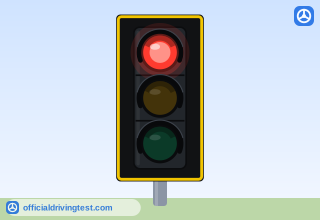
- When moving from a two-way street onto a one-way street
- When moving from a one-way street onto a two-way street
- When moving from a one-way street onto another one-way street
- When no vehicle is visible in either direction
Show answer
Correct answer: When moving from a one-way street onto another one-way street
The manual says some left turns may be permitted on red when moving from a one-way street onto another one-way street.
Source: Class D & E Driver’s Guide (Revised August 2025 (DPSMV2052 R08/25)), page 34 · Open this page in the manual (Manual page 34)
-
Where a left turn on red is permitted, what must you yield to?
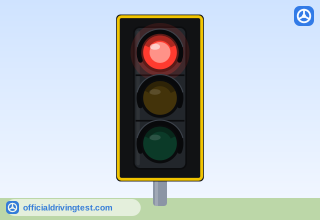
- Only oncoming traffic coming toward you in the opposite lane
- Only pedestrians who are in a marked crosswalk in front of you
- Only vehicles that are also turning right on red from the side
- All traffic and pedestrians crossing in front or to the side
Show answer
Correct answer: All traffic and pedestrians crossing in front or to the side
When turning left on red where permitted, you must yield to all traffic and pedestrians crossing in front or to the side of your vehicle.
Source: Class D & E Driver’s Guide (Revised August 2025 (DPSMV2052 R08/25)), page 34 · Open this page in the manual (Manual page 34)
-
You are in a lane that requires you to turn, but you want to go straight ahead. What does the manual say you must do?
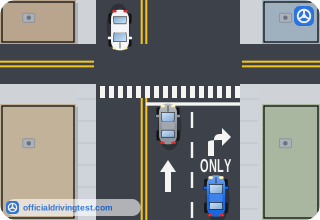
- Go ahead and make the turn
- Stop and wait until you can change lanes safely
- Change lanes quickly before you reach the intersection
- Back up to the previous intersection and change lanes
Show answer
Correct answer: Go ahead and make the turn
If you stop and wait for a chance to change lanes you are blocking traffic, so you must go ahead and make the turn.
Source: Class D & E Driver’s Guide (Revised August 2025 (DPSMV2052 R08/25)), page 37 · Open this page in the manual (Manual page 37)
-
After being forced to turn from a lane when you wanted to go straight, how can you return to the street you want?
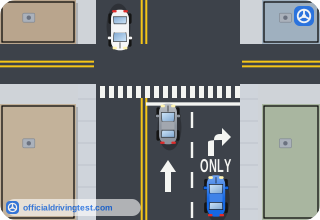
- Make a U-turn in the middle of the intersection
- Stop in the lane until traffic clears
- Drive around the block and return to that street
- Back up into the intersection
Show answer
Correct answer: Drive around the block and return to that street
The manual says to drive around the block and return to the street you want, then continue your trip safely without creating a hazardous situation.
Source: Class D & E Driver’s Guide (Revised August 2025 (DPSMV2052 R08/25)), page 37 · Open this page in the manual (Manual page 37)
-
Why should you not suddenly change lanes if you are in a lane that requires you to turn?
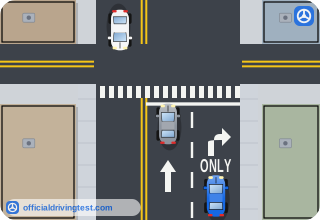
- Lane changes are not allowed within an intersection
- Other drivers will not expect you to change lanes suddenly
- Other drivers always speed up when they see a turn signal
- Your vehicle may lose traction if it changes lanes
Show answer
Correct answer: Other drivers will not expect you to change lanes suddenly
The manual notes that other drivers will not expect you to suddenly change lanes, and drivers behind you will not expect a sudden stop.
Source: Class D & E Driver’s Guide (Revised August 2025 (DPSMV2052 R08/25)), page 37 · Open this page in the manual (Manual page 37)
-
What are roundabouts?
- Rectangular intersections with traffic lights
- Three-way intersections without stop signs
- Divided highways that join with an exit ramp
- Circular intersections
Show answer
Correct answer: Circular intersections
Roundabouts are circular intersections that reduce traffic congestion and conflicts that are often the cause of crashes at traditional intersections.
Source: Class D & E Driver’s Guide (Revised August 2025 (DPSMV2052 R08/25)), page 37 · Open this page in the manual (Manual page 37)