Louisiana: Right-of-way and turning — Part 5 Practice Test
Questions in this part include: “When making a left turn, when should you brake?” · “At a 4-way intersection, what may you do from a lane that is marked as a left turn lane?”
Independent educational site · not affiliated with any government agency or DMV
Ready? Test yourself
- Instant feedback with an explanation
- Every answer cites its source in the manual
- Your best score is saved on this device
Questions are original and based on the official manual "Class D & E Driver’s Guide" (Revised August 2025 (DPSMV2052 R08/25)), Louisiana Office of Motor Vehicles.
All 19 questions in this practice test
Take the test above first, then use this list to study. Tap “Show answer” to see the correct answer and explanation.
Show the questions and answersHide the questions
-
From which lane should you always turn right, unless lane markings indicate multiple lanes can be used?
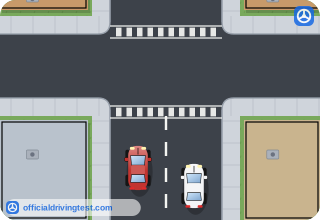
- The center lane
- The left most lane
- The right most lane
- Any lane with the fewest vehicles
Show answer
Correct answer: The right most lane
The guide says to always turn right from the right most lane or when lane markings indicate multiple lanes can be used for a right turn at the same time.
Source: Class D & E Driver’s Guide (Revised August 2025 (DPSMV2052 R08/25)), page 90 · Open this page in the manual (Manual page 90)
-
Why should you keep your wheels straight while waiting to make a left turn?
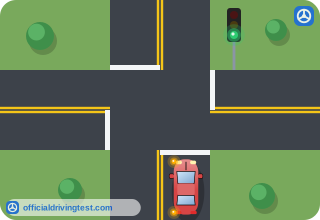
- So you can steer into the turn more quickly when traffic clears
- So you will not be pushed into traffic if you are hit from behind
- So your headlights do not shine into the eyes of oncoming drivers
- So other drivers can tell you intend to turn left
Show answer
Correct answer: So you will not be pushed into traffic if you are hit from behind
The guide says keeping your wheels straight prevents you from being pushed into traffic if you are hit from behind.
Source: Class D & E Driver’s Guide (Revised August 2025 (DPSMV2052 R08/25)), page 90 · Open this page in the manual (Manual page 90)
-
When making a left turn, when should you brake?
- After you start the turn
- In the middle of the intersection
- Only if another vehicle is coming
- Before beginning the turn
Show answer
Correct answer: Before beginning the turn
The guide says to brake prior to beginning the turn and use the appropriate lanes for turning.
Source: Class D & E Driver’s Guide (Revised August 2025 (DPSMV2052 R08/25)), page 90 · Open this page in the manual (Manual page 90)
-
What should you avoid when making a left turn?
- Cutting the corner so sharply that you are in front of someone approaching from the left
- Keeping your wheels straight while you wait to turn
- Slowing so much that your vehicle blocks traffic approaching from the right
- Keeping your wheels so straight that your vehicle stays in the left lane
Show answer
Correct answer: Cutting the corner so sharply that you are in front of someone approaching from the left
The guide says to avoid cutting the corner so sharply that your vehicle is in front of someone approaching from the left.
Source: Class D & E Driver’s Guide (Revised August 2025 (DPSMV2052 R08/25)), page 90 · Open this page in the manual (Manual page 90)
-
You meet another driver at an intersection and both of you signal left turns. How should each driver turn when it is safe?
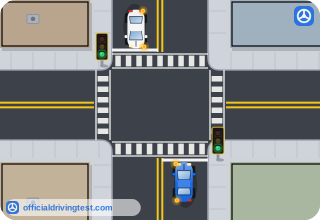
- In front of the other driver’s vehicle
- To the right of the center of the intersection
- To the left of the center of the intersection
- Straight through the center of the intersection
Show answer
Correct answer: To the left of the center of the intersection
The guide says that when it is safe, each driver should turn to the left of the center of the intersection.
Source: Class D & E Driver’s Guide (Revised August 2025 (DPSMV2052 R08/25)), page 90 · Open this page in the manual (Manual page 90)
-
At a 4-way intersection, what may you do from a lane that is marked as a left turn lane?
- Turn left or go straight
- Only turn left
- Turn left or turn right
- Go straight if the lane beside you is blocked
Show answer
Correct answer: Only turn left
The guide says that when a lane is marked as a left turn lane, you may only turn left from it.
Source: Class D & E Driver’s Guide (Revised August 2025 (DPSMV2052 R08/25)), page 90 · Open this page in the manual (Manual page 90)
-
At a 4-way intersection, how many lanes may be designated “left turn only”?
- Only one
- None; left turns are made from the through lanes
- Only the lane next to the center line
- More than one
Show answer
Correct answer: More than one
The guide says more than one lane may be designated as a “left turn only” lane.
Source: Class D & E Driver’s Guide (Revised August 2025 (DPSMV2052 R08/25)), page 90 · Open this page in the manual (Manual page 90)
-
You may not turn around on a hill or in a curve where your vehicle cannot be seen by drivers approaching from either direction within what distance?
- 500 feet
- 100 feet
- 200 feet
- 300 feet
Show answer
Correct answer: 500 feet
The guide says not to turn around on a hill or in a curve where your vehicle cannot be seen by other drivers approaching from either direction within 500 feet.
Source: Class D & E Driver’s Guide (Revised August 2025 (DPSMV2052 R08/25)), page 90 · Open this page in the manual (Manual page 90)
-
While using a shared center left turn lane, for what should you watch?
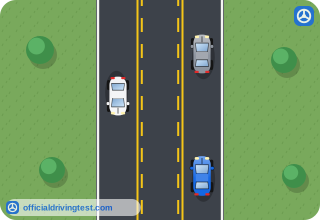
- Vehicles driving in reverse on the shoulder
- Cyclists riding on the sidewalk
- Vehicles pulling out of entrances and side streets
- Trucks parked in the center lane
Show answer
Correct answer: Vehicles pulling out of entrances and side streets
The guide says to watch for vehicles pulling out of entrances and side streets.
Source: Class D & E Driver’s Guide (Revised August 2025 (DPSMV2052 R08/25)), page 91 · Open this page in the manual (Manual page 91)
-
What must you do when using a shared center left turn lane?
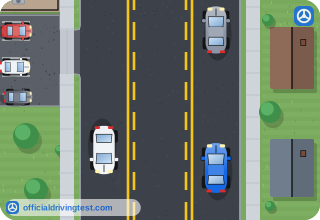
- Signal right, check your mirrors, and look over your right shoulder before entering
- Check ahead and mirrors, signal left, and look over your shoulder at your left blind spot
- Check your mirrors only, then steer quickly into the lane
- Signal left, then speed up before checking your left blind spot
Show answer
Correct answer: Check ahead and mirrors, signal left, and look over your shoulder at your left blind spot
The guide says to check for vehicles ahead, check mirrors, signal left and check your left blind spot by looking over your shoulder.
Source: Class D & E Driver’s Guide (Revised August 2025 (DPSMV2052 R08/25)), page 91 · Open this page in the manual (Manual page 91)
-
After steering smoothly into a shared center left turn lane, what should you choose?
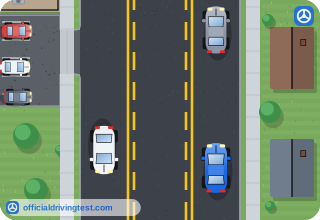
- The shortest gap in the traffic coming from behind you
- A gap that lets you pass the vehicle ahead of you
- A gap in the traffic that is going the same way as you
- An appropriate gap in oncoming traffic to make the left turn
Show answer
Correct answer: An appropriate gap in oncoming traffic to make the left turn
The guide says to steer smoothly into the lane and choose an appropriate gap in oncoming traffic to make the left turn.
Source: Class D & E Driver’s Guide (Revised August 2025 (DPSMV2052 R08/25)), page 91 · Open this page in the manual (Manual page 91)
-
In which direction do vehicles travel around a roundabout or traffic circle?
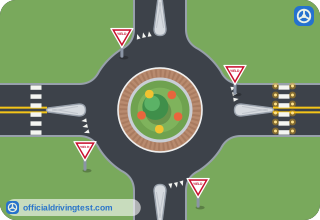
- Counterclockwise
- Clockwise
- Either way, as the driver chooses
- Straight across the center island
Show answer
Correct answer: Counterclockwise
The guide says vehicles travel counterclockwise around a raised center island.
Source: Class D & E Driver’s Guide (Revised August 2025 (DPSMV2052 R08/25)), page 91 · Open this page in the manual (Manual page 91)
-
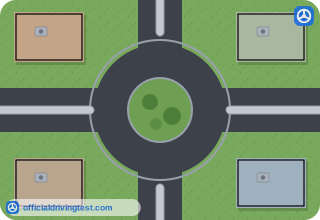
In a roundabout or traffic circle, who yields the right-of-way?
- Circulating traffic yields to entering traffic
- Vehicles in the outside lane yield to vehicles in the inside lane
- Entering traffic yields to circulating traffic
- Larger vehicles yield to smaller vehicles
Show answer
Correct answer: Entering traffic yields to circulating traffic
The guide says entering traffic yields the right-of-way to circulating traffic.
Source: Class D & E Driver’s Guide (Revised August 2025 (DPSMV2052 R08/25)), page 91 · Open this page in the manual (Manual page 91)
-
If there is more than one lane going in the same direction in a roundabout, what should you make sure of before entering?
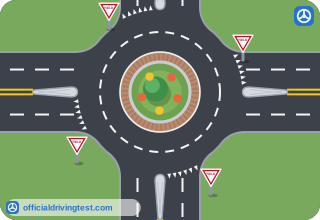
- That you are in the left-most lane so you can pass slower traffic
- That you know where you want to go and are in the proper lane
- That you are in the lane with the fewest vehicles
- That you have stopped at the entrance for all traffic
Show answer
Correct answer: That you know where you want to go and are in the proper lane
The guide says to make sure you know where you want to go and are in the proper lane before entering.
Source: Class D & E Driver’s Guide (Revised August 2025 (DPSMV2052 R08/25)), page 91 · Open this page in the manual (Manual page 91)
-
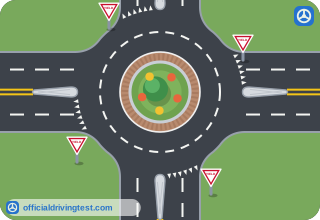
If there is more than one lane going in the same direction in a roundabout, what must you not do?
- Use your turn signal
- Yield to pedestrians
- Follow the pavement markings
- Change lanes or pass any vehicles
Show answer
Correct answer: Change lanes or pass any vehicles
The guide says that in a roundabout with more than one lane going the same way, you must not change lanes or pass any vehicles.
Source: Class D & E Driver’s Guide (Revised August 2025 (DPSMV2052 R08/25)), page 91 · Open this page in the manual (Manual page 91)
-
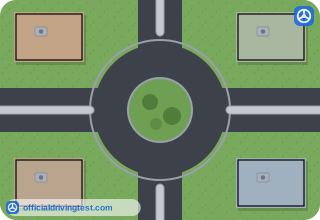
Besides traffic in the circle, whom must you yield to in a traffic circle or roundabout?
- Only pedestrians
- Pedestrians and bicyclists
- Only vehicles on your left
- Only vehicles that are leaving the circle
Show answer
Correct answer: Pedestrians and bicyclists
The guide says to yield to pedestrians and bicyclists in the traffic circle or roundabout.
Source: Class D & E Driver’s Guide (Revised August 2025 (DPSMV2052 R08/25)), page 92 · Open this page in the manual (Manual page 92)
-
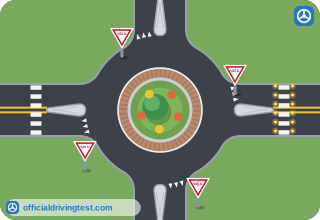
How do you enter a traffic circle?
- Enter to the left, and steer to the left in a clockwise direction
- Enter to the right, and steer to the right in a clockwise direction
- Enter straight, and steer to the right in a counterclockwise direction
- Enter to the right, but steer to the left in a counterclockwise direction
Show answer
Correct answer: Enter to the right, but steer to the left in a counterclockwise direction
The guide says to enter a traffic circle to the right, but steer to the left in a counterclockwise direction.
Source: Class D & E Driver’s Guide (Revised August 2025 (DPSMV2052 R08/25)), page 92 · Open this page in the manual (Manual page 92)
-
If you intend to turn right at a traffic circle or roundabout, when should you signal right?
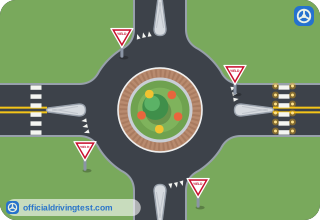
- While approaching and until you have exited
- Only after you have entered
- Only when you reach the exit
- Only while you are still approaching
Show answer
Correct answer: While approaching and until you have exited
The guide says to signal right while approaching and until you have exited the traffic circle or roundabout.
Source: Class D & E Driver’s Guide (Revised August 2025 (DPSMV2052 R08/25)), page 92 · Open this page in the manual (Manual page 92)
-
If you are going straight through a traffic circle or roundabout, what signal is needed while approaching?
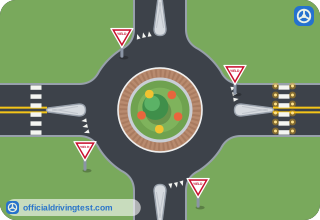
- A right turn signal
- A left turn signal
- No signal
- Your four-way flashers
Show answer
Correct answer: No signal
The guide says that if you are going straight through, no signal is needed while approaching.
Source: Class D & E Driver’s Guide (Revised August 2025 (DPSMV2052 R08/25)), page 92 · Open this page in the manual (Manual page 92)