Louisiana: Right-of-way and turning — Part 4 Practice Test
Questions in this part include: “You should not attempt to pass if you cannot see at least how far ahead?” · “Many intersection collisions occur when drivers do what?”
Independent educational site · not affiliated with any government agency or DMV
Ready? Test yourself
- Instant feedback with an explanation
- Every answer cites its source in the manual
- Your best score is saved on this device
Questions are original and based on the official manual "Class D & E Driver’s Guide" (Revised August 2025 (DPSMV2052 R08/25)), Louisiana Office of Motor Vehicles.
All 19 questions in this practice test
Take the test above first, then use this list to study. Tap “Show answer” to see the correct answer and explanation.
Show the questions and answersHide the questions
-
When may you move from one lane to another?
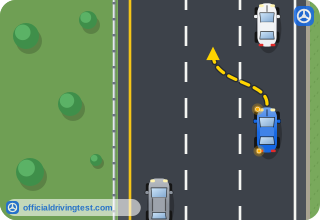
- Only when you are certain you can do so safely
- As soon as your turn signal is on
- Whenever the other lane is moving faster
- Whenever there is a gap behind the next vehicle
Show answer
Correct answer: Only when you are certain you can do so safely
The guide says never to move from one lane to another until you are certain you can do so safely.
Source: Class D & E Driver’s Guide (Revised August 2025 (DPSMV2052 R08/25)), page 87 · Open this page in the manual (Manual page 87)
-
Which mirrors does the guide say to check before changing lanes?
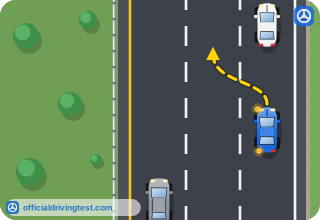
- Only your rear view mirror
- Only the side mirror on the side you are moving toward
- Your rear view and side mirrors
- None, if your turn signal is on
Show answer
Correct answer: Your rear view and side mirrors
The guide’s lane-changing rules start with checking your rear view and side mirrors.
Source: Class D & E Driver’s Guide (Revised August 2025 (DPSMV2052 R08/25)), page 87 · Open this page in the manual (Manual page 87)
-
Before changing lanes, besides checking your mirrors and blind spot, what else should you check for?
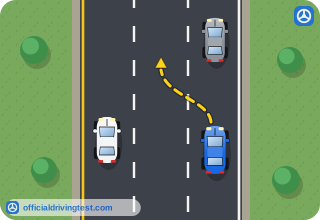
- Whether the lane ahead has fewer vehicles than yours
- Police officers stopped in the lane next to yours
- The speed limit posted for the lane you will enter
- Other drivers who may also be moving into the same lane
Show answer
Correct answer: Other drivers who may also be moving into the same lane
The guide’s lane-changing rules include checking for other drivers who may also be moving into the same lane.
Source: Class D & E Driver’s Guide (Revised August 2025 (DPSMV2052 R08/25)), page 87 · Open this page in the manual (Manual page 87)
-
Why should you look carefully behind you before changing lanes?
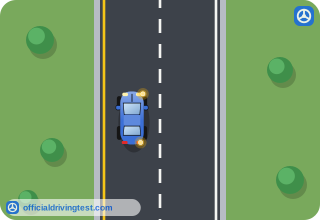
- Someone may be passing you
- A police car may be following you
- A school bus may be stopped behind you
- Your turn signal may have gone off
Show answer
Correct answer: Someone may be passing you
The guide says to look carefully behind you before changing lanes because someone may be passing you.
Source: Class D & E Driver’s Guide (Revised August 2025 (DPSMV2052 R08/25)), page 88 · Open this page in the manual (Manual page 88)
-
You should not attempt to pass if you cannot see at least how far ahead?
- An eighth of a mile
- Half a mile
- A quarter mile
- One mile
Show answer
Correct answer: A quarter mile
The guide says that if you cannot see at least a quarter mile ahead, you should not attempt to pass.
Source: Class D & E Driver’s Guide (Revised August 2025 (DPSMV2052 R08/25)), page 88 · Open this page in the manual (Manual page 88)
-
According to the guide, what is the best scenario for attempting a pass?
- A foggy morning on a long, flat, and clear stretch of road
- A clear, sunny day on a long, flat, and clear stretch of road
- A clear day on a short hill with a curve ahead
- A clear night on a long road with no other traffic
Show answer
Correct answer: A clear, sunny day on a long, flat, and clear stretch of road
The guide calls a clear, sunny day on a long, flat, and clear stretch of road the best scenario for attempting a pass.
Source: Class D & E Driver’s Guide (Revised August 2025 (DPSMV2052 R08/25)), page 88 · Open this page in the manual (Manual page 88)
-
If you are about to miss your exit or turn, what should you do about changing lanes?
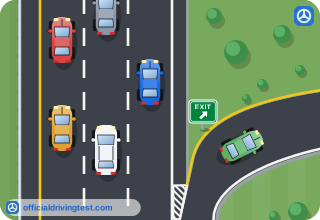
- Change lanes quickly while your signal is on, then slow down
- Stop in the lane until traffic lets you move over safely
- Back up slowly along the shoulder to the exit you missed
- Do not rush a lane change; take the next exit and turn around
Show answer
Correct answer: Do not rush a lane change; take the next exit and turn around
The guide says you should never make a hurried or unsafe lane change, because you can always take the next exit and turn around.
Source: Class D & E Driver’s Guide (Revised August 2025 (DPSMV2052 R08/25)), page 88 · Open this page in the manual (Manual page 88)
-
If a car is in your blind spot in the lane you want to move into, what should you do?
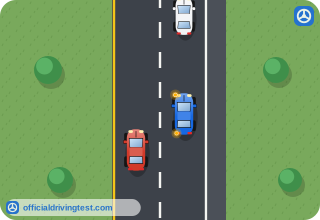
- Speed up or slow down until there is enough space
- Sound your horn so the driver moves out of the way
- Move over slowly so the other driver will see you
- Stop in your lane and wait for the car to pass
Show answer
Correct answer: Speed up or slow down until there is enough space
The guide says to speed up or slow down until there is enough space for you to change lanes, using your mirrors multiple times.
Source: Class D & E Driver’s Guide (Revised August 2025 (DPSMV2052 R08/25)), page 88 · Open this page in the manual (Manual page 88)
-
If speeding up or slowing down to make space for a lane change would put you or others in danger, what should you do?
- Change lanes anyway with your signal on
- Use your horn and change lanes
- Wait to change lanes
- Brake hard to open a gap
Show answer
Correct answer: Wait to change lanes
The guide says that if you would have to speed up or slow down so much that it puts you or others in danger, you should wait to change lanes.
Source: Class D & E Driver’s Guide (Revised August 2025 (DPSMV2052 R08/25)), page 88 · Open this page in the manual (Manual page 88)
-
What does the guide say about forcing your way into a lane?
- Do it only if your signal has been on for 100 feet
- Never do it; it is dangerous for you and other drivers
- Do it only when the other driver is going slower
- Do it only when you have the right of way
Show answer
Correct answer: Never do it; it is dangerous for you and other drivers
The guide says never to force your way into a lane because the maneuver is dangerous for both you and other drivers.
Source: Class D & E Driver’s Guide (Revised August 2025 (DPSMV2052 R08/25)), page 88 · Open this page in the manual (Manual page 88)
-
A car in the lane you want to move into is approaching at a faster speed than you are traveling. What should you do?
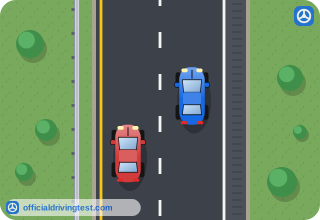
- Speed up and move in front of the car quickly
- Use your horn and move in front of the car
- Slow down and move in front of the car
- Wait for it to pass, then make the lane change
Show answer
Correct answer: Wait for it to pass, then make the lane change
The guide says to wait for the faster car to pass and then change lanes, because the driver might not have enough time to slow down behind you.
Source: Class D & E Driver’s Guide (Revised August 2025 (DPSMV2052 R08/25)), page 88 · Open this page in the manual (Manual page 88)
-
Where is changing lanes dangerous and illegal?
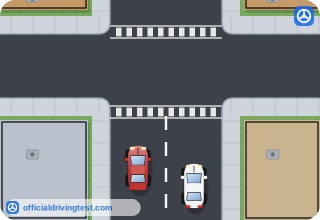
- While driving through or approaching an intersection
- On a road with only one lane in each direction
- While driving on a road with a posted minimum speed
- On a road that has no posted speed limit
Show answer
Correct answer: While driving through or approaching an intersection
The guide says changing lanes while driving through an intersection or approaching an intersection is dangerous and illegal.
Source: Class D & E Driver’s Guide (Revised August 2025 (DPSMV2052 R08/25)), page 88 · Open this page in the manual (Manual page 88)
-
Many intersection collisions occur when drivers do what?
- Stop too far behind the stop line when waiting to cross
- Fail to use turn signals or do not know right-of-way laws
- Slow down too much before entering the intersection
- Wait for the signal to turn green before they move
Show answer
Correct answer: Fail to use turn signals or do not know right-of-way laws
The guide says many intersection collisions occur when drivers fail to use their turn signals or don’t know the right-of-way laws.
Source: Class D & E Driver’s Guide (Revised August 2025 (DPSMV2052 R08/25)), page 89 · Open this page in the manual (Manual page 89)
-
What does the guide say about having the right of way at an intersection?
- It guarantees that you may cross without slowing
- It means you do not need to use your signal
- It lets you cross even when a pedestrian is in the way
- It does not guarantee your safety
Show answer
Correct answer: It does not guarantee your safety
The guide says that having the right of way does not guarantee your safety, so you should slow down and be prepared to stop if necessary.
Source: Class D & E Driver’s Guide (Revised August 2025 (DPSMV2052 R08/25)), page 89 · Open this page in the manual (Manual page 89)
-
Before making a turn, what does the guide say to scan for?
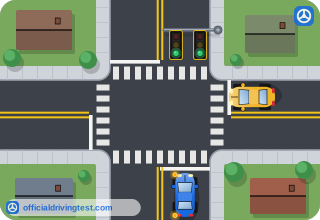
- Where other vehicles and pedestrians are, so the turn is safe
- Where the nearest police officer is parked along the street
- How many lanes the cross street has beyond the intersection
- Whether the traffic signal is about to change to red
Show answer
Correct answer: Where other vehicles and pedestrians are, so the turn is safe
The guide says to scan ahead and around you to see where other vehicles or pedestrians are and be sure it is safe to turn.
Source: Class D & E Driver’s Guide (Revised August 2025 (DPSMV2052 R08/25)), page 89 · Open this page in the manual (Manual page 89)
-
At least how far before making a turn does the law require you to signal and get into the proper lane?
- 50 feet
- 200 feet
- 100 feet
- 500 feet
Show answer
Correct answer: 100 feet
The guide says the law requires you to signal and get into the proper lane at least 100 feet before making a turn.
Source: Class D & E Driver’s Guide (Revised August 2025 (DPSMV2052 R08/25)), page 89 · Open this page in the manual (Manual page 89)
-
What is the correct order when preparing to turn?
- Move into the proper lane first and then signal
- Signal first and then move into the proper lane
- Slow down to a stop first and then signal
- Move into the proper lane first and then check for pedestrians
Show answer
Correct answer: Signal first and then move into the proper lane
The guide says to signal first and then move into the proper lane.
Source: Class D & E Driver’s Guide (Revised August 2025 (DPSMV2052 R08/25)), page 89 · Open this page in the manual (Manual page 89)
-
What does the guide say to do before making a turn, and in which lane should you finish it?
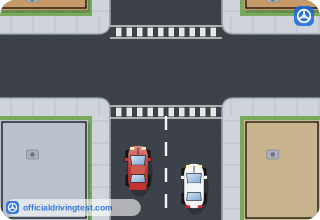
- Speed up before the turn and finish it in the nearest open lane
- Slow down before the turn and finish it in the left-most lane
- Stay at your speed and finish the turn wherever there is room
- Slow down before the turn and finish it in the proper lane
Show answer
Correct answer: Slow down before the turn and finish it in the proper lane
The guide says to slow down before making turns and always finish your turn in the proper lane.
Source: Class D & E Driver’s Guide (Revised August 2025 (DPSMV2052 R08/25)), page 89 · Open this page in the manual (Manual page 89)
-
What should you avoid before making a right turn?
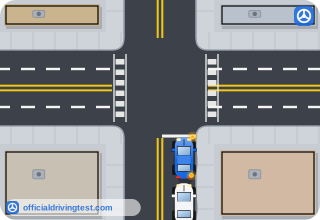
- Swinging left before making the turn
- Slowing down before making the turn
- Signaling before moving into the proper lane
- Looking at pedestrians in the crosswalk
Show answer
Correct answer: Swinging left before making the turn
The guide’s proper method for a right turn begins with avoiding swinging left before making the turn.
Source: Class D & E Driver’s Guide (Revised August 2025 (DPSMV2052 R08/25)), page 90 · Open this page in the manual (Manual page 90)