Louisiana: Right-of-way and turning — Part 3 Practice Test
Questions in this part include: “After you steer into the new lane when changing lanes, what should you do with your turn signal?” · “On what kind of roadway should a three-point turnabout only be used?”
Independent educational site · not affiliated with any government agency or DMV
Ready? Test yourself
- Instant feedback with an explanation
- Every answer cites its source in the manual
- Your best score is saved on this device
Questions are original and based on the official manual "Class D & E Driver’s Guide" (Revised August 2025 (DPSMV2052 R08/25)), Louisiana Office of Motor Vehicles.
All 19 questions in this practice test
Take the test above first, then use this list to study. Tap “Show answer” to see the correct answer and explanation.
Show the questions and answersHide the questions
-
What must you search for before you begin turning right?
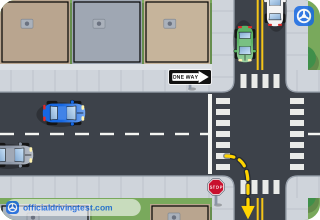
- Pedestrians crossing
- A railroad crossing sign
- A left-turn lane
- Vehicles parked ahead
Show answer
Correct answer: Pedestrians crossing
You must not begin turning right without searching for pedestrians crossing.
Source: Class D & E Driver’s Guide (Revised August 2025 (DPSMV2052 R08/25)), page 63 · Open this page in the manual (Manual page 63)
-
Before changing lanes, where must you check for traffic?
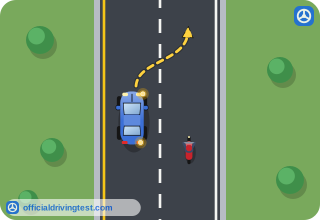
- In the lane you want to enter and behind your vehicle
- Only in the lane you are leaving and the oncoming lanes
- Only ahead of your vehicle in your own lane
- Only in the lane you want to enter
Show answer
Correct answer: In the lane you want to enter and behind your vehicle
Prior to changing lanes, you must check for traffic in the lane you want to enter and behind your vehicle.
Source: Class D & E Driver’s Guide (Revised August 2025 (DPSMV2052 R08/25)), page 63 · Open this page in the manual (Manual page 63)
-
How do you check your blind spots before changing lanes?
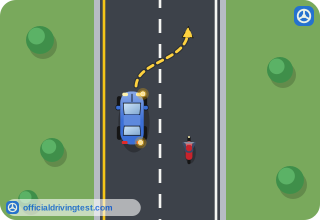
- Look only in your rearview mirror and side mirrors
- Look over your shoulder in the direction you plan to move
- Lean forward and watch your outside mirrors closely
- Wait until the other driver signals to you
Show answer
Correct answer: Look over your shoulder in the direction you plan to move
You check your blind spots by turning your head and looking over your shoulder in the direction you plan to move.
Source: Class D & E Driver’s Guide (Revised August 2025 (DPSMV2052 R08/25)), page 63 · Open this page in the manual (Manual page 63)
-
While checking traffic to the sides, rear or over your shoulder, why should you not look too long at any one time?
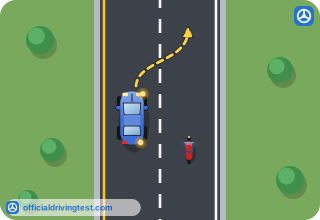
- Your turn signal could turn off
- Your mirrors could move out of position
- Traffic behind you could slow down
- Traffic ahead of you could stop suddenly
Show answer
Correct answer: Traffic ahead of you could stop suddenly
Traffic ahead of you could stop suddenly while you are checking traffic to the sides, rear or over your shoulder.
Source: Class D & E Driver’s Guide (Revised August 2025 (DPSMV2052 R08/25)), page 63 · Open this page in the manual (Manual page 63)
-
When changing lanes, what size gap in traffic should you identify before you signal and look again in the direction of the lane change?
- A 4 to 5 second gap
- A 1 to 2 second gap
- A 7 to 8 second gap
- A 10 to 12 second gap
Show answer
Correct answer: A 4 to 5 second gap
When changing lanes you identify a 4 to 5 second gap in traffic, signal, and look again in the direction of the lane change.
Source: Class D & E Driver’s Guide (Revised August 2025 (DPSMV2052 R08/25)), page 63 · Open this page in the manual (Manual page 63)
-
After you steer into the new lane when changing lanes, what should you do with your turn signal?
- Leave it on until the next intersection
- Flash it twice more
- Cancel it
- Leave it on for the next 5 seconds
Show answer
Correct answer: Cancel it
The lane-change steps end with adjusting speed, steering into the lane and canceling the turn signal.
Source: Class D & E Driver’s Guide (Revised August 2025 (DPSMV2052 R08/25)), page 63 · Open this page in the manual (Manual page 63)
-
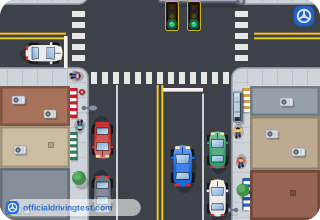
What does the manual say to do about turning around on a busy street?
- Do it quickly at the first break in traffic
- Do it only at an intersection with a signal
- Back up into the nearest driveway
- Avoid it; circling an entire city block is better
Show answer
Correct answer: Avoid it; circling an entire city block is better
You should try to avoid turning around on a busy street, and it is better to circle an entire city block.
Source: Class D & E Driver’s Guide (Revised August 2025 (DPSMV2052 R08/25)), page 66 · Open this page in the manual (Manual page 66)
-
When turning around on a narrow street in light traffic, where should you stop first?
- Close to the right edge of the pavement
- In the center of the street
- Close to the left edge of the pavement
- On the left shoulder
Show answer
Correct answer: Close to the right edge of the pavement
The first step in turning around on a narrow street is to stop close to the right edge of the pavement.
Source: Class D & E Driver’s Guide (Revised August 2025 (DPSMV2052 R08/25)), page 66 · Open this page in the manual (Manual page 66)
-
When turning around on a narrow street, how should you check traffic behind you?
- Look only in your rearview mirror and side mirrors
- Look over your right shoulder only, not left
- Look over your left shoulder, not just in your mirror
- Sound your horn and listen for traffic
Show answer
Correct answer: Look over your left shoulder, not just in your mirror
You look over your left shoulder and check traffic behind you, and you do not depend on your rear view mirror alone; the street must be clear both ahead and behind.
Source: Class D & E Driver’s Guide (Revised August 2025 (DPSMV2052 R08/25)), page 66 · Open this page in the manual (Manual page 66)
-
What should you do with your signal before turning around on a narrow street?
- Signal for a right turn
- Signal for a left turn
- Turn on your hazard lights
- Use no signal because traffic is light
Show answer
Correct answer: Signal for a left turn
After stopping near the right edge and checking traffic, you signal for a left turn and then follow the steps for the turn-around.
Source: Class D & E Driver’s Guide (Revised August 2025 (DPSMV2052 R08/25)), page 66 · Open this page in the manual (Manual page 66)
-
When is a three-point turnabout the right way to turn around?
- Only when the road is too narrow for a U-turn and you cannot go around the block
- Whenever you miss your turn on a busy road with several lanes
- Whenever you want to turn around on a road with three or more lanes
- Only when a traffic officer directs you to turn the vehicle around
Show answer
Correct answer: Only when the road is too narrow for a U-turn and you cannot go around the block
The manual says to use a three-point turnabout only when the road or street is too narrow to make a U-turn and you cannot go around the block.
Source: Class D & E Driver’s Guide (Revised August 2025 (DPSMV2052 R08/25)), page 67 · Open this page in the manual (Manual page 67)
-
On what kind of roadway should a three-point turnabout only be used?
- A roadway with four or more lanes
- A one-way street with three lanes
- A two-lane roadway
- A divided highway with a wide median
Show answer
Correct answer: A two-lane roadway
The manual says a three-point turnabout should only be used on a two-lane roadway.
Source: Class D & E Driver’s Guide (Revised August 2025 (DPSMV2052 R08/25)), page 67 · Open this page in the manual (Manual page 67)
-
Which way of turning your vehicle around does the manual call the most difficult and dangerous?
- A U-turn at an intersection
- A three-point turnabout
- Backing into a driveway
- Going around the block
Show answer
Correct answer: A three-point turnabout
The manual describes the three-point turnabout as the most difficult and dangerous way to perform a turnabout.
Source: Class D & E Driver’s Guide (Revised August 2025 (DPSMV2052 R08/25)), page 67 · Open this page in the manual (Manual page 67)
-
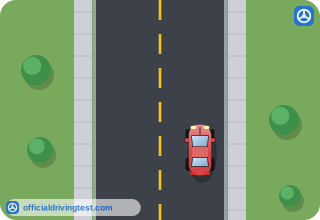
Which turn signal do you activate first when you start a three-point turnabout?
- The left turn signal
- The hazard flashers
- No signal until the car is in reverse
- The right turn signal
Show answer
Correct answer: The right turn signal
To start a three-point turnabout you activate the right turn signal to show you are pulling off to the right side of the road.
Source: Class D & E Driver’s Guide (Revised August 2025 (DPSMV2052 R08/25)), page 67 · Open this page in the manual (Manual page 67)
-
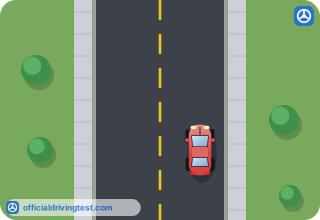
In a three-point turnabout, after checking traffic and your blind spot, how do you steer to cross to the other side of the road?
- Turn hard right to the other side of the road and stop
- Turn slightly left and keep rolling into the new lane
- Turn hard left to the other side of the road and stop
- Turn hard left and drive straight into the new lane
Show answer
Correct answer: Turn hard left to the other side of the road and stop
In the second step of the turnabout you turn hard left to the other side of the road and stop once you reach it.
Source: Class D & E Driver’s Guide (Revised August 2025 (DPSMV2052 R08/25)), page 67 · Open this page in the manual (Manual page 67)
-
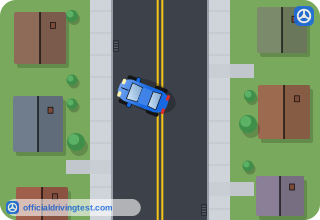
In a three-point turnabout, once you are on the other side of the road, you place the vehicle in reverse and turn which way?
- Hard right to the other side of the road
- Hard left to the other side of the road
- Straight back along the edge of the road
- Hard right and drive forward into the lane
Show answer
Correct answer: Hard right to the other side of the road
In reverse you check traffic and blind spots, then turn hard right to the other side of the road and stop.
Source: Class D & E Driver’s Guide (Revised August 2025 (DPSMV2052 R08/25)), page 67 · Open this page in the manual (Manual page 67)
-
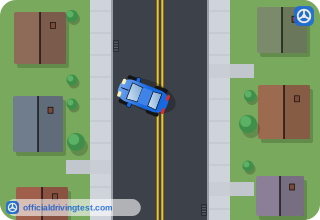
In a three-point turnabout, how do you check your blind spots while the vehicle is in reverse?
- Only by looking in the rearview mirror
- Only over your left shoulder
- Only by looking in the side mirrors
- To both sides by looking over your shoulder
Show answer
Correct answer: To both sides by looking over your shoulder
The manual says to check blind spots to both sides by looking over your shoulder before backing across the road.
Source: Class D & E Driver’s Guide (Revised August 2025 (DPSMV2052 R08/25)), page 67 · Open this page in the manual (Manual page 67)
-
At the end of a three-point turnabout, where do you drive?
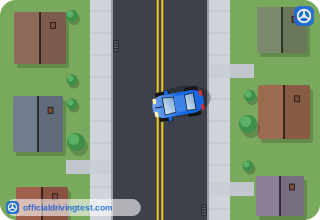
- Forward into the left lane of traffic heading in the new direction
- Forward into the right lane of traffic heading in the new direction
- Straight back into the lane you started in
- Forward, stopping on the shoulder before entering traffic
Show answer
Correct answer: Forward into the right lane of traffic heading in the new direction
The last step is to turn hard left and drive forward into the right lane of traffic heading in the new direction.
Source: Class D & E Driver’s Guide (Revised August 2025 (DPSMV2052 R08/25)), page 67 · Open this page in the manual (Manual page 67)
-
After completing a three-point turnabout, what should you make sure of before driving straight in the new direction?
- That your parking brake is set
- That your turn signal has cancelled
- That your hazard flashers are on
- That your windows are fully down
Show answer
Correct answer: That your turn signal has cancelled
The manual tells you to check traffic and make sure your turn signal has cancelled before continuing straight.
Source: Class D & E Driver’s Guide (Revised August 2025 (DPSMV2052 R08/25)), page 67 · Open this page in the manual (Manual page 67)