Illinois: Sharing the road
Bicycles, e-bikes, motorcycles, trucks, farm equipment and other road users. Split into 6 shorter tests so you're not stuck in one long quiz.
Independent educational site · not affiliated with any government agency or DMV
Choose a part
Sharing the road — Part 1
Questions in this part include: “Using the "Dutch Reach," which hand should you use to open the vehicle door?”
StartSharing the road — Part 2
Questions in this part include: “How does the Illinois manual describe an autocycle?”
StartSharing the road — Part 3
Questions in this part include: “How old must the operator of a Class 3 low-speed electric bicycle be?”
StartSharing the road — Part 4
Questions in this part include: “How old must you be to operate a low-speed electric scooter in Illinois?”
StartSharing the road — Part 5
Questions in this part include: “Which of these is on the list of equipment a low-speed vehicle must have?”
StartSharing the road — Part 6
Questions in this part include: “Which vehicles does the manual define as low-speed vehicles?”
StartAll 102 Sharing the road questions with answers
Choose a part above to take a practice test, or study every question and answer here.
Show the questions and answersHide the questions
-
After you open a vehicle door on the side where traffic is moving, how long may the door stay open?
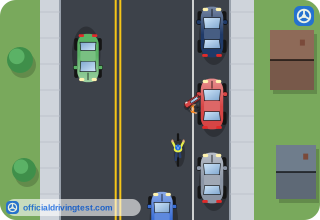
- Until the next vehicle comes up behind you
- For as long as your hazard lights are on
- For up to one minute if no bicycles are near
- Only long enough to load or unload passengers
Show answer
Correct answer: Only long enough to load or unload passengers
A door on the traffic side may be opened only when it is safe, and it may remain open only long enough to load or unload passengers.
Source: Illinois Rules of the Road (2026), page 30
-
Using the "Dutch Reach," which hand should you use to open the vehicle door?
- Your right hand
- Your left hand
- Either hand, while you watch the mirror
- Both hands at the same time
Show answer
Correct answer: Your right hand
The Dutch Reach means using the right hand to open the door, which makes you turn and check for oncoming vehicles and bicyclists.
Source: Illinois Rules of the Road (2026), page 30
-
What should you be aware of about trucks and buses when turning right?
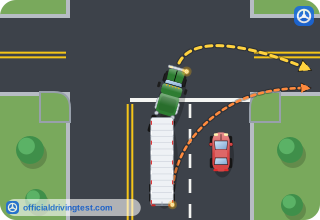
- They may need more space to make a right turn
- They must always make right turns from the left lane
- They are not required to signal right turns
- They have the right of way at every corner
Show answer
Correct answer: They may need more space to make a right turn
The manual warns that trucks and buses may need more space to make a right-hand turn.
Source: Illinois Rules of the Road (2026), page 31
-
When passing a bicyclist in a dedicated bicycle lane, what minimum distance must you keep?
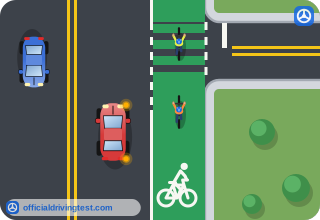
- 3 feet
- 1 foot
- 2 feet
- None; the lane separates you
Show answer
Correct answer: 3 feet
When passing a bicyclist on any road, including on the shoulder or in a dedicated bicycle lane, keep a minimum distance of 3 feet.
Source: Illinois Rules of the Road (2026), page 28
-
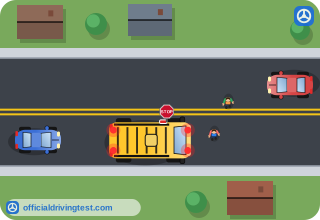
On a two-lane, two-way roadway, a school bus has stopped to load or discharge passengers. May you pass it?
- Yes, if you slow to 20 mph
- No, passing is not allowed
- Yes, on the left, carefully
- Yes, if no children are seen
Show answer
Correct answer: No, passing is not allowed
Passing on a two-lane, two-way roadway is not allowed when a school bus has stopped to load or discharge passengers.
Source: Illinois Rules of the Road (2026), page 29
-
What is the most common cause of motorcycle crashes?
- Motorcyclists riding far too fast
- Drivers not detecting motorcycles
- Motorcycle brake or engine failure
- Wet or icy road surfaces
Show answer
Correct answer: Drivers not detecting motorcycles
The manual says the failure of motorists to detect and recognize motorcycles in traffic is the most common cause of motorcycle crashes.
Source: Illinois Rules of the Road (2026), page 41
-
Because motorcycles are small, what do motorists tend to misjudge about them?
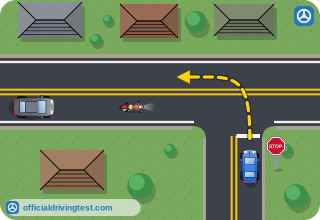
- They underestimate their speed
- They overestimate their speed
- They underestimate their braking distance
- They overestimate their width
Show answer
Correct answer: They underestimate their speed
Due to their small size, motorcycles may be difficult to see, and motorists tend to underestimate their speed.
Source: Illinois Rules of the Road (2026), page 41
-
When should a driver expect to see motorcycles in traffic?
- Mainly in the spring and summer
- Mainly on weekends
- Mainly during daylight hours
- At any time of year
Show answer
Correct answer: At any time of year
A driver should expect to see motorcycles in traffic at any time, not just in the spring and summer.
Source: Illinois Rules of the Road (2026), page 41
-
What share of all motorcycle crashes occur at intersections?
- About 10%
- About 25%
- More than 50%
- More than 90%
Show answer
Correct answer: More than 50%
More than 50% of all motorcycle crashes occur at intersections.
Source: Illinois Rules of the Road (2026), page 41
-
What is the most common motorcycle crash situation at intersections?
- An oncoming car turns left in front of the motorcycle
- A car rear-ends a motorcycle stopped at a light
- A motorcycle runs a red light into cross traffic
- A car turns right and cuts off the motorcycle
Show answer
Correct answer: An oncoming car turns left in front of the motorcycle
The most common situation occurs when an oncoming automobile makes a left turn in front of a motorcycle.
Source: Illinois Rules of the Road (2026), page 41
-
A red light fails to turn green for a motorcyclist. After how long may the motorcyclist proceed, after yielding to oncoming traffic?
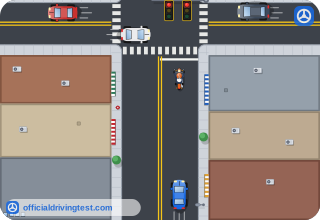
- 60 seconds
- 90 seconds
- 3 minutes
- 120 seconds
Show answer
Correct answer: 120 seconds
If a red light fails to turn green after 120 seconds, a motorcyclist may proceed through the intersection after yielding the right of way to oncoming traffic.
Source: Illinois Rules of the Road (2026), page 41
-
There seems to be enough room in a lane for both your car and a motorcycle. What should you do?
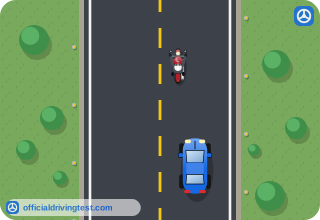
- Share the lane, keeping to the far left side
- Share the lane only at low speeds
- Don't share it; the rider gets the whole lane
- Share the lane if the rider waves you past
Show answer
Correct answer: Don't share it; the rider gets the whole lane
The motorcyclist needs room to maneuver safely and is entitled to the entire lane, so do not share the lane.
Source: Illinois Rules of the Road (2026), page 41
-
What should you do while a motorcycle is passing you?
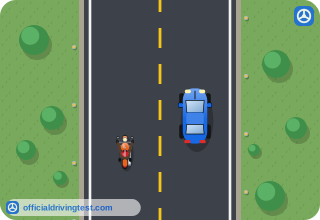
- Slow down sharply to let it by
- Maintain your lane position and speed
- Move to the right edge of your lane
- Speed up so it can merge behind you
Show answer
Correct answer: Maintain your lane position and speed
When being passed by a motorcycle, maintain your lane position and speed and let the motorcycle complete the maneuver.
Source: Illinois Rules of the Road (2026), page 41
-
How much following distance should you allow when behind a motorcycle?
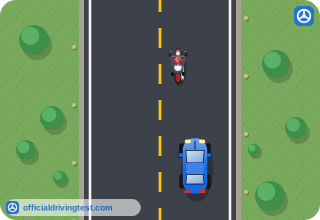
- At least one to two seconds
- At least two seconds
- At least three to four seconds
- At least eight to ten seconds
Show answer
Correct answer: At least three to four seconds
Allow at least three to four seconds following distance behind a motorcycle so the motorcyclist has time to maneuver in an emergency.
Source: Illinois Rules of the Road (2026), page 42
-
In dry conditions, how does a motorcycle's stopping ability compare with a car's?
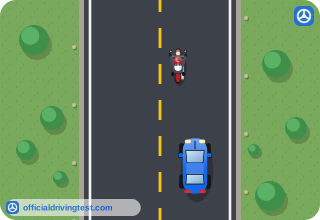
- A motorcycle can stop more quickly than a car
- A motorcycle needs about twice the distance
- A motorcycle needs a slightly longer distance
- Both stop in exactly the same distance
Show answer
Correct answer: A motorcycle can stop more quickly than a car
In dry conditions, motorcycles can stop more quickly than a car, which is one reason to leave extra following distance.
Source: Illinois Rules of the Road (2026), page 42
-
When should you dim your headlights while following another vehicle?
- Only when following a large truck
- Only when following a motorcycle
- Only when it is raining or foggy
- When following any vehicle
Show answer
Correct answer: When following any vehicle
The manual says to dim your headlights when following all vehicles, including motorcycles.
Source: Illinois Rules of the Road (2026), page 42
-
How far can a wind gust, natural or from a large passing vehicle, move an unprepared motorcyclist?
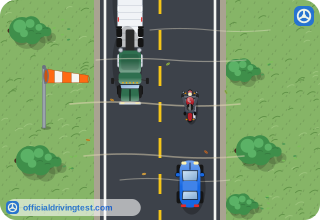
- A few inches at most
- Across an entire lane
- About one foot
- Not at all at highway speeds
Show answer
Correct answer: Across an entire lane
Wind gusts, both natural and those created by large passing vehicles, can move a motorcycle across an entire lane if the rider is not prepared.
Source: Illinois Rules of the Road (2026), page 42
-
Why might a motorcyclist change position within the lane unexpectedly?
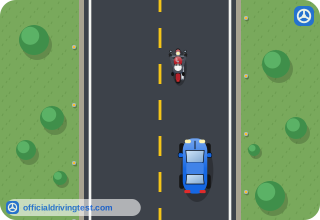
- To signal a turn to other drivers
- To be seen by trucks more easily
- To avoid potholes, oil, gravel, or debris
- Riders must weave to stay visible to cars
Show answer
Correct answer: To avoid potholes, oil, gravel, or debris
Potholes, oil spills, gravel, debris, or railroad tracks often require motorcyclists to change positions within their lane.
Source: Illinois Rules of the Road (2026), page 42
-
How do gravel roads affect a motorcyclist?
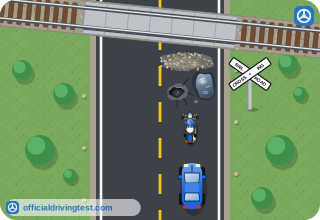
- They reduce traction and may force slowing
- They add traction and allow faster turning
- They have no effect on a motorcycle at all
- They only matter when the gravel is wet
Show answer
Correct answer: They reduce traction and may force slowing
Gravel roads decrease traction and may cause a rider to slow down or brake where a car would not.
Source: Illinois Rules of the Road (2026), page 42
-
How does the Illinois manual describe an autocycle?
- A two-wheeled vehicle with pedals and a motor
- A three-wheeled vehicle with handlebars and a saddle
- A four-wheeled vehicle limited to 25 mph
- A three-wheeled vehicle with a steering wheel
Show answer
Correct answer: A three-wheeled vehicle with a steering wheel
An autocycle is a three-wheeled vehicle that has a steering wheel and seating that does not require the driver to straddle or sit astride it.
Source: Illinois Rules of the Road (2026), page 42
-
What license does the operator of an autocycle need in Illinois?
- A Class M motorcycle license
- A valid Illinois driver's license
- A Class L motorcycle license
- No license is required
Show answer
Correct answer: A valid Illinois driver's license
The operator of an autocycle must have a valid Illinois driver's license to legally operate it.
Source: Illinois Rules of the Road (2026), page 42
-
On most roadways, bicyclists (including electric or gas bicycles that do not exceed 20 mph) have:
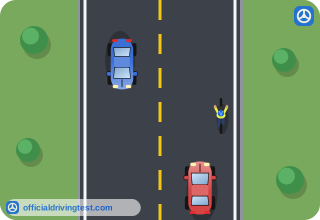
- The same rights and responsibilities as other roadway users
- Fewer rights than motor vehicles and must always yield
- The right to ride on sidewalks and ignore traffic signals
- Rights only when they ride inside a marked bike lane
Show answer
Correct answer: The same rights and responsibilities as other roadway users
On most roadways, bicyclists have the same rights and responsibilities as other roadway users, including the right of way.
Source: Illinois Rules of the Road (2026), page 42
-
May a car stop in a designated bike lane to drop off a passenger when no bicyclists are present?
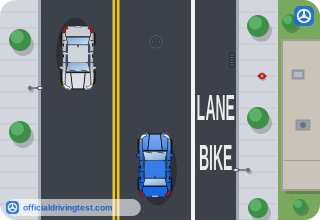
- Yes, if the stop is brief and quick
- Yes, if the hazard lights are on
- No, not even if no cyclists are there
- Yes, but only at night
Show answer
Correct answer: No, not even if no cyclists are there
Vehicles are not allowed to drive, park, idle, or drop off or pick up passengers in bike lanes even if bicyclists are not present.
Source: Illinois Rules of the Road (2026), page 42
-
Where are bicyclists prohibited from riding in Illinois?
- On any road that has no bike lane
- On roads posted above 35 mph
- On residential streets after dark
- On controlled-access highways
Show answer
Correct answer: On controlled-access highways
Bicyclists are prohibited on controlled-access highways, expressways, and other marked roadways.
Source: Illinois Rules of the Road (2026), page 42
-
In which direction are bicyclists required to travel on the road?
- Facing oncoming traffic
- The same direction as vehicles
- Either direction, rider's choice
- Against traffic on one-way streets
Show answer
Correct answer: The same direction as vehicles
Bicyclists are required to travel in the same direction as vehicles.
Source: Illinois Rules of the Road (2026), page 43
-
Why might a bicyclist move toward the center of the lane instead of riding just to the right of traffic?
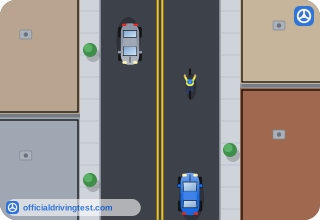
- To avoid debris, drainage grates, or a narrow lane
- Because bicyclists must always ride in the center
- To block cars from passing on the right side
- Because the law forbids riding near the curb
Show answer
Correct answer: To avoid debris, drainage grates, or a narrow lane
Bicyclists should ride just to the right of faster traffic, but hazards such as rough surfaces, debris, drainage grates, or a narrow lane may require them to move toward the center.
Source: Illinois Rules of the Road (2026), page 43
-
On an ordinary roadway, what is the most bicyclists allowed to ride side by side?
- Single file only
- Three abreast
- Two abreast
- Any number
Show answer
Correct answer: Two abreast
Bicyclists may ride side by side if traffic is not impeded; riding more than two abreast is prohibited except on paths or lanes set aside for bicycles.
Source: Illinois Rules of the Road (2026), page 43
-
How must drivers treat a bicyclist when it comes to the right of way?
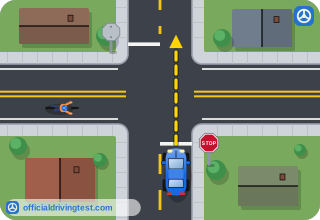
- Bicyclists must always yield to cars
- Only bicyclists in bike lanes get it
- Drivers yield only to child cyclists
- Yield just as they would to a vehicle
Show answer
Correct answer: Yield just as they would to a vehicle
Drivers must yield the right of way to a bicyclist just as they would to another vehicle.
Source: Illinois Rules of the Road (2026), page 43
-
When passing a bicyclist, how much space must you leave, measured from the edge of your side mirror?
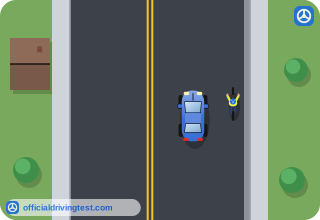
- At least 2 feet
- At least 3 feet
- At least 5 feet
- At least 6 feet
Show answer
Correct answer: At least 3 feet
Motorists must pass a bicyclist slowly and leave at least 3 feet of passing space from the edge of the vehicle's side mirror.
Source: Illinois Rules of the Road (2026), page 43
-
You want to pass a bicyclist, but there is not enough room to leave the required passing space. What must you do?
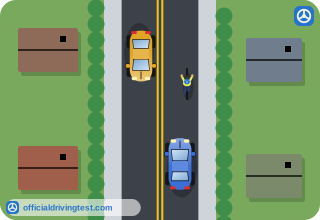
- Honk so the rider moves over
- Pass quickly to limit the risk
- Wait until you can pass safely
- Pass using the bike lane
Show answer
Correct answer: Wait until you can pass safely
If there is not 3 feet of passing space, drivers must wait to pass until they can do so safely.
Source: Illinois Rules of the Road (2026), page 43
-
A driver passes too close to a bicyclist and causes a crash. What may the driver face?
- Criminal charges
- A written warning only
- No penalty if no one died
- A parking citation
Show answer
Correct answer: Criminal charges
If a driver passes too close to a bicyclist and it results in a crash, the driver may face criminal charges.
Source: Illinois Rules of the Road (2026), page 43
-
At night, what should you not use when approaching an oncoming bicyclist?
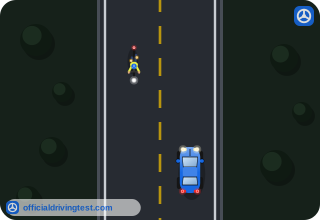
- Your turn signals
- Your low beams
- Your horn
- Your high beams
Show answer
Correct answer: Your high beams
High beam lights should not be used at night when approaching an oncoming bicyclist.
Source: Illinois Rules of the Road (2026), page 43
-
You are turning left and a bicyclist enters the intersection from the opposite direction. What should you do?
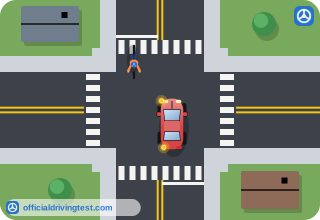
- Turn first, since cars have priority
- Wait for the bicyclist to pass, then turn
- Sound your horn and complete the turn
- Turn if the bicyclist is still far away
Show answer
Correct answer: Wait for the bicyclist to pass, then turn
When turning left with a bicyclist entering from the opposite direction, the driver should wait for the bicyclist to pass before making the turn.
Source: Illinois Rules of the Road (2026), page 43
-
You are sharing a left-turn lane with a bicyclist. What should you do?
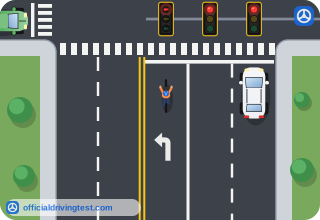
- Pull beside the bicyclist and turn together
- Pass the bicyclist before the intersection
- Stay behind until the bicyclist completes the turn
- Turn first and let the bicyclist follow you
Show answer
Correct answer: Stay behind until the bicyclist completes the turn
If a motorist is sharing the left-turn lane with a bicyclist, the motorist should stay behind until the bicyclist has safely completed the turn.
Source: Illinois Rules of the Road (2026), page 43
-
You are about to turn right and a bicyclist is approaching on your right. What should you do?
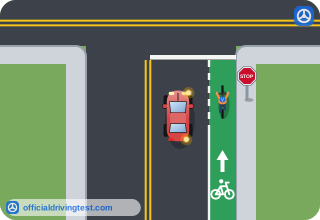
- Turn quickly before the bicyclist arrives
- Signal and turn, since the cyclist must yield
- Move into the bike lane to block the cyclist
- Let the bicyclist go through first, then turn
Show answer
Correct answer: Let the bicyclist go through first, then turn
If you are turning right and a bicyclist is approaching on the right, let the bicyclist go through the intersection first before making the right turn.
Source: Illinois Rules of the Road (2026), page 43
-
How old must the operator of a Class 3 low-speed electric bicycle be?
- At least 16
- At least 14
- At least 18
- At least 12
Show answer
Correct answer: At least 16
The manual states that operators of a Class 3 low-speed electric bicycle must be at least age 16.
Source: Illinois Rules of the Road (2026), page 44
-
Where may low-speed electric bicycles never be operated, according to the manual?
- On authorized streets
- In bicycle lanes
- On sidewalks
- On authorized highways
Show answer
Correct answer: On sidewalks
Low-speed electric bicycles may not be operated on sidewalks. They may use authorized highways, streets and roadways, including bicycle lanes.
Source: Illinois Rules of the Road (2026), page 43
-
After parking, which hand does the manual suggest using to open the driver's door, and why?
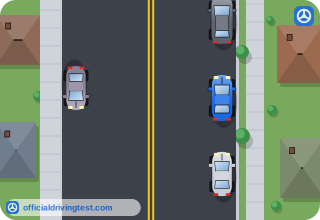
- Your left hand, to open the door faster
- Your right hand, so you turn and can see bikes
- Either hand, as long as you open it slowly
- Your left hand, so you can watch the mirror
Show answer
Correct answer: Your right hand, so you turn and can see bikes
Drivers should consider reaching with their right hand to open the door, which turns the upper body and gives a better chance to check for oncoming vehicles and bicyclists.
Source: Illinois Rules of the Road (2026), page 43
-
A low-speed electric bicycle has fully operable pedals and an electric motor of less than:
- 500 watts
- 1,000 watts
- 1,500 watts
- 750 watts
Show answer
Correct answer: 750 watts
The manual defines a low-speed electric bicycle as a bicycle with fully operable pedals and an electric motor of less than 750 watts.
Source: Illinois Rules of the Road (2026), page 43
-
Who may prohibit the use of low-speed electric bicycles on roadways or bike paths within their area?
- Local authorities
- Only the federal government
- No one; state law allows them everywhere
- Only the owners of adjoining property
Show answer
Correct answer: Local authorities
Local authorities may prohibit the use of low-speed electric bicycles on roadways or bike paths within their jurisdiction.
Source: Illinois Rules of the Road (2026), page 43
-
How many classes of low-speed electric bicycles does the manual describe?
- Two
- Four
- Three
- Five
Show answer
Correct answer: Three
The manual states there are three classes of low-speed electric bicycles (Class 1, Class 2, and Class 3).
Source: Illinois Rules of the Road (2026), page 44
-
Which class of low-speed electric bicycle has a motor that assists only while the rider pedals and stops assisting at 20 mph?
- Class 2
- Class 3
- Class L
- Class 1
Show answer
Correct answer: Class 1
A Class 1 e-bike's motor provides assistance only when the rider is pedaling and ceases to provide assistance when the bicycle reaches 20 mph.
Source: Illinois Rules of the Road (2026), page 44
-
Which class of low-speed electric bicycle has a motor that may be used exclusively to propel the bicycle?
- Class 1
- Class 2
- Class 3
- Class M
Show answer
Correct answer: Class 2
A Class 2 e-bike is equipped with a motor that may be used exclusively to propel the bicycle but is not capable of engaging when the bicycle reaches 20 mph.
Source: Illinois Rules of the Road (2026), page 44
-
When may a scooter be titled and registered in Illinois?
- When it has a federal safety label and a VIN
- When its engine is under 50cc and it has pedals
- When its owner holds a Class M license
- Scooters can never be titled or registered
Show answer
Correct answer: When it has a federal safety label and a VIN
A scooter may be titled and registered in Illinois if it displays a federal safety certification label and has a vehicle identification number (VIN).
Source: Illinois Rules of the Road (2026), page 44
-
What must a moped or scooter have in order to carry two people?
- A second set of passenger handlebars
- A sidecar attached to the right side
- A seat and footrest for the passenger
- An engine of at least 150cc
Show answer
Correct answer: A seat and footrest for the passenger
Mopeds or scooters carrying two people must have a seat and footrest for the passenger.
Source: Illinois Rules of the Road (2026), page 44
-
If a moped or scooter is driven at night, its headlight must be visible from at least how far?
- 100 feet
- 200 feet
- 1,000 feet
- 500 feet
Show answer
Correct answer: 500 feet
If driven at night, a moped or scooter must have a headlight visible from at least 500 feet and a taillight visible from at least 100-600 feet.
Source: Illinois Rules of the Road (2026), page 44
-
A scooter has an engine with less than 150cc displacement. What license is required to operate it?
- An instruction permit only
- Class L motorcycle license
- Any valid driver's license
- No license is required
Show answer
Correct answer: Class L motorcycle license
A scooter with an engine of less than 150cc displacement is a motor-driven cycle, and a Class L motorcycle license is required.
Source: Illinois Rules of the Road (2026), page 44
-
A scooter has an engine with 150cc displacement or greater. What license is required?
- Class L license
- Any valid license
- Class M license
- No license
Show answer
Correct answer: Class M license
A scooter with an engine of 150cc or greater is a motorcycle, and a Class M license is required.
Source: Illinois Rules of the Road (2026), page 44
-
What license is needed to operate a moped in Illinois?
- A Class M motorcycle license
- A Class L motorcycle license
- A moped permit and nothing else
- Any valid Illinois license
Show answer
Correct answer: Any valid Illinois license
A moped may be operated with any valid Illinois driver's license.
Source: Illinois Rules of the Road (2026), page 44
-
If a moped uses a combustion engine, what limits apply?
- No more than 50cc, and no gear shifting required
- No more than 150cc, with a manual gearbox
- No more than 100cc, and top speed of 35 mph
- No more than 750cc, and pedals are required
Show answer
Correct answer: No more than 50cc, and no gear shifting required
A moped's combustion engine may not exceed 50cc displacement and may not require the operator to shift gears.
Source: Illinois Rules of the Road (2026), page 44
-
What is the maximum speed of a low-speed electric scooter, as defined in the manual?
- 15 miles per hour
- 10 miles per hour
- 20 miles per hour
- 25 miles per hour
Show answer
Correct answer: 10 miles per hour
A low-speed electric scooter weighs less than 100 pounds and has a maximum speed of 10 miles per hour.
Source: Illinois Rules of the Road (2026), page 44
-
To count as a low-speed electric scooter, a scooter must weigh less than:
- 50 pounds
- 150 pounds
- 100 pounds
- 250 pounds
Show answer
Correct answer: 100 pounds
A low-speed electric scooter is a scooter that weighs less than 100 pounds and has 2 or 3 wheels, handlebars, and a floorboard.
Source: Illinois Rules of the Road (2026), page 44
-
How old must you be to operate a low-speed electric scooter in Illinois?
- 12 or older
- 14 or older
- 16 or older
- 18 or older
Show answer
Correct answer: 18 or older
You must be 18 years of age or older to operate a low-speed electric scooter.
Source: Illinois Rules of the Road (2026), page 44
-
Does operating a low-speed electric scooter require a driver's license?
- No
- Yes, a Class L license
- Yes, any valid license
- Yes, an instruction permit
Show answer
Correct answer: No
A low-speed electric scooter does not require a driver's license, and it may be used on a roadway, trail, or sidewalk only if the local municipality or park district permits it.
Source: Illinois Rules of the Road (2026), page 44
-
Where may a low-speed electric scooter be operated on a roadway, trail, or sidewalk?
- Anywhere, since state law allows it
- Only where local authorities permit it
- Only on sidewalks, never on a roadway
- Only on roads posted 45 mph or less
Show answer
Correct answer: Only where local authorities permit it
A low-speed electric scooter may only be operated on a roadway, trail, or sidewalk if permitted by the local municipality or park district.
Source: Illinois Rules of the Road (2026), page 44
-
A low-speed electric scooter may not be operated on any highway with a speed limit of:
- 15 mph
- 20 mph
- 35 mph
- 10 mph
Show answer
Correct answer: 35 mph
The manual says you may not operate a low-speed scooter on any highway with a speed limit of 35 mph.
Source: Illinois Rules of the Road (2026), page 44
-
What equipment must a low-speed electric scooter have?
- A horn and a speedometer gauge
- Turn signals and a side mirror
- A passenger seat and footrest
- Head lamp and red rear reflector
Show answer
Correct answer: Head lamp and red rear reflector
A low-speed electric scooter must be equipped with a head lamp, which may be visible up to 500 feet, and a red reflector or lamp on the rear.
Source: Illinois Rules of the Road (2026), page 44
-
How many people may ride on a low-speed electric scooter at one time?
- No more than one
- Up to two
- Up to two, if both are adults
- Up to three
Show answer
Correct answer: No more than one
No more than one person may be on a low-speed electric scooter.
Source: Illinois Rules of the Road (2026), page 44
-
When following a truck or bus, where should you position your vehicle?
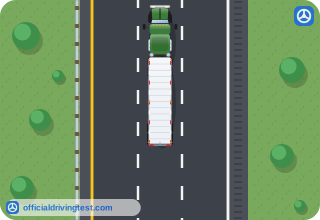
- Close behind it to cut down wind drag
- Out of blind spots, visible to its driver
- Just beside its rear wheels, ready to pass
- Directly behind it, near its rear bumper
Show answer
Correct answer: Out of blind spots, visible to its driver
Stay out of blind spots and keep a visible position when following a large vehicle; its driver should be able to see surrounding vehicles in the side mirrors.
Source: Illinois Rules of the Road (2026), page 45
-
A large truck ahead is signaling a right turn and has left an open space to its right. What should you know?
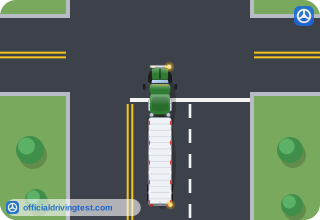
- The space is for cars to pass on the right
- The truck is pulling over to park
- Large vehicles make wide right turns
- The truck is about to turn left instead
Show answer
Correct answer: Large vehicles make wide right turns
Large vehicles make wide right turns and sometimes leave an open space to the right just before the turn, so give them plenty of room.
Source: Illinois Rules of the Road (2026), page 45
-
Why should you always dim your headlights when following a truck at night?
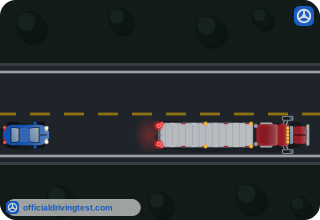
- Bright lights drain the car's battery
- Glare off its big mirrors blinds the driver
- The truck's rear lights are harder to see
- It is required only inside city limits
Show answer
Correct answer: Glare off its big mirrors blinds the driver
Bright lights will blind the drivers of large vehicles when they reflect off the large side mirrors.
Source: Illinois Rules of the Road (2026), page 45
-
How can you let a truck driver know you are passing, especially at night?
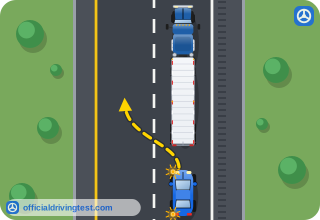
- Blink your headlights
- Sound your horn twice
- Turn on your hazard lights
- Follow closely first
Show answer
Correct answer: Blink your headlights
Blink the vehicle's headlights when passing a truck to let the truck driver know, especially at night.
Source: Illinois Rules of the Road (2026), page 45
-
When passing a truck, how should you complete the pass?
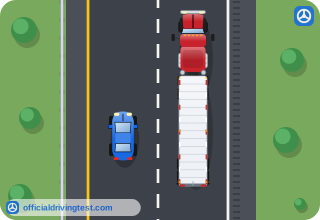
- Slowly, matching the truck's speed
- After riding alongside to be seen
- Only on the truck's right side
- As quickly as possible
Show answer
Correct answer: As quickly as possible
The pass should be completed as quickly as possible to avoid staying alongside the truck.
Source: Illinois Rules of the Road (2026), page 45
-
On a four-lane highway, you approach a disabled vehicle with its hazard lights on. What does Illinois law require if it is safe?
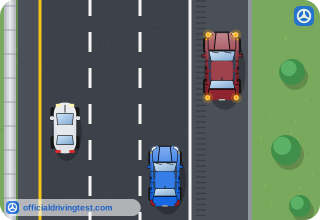
- Stop behind it and offer help
- Sound your horn as you pass
- Speed up to pass it quickly
- Change lanes away from it
Show answer
Correct answer: Change lanes away from it
Illinois law requires drivers approaching a disabled vehicle using hazard lights on a four-lane highway to change lanes away from it if it is safe to do so.
Source: Illinois Rules of the Road (2026), page 45
-
You cannot safely change lanes away from a disabled vehicle with hazard lights. What should you do?
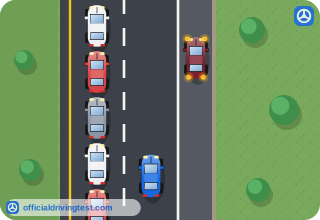
- Reduce speed, and don't speed up until well past it
- Keep your speed and pass it as fast as you can
- Stop in your lane until the vehicle is removed
- Pass it on the shoulder on the opposite side
Show answer
Correct answer: Reduce speed, and don't speed up until well past it
If it is not safe to change lanes, reduce speed when approaching and passing the disabled vehicle, and do not increase speed until well past it.
Source: Illinois Rules of the Road (2026), page 45
-
What is the maximum speed a low-speed vehicle can have?
- 20 mph
- 25 mph
- 30 mph
- 35 mph
Show answer
Correct answer: 25 mph
A low-speed vehicle is a four-wheeled vehicle with a federal safety certification label and a VIN, and it can have a maximum speed of 25 mph.
Source: Illinois Rules of the Road (2026), page 46
-
Unless the local municipality prohibits it, a low-speed vehicle may operate on streets with a posted speed limit of:
- 30 mph or less
- 25 mph or less
- 35 mph or less
- 45 mph or less
Show answer
Correct answer: 30 mph or less
Low-speed vehicles may operate on any street with a posted speed limit of 30 mph or less unless prohibited by the local municipality.
Source: Illinois Rules of the Road (2026), page 46
-
How must low-speed vehicles be titled and registered?
- They are exempt from titling
- Only through the local city
- The same as any other vehicle
- Only if driven over 20 mph
Show answer
Correct answer: The same as any other vehicle
Low-speed vehicles must be titled and registered in the same manner as any other vehicle.
Source: Illinois Rules of the Road (2026), page 46
-
Which of these is on the list of equipment a low-speed vehicle must have?
- A backup camera
- A spare tire
- Safety belts
- Air bags
Show answer
Correct answer: Safety belts
The manual's required equipment list for low-speed vehicles includes safety belts, along with a parking brake, windshield, mirrors, lights, and turn signals.
Source: Illinois Rules of the Road (2026), page 46
-
Where must a low-speed vehicle's exterior rearview mirror be mounted?
- On the passenger side
- On the driver's side
- On the rear bumper
- On the roof
Show answer
Correct answer: On the driver's side
The required exterior rearview mirror on a low-speed vehicle is mounted on the driver's side of the vehicle.
Source: Illinois Rules of the Road (2026), page 46
-
What must be displayed on the rear of certain slow-moving vehicles?
- An orange slow-moving vehicle emblem
- A red flag at least 12 inches wide
- A white reflective oversize sign
- A blue flashing light on the roof
Show answer
Correct answer: An orange slow-moving vehicle emblem
An orange slow-moving vehicle emblem must be on the rear of certain slow-moving vehicles.
Source: Illinois Rules of the Road (2026), page 46
-
What is the normal speed range of slow-moving vehicles such as farm equipment?
- 1-5 mph
- 25-35 mph
- 20-30 mph
- 5-20 mph
Show answer
Correct answer: 5-20 mph
Normal speeds for slow-moving vehicles range from 5-20 mph, so a vehicle at highway speed closes on them very quickly.
Source: Illinois Rules of the Road (2026), page 46
-
When you approach a slow-moving vehicle from behind at normal highway speed, what happens?
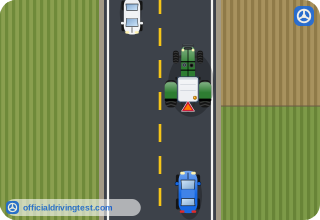
- You have extra time to decide whether to pass
- The speed difference sharply shortens the time to reach it
- The slow vehicle must pull off the road for you
- Your closing speed is about the same as in traffic
Show answer
Correct answer: The speed difference sharply shortens the time to reach it
When a vehicle at normal highway speed approaches a slow-moving vehicle from the rear, the speed differential dramatically shortens the time it takes to reach it.
Source: Illinois Rules of the Road (2026), page 46
-
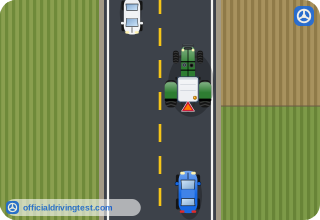
What should you expect from slow-moving vehicles such as farm equipment when it comes to turning?
- They may only turn at marked intersections
- They always pull onto the shoulder first
- They may make wide turns into unmarked entrances
- They are not allowed to turn left on highways
Show answer
Correct answer: They may make wide turns into unmarked entrances
Slow-moving vehicles may make wide turns and may turn right or left at any time into unmarked entrances.
Source: Illinois Rules of the Road (2026), page 46
-
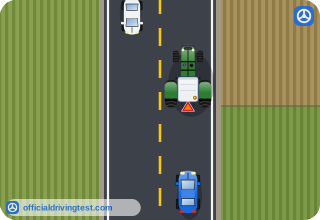
Before you begin passing a slow-moving vehicle, what should you be certain of?
- That its operator knows you intend to pass
- That you are inside a marked no-passing zone
- That its orange emblem is lit up brightly
- That you can pass it on the right shoulder
Show answer
Correct answer: That its operator knows you intend to pass
Be certain that the slow-moving vehicle operator knows your presence and intent to pass before beginning the maneuver.
Source: Illinois Rules of the Road (2026), page 46
-
When lights are required on a slow-moving vehicle, what rear signal must it have?
- A steady red light visible for 100 feet
- A flashing blue light on the rear bumper
- A white strobe mounted at bumper height
- A flashing amber signal mounted up high
Show answer
Correct answer: A flashing amber signal mounted up high
When lights are required, a flashing amber signal must be mounted as high as possible on the rear of the vehicle and be visible for 500 feet in sunlight.
Source: Illinois Rules of the Road (2026), page 46
-
When lights are required, a slow-moving vehicle’s rear signal must be visible in sunlight for at least:
- 100 feet
- 500 feet
- 250 feet
- 1,000 feet
Show answer
Correct answer: 500 feet
The flashing amber signal on the rear of a slow-moving vehicle must be visible for 500 feet in sunlight.
Source: Illinois Rules of the Road (2026), page 46
-
On a road with more than one lane in your direction, which lane must slower traffic use?
- The left lane
- The center lane
- The right lane
- Any open lane
Show answer
Correct answer: The right lane
Slower traffic must drive in the right lane; the left lane is for passing and turning.
Source: Illinois Rules of the Road (2026), page 46
-
Where are horseback riders not allowed to ride?
- On any public road at all
- On controlled-access highways
- On rural two-lane roads
- On roads with no paved shoulder
Show answer
Correct answer: On controlled-access highways
Horseback riders may use public roadways, except controlled-access highways and most expressways.
Source: Illinois Rules of the Road (2026), page 47
-
How must horseback riders ride on the road?
- Facing traffic, on the left side
- In the center of the lane
- Either direction, near the edge
- With traffic, as far right as possible
Show answer
Correct answer: With traffic, as far right as possible
Horseback riders must ride in the same direction as other traffic and as far to the right as possible.
Source: Illinois Rules of the Road (2026), page 47
-
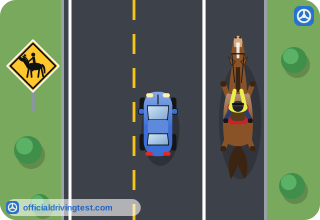
Why should you never sound your horn near a horse or other livestock?
- The sound may frighten it and cause a crash
- It is only illegal inside city limits
- Horses cannot hear car horns at all
- It is allowed only when passing slowly
Show answer
Correct answer: The sound may frighten it and cause a crash
Never sound a horn near a horse or other livestock, as the sound may frighten it and cause a crash.
Source: Illinois Rules of the Road (2026), page 47
-
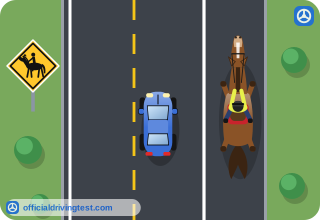
How should you meet or pass a horseback rider?
- Quickly, to get past the horse
- With a short tap of the horn
- With caution, prepared to stop
- With high beams on to be seen
Show answer
Correct answer: With caution, prepared to stop
When meeting or passing a horseback rider, do so with caution and be prepared to stop.
Source: Illinois Rules of the Road (2026), page 47
-
Compared with other roadway users, motorcycle riders have:
- Fewer rights, since they are smaller
- More rights, since they are exposed
- The same rights and responsibilities
- Rights only in the right-hand lane
Show answer
Correct answer: The same rights and responsibilities
Motorcycle riders have the same rights and responsibilities as other roadway users.
Source: Illinois Rules of the Road (2026), page 41
-
What must be done before an autocycle may be operated on Illinois roadways?
- It must be registered with the local police
- It must pass a yearly emissions test
- It must carry a slow-moving vehicle emblem
- It must be correctly titled and registered
Show answer
Correct answer: It must be correctly titled and registered
An autocycle may be operated on Illinois roadways when correctly titled and registered with the Secretary of State.
Source: Illinois Rules of the Road (2026), page 42
-
On a road with a bike lane, a bicyclist rides outside the lane. What should drivers do?
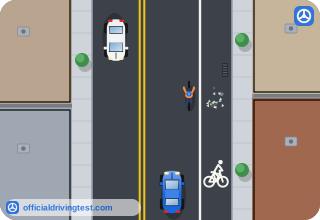
- Honk until the bicyclist returns to the bike lane
- Be prepared to safely move around the bicyclist
- Follow closely so the bicyclist moves over
- Report the bicyclist, since this is always illegal
Show answer
Correct answer: Be prepared to safely move around the bicyclist
Bicyclists may need to ride outside a bike lane, and drivers should be prepared to safely move around them.
Source: Illinois Rules of the Road (2026), page 42
-
Under the manual's bicycle rules, crowding or threatening a bicyclist is:
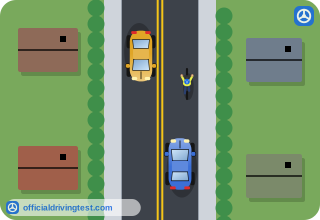
- Prohibited
- Allowed on narrow roads
- Allowed if you honk first
- Only a courtesy issue
Show answer
Correct answer: Prohibited
The manual states that crowding or threatening a bicyclist is prohibited.
Source: Illinois Rules of the Road (2026), page 43
-
When following bicyclists, what should a driver do?
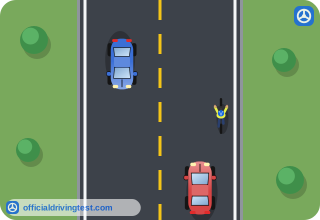
- Follow closely so they know you are there
- Use high beams so they can see the road
- Give them plenty of room and be ready to stop
- Pass them right away, even in bad weather
Show answer
Correct answer: Give them plenty of room and be ready to stop
When following bicyclists, give them plenty of room and be prepared to stop quickly, using extra caution in bad weather.
Source: Illinois Rules of the Road (2026), page 43
-
Which traffic rules apply to a scooter or moped driver?
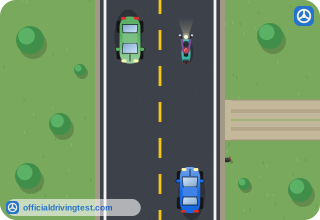
- Only speed limits, not signs or signals
- Only the rules for pedestrians
- None, if the engine is under 50cc
- All signs, signals, and traffic laws
Show answer
Correct answer: All signs, signals, and traffic laws
A scooter or moped driver must obey all signs, signals and traffic laws and is subject to most laws regarding the use of bicycles.
Source: Illinois Rules of the Road (2026), page 44
-
Which vehicles does the manual define as low-speed vehicles?
- Three-wheeled vehicles with a steering wheel
- Four-wheelers with a safety label and VIN
- Any farm vehicle that goes under 20 mph
- Scooters that weigh less than 100 pounds
Show answer
Correct answer: Four-wheelers with a safety label and VIN
A low-speed vehicle is any four-wheeled vehicle that has a federal safety certification label and a vehicle identification number (VIN).
Source: Illinois Rules of the Road (2026), page 45
-
Why may a slow-moving vehicle temporarily move into an adjoining lane?
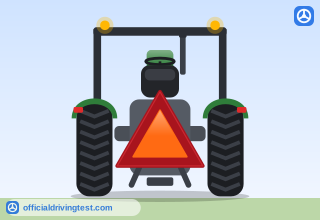
- To let faster traffic pass on the right
- To signal that it is about to stop
- It may be wider than the lane itself
- It is required to change lanes every mile
Show answer
Correct answer: It may be wider than the lane itself
Slow-moving vehicles may be wider than the lane width, so they may need to temporarily move into an adjoining lane to avoid roadside obstructions.
Source: Illinois Rules of the Road (2026), page 46
-
A license may be revoked for a conviction for overtaking or passing a school bus that results in what?
- A crash with minor damage
- A crash where a death occurred
- A ticket from a bus camera
- A complaint from a parent
Show answer
Correct answer: A crash where a death occurred
The School Bus Violation leading to revocation is a conviction for overtaking or passing a school bus that results in a crash where a death occurred.
Source: Illinois Rules of the Road (2026), page 59
-
Failure to pay how many camera-recorded violations for not yielding to a stopped school bus may lead to suspension?
- Five or more
- Two or more
- Three or more
- Ten or more
Show answer
Correct answer: Five or more
School Bus Violations include failure to pay five or more violations of yielding to a stopped school bus when recorded by a camera.
Source: Illinois Rules of the Road (2026), page 60
-
How is a bicycle lane marked as it approaches a corner?
- A double yellow line that stops at the crosswalk
- A solid white line that becomes a dotted line before the corner
- A dotted white line that turns solid through the corner
- A solid yellow line that continues through the intersection
Show answer
Correct answer: A solid white line that becomes a dotted line before the corner
Bicycle lanes are marked by a solid white line that becomes a dotted line ending before it reaches the corner.
Source: Illinois Rules of the Road (2026), page 68
-
Why are bicycle lanes sometimes painted a bright green color?
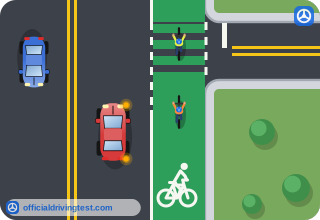
- To show that cars may park there
- To mark the lane as a bus-only lane
- To show where drivers may pass
- To increase visibility
Show answer
Correct answer: To increase visibility
Bicycle lanes are sometimes painted a bright green color to increase visibility.
Source: Illinois Rules of the Road (2026), page 68
-
What must you do when you come upon a vehicle displaying a Slow-Moving Vehicle sign?
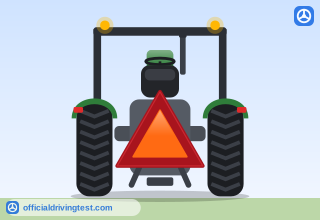
- Slow down and pass only when safe and legal
- Sound your horn so it pulls off the road
- Pass it right away on the right shoulder
- Follow it closely until it turns off
Show answer
Correct answer: Slow down and pass only when safe and legal
A vehicle displaying this sign is moving slowly; you must slow down and may pass only when safe and legal to do so.
Source: Illinois Rules of the Road (2026), page 74
-
What does the manual advise about predicting what another driver will do?
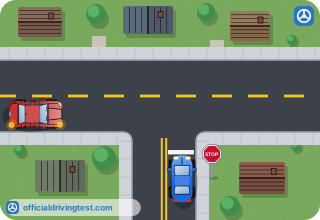
- Assume other drivers will always obey the law
- Assume they will do what their signal shows
- Do not assume you know what the other driver will do
- Assume larger vehicles will yield to you
Show answer
Correct answer: Do not assume you know what the other driver will do
To drive defensively, always be prepared to react and do not assume you know what the other driver is going to do.
Source: Illinois Rules of the Road (2026), page 83
-
How does the manual define aggressive driving?
- Any driving above the posted speed limit
- Driving without a valid driver's license
- Driving a vehicle that has faulty brakes
- Driving that endangers people or property
Show answer
Correct answer: Driving that endangers people or property
Aggressive driving is operating a motor vehicle in a manner that endangers or is likely to endanger persons or property.
Source: Illinois Rules of the Road (2026), page 89
-
Which of these does the manual list as a possible act of aggressive driving?
- Using hazard flashers when stopped
- Passing on the shoulder of the road
- Driving in the right lane
- Signaling before a lane change
Show answer
Correct answer: Passing on the shoulder of the road
Passing on the shoulder of the road is listed among the acts that may be aggressive driving.
Source: Illinois Rules of the Road (2026), page 89
-
Which of these is listed in the manual as a possible act of aggressive driving?
- Dimming your high beams
- Using the horn to warn of danger
- Repeatedly flashing the headlights
- Driving below the speed limit
Show answer
Correct answer: Repeatedly flashing the headlights
Repeatedly flashing the headlights (and repeatedly honking) are listed as possible acts of aggressive driving.
Source: Illinois Rules of the Road (2026), page 89
-
If you encounter an angry or aggressive motorist, what should you do?
- Avoid making eye contact with the driver
- Make eye contact to show you are calm
- Honk to let the driver know they're wrong
- Follow the driver to get the plate number
Show answer
Correct answer: Avoid making eye contact with the driver
With an aggressive motorist, do not retaliate or engage the other driver, and do not make eye contact.
Source: Illinois Rules of the Road (2026), page 89
-
When dealing with an aggressive motorist, how should you keep your doors and windows?
- Unlocked, windows down
- Unlocked, windows up
- Locked, windows down
- Locked, windows up
Show answer
Correct answer: Locked, windows up
Keep your vehicle doors locked and windows up.
Source: Illinois Rules of the Road (2026), page 89
-
When an aggressive motorist is near, why should you keep enough space between you and the vehicle in front of you?
- So you can read its license plate
- So you can pull out from behind it
- So you can save fuel in traffic
- So the aggressive driver can cut in
Show answer
Correct answer: So you can pull out from behind it
Keep enough space between you and the vehicle in front of you to pull out from behind.
Source: Illinois Rules of the Road (2026), page 89