Illinois: Sharing the road — Part 2 Practice Test
Questions in this part include: “How does the Illinois manual describe an autocycle?” · “In which direction are bicyclists required to travel on the road?”
Independent educational site · not affiliated with any government agency or DMV
Ready? Test yourself
- Instant feedback with an explanation
- Every answer cites its source in the manual
- Your best score is saved on this device
Questions are original and based on the official manual "Illinois Rules of the Road" (2026), Illinois Secretary of State.
All 17 questions in this practice test
Take the test above first, then use this list to study. Tap “Show answer” to see the correct answer and explanation.
Show the questions and answersHide the questions
-
Why might a motorcyclist change position within the lane unexpectedly?

- To signal a turn to other drivers
- To be seen by trucks more easily
- To avoid potholes, oil, gravel, or debris
- Riders must weave to stay visible to cars
Show answer
Correct answer: To avoid potholes, oil, gravel, or debris
Potholes, oil spills, gravel, debris, or railroad tracks often require motorcyclists to change positions within their lane.
Source: Illinois Rules of the Road (2026), page 42
-
How do gravel roads affect a motorcyclist?
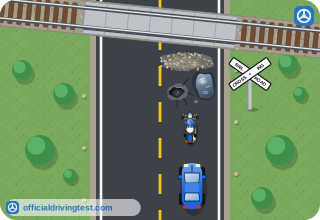
- They reduce traction and may force slowing
- They add traction and allow faster turning
- They have no effect on a motorcycle at all
- They only matter when the gravel is wet
Show answer
Correct answer: They reduce traction and may force slowing
Gravel roads decrease traction and may cause a rider to slow down or brake where a car would not.
Source: Illinois Rules of the Road (2026), page 42
-
How does the Illinois manual describe an autocycle?
- A two-wheeled vehicle with pedals and a motor
- A three-wheeled vehicle with handlebars and a saddle
- A four-wheeled vehicle limited to 25 mph
- A three-wheeled vehicle with a steering wheel
Show answer
Correct answer: A three-wheeled vehicle with a steering wheel
An autocycle is a three-wheeled vehicle that has a steering wheel and seating that does not require the driver to straddle or sit astride it.
Source: Illinois Rules of the Road (2026), page 42
-
What license does the operator of an autocycle need in Illinois?
- A Class M motorcycle license
- A valid Illinois driver's license
- A Class L motorcycle license
- No license is required
Show answer
Correct answer: A valid Illinois driver's license
The operator of an autocycle must have a valid Illinois driver's license to legally operate it.
Source: Illinois Rules of the Road (2026), page 42
-
On most roadways, bicyclists (including electric or gas bicycles that do not exceed 20 mph) have:
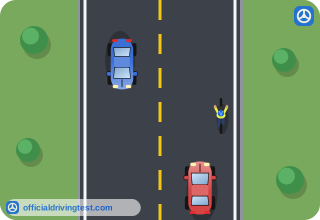
- The same rights and responsibilities as other roadway users
- Fewer rights than motor vehicles and must always yield
- The right to ride on sidewalks and ignore traffic signals
- Rights only when they ride inside a marked bike lane
Show answer
Correct answer: The same rights and responsibilities as other roadway users
On most roadways, bicyclists have the same rights and responsibilities as other roadway users, including the right of way.
Source: Illinois Rules of the Road (2026), page 42
-
May a car stop in a designated bike lane to drop off a passenger when no bicyclists are present?
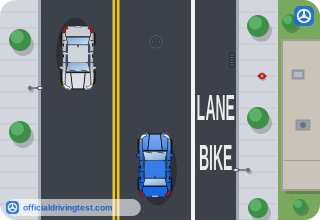
- Yes, if the stop is brief and quick
- Yes, if the hazard lights are on
- No, not even if no cyclists are there
- Yes, but only at night
Show answer
Correct answer: No, not even if no cyclists are there
Vehicles are not allowed to drive, park, idle, or drop off or pick up passengers in bike lanes even if bicyclists are not present.
Source: Illinois Rules of the Road (2026), page 42
-
Where are bicyclists prohibited from riding in Illinois?
- On any road that has no bike lane
- On roads posted above 35 mph
- On residential streets after dark
- On controlled-access highways
Show answer
Correct answer: On controlled-access highways
Bicyclists are prohibited on controlled-access highways, expressways, and other marked roadways.
Source: Illinois Rules of the Road (2026), page 42
-
In which direction are bicyclists required to travel on the road?
- Facing oncoming traffic
- The same direction as vehicles
- Either direction, rider's choice
- Against traffic on one-way streets
Show answer
Correct answer: The same direction as vehicles
Bicyclists are required to travel in the same direction as vehicles.
Source: Illinois Rules of the Road (2026), page 43
-
Why might a bicyclist move toward the center of the lane instead of riding just to the right of traffic?
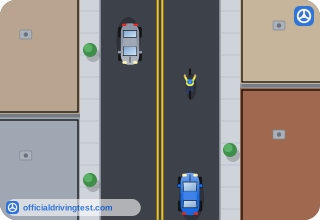
- To avoid debris, drainage grates, or a narrow lane
- Because bicyclists must always ride in the center
- To block cars from passing on the right side
- Because the law forbids riding near the curb
Show answer
Correct answer: To avoid debris, drainage grates, or a narrow lane
Bicyclists should ride just to the right of faster traffic, but hazards such as rough surfaces, debris, drainage grates, or a narrow lane may require them to move toward the center.
Source: Illinois Rules of the Road (2026), page 43
-
On an ordinary roadway, what is the most bicyclists allowed to ride side by side?
- Single file only
- Three abreast
- Two abreast
- Any number
Show answer
Correct answer: Two abreast
Bicyclists may ride side by side if traffic is not impeded; riding more than two abreast is prohibited except on paths or lanes set aside for bicycles.
Source: Illinois Rules of the Road (2026), page 43
-
How must drivers treat a bicyclist when it comes to the right of way?
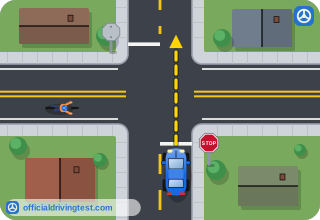
- Bicyclists must always yield to cars
- Only bicyclists in bike lanes get it
- Drivers yield only to child cyclists
- Yield just as they would to a vehicle
Show answer
Correct answer: Yield just as they would to a vehicle
Drivers must yield the right of way to a bicyclist just as they would to another vehicle.
Source: Illinois Rules of the Road (2026), page 43
-
When passing a bicyclist, how much space must you leave, measured from the edge of your side mirror?

- At least 2 feet
- At least 3 feet
- At least 5 feet
- At least 6 feet
Show answer
Correct answer: At least 3 feet
Motorists must pass a bicyclist slowly and leave at least 3 feet of passing space from the edge of the vehicle's side mirror.
Source: Illinois Rules of the Road (2026), page 43
-
You want to pass a bicyclist, but there is not enough room to leave the required passing space. What must you do?
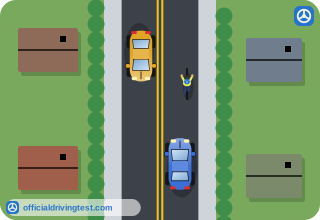
- Honk so the rider moves over
- Pass quickly to limit the risk
- Wait until you can pass safely
- Pass using the bike lane
Show answer
Correct answer: Wait until you can pass safely
If there is not 3 feet of passing space, drivers must wait to pass until they can do so safely.
Source: Illinois Rules of the Road (2026), page 43
-
A driver passes too close to a bicyclist and causes a crash. What may the driver face?
- Criminal charges
- A written warning only
- No penalty if no one died
- A parking citation
Show answer
Correct answer: Criminal charges
If a driver passes too close to a bicyclist and it results in a crash, the driver may face criminal charges.
Source: Illinois Rules of the Road (2026), page 43
-
At night, what should you not use when approaching an oncoming bicyclist?

- Your turn signals
- Your low beams
- Your horn
- Your high beams
Show answer
Correct answer: Your high beams
High beam lights should not be used at night when approaching an oncoming bicyclist.
Source: Illinois Rules of the Road (2026), page 43
-
You are turning left and a bicyclist enters the intersection from the opposite direction. What should you do?
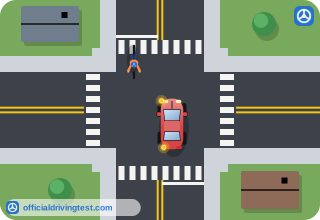
- Turn first, since cars have priority
- Wait for the bicyclist to pass, then turn
- Sound your horn and complete the turn
- Turn if the bicyclist is still far away
Show answer
Correct answer: Wait for the bicyclist to pass, then turn
When turning left with a bicyclist entering from the opposite direction, the driver should wait for the bicyclist to pass before making the turn.
Source: Illinois Rules of the Road (2026), page 43
-
You are sharing a left-turn lane with a bicyclist. What should you do?
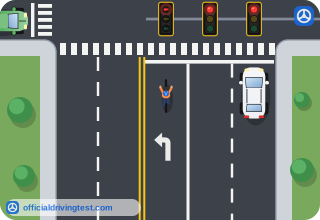
- Pull beside the bicyclist and turn together
- Pass the bicyclist before the intersection
- Stay behind until the bicyclist completes the turn
- Turn first and let the bicyclist follow you
Show answer
Correct answer: Stay behind until the bicyclist completes the turn
If a motorist is sharing the left-turn lane with a bicyclist, the motorist should stay behind until the bicyclist has safely completed the turn.
Source: Illinois Rules of the Road (2026), page 43