Illinois: Sharing the road — Part 5 Practice Test
Questions in this part include: “Which of these is on the list of equipment a low-speed vehicle must have?” · “When lights are required on a slow-moving vehicle, what rear signal must it have?”
Independent educational site · not affiliated with any government agency or DMV
Ready? Test yourself
- Instant feedback with an explanation
- Every answer cites its source in the manual
- Your best score is saved on this device
Questions are original and based on the official manual "Illinois Rules of the Road" (2026), Illinois Secretary of State.
All 17 questions in this practice test
Take the test above first, then use this list to study. Tap “Show answer” to see the correct answer and explanation.
Show the questions and answersHide the questions
-
Which of these is on the list of equipment a low-speed vehicle must have?
- A backup camera
- A spare tire
- Safety belts
- Air bags
Show answer
Correct answer: Safety belts
The manual's required equipment list for low-speed vehicles includes safety belts, along with a parking brake, windshield, mirrors, lights, and turn signals.
Source: Illinois Rules of the Road (2026), page 46
-
Where must a low-speed vehicle's exterior rearview mirror be mounted?
- On the passenger side
- On the driver's side
- On the rear bumper
- On the roof
Show answer
Correct answer: On the driver's side
The required exterior rearview mirror on a low-speed vehicle is mounted on the driver's side of the vehicle.
Source: Illinois Rules of the Road (2026), page 46
-
What must be displayed on the rear of certain slow-moving vehicles?
- An orange slow-moving vehicle emblem
- A red flag at least 12 inches wide
- A white reflective oversize sign
- A blue flashing light on the roof
Show answer
Correct answer: An orange slow-moving vehicle emblem
An orange slow-moving vehicle emblem must be on the rear of certain slow-moving vehicles.
Source: Illinois Rules of the Road (2026), page 46
-
What is the normal speed range of slow-moving vehicles such as farm equipment?
- 1-5 mph
- 25-35 mph
- 20-30 mph
- 5-20 mph
Show answer
Correct answer: 5-20 mph
Normal speeds for slow-moving vehicles range from 5-20 mph, so a vehicle at highway speed closes on them very quickly.
Source: Illinois Rules of the Road (2026), page 46
-
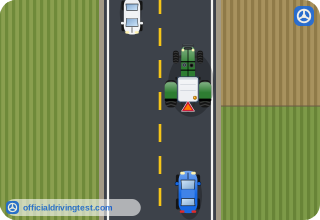
When you approach a slow-moving vehicle from behind at normal highway speed, what happens?
- You have extra time to decide whether to pass
- The speed difference sharply shortens the time to reach it
- The slow vehicle must pull off the road for you
- Your closing speed is about the same as in traffic
Show answer
Correct answer: The speed difference sharply shortens the time to reach it
When a vehicle at normal highway speed approaches a slow-moving vehicle from the rear, the speed differential dramatically shortens the time it takes to reach it.
Source: Illinois Rules of the Road (2026), page 46
-
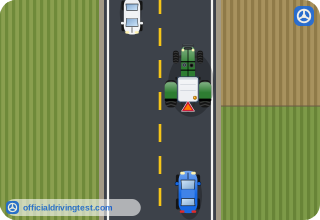
What should you expect from slow-moving vehicles such as farm equipment when it comes to turning?
- They may only turn at marked intersections
- They always pull onto the shoulder first
- They may make wide turns into unmarked entrances
- They are not allowed to turn left on highways
Show answer
Correct answer: They may make wide turns into unmarked entrances
Slow-moving vehicles may make wide turns and may turn right or left at any time into unmarked entrances.
Source: Illinois Rules of the Road (2026), page 46
-
Before you begin passing a slow-moving vehicle, what should you be certain of?
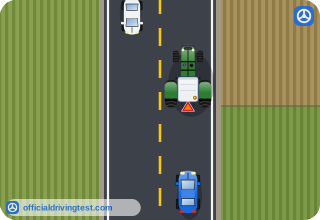
- That its operator knows you intend to pass
- That you are inside a marked no-passing zone
- That its orange emblem is lit up brightly
- That you can pass it on the right shoulder
Show answer
Correct answer: That its operator knows you intend to pass
Be certain that the slow-moving vehicle operator knows your presence and intent to pass before beginning the maneuver.
Source: Illinois Rules of the Road (2026), page 46
-
When lights are required on a slow-moving vehicle, what rear signal must it have?
- A steady red light visible for 100 feet
- A flashing blue light on the rear bumper
- A white strobe mounted at bumper height
- A flashing amber signal mounted up high
Show answer
Correct answer: A flashing amber signal mounted up high
When lights are required, a flashing amber signal must be mounted as high as possible on the rear of the vehicle and be visible for 500 feet in sunlight.
Source: Illinois Rules of the Road (2026), page 46
-
When lights are required, a slow-moving vehicle’s rear signal must be visible in sunlight for at least:
- 100 feet
- 500 feet
- 250 feet
- 1,000 feet
Show answer
Correct answer: 500 feet
The flashing amber signal on the rear of a slow-moving vehicle must be visible for 500 feet in sunlight.
Source: Illinois Rules of the Road (2026), page 46
-
On a road with more than one lane in your direction, which lane must slower traffic use?
- The left lane
- The center lane
- The right lane
- Any open lane
Show answer
Correct answer: The right lane
Slower traffic must drive in the right lane; the left lane is for passing and turning.
Source: Illinois Rules of the Road (2026), page 46
-
Where are horseback riders not allowed to ride?
- On any public road at all
- On controlled-access highways
- On rural two-lane roads
- On roads with no paved shoulder
Show answer
Correct answer: On controlled-access highways
Horseback riders may use public roadways, except controlled-access highways and most expressways.
Source: Illinois Rules of the Road (2026), page 47
-
How must horseback riders ride on the road?
- Facing traffic, on the left side
- In the center of the lane
- Either direction, near the edge
- With traffic, as far right as possible
Show answer
Correct answer: With traffic, as far right as possible
Horseback riders must ride in the same direction as other traffic and as far to the right as possible.
Source: Illinois Rules of the Road (2026), page 47
-
Why should you never sound your horn near a horse or other livestock?
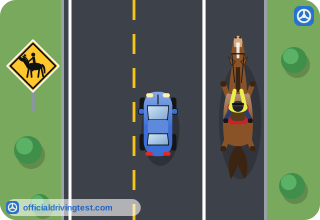
- The sound may frighten it and cause a crash
- It is only illegal inside city limits
- Horses cannot hear car horns at all
- It is allowed only when passing slowly
Show answer
Correct answer: The sound may frighten it and cause a crash
Never sound a horn near a horse or other livestock, as the sound may frighten it and cause a crash.
Source: Illinois Rules of the Road (2026), page 47
-
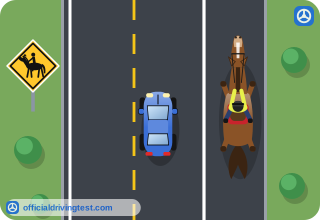
How should you meet or pass a horseback rider?
- Quickly, to get past the horse
- With a short tap of the horn
- With caution, prepared to stop
- With high beams on to be seen
Show answer
Correct answer: With caution, prepared to stop
When meeting or passing a horseback rider, do so with caution and be prepared to stop.
Source: Illinois Rules of the Road (2026), page 47
-
Compared with other roadway users, motorcycle riders have:
- Fewer rights, since they are smaller
- More rights, since they are exposed
- The same rights and responsibilities
- Rights only in the right-hand lane
Show answer
Correct answer: The same rights and responsibilities
Motorcycle riders have the same rights and responsibilities as other roadway users.
Source: Illinois Rules of the Road (2026), page 41
-
What must be done before an autocycle may be operated on Illinois roadways?
- It must be registered with the local police
- It must pass a yearly emissions test
- It must carry a slow-moving vehicle emblem
- It must be correctly titled and registered
Show answer
Correct answer: It must be correctly titled and registered
An autocycle may be operated on Illinois roadways when correctly titled and registered with the Secretary of State.
Source: Illinois Rules of the Road (2026), page 42
-
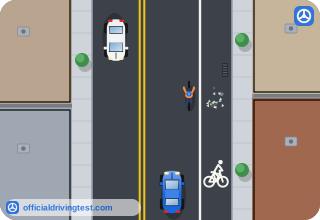
On a road with a bike lane, a bicyclist rides outside the lane. What should drivers do?
- Honk until the bicyclist returns to the bike lane
- Be prepared to safely move around the bicyclist
- Follow closely so the bicyclist moves over
- Report the bicyclist, since this is always illegal
Show answer
Correct answer: Be prepared to safely move around the bicyclist
Bicyclists may need to ride outside a bike lane, and drivers should be prepared to safely move around them.
Source: Illinois Rules of the Road (2026), page 42