Illinois: Sharing the road — Part 6 Practice Test
Questions in this part include: “Which vehicles does the manual define as low-speed vehicles?” · “Which of these does the manual list as a possible act of aggressive driving?”
Independent educational site · not affiliated with any government agency or DMV
Ready? Test yourself
- Instant feedback with an explanation
- Every answer cites its source in the manual
- Your best score is saved on this device
Questions are original and based on the official manual "Illinois Rules of the Road" (2026), Illinois Secretary of State.
All 17 questions in this practice test
Take the test above first, then use this list to study. Tap “Show answer” to see the correct answer and explanation.
Show the questions and answersHide the questions
-
Under the manual's bicycle rules, crowding or threatening a bicyclist is:
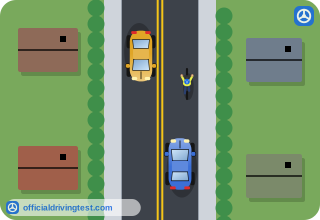
- Prohibited
- Allowed on narrow roads
- Allowed if you honk first
- Only a courtesy issue
Show answer
Correct answer: Prohibited
The manual states that crowding or threatening a bicyclist is prohibited.
Source: Illinois Rules of the Road (2026), page 43
-
When following bicyclists, what should a driver do?
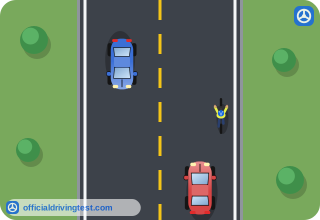
- Follow closely so they know you are there
- Use high beams so they can see the road
- Give them plenty of room and be ready to stop
- Pass them right away, even in bad weather
Show answer
Correct answer: Give them plenty of room and be ready to stop
When following bicyclists, give them plenty of room and be prepared to stop quickly, using extra caution in bad weather.
Source: Illinois Rules of the Road (2026), page 43
-
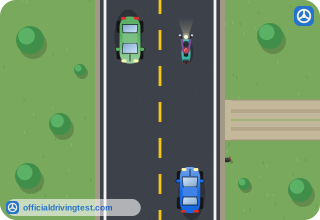
Which traffic rules apply to a scooter or moped driver?
- Only speed limits, not signs or signals
- Only the rules for pedestrians
- None, if the engine is under 50cc
- All signs, signals, and traffic laws
Show answer
Correct answer: All signs, signals, and traffic laws
A scooter or moped driver must obey all signs, signals and traffic laws and is subject to most laws regarding the use of bicycles.
Source: Illinois Rules of the Road (2026), page 44
-
Which vehicles does the manual define as low-speed vehicles?
- Three-wheeled vehicles with a steering wheel
- Four-wheelers with a safety label and VIN
- Any farm vehicle that goes under 20 mph
- Scooters that weigh less than 100 pounds
Show answer
Correct answer: Four-wheelers with a safety label and VIN
A low-speed vehicle is any four-wheeled vehicle that has a federal safety certification label and a vehicle identification number (VIN).
Source: Illinois Rules of the Road (2026), page 45
-
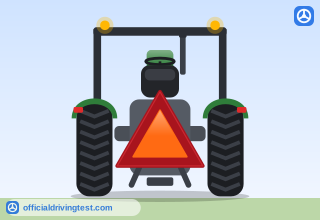
Why may a slow-moving vehicle temporarily move into an adjoining lane?
- To let faster traffic pass on the right
- To signal that it is about to stop
- It may be wider than the lane itself
- It is required to change lanes every mile
Show answer
Correct answer: It may be wider than the lane itself
Slow-moving vehicles may be wider than the lane width, so they may need to temporarily move into an adjoining lane to avoid roadside obstructions.
Source: Illinois Rules of the Road (2026), page 46
-
A license may be revoked for a conviction for overtaking or passing a school bus that results in what?
- A crash with minor damage
- A crash where a death occurred
- A ticket from a bus camera
- A complaint from a parent
Show answer
Correct answer: A crash where a death occurred
The School Bus Violation leading to revocation is a conviction for overtaking or passing a school bus that results in a crash where a death occurred.
Source: Illinois Rules of the Road (2026), page 59
-
Failure to pay how many camera-recorded violations for not yielding to a stopped school bus may lead to suspension?
- Five or more
- Two or more
- Three or more
- Ten or more
Show answer
Correct answer: Five or more
School Bus Violations include failure to pay five or more violations of yielding to a stopped school bus when recorded by a camera.
Source: Illinois Rules of the Road (2026), page 60
-
How is a bicycle lane marked as it approaches a corner?
- A double yellow line that stops at the crosswalk
- A solid white line that becomes a dotted line before the corner
- A dotted white line that turns solid through the corner
- A solid yellow line that continues through the intersection
Show answer
Correct answer: A solid white line that becomes a dotted line before the corner
Bicycle lanes are marked by a solid white line that becomes a dotted line ending before it reaches the corner.
Source: Illinois Rules of the Road (2026), page 68
-
Why are bicycle lanes sometimes painted a bright green color?
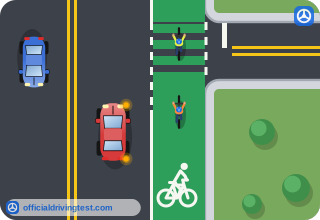
- To show that cars may park there
- To mark the lane as a bus-only lane
- To show where drivers may pass
- To increase visibility
Show answer
Correct answer: To increase visibility
Bicycle lanes are sometimes painted a bright green color to increase visibility.
Source: Illinois Rules of the Road (2026), page 68
-
What must you do when you come upon a vehicle displaying a Slow-Moving Vehicle sign?
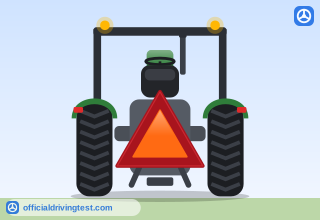
- Slow down and pass only when safe and legal
- Sound your horn so it pulls off the road
- Pass it right away on the right shoulder
- Follow it closely until it turns off
Show answer
Correct answer: Slow down and pass only when safe and legal
A vehicle displaying this sign is moving slowly; you must slow down and may pass only when safe and legal to do so.
Source: Illinois Rules of the Road (2026), page 74
-
What does the manual advise about predicting what another driver will do?
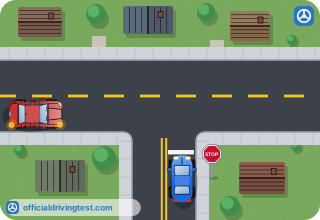
- Assume other drivers will always obey the law
- Assume they will do what their signal shows
- Do not assume you know what the other driver will do
- Assume larger vehicles will yield to you
Show answer
Correct answer: Do not assume you know what the other driver will do
To drive defensively, always be prepared to react and do not assume you know what the other driver is going to do.
Source: Illinois Rules of the Road (2026), page 83
-
How does the manual define aggressive driving?
- Any driving above the posted speed limit
- Driving without a valid driver's license
- Driving a vehicle that has faulty brakes
- Driving that endangers people or property
Show answer
Correct answer: Driving that endangers people or property
Aggressive driving is operating a motor vehicle in a manner that endangers or is likely to endanger persons or property.
Source: Illinois Rules of the Road (2026), page 89
-
Which of these does the manual list as a possible act of aggressive driving?
- Using hazard flashers when stopped
- Passing on the shoulder of the road
- Driving in the right lane
- Signaling before a lane change
Show answer
Correct answer: Passing on the shoulder of the road
Passing on the shoulder of the road is listed among the acts that may be aggressive driving.
Source: Illinois Rules of the Road (2026), page 89
-
Which of these is listed in the manual as a possible act of aggressive driving?
- Dimming your high beams
- Using the horn to warn of danger
- Repeatedly flashing the headlights
- Driving below the speed limit
Show answer
Correct answer: Repeatedly flashing the headlights
Repeatedly flashing the headlights (and repeatedly honking) are listed as possible acts of aggressive driving.
Source: Illinois Rules of the Road (2026), page 89
-
If you encounter an angry or aggressive motorist, what should you do?
- Avoid making eye contact with the driver
- Make eye contact to show you are calm
- Honk to let the driver know they're wrong
- Follow the driver to get the plate number
Show answer
Correct answer: Avoid making eye contact with the driver
With an aggressive motorist, do not retaliate or engage the other driver, and do not make eye contact.
Source: Illinois Rules of the Road (2026), page 89
-
When dealing with an aggressive motorist, how should you keep your doors and windows?
- Unlocked, windows down
- Unlocked, windows up
- Locked, windows down
- Locked, windows up
Show answer
Correct answer: Locked, windows up
Keep your vehicle doors locked and windows up.
Source: Illinois Rules of the Road (2026), page 89
-
When an aggressive motorist is near, why should you keep enough space between you and the vehicle in front of you?
- So you can read its license plate
- So you can pull out from behind it
- So you can save fuel in traffic
- So the aggressive driver can cut in
Show answer
Correct answer: So you can pull out from behind it
Keep enough space between you and the vehicle in front of you to pull out from behind.
Source: Illinois Rules of the Road (2026), page 89