Illinois: Sharing the road — Part 4 Practice Test
Questions in this part include: “How old must you be to operate a low-speed electric scooter in Illinois?” · “What equipment must a low-speed electric scooter have?”
Independent educational site · not affiliated with any government agency or DMV
Ready? Test yourself
- Instant feedback with an explanation
- Every answer cites its source in the manual
- Your best score is saved on this device
Questions are original and based on the official manual "Illinois Rules of the Road" (2026), Illinois Secretary of State.
All 17 questions in this practice test
Take the test above first, then use this list to study. Tap “Show answer” to see the correct answer and explanation.
Show the questions and answersHide the questions
-
To count as a low-speed electric scooter, a scooter must weigh less than:
- 50 pounds
- 150 pounds
- 100 pounds
- 250 pounds
Show answer
Correct answer: 100 pounds
A low-speed electric scooter is a scooter that weighs less than 100 pounds and has 2 or 3 wheels, handlebars, and a floorboard.
Source: Illinois Rules of the Road (2026), page 44
-
How old must you be to operate a low-speed electric scooter in Illinois?
- 12 or older
- 14 or older
- 16 or older
- 18 or older
Show answer
Correct answer: 18 or older
You must be 18 years of age or older to operate a low-speed electric scooter.
Source: Illinois Rules of the Road (2026), page 44
-
Does operating a low-speed electric scooter require a driver's license?
- No
- Yes, a Class L license
- Yes, any valid license
- Yes, an instruction permit
Show answer
Correct answer: No
A low-speed electric scooter does not require a driver's license, and it may be used on a roadway, trail, or sidewalk only if the local municipality or park district permits it.
Source: Illinois Rules of the Road (2026), page 44
-
Where may a low-speed electric scooter be operated on a roadway, trail, or sidewalk?
- Anywhere, since state law allows it
- Only where local authorities permit it
- Only on sidewalks, never on a roadway
- Only on roads posted 45 mph or less
Show answer
Correct answer: Only where local authorities permit it
A low-speed electric scooter may only be operated on a roadway, trail, or sidewalk if permitted by the local municipality or park district.
Source: Illinois Rules of the Road (2026), page 44
-
A low-speed electric scooter may not be operated on any highway with a speed limit of:
- 15 mph
- 20 mph
- 35 mph
- 10 mph
Show answer
Correct answer: 35 mph
The manual says you may not operate a low-speed scooter on any highway with a speed limit of 35 mph.
Source: Illinois Rules of the Road (2026), page 44
-
What equipment must a low-speed electric scooter have?
- A horn and a speedometer gauge
- Turn signals and a side mirror
- A passenger seat and footrest
- Head lamp and red rear reflector
Show answer
Correct answer: Head lamp and red rear reflector
A low-speed electric scooter must be equipped with a head lamp, which may be visible up to 500 feet, and a red reflector or lamp on the rear.
Source: Illinois Rules of the Road (2026), page 44
-
How many people may ride on a low-speed electric scooter at one time?
- No more than one
- Up to two
- Up to two, if both are adults
- Up to three
Show answer
Correct answer: No more than one
No more than one person may be on a low-speed electric scooter.
Source: Illinois Rules of the Road (2026), page 44
-
When following a truck or bus, where should you position your vehicle?
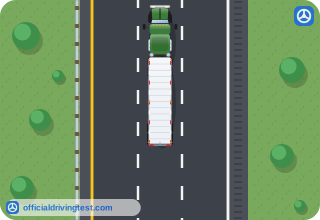
- Close behind it to cut down wind drag
- Out of blind spots, visible to its driver
- Just beside its rear wheels, ready to pass
- Directly behind it, near its rear bumper
Show answer
Correct answer: Out of blind spots, visible to its driver
Stay out of blind spots and keep a visible position when following a large vehicle; its driver should be able to see surrounding vehicles in the side mirrors.
Source: Illinois Rules of the Road (2026), page 45
-
A large truck ahead is signaling a right turn and has left an open space to its right. What should you know?
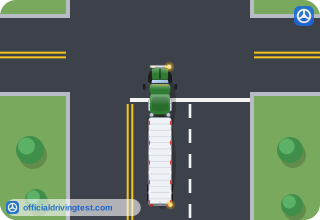
- The space is for cars to pass on the right
- The truck is pulling over to park
- Large vehicles make wide right turns
- The truck is about to turn left instead
Show answer
Correct answer: Large vehicles make wide right turns
Large vehicles make wide right turns and sometimes leave an open space to the right just before the turn, so give them plenty of room.
Source: Illinois Rules of the Road (2026), page 45
-
Why should you always dim your headlights when following a truck at night?
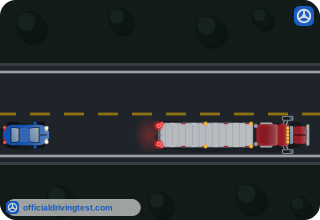
- Bright lights drain the car's battery
- Glare off its big mirrors blinds the driver
- The truck's rear lights are harder to see
- It is required only inside city limits
Show answer
Correct answer: Glare off its big mirrors blinds the driver
Bright lights will blind the drivers of large vehicles when they reflect off the large side mirrors.
Source: Illinois Rules of the Road (2026), page 45
-
How can you let a truck driver know you are passing, especially at night?
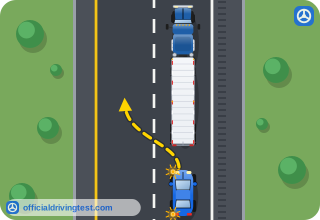
- Blink your headlights
- Sound your horn twice
- Turn on your hazard lights
- Follow closely first
Show answer
Correct answer: Blink your headlights
Blink the vehicle's headlights when passing a truck to let the truck driver know, especially at night.
Source: Illinois Rules of the Road (2026), page 45
-
When passing a truck, how should you complete the pass?
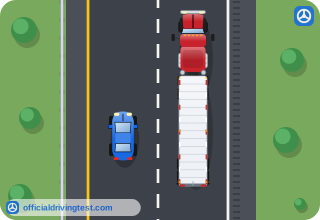
- Slowly, matching the truck's speed
- After riding alongside to be seen
- Only on the truck's right side
- As quickly as possible
Show answer
Correct answer: As quickly as possible
The pass should be completed as quickly as possible to avoid staying alongside the truck.
Source: Illinois Rules of the Road (2026), page 45
-
On a four-lane highway, you approach a disabled vehicle with its hazard lights on. What does Illinois law require if it is safe?

- Stop behind it and offer help
- Sound your horn as you pass
- Speed up to pass it quickly
- Change lanes away from it
Show answer
Correct answer: Change lanes away from it
Illinois law requires drivers approaching a disabled vehicle using hazard lights on a four-lane highway to change lanes away from it if it is safe to do so.
Source: Illinois Rules of the Road (2026), page 45
-
You cannot safely change lanes away from a disabled vehicle with hazard lights. What should you do?
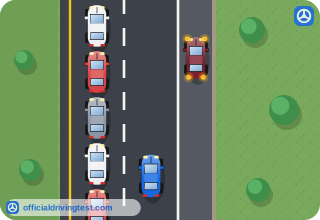
- Reduce speed, and don't speed up until well past it
- Keep your speed and pass it as fast as you can
- Stop in your lane until the vehicle is removed
- Pass it on the shoulder on the opposite side
Show answer
Correct answer: Reduce speed, and don't speed up until well past it
If it is not safe to change lanes, reduce speed when approaching and passing the disabled vehicle, and do not increase speed until well past it.
Source: Illinois Rules of the Road (2026), page 45
-
What is the maximum speed a low-speed vehicle can have?
- 20 mph
- 25 mph
- 30 mph
- 35 mph
Show answer
Correct answer: 25 mph
A low-speed vehicle is a four-wheeled vehicle with a federal safety certification label and a VIN, and it can have a maximum speed of 25 mph.
Source: Illinois Rules of the Road (2026), page 46
-
Unless the local municipality prohibits it, a low-speed vehicle may operate on streets with a posted speed limit of:
- 30 mph or less
- 25 mph or less
- 35 mph or less
- 45 mph or less
Show answer
Correct answer: 30 mph or less
Low-speed vehicles may operate on any street with a posted speed limit of 30 mph or less unless prohibited by the local municipality.
Source: Illinois Rules of the Road (2026), page 46
-
How must low-speed vehicles be titled and registered?
- They are exempt from titling
- Only through the local city
- The same as any other vehicle
- Only if driven over 20 mph
Show answer
Correct answer: The same as any other vehicle
Low-speed vehicles must be titled and registered in the same manner as any other vehicle.
Source: Illinois Rules of the Road (2026), page 46