Illinois: Sharing the road — Part 1 Practice Test
Questions in this part include: “Using the "Dutch Reach," which hand should you use to open the vehicle door?” · “What share of all motorcycle crashes occur at intersections?”
Independent educational site · not affiliated with any government agency or DMV
Ready? Test yourself
- Instant feedback with an explanation
- Every answer cites its source in the manual
- Your best score is saved on this device
Questions are original and based on the official manual "Illinois Rules of the Road" (2026), Illinois Secretary of State.
All 17 questions in this practice test
Take the test above first, then use this list to study. Tap “Show answer” to see the correct answer and explanation.
Show the questions and answersHide the questions
-
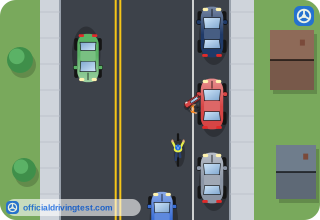
After you open a vehicle door on the side where traffic is moving, how long may the door stay open?
- Until the next vehicle comes up behind you
- For as long as your hazard lights are on
- For up to one minute if no bicycles are near
- Only long enough to load or unload passengers
Show answer
Correct answer: Only long enough to load or unload passengers
A door on the traffic side may be opened only when it is safe, and it may remain open only long enough to load or unload passengers.
Source: Illinois Rules of the Road (2026), page 30
-
Using the "Dutch Reach," which hand should you use to open the vehicle door?
- Your right hand
- Your left hand
- Either hand, while you watch the mirror
- Both hands at the same time
Show answer
Correct answer: Your right hand
The Dutch Reach means using the right hand to open the door, which makes you turn and check for oncoming vehicles and bicyclists.
Source: Illinois Rules of the Road (2026), page 30
-
What should you be aware of about trucks and buses when turning right?
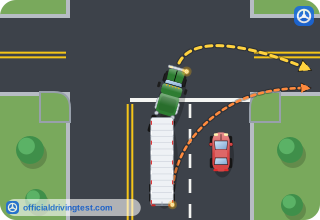
- They may need more space to make a right turn
- They must always make right turns from the left lane
- They are not required to signal right turns
- They have the right of way at every corner
Show answer
Correct answer: They may need more space to make a right turn
The manual warns that trucks and buses may need more space to make a right-hand turn.
Source: Illinois Rules of the Road (2026), page 31
-
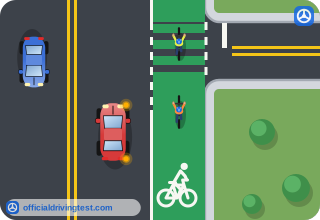
When passing a bicyclist in a dedicated bicycle lane, what minimum distance must you keep?
- 3 feet
- 1 foot
- 2 feet
- None; the lane separates you
Show answer
Correct answer: 3 feet
When passing a bicyclist on any road, including on the shoulder or in a dedicated bicycle lane, keep a minimum distance of 3 feet.
Source: Illinois Rules of the Road (2026), page 28
-
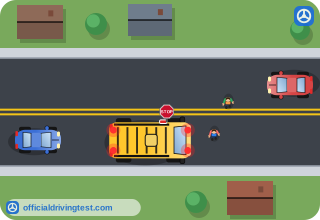
On a two-lane, two-way roadway, a school bus has stopped to load or discharge passengers. May you pass it?
- Yes, if you slow to 20 mph
- No, passing is not allowed
- Yes, on the left, carefully
- Yes, if no children are seen
Show answer
Correct answer: No, passing is not allowed
Passing on a two-lane, two-way roadway is not allowed when a school bus has stopped to load or discharge passengers.
Source: Illinois Rules of the Road (2026), page 29
-
What is the most common cause of motorcycle crashes?
- Motorcyclists riding far too fast
- Drivers not detecting motorcycles
- Motorcycle brake or engine failure
- Wet or icy road surfaces
Show answer
Correct answer: Drivers not detecting motorcycles
The manual says the failure of motorists to detect and recognize motorcycles in traffic is the most common cause of motorcycle crashes.
Source: Illinois Rules of the Road (2026), page 41
-
Because motorcycles are small, what do motorists tend to misjudge about them?
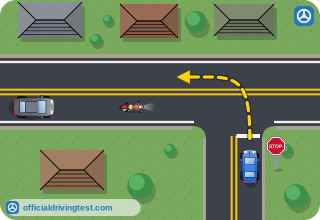
- They underestimate their speed
- They overestimate their speed
- They underestimate their braking distance
- They overestimate their width
Show answer
Correct answer: They underestimate their speed
Due to their small size, motorcycles may be difficult to see, and motorists tend to underestimate their speed.
Source: Illinois Rules of the Road (2026), page 41
-
When should a driver expect to see motorcycles in traffic?
- Mainly in the spring and summer
- Mainly on weekends
- Mainly during daylight hours
- At any time of year
Show answer
Correct answer: At any time of year
A driver should expect to see motorcycles in traffic at any time, not just in the spring and summer.
Source: Illinois Rules of the Road (2026), page 41
-
What share of all motorcycle crashes occur at intersections?
- About 10%
- About 25%
- More than 50%
- More than 90%
Show answer
Correct answer: More than 50%
More than 50% of all motorcycle crashes occur at intersections.
Source: Illinois Rules of the Road (2026), page 41
-
What is the most common motorcycle crash situation at intersections?
- An oncoming car turns left in front of the motorcycle
- A car rear-ends a motorcycle stopped at a light
- A motorcycle runs a red light into cross traffic
- A car turns right and cuts off the motorcycle
Show answer
Correct answer: An oncoming car turns left in front of the motorcycle
The most common situation occurs when an oncoming automobile makes a left turn in front of a motorcycle.
Source: Illinois Rules of the Road (2026), page 41
-
A red light fails to turn green for a motorcyclist. After how long may the motorcyclist proceed, after yielding to oncoming traffic?
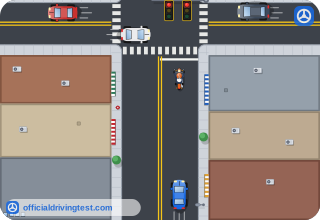
- 60 seconds
- 90 seconds
- 3 minutes
- 120 seconds
Show answer
Correct answer: 120 seconds
If a red light fails to turn green after 120 seconds, a motorcyclist may proceed through the intersection after yielding the right of way to oncoming traffic.
Source: Illinois Rules of the Road (2026), page 41
-
There seems to be enough room in a lane for both your car and a motorcycle. What should you do?
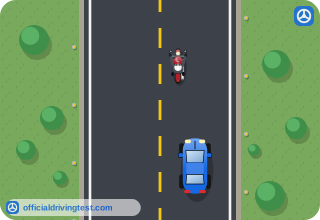
- Share the lane, keeping to the far left side
- Share the lane only at low speeds
- Don't share it; the rider gets the whole lane
- Share the lane if the rider waves you past
Show answer
Correct answer: Don't share it; the rider gets the whole lane
The motorcyclist needs room to maneuver safely and is entitled to the entire lane, so do not share the lane.
Source: Illinois Rules of the Road (2026), page 41
-
What should you do while a motorcycle is passing you?
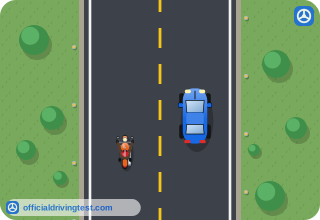
- Slow down sharply to let it by
- Maintain your lane position and speed
- Move to the right edge of your lane
- Speed up so it can merge behind you
Show answer
Correct answer: Maintain your lane position and speed
When being passed by a motorcycle, maintain your lane position and speed and let the motorcycle complete the maneuver.
Source: Illinois Rules of the Road (2026), page 41
-
How much following distance should you allow when behind a motorcycle?
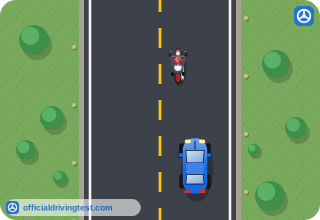
- At least one to two seconds
- At least two seconds
- At least three to four seconds
- At least eight to ten seconds
Show answer
Correct answer: At least three to four seconds
Allow at least three to four seconds following distance behind a motorcycle so the motorcyclist has time to maneuver in an emergency.
Source: Illinois Rules of the Road (2026), page 42
-
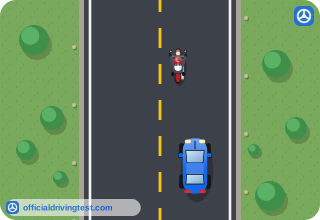
In dry conditions, how does a motorcycle's stopping ability compare with a car's?
- A motorcycle can stop more quickly than a car
- A motorcycle needs about twice the distance
- A motorcycle needs a slightly longer distance
- Both stop in exactly the same distance
Show answer
Correct answer: A motorcycle can stop more quickly than a car
In dry conditions, motorcycles can stop more quickly than a car, which is one reason to leave extra following distance.
Source: Illinois Rules of the Road (2026), page 42
-
When should you dim your headlights while following another vehicle?
- Only when following a large truck
- Only when following a motorcycle
- Only when it is raining or foggy
- When following any vehicle
Show answer
Correct answer: When following any vehicle
The manual says to dim your headlights when following all vehicles, including motorcycles.
Source: Illinois Rules of the Road (2026), page 42
-
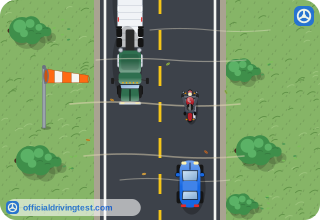
How far can a wind gust, natural or from a large passing vehicle, move an unprepared motorcyclist?
- A few inches at most
- Across an entire lane
- About one foot
- Not at all at highway speeds
Show answer
Correct answer: Across an entire lane
Wind gusts, both natural and those created by large passing vehicles, can move a motorcycle across an entire lane if the rider is not prepared.
Source: Illinois Rules of the Road (2026), page 42