Idaho: Signals and vehicle controls
Turn signals and arm signals, required vehicle equipment, lights, mirrors, tires, starting out, lane changes and headlights. Split into 5 shorter tests so you're not stuck in one long quiz.
Independent educational site · not affiliated with any government agency or DMV
Choose a part
Signals and vehicle controls — Part 1
Questions in this part include: “What is the minimum tire tread depth the examiner requires on the skills test vehicle?”
StartSignals and vehicle controls — Part 2
Questions in this part include: “A trailer must have at least how many red lights mounted on the rear?”
StartSignals and vehicle controls — Part 3
Questions in this part include: “Who are red or blue emergency lights authorized for?”
StartSignals and vehicle controls — Part 4
Questions in this part include: “At night, what replaces the red flag on a load that extends four feet or more beyond the rear?”
StartSignals and vehicle controls — Part 5
Questions in this part include: “In the five-step procedure, what do you do right after signaling?”
StartAll 98 Signals and vehicle controls questions with answers
Choose a part above to take a practice test, or study every question and answer here.
Show the questions and answersHide the questions
-
What is the minimum tire tread depth the examiner requires on the skills test vehicle?
- At least 4/32 of an inch
- At least 6/32 of an inch
- At least 1/32 of an inch
- At least 2/32 of an inch
Show answer
Correct answer: At least 2/32 of an inch
Tires must have at least 2/32 of an inch or more of tread.
Source: Idaho Driver's Handbook (July 2026), page 36 · Open this page in the manual (Manual page 36)
-
During which dates are studded tires not allowed on the vehicle used for the skills test?
- May 1 to September 30
- April 1 to October 31
- June 1 to August 31
- May 1 to October 31
Show answer
Correct answer: May 1 to September 30
Studded tires are not allowed May 1 to September 30.
Source: Idaho Driver's Handbook (July 2026), page 36 · Open this page in the manual (Manual page 36)
-
Which mirrors does the examiner’s vehicle inspection require at a minimum?
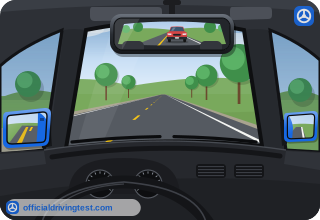
- Only the left side mirror
- Only the right side mirror
- The rear-view mirror or both side mirrors
- Both side mirrors and a rear-view mirror are all required
Show answer
Correct answer: The rear-view mirror or both side mirrors
The inspection accepts the rear-view or both side mirrors.
Source: Idaho Driver's Handbook (July 2026), page 36 · Open this page in the manual (Manual page 36)
-
What must be true of the windshield on the skills test vehicle?
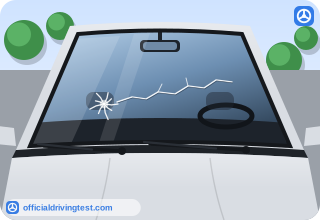
- It has a tinted strip across the top
- It has no cracks or obstructions
- It has a clean sticker from the county office
- It is free of cracks, but obstructions are allowed
Show answer
Correct answer: It has no cracks or obstructions
The examiner checks the windshield for cracks and obstructions.
Source: Idaho Driver's Handbook (July 2026), page 36 · Open this page in the manual (Manual page 36)
-
What must be true of the dashboard gauges and lights on the skills test vehicle?
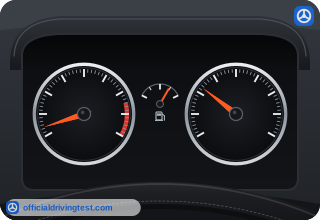
- The gauges are all working and the lights are lit
- The oil light may be illuminated
- The odometer reads under 100,000 miles
- No critical lights or gauges are illuminated
Show answer
Correct answer: No critical lights or gauges are illuminated
The inspection requires that no critical lights or gauges are illuminated.
Source: Idaho Driver's Handbook (July 2026), page 36 · Open this page in the manual (Manual page 36)
-
Which of these must you be able to locate or demonstrate as working properly to the skills test examiner?
- The cruise control
- The air conditioning
- The defroster/defogger
- The heated seats
Show answer
Correct answer: The defroster/defogger
The list includes the defroster/defogger.
Source: Idaho Driver's Handbook (July 2026), page 36 · Open this page in the manual (Manual page 36)
-
How many arm signals must you be able to demonstrate to the skills test examiner?
- Only left turn
- All three
- Only the stop signal
- Two, as chosen by the examiner
Show answer
Correct answer: All three
You must properly demonstrate all three arm signals.
Source: Idaho Driver's Handbook (July 2026), page 36 · Open this page in the manual (Manual page 36)
-
What does Idaho law say about driving a vehicle that is mechanically unsafe?
- You may drive it only in daylight
- You may drive it with a repair estimate
- You may not drive it
- You may drive it on county roads only
Show answer
Correct answer: You may not drive it
Idaho law does not allow you to drive a mechanically unsafe vehicle.
Source: Idaho Driver's Handbook (July 2026), page 38 · Open this page in the manual (Manual page 38)
-
Who is responsible for correcting a vehicle that needs repairs, lacks vital equipment, or presents some other danger?
- The county sheriff's office
- You, the person driving it
- The Idaho Transportation Department
- The company that insures it
Show answer
Correct answer: You, the person driving it
The handbook says that if your vehicle needs repairs, lacks vital equipment, or is dangerous, you are responsible for correcting the problem.
Source: Idaho Driver's Handbook (July 2026), page 38 · Open this page in the manual (Manual page 38)
-
What does Idaho require regarding annual vehicle safety inspections?
- An annual inspection is required for every vehicle
- An inspection is required only for vehicles over ten years old
- An inspection is required only when you renew your license
- None is required, but an officer may cite an unsafe vehicle
Show answer
Correct answer: None is required, but an officer may cite an unsafe vehicle
Idaho does not require an annual safety inspection, but an officer who stops an unsafe vehicle or one lacking proper equipment may issue a citation.
Source: Idaho Driver's Handbook (July 2026), page 38 · Open this page in the manual (Manual page 38)
-
How many separate brake systems must every vehicle have?
- One, with a backup warning light
- Two, but only on heavy vehicles
- Two, each backing up the other
- Three, including a trailer brake
Show answer
Correct answer: Two, each backing up the other
All vehicles must have two brake systems designed so that if one fails the other still works.
Source: Idaho Driver's Handbook (July 2026), page 38 · Open this page in the manual (Manual page 38)
-
Foot brakes must be able to stop a vehicle traveling 20 miles per hour on dry pavement within what distance?
- 25 feet
- 15 feet
- 55 feet
- 100 feet
Show answer
Correct answer: 25 feet
Foot brakes must stop a vehicle traveling 20 miles per hour on dry pavement within 25 feet.
Source: Idaho Driver's Handbook (July 2026), page 38 · Open this page in the manual (Manual page 38)
-
The emergency or parking brake must be able to stop a vehicle within what distance under the same conditions as the foot brakes?
- 25 feet
- 100 feet
- 150 feet
- 55 feet
Show answer
Correct answer: 55 feet
The emergency or parking brake must stop the vehicle within 55 feet under similar conditions.
Source: Idaho Driver's Handbook (July 2026), page 38 · Open this page in the manual (Manual page 38)
-
Besides being able to stop the vehicle, what else must the emergency or parking brake be able to do?
- Release automatically when the engine starts
- Hold the vehicle stationary on a hill when parked
- Operate the brake lights while parked
- Stop the vehicle faster than the foot brakes
Show answer
Correct answer: Hold the vehicle stationary on a hill when parked
The parking brake must be able to hold the car stationary on a hill when parked.
Source: Idaho Driver's Handbook (July 2026), page 38 · Open this page in the manual (Manual page 38)
-
How many headlamps must a vehicle have, and what must each provide?
- Two, with high and low beams
- Two, with a low beam only
- One, with high and low beams
- Four, with fog and driving beams
Show answer
Correct answer: Two, with high and low beams
Two headlamps with high and low beams are required.
Source: Idaho Driver's Handbook (July 2026), page 38 · Open this page in the manual (Manual page 38)
-
High beams must allow the driver to see people and vehicles at least how far away?
- 100 feet
- 200 feet
- 350 feet
- 500 feet
Show answer
Correct answer: 350 feet
High beams must let the driver see people and vehicles at least 350 feet away.
Source: Idaho Driver's Handbook (July 2026), page 38 · Open this page in the manual (Manual page 38)
-
Low beams must light the roadway at least how far ahead?
- 50 feet
- 100 feet
- 200 feet
- 350 feet
Show answer
Correct answer: 100 feet
Low beams must light the roadway at least 100 feet ahead.
Source: Idaho Driver's Handbook (July 2026), page 38 · Open this page in the manual (Manual page 38)
-
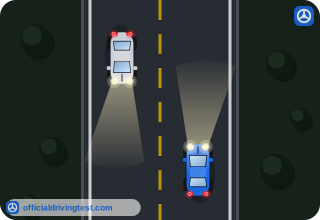
How must headlamps be aimed?
- Slightly upward to show overhead road signs
- Toward the shoulder of the road at all times
- Straight at the back of the vehicle ahead
- To light the road without blinding oncoming drivers
Show answer
Correct answer: To light the road without blinding oncoming drivers
Headlamps must be aimed to light the road without blinding oncoming drivers.
Source: Idaho Driver's Handbook (July 2026), page 38 · Open this page in the manual (Manual page 38)
-
Brake lights must be visible for at least how far to the rear in normal sunlight?
- 50 feet
- 200 feet
- 100 feet
- 500 feet
Show answer
Correct answer: 100 feet
Functioning brake lights must be visible for at least 100 feet to the rear in normal sunlight.
Source: Idaho Driver's Handbook (July 2026), page 39 · Open this page in the manual (Manual page 39)
-
What colors may a motor vehicle's brake lights be?
- Red or amber
- Red or white
- Amber or white
- Red only
Show answer
Correct answer: Red or amber
All motor vehicles must have functioning red or amber brake lights.
Source: Idaho Driver's Handbook (July 2026), page 39 · Open this page in the manual (Manual page 39)
-
Brake lights must be designed to come on when you do what?
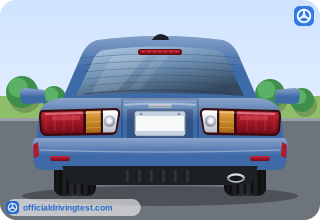
- Take your foot off the accelerator
- Turn on the headlights
- Shift the transmission into reverse
- Apply the foot brake
Show answer
Correct answer: Apply the foot brake
Brake lights must be designed to come on when you apply the foot brake.
Source: Idaho Driver's Handbook (July 2026), page 39 · Open this page in the manual (Manual page 39)
-
What does the handbook say about brake light lenses?
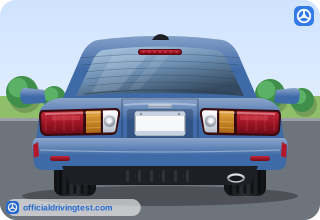
- Replace them every year
- Keep them clean
- Cover them when parked
- Tint them to reduce glare
Show answer
Correct answer: Keep them clean
The handbook tells drivers to keep the brake light lenses clean.
Source: Idaho Driver's Handbook (July 2026), page 39 · Open this page in the manual (Manual page 39)
-
A trailer must have at least how many red lights mounted on the rear?
- Two, on the left and right rear
- One, in the center of the rear
- Three, including one on top
- None, if it has reflectors
Show answer
Correct answer: Two, on the left and right rear
Trailers and semitrailers must have at least two red lights mounted on the left and right rear.
Source: Idaho Driver's Handbook (July 2026), page 39 · Open this page in the manual (Manual page 39)
-
Which vehicles need only one red light mounted on the rear?
- Motorcycles and all trailers and semitrailers
- All vehicles built before January 1, 1966
- Motorcycles and vehicles built before 1956
- Trailers, semitrailers and vehicles built after 1955
Show answer
Correct answer: Motorcycles and vehicles built before 1956
Vehicles built before January 1, 1956, and motorcycles need at least one red rear light.
Source: Idaho Driver's Handbook (July 2026), page 39 · Open this page in the manual (Manual page 39)
-
Taillights on a vehicle must be visible from how far to the rear?
- 100 feet
- 500 feet
- 200 feet
- 1,000 feet
Show answer
Correct answer: 500 feet
The two red taillights must be visible from 500 feet to the rear.
Source: Idaho Driver's Handbook (July 2026), page 39 · Open this page in the manual (Manual page 39)
-
What type of turn signals must motor vehicles built after January 1, 1955, have?
- Hand-operated signal arms on each side of the vehicle
- Flashing signals on the rear of the vehicle only
- A single steady amber warning light on the dash
- Flashing electric left and right signals, front and rear
Show answer
Correct answer: Flashing electric left and right signals, front and rear
Motor vehicles built after January 1, 1955, must have flashing electric left and right turn signals on the front and rear.
Source: Idaho Driver's Handbook (July 2026), page 39 · Open this page in the manual (Manual page 39)
-
Turn signals must be visible from what distance?
- 25 feet
- 200 feet
- 100 feet
- 500 feet
Show answer
Correct answer: 100 feet
Turn signals must have a driver-controlled switch and be visible from 100 feet.
Source: Idaho Driver's Handbook (July 2026), page 39 · Open this page in the manual (Manual page 39)
-
What color must a vehicle's front turn signals be?
- White or amber
- Red or white
- Red only
- Green or amber
Show answer
Correct answer: White or amber
The front signals must be white or amber.
Source: Idaho Driver's Handbook (July 2026), page 39 · Open this page in the manual (Manual page 39)
-
What color must a vehicle's rear turn signals be?
- White or red
- White only
- Amber or green
- Red or amber
Show answer
Correct answer: Red or amber
The rear signals must be red or amber.
Source: Idaho Driver's Handbook (July 2026), page 39 · Open this page in the manual (Manual page 39)
-
Each tire should have at least how much tread?
- 1/32 of an inch
- 2/32 of an inch
- 4/32 of an inch
- 1/4 of an inch
Show answer
Correct answer: 2/32 of an inch
Each tire should have at least 2/32 inch or more of tread.
Source: Idaho Driver's Handbook (July 2026), page 39 · Open this page in the manual (Manual page 39)
-
A motor vehicle's horn must be able to be heard from at least how far away?
- 200 feet
- 50 feet
- 100 feet
- 500 feet
Show answer
Correct answer: 200 feet
All motor vehicles must have a horn that can be heard at least 200 feet away.
Source: Idaho Driver's Handbook (July 2026), page 39 · Open this page in the manual (Manual page 39)
-
What kind of horn is prohibited?
- One that can be heard from 200 feet away
- One that is mounted near the steering wheel
- One with an unreasonably loud or harsh sound
- One that gives a single short, mild tone
Show answer
Correct answer: One with an unreasonably loud or harsh sound
Horns with unreasonably loud or harsh sounds are prohibited.
Source: Idaho Driver's Handbook (July 2026), page 39 · Open this page in the manual (Manual page 39)
-
What kind of glass must windows and windshields be made of?
- Tempered glass with a tint
- Approved safety glass
- Any clear glass
- Plastic or acrylic panels
Show answer
Correct answer: Approved safety glass
Windows and windshields must be made of approved safety glass.
Source: Idaho Driver's Handbook (July 2026), page 40 · Open this page in the manual (Manual page 40)
-
When must a windshield or window be replaced?
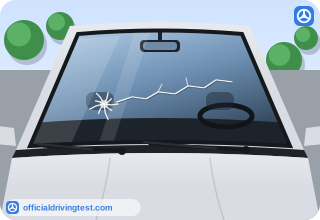
- When it has any chip or scratch at all
- When it is more than ten years old
- When someone has put a sticker on it
- When damage blocks the driver's view
Show answer
Correct answer: When damage blocks the driver's view
Glass must be replaced when damage to the glass obstructs the driver's view.
Source: Idaho Driver's Handbook (July 2026), page 40 · Open this page in the manual (Manual page 40)
-
What must you not do to the windows and windshield of your vehicle?
- Wash them with water and a soft cloth
- Keep wipers installed on the windshield
- Treat them with a mirror surface
- Make them from approved safety glass
Show answer
Correct answer: Treat them with a mirror surface
Windows and windshields must not be treated with a mirror surface or other substance that makes them difficult to see through, even from the outside.
Source: Idaho Driver's Handbook (July 2026), page 40 · Open this page in the manual (Manual page 40)
-
Windows and windshields must not be blocked by what?
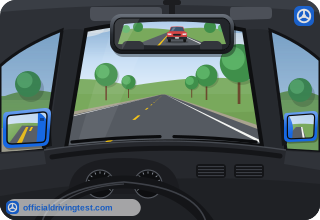
- Any object placed or hung in the vehicle
- Wipers in their rest position
- Only objects hung from the mirror
- The vehicle's required safety glass
Show answer
Correct answer: Any object placed or hung in the vehicle
Windows and windshields must not be blocked by any object placed or hung in the vehicle.
Source: Idaho Driver's Handbook (July 2026), page 40 · Open this page in the manual (Manual page 40)
-
What must all motor vehicles have to keep the windshield clear of rain, snow, or other moisture?
- A windshield visor
- Mud flaps
- Fog lights
- Windshield wipers
Show answer
Correct answer: Windshield wipers
All motor vehicles must be equipped with wipers to keep the windshield clear of rain, snow, or other moisture.
Source: Idaho Driver's Handbook (July 2026), page 40 · Open this page in the manual (Manual page 40)
-
A motor vehicle's rear view mirror must provide a view of the highway for at least how far to the rear?
- 50 feet
- 200 feet
- 100 feet
- 500 feet
Show answer
Correct answer: 200 feet
The rear view mirror must provide a view of the highway for at least 200 feet to the rear.
Source: Idaho Driver's Handbook (July 2026), page 40 · Open this page in the manual (Manual page 40)
-
What must a vehicle have if a load or trailer blocks the driver's normal view through the rear window?
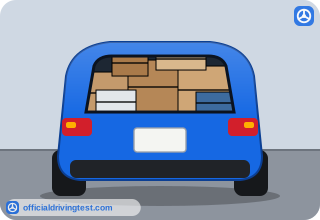
- Two additional mirrors, one on each side
- A single wide mirror on the left side
- A rear camera on the back of it
- A red flag displayed on the load
Show answer
Correct answer: Two additional mirrors, one on each side
If a load or trailer obscures the rear view, the vehicle must have two additional mirrors, one on each side.
Source: Idaho Driver's Handbook (July 2026), page 40 · Open this page in the manual (Manual page 40)
-
What must a vehicle have if it has no rear-view mirror?
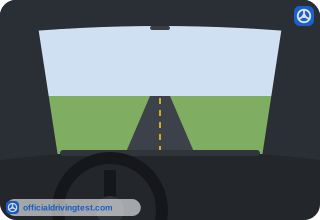
- One left side mirror only
- A convex mirror on the dashboard
- Two side mirrors, left and right
- No mirrors are required at all
Show answer
Correct answer: Two side mirrors, left and right
If no rear-view mirror is present, the vehicle must have 2 side mirrors (1 left, 1 right).
Source: Idaho Driver's Handbook (July 2026), page 40 · Open this page in the manual (Manual page 40)
-
What must a motor vehicle's muffler do?
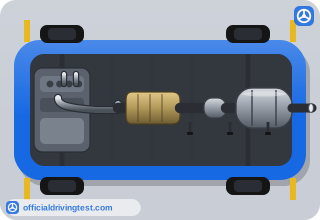
- Be as loud as the engine allows for
- Be in good working order and quiet
- Be removed when driving off-road
- Be replaced once every year or so
Show answer
Correct answer: Be in good working order and quiet
A muffler must be in good working order and prevent loud or unusual noise.
Source: Idaho Driver's Handbook (July 2026), page 40 · Open this page in the manual (Manual page 40)
-
What are fenders, wheel covers, or flaps required to prevent?
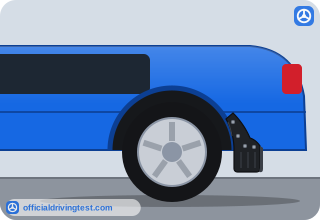
- Tires from wearing unevenly over time
- Wheels from locking up in the snow
- Rust from forming on the vehicle body
- Mud or water thrown onto other vehicles
Show answer
Correct answer: Mud or water thrown onto other vehicles
Fenders, wheel covers or flaps prevent mud, water or other material from being thrown from the wheels up onto other vehicles.
Source: Idaho Driver's Handbook (July 2026), page 40 · Open this page in the manual (Manual page 40)
-
Who are red or blue emergency lights authorized for?
- Tow trucks and delivery vans
- Emergency vehicles only
- Any vehicle in poor weather
- Highway maintenance vehicles only
Show answer
Correct answer: Emergency vehicles only
Red or blue emergency lights are not allowed on regular vehicles because they are authorized for emergency vehicles only.
Source: Idaho Driver's Handbook (July 2026), page 42 · Open this page in the manual (Manual page 42)
-
Which of these is equipment not allowed on a regular vehicle?
- A horn heard 200 feet away
- Two fog lights in front
- Windshield wipers
- A siren
Show answer
Correct answer: A siren
Sirens, bells, and whistles are listed as equipment that is not allowed.
Source: Idaho Driver's Handbook (July 2026), page 42 · Open this page in the manual (Manual page 42)
-
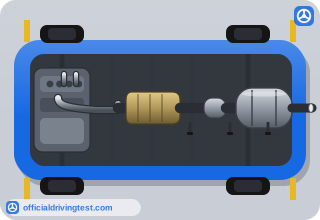
What kind of muffler modification is not allowed?
- A muffler fitted with a heat shield
- A muffler replaced with a new one
- A cut-out or bypass that adds noise
- A muffler in good working order
Show answer
Correct answer: A cut-out or bypass that adds noise
Any muffler cut-out or bypass that makes the exhaust system amplify or increase noise is not allowed.
Source: Idaho Driver's Handbook (July 2026), page 42 · Open this page in the manual (Manual page 42)
-
A vehicle may have no more than how many spotlights?
- Two
- One
- Three
- Four
Show answer
Correct answer: Two
More than two spotlights are not allowed.
Source: Idaho Driver's Handbook (July 2026), page 42 · Open this page in the manual (Manual page 42)
-
A vehicle may have no more than how many auxiliary lights in front?
- One
- Three
- Four
- Two
Show answer
Correct answer: Two
More than two auxiliary lights in front are not allowed.
Source: Idaho Driver's Handbook (July 2026), page 42 · Open this page in the manual (Manual page 42)
-
A vehicle may have no more than how many fog lights in front?
- One
- Two
- Three
- Four
Show answer
Correct answer: Two
More than two fog lights in front are not allowed.
Source: Idaho Driver's Handbook (July 2026), page 42 · Open this page in the manual (Manual page 42)
-
A vehicle may have no more than how many cowl or fender lights?
- Two
- One
- Three
- Four
Show answer
Correct answer: Two
More than two cowl or fender lights are not allowed.
Source: Idaho Driver's Handbook (July 2026), page 42 · Open this page in the manual (Manual page 42)
-
Studded snow tires may be used only during which dates?
- September 1 to March 31
- November 1 to May 31
- October 1 to April 30
- October 15 to April 15
Show answer
Correct answer: October 1 to April 30
Studded snow tires may be used only from October 1 to April 30.
Source: Idaho Driver's Handbook (July 2026), page 42 · Open this page in the manual (Manual page 42)
-
Why does the Idaho Transportation Department sometimes adjust the dates for studded snow tires?
- Because of road construction
- Because of weather conditions
- Because of changes in federal law
- Because of tire supply shortages
Show answer
Correct answer: Because of weather conditions
The department adjusts the dates in some years due to weather conditions.
Source: Idaho Driver's Handbook (July 2026), page 42 · Open this page in the manual (Manual page 42)
-
During which hours must headlamps and tail lamps be lighted, besides when poor visibility makes them necessary?
- From one hour after sunset to sunrise
- From 8 p.m. to 6 a.m.
- From dusk until midnight
- From sunset to sunrise
Show answer
Correct answer: From sunset to sunrise
Headlamps and tail lamps must be lighted from sunset to sunrise and when poor visibility makes them necessary for safety.
Source: Idaho Driver's Handbook (July 2026), page 43 · Open this page in the manual (Manual page 43)
-
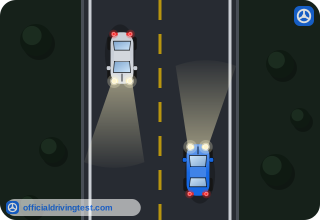
How far before meeting another vehicle must headlamps be dimmed?
- 100 feet
- 300 feet
- 500 feet
- 1,000 feet
Show answer
Correct answer: 500 feet
Headlamps must be dimmed 500 feet before meeting another vehicle.
Source: Idaho Driver's Handbook (July 2026), page 43 · Open this page in the manual (Manual page 43)
-
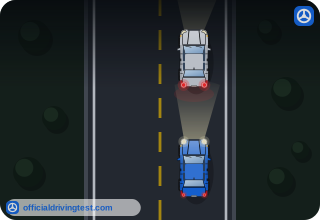
How far before overtaking another vehicle must headlamps be dimmed?
- 200 feet
- 50 feet
- 100 feet
- 300 feet
Show answer
Correct answer: 200 feet
Headlamps must be dimmed 200 feet before overtaking another vehicle.
Source: Idaho Driver's Handbook (July 2026), page 43 · Open this page in the manual (Manual page 43)
-
When lights are needed for driving, which should you use?
- Parking lights only
- Parking lights and fog lights
- Emergency flashers
- Headlamps, not parking lights
Show answer
Correct answer: Headlamps, not parking lights
When lights are needed for driving, use headlamps, not parking lights.
Source: Idaho Driver's Handbook (July 2026), page 43 · Open this page in the manual (Manual page 43)
-
What must you do before driving to ensure maximum visibility in all directions?
- Warm up the engine for five minutes
- Clean ice, snow, or dirt from the windows
- Turn on the emergency flashers
- Clear only the front windshield
Show answer
Correct answer: Clean ice, snow, or dirt from the windows
You must clean windows of ice, snow, or dirt before driving to ensure maximum visibility in all directions.
Source: Idaho Driver's Handbook (July 2026), page 43 · Open this page in the manual (Manual page 43)
-
Which signs, posters, and stickers may be on windows and windshields?
- Only those required by law
- Those under 6 inches square
- Those placed in the lower corners
- Only those on the rear window
Show answer
Correct answer: Only those required by law
Windows and windshields must be kept clean of signs, posters, and stickers except those required by law.
Source: Idaho Driver's Handbook (July 2026), page 43 · Open this page in the manual (Manual page 43)
-
What is illegal for passengers or freight to do?
- Weigh more than half the vehicle's weight when loaded
- Shift position slightly when the vehicle turns
- Obstruct the driver's view or interfere with operating it
- Block the view of the rear license plate
Show answer
Correct answer: Obstruct the driver's view or interfere with operating it
It is illegal for passengers or freight to obstruct a driver's view or interfere with the operation of a vehicle.
Source: Idaho Driver's Handbook (July 2026), page 43 · Open this page in the manual (Manual page 43)
-
When a load extends how far beyond the rear of a vehicle must a red flag be displayed at the end of the load?
- One foot or more
- Four feet or more
- Two feet or more
- Six feet or more
Show answer
Correct answer: Four feet or more
A red flag must be displayed when a load extends four feet or more beyond the rear of the vehicle.
Source: Idaho Driver's Handbook (July 2026), page 43 · Open this page in the manual (Manual page 43)
-
What is the minimum size of the red flag displayed on an overhanging load?
- 6 inches square
- 12 inches square
- 24 inches square
- 18 inches square
Show answer
Correct answer: 18 inches square
The red flag must be at least 18 inches square.
Source: Idaho Driver's Handbook (July 2026), page 43 · Open this page in the manual (Manual page 43)
-
At night, what replaces the red flag on a load that extends four feet or more beyond the rear?
- A white light visible for 200 feet
- A red reflector on the end
- A red light visible for 500 feet
- A second, larger red flag
Show answer
Correct answer: A red light visible for 500 feet
At night, the flag must be replaced by a red light visible for at least 500 feet.
Source: Idaho Driver's Handbook (July 2026), page 43 · Open this page in the manual (Manual page 43)
-
How far may a vehicle's load extend outside the fenders on the left side?
- Not at all
- Up to 3 inches
- Up to 6 inches
- Up to 12 inches
Show answer
Correct answer: Not at all
The load must not extend outside the fenders on the left side.
Source: Idaho Driver's Handbook (July 2026), page 43 · Open this page in the manual (Manual page 43)
-
How far may a vehicle's load extend outside the fenders on the right side?
- Not at all
- No more than 12 inches
- No more than 18 inches
- No more than six inches
Show answer
Correct answer: No more than six inches
The load must not extend more than six inches outside the fenders on the right.
Source: Idaho Driver's Handbook (July 2026), page 43 · Open this page in the manual (Manual page 43)
-
How do equipment requirements for antique vehicles and street rods compare with those for regular passenger vehicles?
- They are exactly the same as for cars
- They are waived for all of them
- They may vary from the regular requirements
- They apply only to brakes and lights
Show answer
Correct answer: They may vary from the regular requirements
Equipment requirements for antique vehicles and street rods may vary from the requirements for regular passenger vehicles.
Source: Idaho Driver's Handbook (July 2026), page 43 · Open this page in the manual (Manual page 43)
-
When you slow down or stop, how may you give the required signal to other drivers?
- Only by flashing your headlights
- With brake lights or an arm signal
- Only with your left turn signal
- No signal is needed to slow down
Show answer
Correct answer: With brake lights or an arm signal
When slowing down or stopping, you must give a signal to other drivers, using either the brake-operated signal lights on the rear of your vehicle or an arm signal.
Source: Idaho Driver's Handbook (July 2026), page 71 · Open this page in the manual (Manual page 71)
-
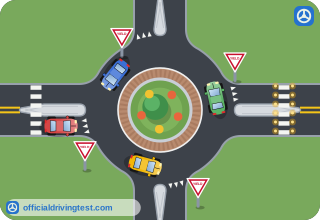
Must you use your turn signal when you exit a roundabout?
- No, never
- Yes, always
- Only in a multi-lane roundabout
- Only when a car is behind you
Show answer
Correct answer: Yes, always
The handbook lists exiting a roundabout among the times you must always use a turn signal.
Source: Idaho Driver's Handbook (July 2026), page 72 · Open this page in the manual (Manual page 72)
-
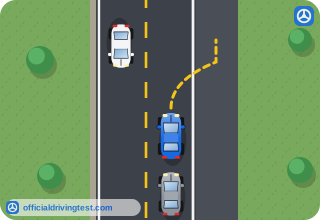
You are pulling over to the side of the road. What does the handbook say about your turn signal?
- Use it only if a vehicle is close behind
- Use it only on freeways and highways
- It is not needed when leaving traffic
- Always use it
Show answer
Correct answer: Always use it
The handbook lists pulling over to the side of the road among the times you must always use a turn signal.
Source: Idaho Driver's Handbook (July 2026), page 72 · Open this page in the manual (Manual page 72)
-
In business or residential areas, how far before you turn or change lanes must your signal start?
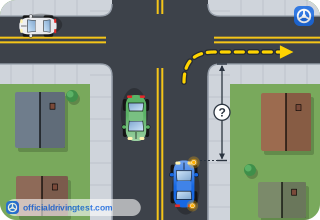
- At least 100 feet
- At least 25 feet
- At least 50 feet
- At least 300 feet
Show answer
Correct answer: At least 100 feet
Signals must start at least 100 feet in business or residential areas before you turn or change lanes.
Source: Idaho Driver's Handbook (July 2026), page 72 · Open this page in the manual (Manual page 72)
-
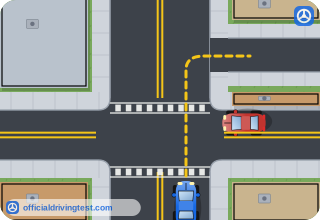
You plan to turn just beyond an intersection. When should you signal?
- Before you enter the intersection
- Just after you pass through the intersection
- While you are in the middle of the intersection
- Only once you have started the turn
Show answer
Correct answer: Just after you pass through the intersection
If you plan to turn just beyond an intersection, signal just after you pass through the intersection so you won't confuse other drivers.
Source: Idaho Driver's Handbook (July 2026), page 72 · Open this page in the manual (Manual page 72)
-
Proper signaling may help prevent which type of collision?
- A collision with a train
- A rollover crash
- A collision with a deer
- A rear-end collision
Show answer
Correct answer: A rear-end collision
The handbook states that proper signaling may prevent a rear-end collision.
Source: Idaho Driver's Handbook (July 2026), page 72 · Open this page in the manual (Manual page 72)
-
A driver's arm and hand are extended straight out the window. What does this arm signal mean?
- Left turn
- Right turn
- Slow or stop
- Go ahead and pass
Show answer
Correct answer: Left turn
The correct arm signal for a left turn is your arm and hand extended straight out the window.
Source: Idaho Driver's Handbook (July 2026), page 72 · Open this page in the manual (Manual page 72)
-
A driver's arm and hand are extended upward out the window. What does this arm signal mean?
- Left turn
- Slow or stop
- Right turn
- Go ahead and pass
Show answer
Correct answer: Right turn
The correct arm signal for a right turn is your arm and hand extended upward out the window.
Source: Idaho Driver's Handbook (July 2026), page 72 · Open this page in the manual (Manual page 72)
-
Which arm signal tells other drivers you are slowing or stopping?
- Arm and hand extended upward
- Arm and hand extended downward
- Arm and hand extended straight out
- Arm waved back and forth
Show answer
Correct answer: Arm and hand extended downward
The correct arm signal to slow or stop is your arm and hand extended downward out the window.
Source: Idaho Driver's Handbook (July 2026), page 72 · Open this page in the manual (Manual page 72)
-
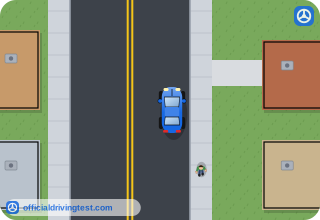
What should you do before you get into your vehicle?
- Turn on the engine to let it warm up for a minute
- Release the parking brake and shift to the proper gear
- Adjust the radio station and your phone settings
- Look in front and back of it for a child or obstacle
Show answer
Correct answer: Look in front and back of it for a child or obstacle
The manual says to always look in front and back of the vehicle for a child or obstacle before getting in.
Source: Idaho Driver's Handbook (July 2026), page 87 · Open this page in the manual (Manual page 87)
-
In the manual's routine for starting your car, what do you do with the hand brake set?
- Shift into first gear, release the hand brake and start the engine
- Ensure the vehicle is in park or neutral and start the engine
- Release the hand brake, put the car in drive and start the engine
- Shift into reverse, turn on the lights and release the brake
Show answer
Correct answer: Ensure the vehicle is in park or neutral and start the engine
With the hand brake set, you ensure the vehicle is in park or neutral and start the engine.
Source: Idaho Driver's Handbook (July 2026), page 87 · Open this page in the manual (Manual page 87)
-
While holding the foot brake (and clutch if you have one) and after shifting to the proper gear, what is the next step in the starting routine?
- Turn off the engine and restart it
- Press the accelerator and then set the parking brake
- Set the parking brake and check the mirrors again
- Release the parking brake and prepare to pull out
Show answer
Correct answer: Release the parking brake and prepare to pull out
The manual says to shift to the proper gear, then release the parking brake and prepare to pull out.
Source: Idaho Driver's Handbook (July 2026), page 87 · Open this page in the manual (Manual page 87)
-
The five-step procedure applies when you do which of the following?
- Start from the curb, pull into a parking space or change lanes
- Slow down on a straight road when no other traffic is near
- Stop at a red light or at a stop sign at an intersection
- Drive through a roundabout or around a curve on a highway
Show answer
Correct answer: Start from the curb, pull into a parking space or change lanes
The five-step procedure is for starting from the curb, pulling into a parking space or changing lanes.
Source: Idaho Driver's Handbook (July 2026), page 87 · Open this page in the manual (Manual page 87)
-
What is the first step of the five-step procedure for starting from the curb, pulling into a parking space or changing lanes?
- Signal
- Glance over your shoulder
- Check mirrors
- Cancel the turn signal
Show answer
Correct answer: Check mirrors
Step 1 of the five-step procedure is to check your mirrors.
Source: Idaho Driver's Handbook (July 2026), page 87 · Open this page in the manual (Manual page 87)
-
In the five-step procedure, how far or how long before moving your vehicle must you signal?
- Two seconds or 25 feet
- Three seconds or 50 feet
- Ten seconds or 200 feet
- Five seconds or 100 feet
Show answer
Correct answer: Five seconds or 100 feet
The procedure calls for signaling for the required five seconds or 100 feet before moving.
Source: Idaho Driver's Handbook (July 2026), page 87 · Open this page in the manual (Manual page 87)
-
In the five-step procedure, what do you do right after signaling?
- Make your move quickly
- Glance over your shoulder
- Cancel the turn signal
- Check the mirrors again
Show answer
Correct answer: Glance over your shoulder
Step 3 after signaling is to glance over your shoulder in the direction you are going to move.
Source: Idaho Driver's Handbook (July 2026), page 87 · Open this page in the manual (Manual page 87)
-
What is the last of the five steps when starting from the curb, pulling into a parking space or changing lanes?
- Check mirrors
- Signal for five seconds
- Cancel the turn signal
- Glance over your shoulder
Show answer
Correct answer: Cancel the turn signal
The fifth and final step is to cancel the turn signal after making your move.
Source: Idaho Driver's Handbook (July 2026), page 87 · Open this page in the manual (Manual page 87)
-
In the five-step procedure, how should you make your move once it is safe to do so?
- Gradually and smoothly
- As fast as you can
- With a quick burst of speed
- Suddenly, without slowing down first
Show answer
Correct answer: Gradually and smoothly
Step 4 says to make your move gradually and smoothly when it is safe.
Source: Idaho Driver's Handbook (July 2026), page 87 · Open this page in the manual (Manual page 87)
-
To be ready to react promptly to emergencies, where should your hands be placed on the steering wheel?
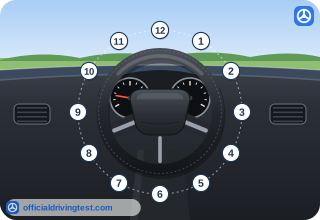
- Both hands side by side at the top of the steering wheel
- Both hands on opposite sides, at about nine o'clock and three o'clock
- One hand at the bottom and the other hand on the gear shift
- Both hands at the six o'clock position of the wheel
Show answer
Correct answer: Both hands on opposite sides, at about nine o'clock and three o'clock
The manual says to drive with both hands on opposite sides of the wheel at approximately nine o’clock and three o’clock.
Source: Idaho Driver's Handbook (July 2026), page 89 · Open this page in the manual (Manual page 89)
-
If your vehicle is equipped with airbags, where should you check for proper hand placement?
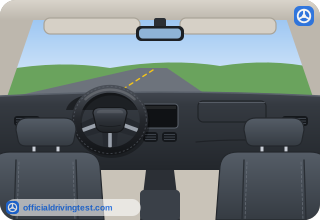
- The traffic signs along the road
- Your owner's manual
- A passenger's opinion
- The sticker on the rear window
Show answer
Correct answer: Your owner's manual
The manual says to check your owner’s manual for proper hand placement if the vehicle has airbags.
Source: Idaho Driver's Handbook (July 2026), page 89 · Open this page in the manual (Manual page 89)
-
Before you make any move to the side, what should you do besides using your mirrors?
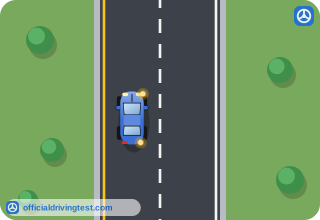
- Sound your horn twice before moving over
- Slow down to a stop before you move over
- Quickly turn your head to check the blind spot
- Flash your headlights at the traffic beside you
Show answer
Correct answer: Quickly turn your head to check the blind spot
The manual says never to rely on mirrors alone and to quickly turn your head to check the blind spot.
Source: Idaho Driver's Handbook (July 2026), page 90 · Open this page in the manual (Manual page 90)
-
When should you sound your horn while driving in the mountains?
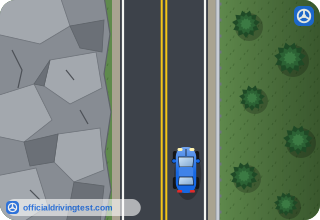
- At every curve on a wide road, whatever the view ahead may be
- Only when you can already see the headlights of an oncoming vehicle
- When approaching any curve on a narrow road where the view is obstructed
- Whenever you start going down a long hill or up a steep one
Show answer
Correct answer: When approaching any curve on a narrow road where the view is obstructed
The manual says to sound the horn when approaching any curve on a narrow road where the view is obstructed.
Source: Idaho Driver's Handbook (July 2026), page 107 · Open this page in the manual (Manual page 107)
-
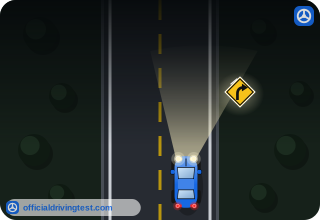
Between what times should you turn on your headlights, not just your parking lights?
- Between sunset and sunrise
- Between 9 p.m. and 5 a.m.
- Only when the sky is completely dark
- Only when you see other vehicles using their lights
Show answer
Correct answer: Between sunset and sunrise
The manual says to turn on your headlights, not just your parking lights, when driving between sunset and sunrise.
Source: Idaho Driver's Handbook (July 2026), page 109 · Open this page in the manual (Manual page 109)
-
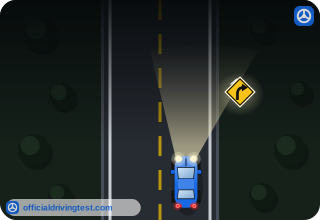
What does the manual say about wearing sunglasses when light levels are low?
- Never wear them
- Wear them only on lighted roads
- Wear them only when you drive slowly
- Wear them to cut the glare of oncoming headlights
Show answer
Correct answer: Never wear them
The manual says never to wear sunglasses when light levels are low.
Source: Idaho Driver's Handbook (July 2026), page 109 · Open this page in the manual (Manual page 109)
-
How should you keep your windshield for night driving?
- Clean on the outside only
- Covered with an anti-glare film
- Clean, both inside and out
- Clean on the inside only
Show answer
Correct answer: Clean, both inside and out
The manual says to keep your windshield clean, both inside and out, to make night driving safer.
Source: Idaho Driver's Handbook (July 2026), page 109 · Open this page in the manual (Manual page 109)
-
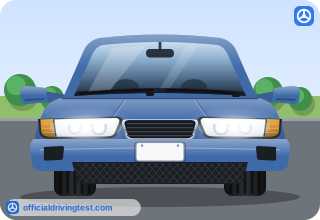
What does dirt on your headlights do?
- It makes the light shine farther ahead
- It dims their light and may distort the beam
- It reduces glare for oncoming drivers
- It has no effect when you use the low beams
Show answer
Correct answer: It dims their light and may distort the beam
The manual says dirt will dim the light of your headlights and may distort the beam.
Source: Idaho Driver's Handbook (July 2026), page 109 · Open this page in the manual (Manual page 109)
-
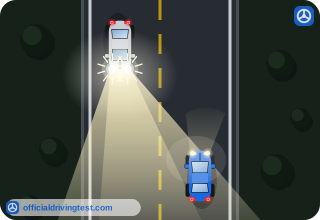
To avoid the glare of an oncoming vehicle's headlights, where should you look?
- Shift your eyes up to the upper left side of your lane
- Look at the center line until the vehicle has passed
- Look directly into the headlights to judge their distance
- Shift your eyes down to the lower right side of your traffic lane
Show answer
Correct answer: Shift your eyes down to the lower right side of your traffic lane
The manual says to avoid looking into oncoming headlights and to shift your eyes to the lower right side of your lane.
Source: Idaho Driver's Handbook (July 2026), page 109 · Open this page in the manual (Manual page 109)
-
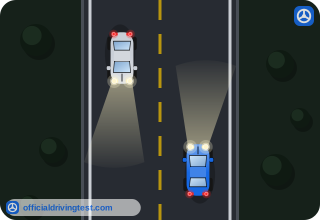
When should you dim your headlights to low beam?
- When approaching or following another vehicle, or on lighted roads
- Only when an oncoming driver flashes their lights at you
- Only when it is raining or snowing at the time of driving
- Only when you are traveling below 35 miles per hour
Show answer
Correct answer: When approaching or following another vehicle, or on lighted roads
The manual says to dim your headlights to low beam when approaching or following another vehicle or on lighted roads.
Source: Idaho Driver's Handbook (July 2026), page 109 · Open this page in the manual (Manual page 109)
-
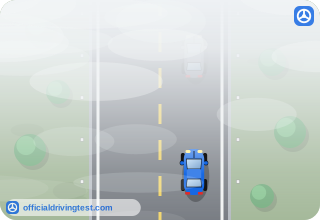
In the daytime, headlights are required when vision is reduced to about what distance?
- 1,000 feet
- 500 feet
- 2,000 feet
- 1,500 feet
Show answer
Correct answer: 500 feet
You are required to turn on your headlights in the daytime when vision is reduced to about 500 feet.
Source: Idaho Driver's Handbook (July 2026), page 110 · Open this page in the manual (Manual page 110)
-
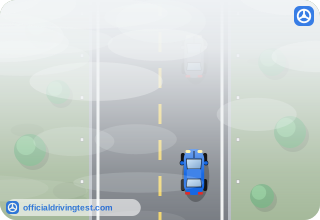
Which headlight setting is best in fog, smoke, dust or rain?
- Low beams
- High beams
- Parking lights only
- Emergency flashers
Show answer
Correct answer: Low beams
The handbook says low beams are best when vision is reduced, and to make sure the headlights are on low beams when you first turn them on.
Source: Idaho Driver's Handbook (July 2026), page 110 · Open this page in the manual (Manual page 110)
-
Why should you avoid using your emergency flashers while your vehicle is moving in bad weather?
- The flashers hide your headlights
- The flashers make the vehicle harder to steer
- The flashers cancel your brake lights
- Other drivers may think you have stopped
Show answer
Correct answer: Other drivers may think you have stopped
The handbook says other drivers may think you have stopped when your emergency flashers are on while you move.
Source: Idaho Driver's Handbook (July 2026), page 111 · Open this page in the manual (Manual page 111)
-
Which part of your vehicle is especially important for winter driving?

- The radio
- The odometer
- The windshield wipers
- The cruise control
Show answer
Correct answer: The windshield wipers
The handbook lists the lights, tires, brakes, windshield wipers, defroster and radiator as especially important for winter driving.
Source: Idaho Driver's Handbook (July 2026), page 113 · Open this page in the manual (Manual page 113)
-
What should you do about frosted windows before a short winter trip?
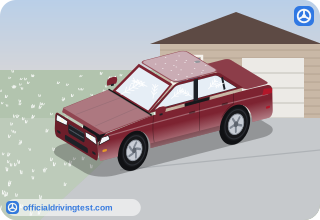
- Clear only a small spot on the windshield
- Do not start driving until the windows are defrosted and clean
- Start driving at once and let the defroster clear them as you go
- Clear only the driver side window
Show answer
Correct answer: Do not start driving until the windows are defrosted and clean
The handbook says not to start driving until the windows are defrosted and clean, even for a short distance.
Source: Idaho Driver's Handbook (July 2026), page 113 · Open this page in the manual (Manual page 113)
-
What should the windshield washer reservoir hold all winter?
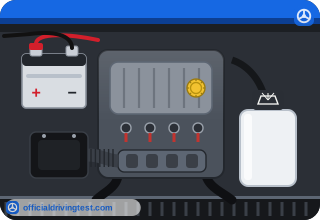
- Plain water only
- Nothing, so that it cannot freeze
- Water mixed with road salt
- A non-freezing solution
Show answer
Correct answer: A non-freezing solution
The handbook says to keep the reservoir filled with a non-freezing solution all winter.
Source: Idaho Driver's Handbook (July 2026), page 113 · Open this page in the manual (Manual page 113)