Idaho: Signals and vehicle controls — Part 1 Practice Test
Questions in this part include: “What is the minimum tire tread depth the examiner requires on the skills test vehicle?” · “How many separate brake systems must every vehicle have?”
Independent educational site · not affiliated with any government agency or DMV
Ready? Test yourself
- Instant feedback with an explanation
- Every answer cites its source in the manual
- Your best score is saved on this device
Questions are original and based on the official manual "Idaho Driver's Handbook" (July 2026), Idaho Transportation Department.
All 20 questions in this practice test
Take the test above first, then use this list to study. Tap “Show answer” to see the correct answer and explanation.
Show the questions and answersHide the questions
-
What is the minimum tire tread depth the examiner requires on the skills test vehicle?
- At least 4/32 of an inch
- At least 6/32 of an inch
- At least 1/32 of an inch
- At least 2/32 of an inch
Show answer
Correct answer: At least 2/32 of an inch
Tires must have at least 2/32 of an inch or more of tread.
Source: Idaho Driver's Handbook (July 2026), page 36 · Open this page in the manual (Manual page 36)
-
During which dates are studded tires not allowed on the vehicle used for the skills test?
- May 1 to September 30
- April 1 to October 31
- June 1 to August 31
- May 1 to October 31
Show answer
Correct answer: May 1 to September 30
Studded tires are not allowed May 1 to September 30.
Source: Idaho Driver's Handbook (July 2026), page 36 · Open this page in the manual (Manual page 36)
-
Which mirrors does the examiner’s vehicle inspection require at a minimum?
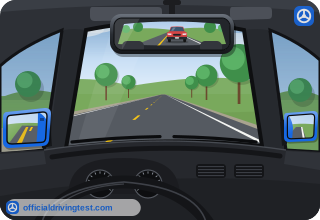
- Only the left side mirror
- Only the right side mirror
- The rear-view mirror or both side mirrors
- Both side mirrors and a rear-view mirror are all required
Show answer
Correct answer: The rear-view mirror or both side mirrors
The inspection accepts the rear-view or both side mirrors.
Source: Idaho Driver's Handbook (July 2026), page 36 · Open this page in the manual (Manual page 36)
-
What must be true of the windshield on the skills test vehicle?
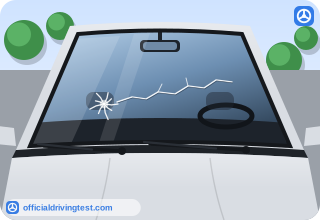
- It has a tinted strip across the top
- It has no cracks or obstructions
- It has a clean sticker from the county office
- It is free of cracks, but obstructions are allowed
Show answer
Correct answer: It has no cracks or obstructions
The examiner checks the windshield for cracks and obstructions.
Source: Idaho Driver's Handbook (July 2026), page 36 · Open this page in the manual (Manual page 36)
-
What must be true of the dashboard gauges and lights on the skills test vehicle?
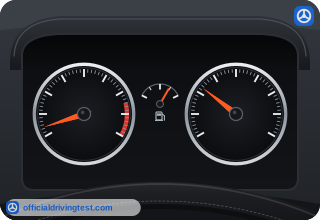
- The gauges are all working and the lights are lit
- The oil light may be illuminated
- The odometer reads under 100,000 miles
- No critical lights or gauges are illuminated
Show answer
Correct answer: No critical lights or gauges are illuminated
The inspection requires that no critical lights or gauges are illuminated.
Source: Idaho Driver's Handbook (July 2026), page 36 · Open this page in the manual (Manual page 36)
-
Which of these must you be able to locate or demonstrate as working properly to the skills test examiner?
- The cruise control
- The air conditioning
- The defroster/defogger
- The heated seats
Show answer
Correct answer: The defroster/defogger
The list includes the defroster/defogger.
Source: Idaho Driver's Handbook (July 2026), page 36 · Open this page in the manual (Manual page 36)
-
How many arm signals must you be able to demonstrate to the skills test examiner?
- Only left turn
- All three
- Only the stop signal
- Two, as chosen by the examiner
Show answer
Correct answer: All three
You must properly demonstrate all three arm signals.
Source: Idaho Driver's Handbook (July 2026), page 36 · Open this page in the manual (Manual page 36)
-
What does Idaho law say about driving a vehicle that is mechanically unsafe?
- You may drive it only in daylight
- You may drive it with a repair estimate
- You may not drive it
- You may drive it on county roads only
Show answer
Correct answer: You may not drive it
Idaho law does not allow you to drive a mechanically unsafe vehicle.
Source: Idaho Driver's Handbook (July 2026), page 38 · Open this page in the manual (Manual page 38)
-
Who is responsible for correcting a vehicle that needs repairs, lacks vital equipment, or presents some other danger?
- The county sheriff's office
- You, the person driving it
- The Idaho Transportation Department
- The company that insures it
Show answer
Correct answer: You, the person driving it
The handbook says that if your vehicle needs repairs, lacks vital equipment, or is dangerous, you are responsible for correcting the problem.
Source: Idaho Driver's Handbook (July 2026), page 38 · Open this page in the manual (Manual page 38)
-
What does Idaho require regarding annual vehicle safety inspections?
- An annual inspection is required for every vehicle
- An inspection is required only for vehicles over ten years old
- An inspection is required only when you renew your license
- None is required, but an officer may cite an unsafe vehicle
Show answer
Correct answer: None is required, but an officer may cite an unsafe vehicle
Idaho does not require an annual safety inspection, but an officer who stops an unsafe vehicle or one lacking proper equipment may issue a citation.
Source: Idaho Driver's Handbook (July 2026), page 38 · Open this page in the manual (Manual page 38)
-
How many separate brake systems must every vehicle have?
- One, with a backup warning light
- Two, but only on heavy vehicles
- Two, each backing up the other
- Three, including a trailer brake
Show answer
Correct answer: Two, each backing up the other
All vehicles must have two brake systems designed so that if one fails the other still works.
Source: Idaho Driver's Handbook (July 2026), page 38 · Open this page in the manual (Manual page 38)
-
Foot brakes must be able to stop a vehicle traveling 20 miles per hour on dry pavement within what distance?
- 25 feet
- 15 feet
- 55 feet
- 100 feet
Show answer
Correct answer: 25 feet
Foot brakes must stop a vehicle traveling 20 miles per hour on dry pavement within 25 feet.
Source: Idaho Driver's Handbook (July 2026), page 38 · Open this page in the manual (Manual page 38)
-
The emergency or parking brake must be able to stop a vehicle within what distance under the same conditions as the foot brakes?
- 25 feet
- 100 feet
- 150 feet
- 55 feet
Show answer
Correct answer: 55 feet
The emergency or parking brake must stop the vehicle within 55 feet under similar conditions.
Source: Idaho Driver's Handbook (July 2026), page 38 · Open this page in the manual (Manual page 38)
-
Besides being able to stop the vehicle, what else must the emergency or parking brake be able to do?
- Release automatically when the engine starts
- Hold the vehicle stationary on a hill when parked
- Operate the brake lights while parked
- Stop the vehicle faster than the foot brakes
Show answer
Correct answer: Hold the vehicle stationary on a hill when parked
The parking brake must be able to hold the car stationary on a hill when parked.
Source: Idaho Driver's Handbook (July 2026), page 38 · Open this page in the manual (Manual page 38)
-
How many headlamps must a vehicle have, and what must each provide?
- Two, with high and low beams
- Two, with a low beam only
- One, with high and low beams
- Four, with fog and driving beams
Show answer
Correct answer: Two, with high and low beams
Two headlamps with high and low beams are required.
Source: Idaho Driver's Handbook (July 2026), page 38 · Open this page in the manual (Manual page 38)
-
High beams must allow the driver to see people and vehicles at least how far away?
- 100 feet
- 200 feet
- 350 feet
- 500 feet
Show answer
Correct answer: 350 feet
High beams must let the driver see people and vehicles at least 350 feet away.
Source: Idaho Driver's Handbook (July 2026), page 38 · Open this page in the manual (Manual page 38)
-
Low beams must light the roadway at least how far ahead?
- 50 feet
- 100 feet
- 200 feet
- 350 feet
Show answer
Correct answer: 100 feet
Low beams must light the roadway at least 100 feet ahead.
Source: Idaho Driver's Handbook (July 2026), page 38 · Open this page in the manual (Manual page 38)
-
How must headlamps be aimed?
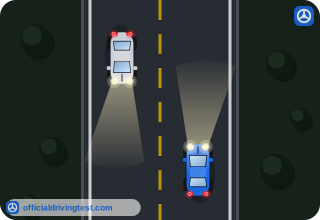
- Slightly upward to show overhead road signs
- Toward the shoulder of the road at all times
- Straight at the back of the vehicle ahead
- To light the road without blinding oncoming drivers
Show answer
Correct answer: To light the road without blinding oncoming drivers
Headlamps must be aimed to light the road without blinding oncoming drivers.
Source: Idaho Driver's Handbook (July 2026), page 38 · Open this page in the manual (Manual page 38)
-
Brake lights must be visible for at least how far to the rear in normal sunlight?
- 50 feet
- 200 feet
- 100 feet
- 500 feet
Show answer
Correct answer: 100 feet
Functioning brake lights must be visible for at least 100 feet to the rear in normal sunlight.
Source: Idaho Driver's Handbook (July 2026), page 39 · Open this page in the manual (Manual page 39)
-
What colors may a motor vehicle's brake lights be?
- Red or amber
- Red or white
- Amber or white
- Red only
Show answer
Correct answer: Red or amber
All motor vehicles must have functioning red or amber brake lights.
Source: Idaho Driver's Handbook (July 2026), page 39 · Open this page in the manual (Manual page 39)