Idaho: Signals and vehicle controls — Part 5 Practice Test
Questions in this part include: “In the five-step procedure, what do you do right after signaling?” · “In the five-step procedure, how should you make your move once it is safe to do so?”
Independent educational site · not affiliated with any government agency or DMV
Ready? Test yourself
- Instant feedback with an explanation
- Every answer cites its source in the manual
- Your best score is saved on this device
Questions are original and based on the official manual "Idaho Driver's Handbook" (July 2026), Idaho Transportation Department.
All 19 questions in this practice test
Take the test above first, then use this list to study. Tap “Show answer” to see the correct answer and explanation.
Show the questions and answersHide the questions
-
In the five-step procedure, what do you do right after signaling?
- Make your move quickly
- Glance over your shoulder
- Cancel the turn signal
- Check the mirrors again
Show answer
Correct answer: Glance over your shoulder
Step 3 after signaling is to glance over your shoulder in the direction you are going to move.
Source: Idaho Driver's Handbook (July 2026), page 87 · Open this page in the manual (Manual page 87)
-
What is the last of the five steps when starting from the curb, pulling into a parking space or changing lanes?
- Check mirrors
- Signal for five seconds
- Cancel the turn signal
- Glance over your shoulder
Show answer
Correct answer: Cancel the turn signal
The fifth and final step is to cancel the turn signal after making your move.
Source: Idaho Driver's Handbook (July 2026), page 87 · Open this page in the manual (Manual page 87)
-
In the five-step procedure, how should you make your move once it is safe to do so?
- Gradually and smoothly
- As fast as you can
- With a quick burst of speed
- Suddenly, without slowing down first
Show answer
Correct answer: Gradually and smoothly
Step 4 says to make your move gradually and smoothly when it is safe.
Source: Idaho Driver's Handbook (July 2026), page 87 · Open this page in the manual (Manual page 87)
-
To be ready to react promptly to emergencies, where should your hands be placed on the steering wheel?
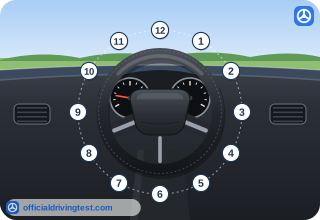
- Both hands side by side at the top of the steering wheel
- Both hands on opposite sides, at about nine o'clock and three o'clock
- One hand at the bottom and the other hand on the gear shift
- Both hands at the six o'clock position of the wheel
Show answer
Correct answer: Both hands on opposite sides, at about nine o'clock and three o'clock
The manual says to drive with both hands on opposite sides of the wheel at approximately nine o’clock and three o’clock.
Source: Idaho Driver's Handbook (July 2026), page 89 · Open this page in the manual (Manual page 89)
-
If your vehicle is equipped with airbags, where should you check for proper hand placement?
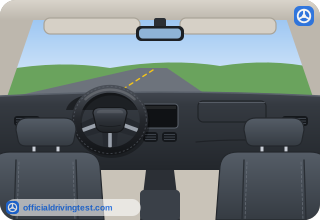
- The traffic signs along the road
- Your owner's manual
- A passenger's opinion
- The sticker on the rear window
Show answer
Correct answer: Your owner's manual
The manual says to check your owner’s manual for proper hand placement if the vehicle has airbags.
Source: Idaho Driver's Handbook (July 2026), page 89 · Open this page in the manual (Manual page 89)
-
Before you make any move to the side, what should you do besides using your mirrors?

- Sound your horn twice before moving over
- Slow down to a stop before you move over
- Quickly turn your head to check the blind spot
- Flash your headlights at the traffic beside you
Show answer
Correct answer: Quickly turn your head to check the blind spot
The manual says never to rely on mirrors alone and to quickly turn your head to check the blind spot.
Source: Idaho Driver's Handbook (July 2026), page 90 · Open this page in the manual (Manual page 90)
-
When should you sound your horn while driving in the mountains?
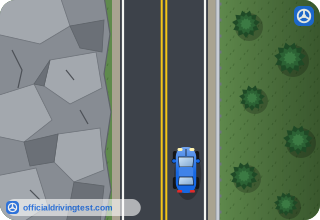
- At every curve on a wide road, whatever the view ahead may be
- Only when you can already see the headlights of an oncoming vehicle
- When approaching any curve on a narrow road where the view is obstructed
- Whenever you start going down a long hill or up a steep one
Show answer
Correct answer: When approaching any curve on a narrow road where the view is obstructed
The manual says to sound the horn when approaching any curve on a narrow road where the view is obstructed.
Source: Idaho Driver's Handbook (July 2026), page 107 · Open this page in the manual (Manual page 107)
-
Between what times should you turn on your headlights, not just your parking lights?
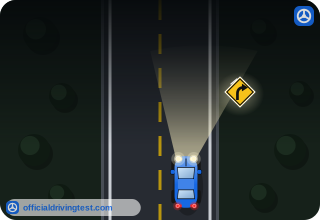
- Between sunset and sunrise
- Between 9 p.m. and 5 a.m.
- Only when the sky is completely dark
- Only when you see other vehicles using their lights
Show answer
Correct answer: Between sunset and sunrise
The manual says to turn on your headlights, not just your parking lights, when driving between sunset and sunrise.
Source: Idaho Driver's Handbook (July 2026), page 109 · Open this page in the manual (Manual page 109)
-
What does the manual say about wearing sunglasses when light levels are low?
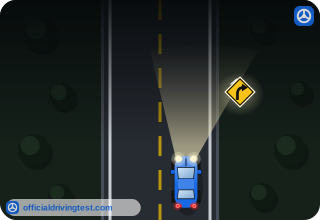
- Never wear them
- Wear them only on lighted roads
- Wear them only when you drive slowly
- Wear them to cut the glare of oncoming headlights
Show answer
Correct answer: Never wear them
The manual says never to wear sunglasses when light levels are low.
Source: Idaho Driver's Handbook (July 2026), page 109 · Open this page in the manual (Manual page 109)
-
How should you keep your windshield for night driving?
- Clean on the outside only
- Covered with an anti-glare film
- Clean, both inside and out
- Clean on the inside only
Show answer
Correct answer: Clean, both inside and out
The manual says to keep your windshield clean, both inside and out, to make night driving safer.
Source: Idaho Driver's Handbook (July 2026), page 109 · Open this page in the manual (Manual page 109)
-
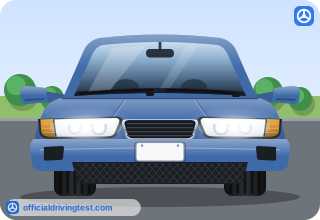
What does dirt on your headlights do?
- It makes the light shine farther ahead
- It dims their light and may distort the beam
- It reduces glare for oncoming drivers
- It has no effect when you use the low beams
Show answer
Correct answer: It dims their light and may distort the beam
The manual says dirt will dim the light of your headlights and may distort the beam.
Source: Idaho Driver's Handbook (July 2026), page 109 · Open this page in the manual (Manual page 109)
-
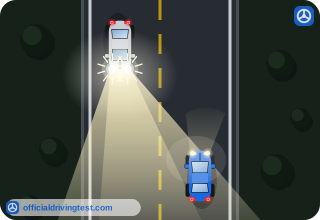
To avoid the glare of an oncoming vehicle's headlights, where should you look?
- Shift your eyes up to the upper left side of your lane
- Look at the center line until the vehicle has passed
- Look directly into the headlights to judge their distance
- Shift your eyes down to the lower right side of your traffic lane
Show answer
Correct answer: Shift your eyes down to the lower right side of your traffic lane
The manual says to avoid looking into oncoming headlights and to shift your eyes to the lower right side of your lane.
Source: Idaho Driver's Handbook (July 2026), page 109 · Open this page in the manual (Manual page 109)
-
When should you dim your headlights to low beam?
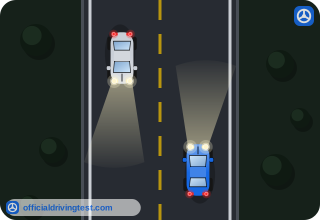
- When approaching or following another vehicle, or on lighted roads
- Only when an oncoming driver flashes their lights at you
- Only when it is raining or snowing at the time of driving
- Only when you are traveling below 35 miles per hour
Show answer
Correct answer: When approaching or following another vehicle, or on lighted roads
The manual says to dim your headlights to low beam when approaching or following another vehicle or on lighted roads.
Source: Idaho Driver's Handbook (July 2026), page 109 · Open this page in the manual (Manual page 109)
-
In the daytime, headlights are required when vision is reduced to about what distance?

- 1,000 feet
- 500 feet
- 2,000 feet
- 1,500 feet
Show answer
Correct answer: 500 feet
You are required to turn on your headlights in the daytime when vision is reduced to about 500 feet.
Source: Idaho Driver's Handbook (July 2026), page 110 · Open this page in the manual (Manual page 110)
-
Which headlight setting is best in fog, smoke, dust or rain?

- Low beams
- High beams
- Parking lights only
- Emergency flashers
Show answer
Correct answer: Low beams
The handbook says low beams are best when vision is reduced, and to make sure the headlights are on low beams when you first turn them on.
Source: Idaho Driver's Handbook (July 2026), page 110 · Open this page in the manual (Manual page 110)
-
Why should you avoid using your emergency flashers while your vehicle is moving in bad weather?

- The flashers hide your headlights
- The flashers make the vehicle harder to steer
- The flashers cancel your brake lights
- Other drivers may think you have stopped
Show answer
Correct answer: Other drivers may think you have stopped
The handbook says other drivers may think you have stopped when your emergency flashers are on while you move.
Source: Idaho Driver's Handbook (July 2026), page 111 · Open this page in the manual (Manual page 111)
-
Which part of your vehicle is especially important for winter driving?

- The radio
- The odometer
- The windshield wipers
- The cruise control
Show answer
Correct answer: The windshield wipers
The handbook lists the lights, tires, brakes, windshield wipers, defroster and radiator as especially important for winter driving.
Source: Idaho Driver's Handbook (July 2026), page 113 · Open this page in the manual (Manual page 113)
-
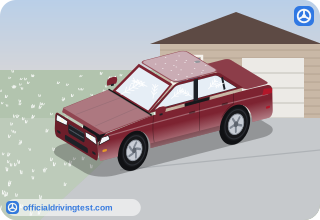
What should you do about frosted windows before a short winter trip?
- Clear only a small spot on the windshield
- Do not start driving until the windows are defrosted and clean
- Start driving at once and let the defroster clear them as you go
- Clear only the driver side window
Show answer
Correct answer: Do not start driving until the windows are defrosted and clean
The handbook says not to start driving until the windows are defrosted and clean, even for a short distance.
Source: Idaho Driver's Handbook (July 2026), page 113 · Open this page in the manual (Manual page 113)
-
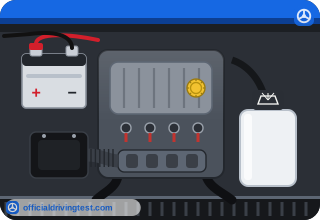
What should the windshield washer reservoir hold all winter?
- Plain water only
- Nothing, so that it cannot freeze
- Water mixed with road salt
- A non-freezing solution
Show answer
Correct answer: A non-freezing solution
The handbook says to keep the reservoir filled with a non-freezing solution all winter.
Source: Idaho Driver's Handbook (July 2026), page 113 · Open this page in the manual (Manual page 113)