Idaho: Signals and vehicle controls — Part 4 Practice Test
Questions in this part include: “At night, what replaces the red flag on a load that extends four feet or more beyond the rear?” · “Proper signaling may help prevent which type of collision?”
Independent educational site · not affiliated with any government agency or DMV
Ready? Test yourself
- Instant feedback with an explanation
- Every answer cites its source in the manual
- Your best score is saved on this device
Questions are original and based on the official manual "Idaho Driver's Handbook" (July 2026), Idaho Transportation Department.
All 19 questions in this practice test
Take the test above first, then use this list to study. Tap “Show answer” to see the correct answer and explanation.
Show the questions and answersHide the questions
-
At night, what replaces the red flag on a load that extends four feet or more beyond the rear?
- A white light visible for 200 feet
- A red reflector on the end
- A red light visible for 500 feet
- A second, larger red flag
Show answer
Correct answer: A red light visible for 500 feet
At night, the flag must be replaced by a red light visible for at least 500 feet.
Source: Idaho Driver's Handbook (July 2026), page 43 · Open this page in the manual (Manual page 43)
-
How far may a vehicle's load extend outside the fenders on the left side?
- Not at all
- Up to 3 inches
- Up to 6 inches
- Up to 12 inches
Show answer
Correct answer: Not at all
The load must not extend outside the fenders on the left side.
Source: Idaho Driver's Handbook (July 2026), page 43 · Open this page in the manual (Manual page 43)
-
How far may a vehicle's load extend outside the fenders on the right side?
- Not at all
- No more than 12 inches
- No more than 18 inches
- No more than six inches
Show answer
Correct answer: No more than six inches
The load must not extend more than six inches outside the fenders on the right.
Source: Idaho Driver's Handbook (July 2026), page 43 · Open this page in the manual (Manual page 43)
-
How do equipment requirements for antique vehicles and street rods compare with those for regular passenger vehicles?
- They are exactly the same as for cars
- They are waived for all of them
- They may vary from the regular requirements
- They apply only to brakes and lights
Show answer
Correct answer: They may vary from the regular requirements
Equipment requirements for antique vehicles and street rods may vary from the requirements for regular passenger vehicles.
Source: Idaho Driver's Handbook (July 2026), page 43 · Open this page in the manual (Manual page 43)
-
When you slow down or stop, how may you give the required signal to other drivers?
- Only by flashing your headlights
- With brake lights or an arm signal
- Only with your left turn signal
- No signal is needed to slow down
Show answer
Correct answer: With brake lights or an arm signal
When slowing down or stopping, you must give a signal to other drivers, using either the brake-operated signal lights on the rear of your vehicle or an arm signal.
Source: Idaho Driver's Handbook (July 2026), page 71 · Open this page in the manual (Manual page 71)
-
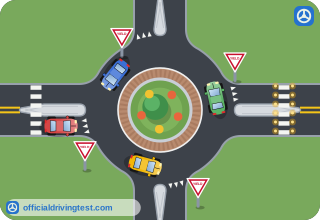
Must you use your turn signal when you exit a roundabout?
- No, never
- Yes, always
- Only in a multi-lane roundabout
- Only when a car is behind you
Show answer
Correct answer: Yes, always
The handbook lists exiting a roundabout among the times you must always use a turn signal.
Source: Idaho Driver's Handbook (July 2026), page 72 · Open this page in the manual (Manual page 72)
-
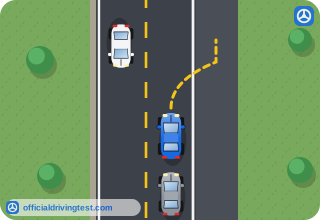
You are pulling over to the side of the road. What does the handbook say about your turn signal?
- Use it only if a vehicle is close behind
- Use it only on freeways and highways
- It is not needed when leaving traffic
- Always use it
Show answer
Correct answer: Always use it
The handbook lists pulling over to the side of the road among the times you must always use a turn signal.
Source: Idaho Driver's Handbook (July 2026), page 72 · Open this page in the manual (Manual page 72)
-
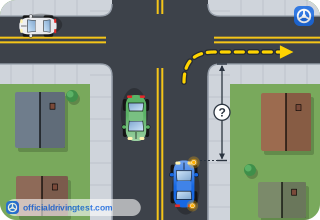
In business or residential areas, how far before you turn or change lanes must your signal start?
- At least 100 feet
- At least 25 feet
- At least 50 feet
- At least 300 feet
Show answer
Correct answer: At least 100 feet
Signals must start at least 100 feet in business or residential areas before you turn or change lanes.
Source: Idaho Driver's Handbook (July 2026), page 72 · Open this page in the manual (Manual page 72)
-
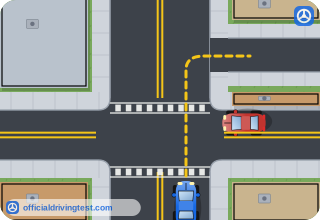
You plan to turn just beyond an intersection. When should you signal?
- Before you enter the intersection
- Just after you pass through the intersection
- While you are in the middle of the intersection
- Only once you have started the turn
Show answer
Correct answer: Just after you pass through the intersection
If you plan to turn just beyond an intersection, signal just after you pass through the intersection so you won't confuse other drivers.
Source: Idaho Driver's Handbook (July 2026), page 72 · Open this page in the manual (Manual page 72)
-
Proper signaling may help prevent which type of collision?
- A collision with a train
- A rollover crash
- A collision with a deer
- A rear-end collision
Show answer
Correct answer: A rear-end collision
The handbook states that proper signaling may prevent a rear-end collision.
Source: Idaho Driver's Handbook (July 2026), page 72 · Open this page in the manual (Manual page 72)
-
A driver's arm and hand are extended straight out the window. What does this arm signal mean?
- Left turn
- Right turn
- Slow or stop
- Go ahead and pass
Show answer
Correct answer: Left turn
The correct arm signal for a left turn is your arm and hand extended straight out the window.
Source: Idaho Driver's Handbook (July 2026), page 72 · Open this page in the manual (Manual page 72)
-
A driver's arm and hand are extended upward out the window. What does this arm signal mean?
- Left turn
- Slow or stop
- Right turn
- Go ahead and pass
Show answer
Correct answer: Right turn
The correct arm signal for a right turn is your arm and hand extended upward out the window.
Source: Idaho Driver's Handbook (July 2026), page 72 · Open this page in the manual (Manual page 72)
-
Which arm signal tells other drivers you are slowing or stopping?
- Arm and hand extended upward
- Arm and hand extended downward
- Arm and hand extended straight out
- Arm waved back and forth
Show answer
Correct answer: Arm and hand extended downward
The correct arm signal to slow or stop is your arm and hand extended downward out the window.
Source: Idaho Driver's Handbook (July 2026), page 72 · Open this page in the manual (Manual page 72)
-
What should you do before you get into your vehicle?
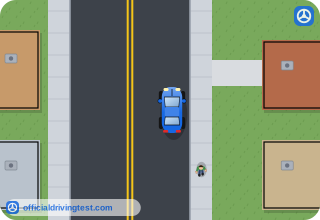
- Turn on the engine to let it warm up for a minute
- Release the parking brake and shift to the proper gear
- Adjust the radio station and your phone settings
- Look in front and back of it for a child or obstacle
Show answer
Correct answer: Look in front and back of it for a child or obstacle
The manual says to always look in front and back of the vehicle for a child or obstacle before getting in.
Source: Idaho Driver's Handbook (July 2026), page 87 · Open this page in the manual (Manual page 87)
-
In the manual's routine for starting your car, what do you do with the hand brake set?
- Shift into first gear, release the hand brake and start the engine
- Ensure the vehicle is in park or neutral and start the engine
- Release the hand brake, put the car in drive and start the engine
- Shift into reverse, turn on the lights and release the brake
Show answer
Correct answer: Ensure the vehicle is in park or neutral and start the engine
With the hand brake set, you ensure the vehicle is in park or neutral and start the engine.
Source: Idaho Driver's Handbook (July 2026), page 87 · Open this page in the manual (Manual page 87)
-
While holding the foot brake (and clutch if you have one) and after shifting to the proper gear, what is the next step in the starting routine?
- Turn off the engine and restart it
- Press the accelerator and then set the parking brake
- Set the parking brake and check the mirrors again
- Release the parking brake and prepare to pull out
Show answer
Correct answer: Release the parking brake and prepare to pull out
The manual says to shift to the proper gear, then release the parking brake and prepare to pull out.
Source: Idaho Driver's Handbook (July 2026), page 87 · Open this page in the manual (Manual page 87)
-
The five-step procedure applies when you do which of the following?
- Start from the curb, pull into a parking space or change lanes
- Slow down on a straight road when no other traffic is near
- Stop at a red light or at a stop sign at an intersection
- Drive through a roundabout or around a curve on a highway
Show answer
Correct answer: Start from the curb, pull into a parking space or change lanes
The five-step procedure is for starting from the curb, pulling into a parking space or changing lanes.
Source: Idaho Driver's Handbook (July 2026), page 87 · Open this page in the manual (Manual page 87)
-
What is the first step of the five-step procedure for starting from the curb, pulling into a parking space or changing lanes?
- Signal
- Glance over your shoulder
- Check mirrors
- Cancel the turn signal
Show answer
Correct answer: Check mirrors
Step 1 of the five-step procedure is to check your mirrors.
Source: Idaho Driver's Handbook (July 2026), page 87 · Open this page in the manual (Manual page 87)
-
In the five-step procedure, how far or how long before moving your vehicle must you signal?
- Two seconds or 25 feet
- Three seconds or 50 feet
- Ten seconds or 200 feet
- Five seconds or 100 feet
Show answer
Correct answer: Five seconds or 100 feet
The procedure calls for signaling for the required five seconds or 100 feet before moving.
Source: Idaho Driver's Handbook (July 2026), page 87 · Open this page in the manual (Manual page 87)