Idaho: Signals and vehicle controls — Part 3 Practice Test
Questions in this part include: “Who are red or blue emergency lights authorized for?” · “Why does the Idaho Transportation Department sometimes adjust the dates for studded snow tires?”
Independent educational site · not affiliated with any government agency or DMV
Ready? Test yourself
- Instant feedback with an explanation
- Every answer cites its source in the manual
- Your best score is saved on this device
Questions are original and based on the official manual "Idaho Driver's Handbook" (July 2026), Idaho Transportation Department.
All 20 questions in this practice test
Take the test above first, then use this list to study. Tap “Show answer” to see the correct answer and explanation.
Show the questions and answersHide the questions
-
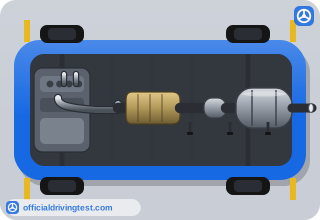
What must a motor vehicle's muffler do?
- Be as loud as the engine allows for
- Be in good working order and quiet
- Be removed when driving off-road
- Be replaced once every year or so
Show answer
Correct answer: Be in good working order and quiet
A muffler must be in good working order and prevent loud or unusual noise.
Source: Idaho Driver's Handbook (July 2026), page 40 · Open this page in the manual (Manual page 40)
-
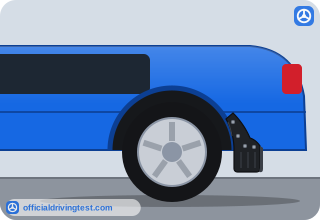
What are fenders, wheel covers, or flaps required to prevent?
- Tires from wearing unevenly over time
- Wheels from locking up in the snow
- Rust from forming on the vehicle body
- Mud or water thrown onto other vehicles
Show answer
Correct answer: Mud or water thrown onto other vehicles
Fenders, wheel covers or flaps prevent mud, water or other material from being thrown from the wheels up onto other vehicles.
Source: Idaho Driver's Handbook (July 2026), page 40 · Open this page in the manual (Manual page 40)
-
Who are red or blue emergency lights authorized for?
- Tow trucks and delivery vans
- Emergency vehicles only
- Any vehicle in poor weather
- Highway maintenance vehicles only
Show answer
Correct answer: Emergency vehicles only
Red or blue emergency lights are not allowed on regular vehicles because they are authorized for emergency vehicles only.
Source: Idaho Driver's Handbook (July 2026), page 42 · Open this page in the manual (Manual page 42)
-
Which of these is equipment not allowed on a regular vehicle?
- A horn heard 200 feet away
- Two fog lights in front
- Windshield wipers
- A siren
Show answer
Correct answer: A siren
Sirens, bells, and whistles are listed as equipment that is not allowed.
Source: Idaho Driver's Handbook (July 2026), page 42 · Open this page in the manual (Manual page 42)
-
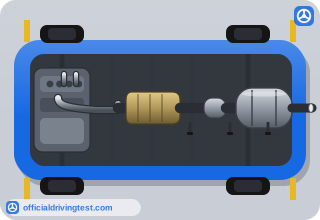
What kind of muffler modification is not allowed?
- A muffler fitted with a heat shield
- A muffler replaced with a new one
- A cut-out or bypass that adds noise
- A muffler in good working order
Show answer
Correct answer: A cut-out or bypass that adds noise
Any muffler cut-out or bypass that makes the exhaust system amplify or increase noise is not allowed.
Source: Idaho Driver's Handbook (July 2026), page 42 · Open this page in the manual (Manual page 42)
-
A vehicle may have no more than how many spotlights?
- Two
- One
- Three
- Four
Show answer
Correct answer: Two
More than two spotlights are not allowed.
Source: Idaho Driver's Handbook (July 2026), page 42 · Open this page in the manual (Manual page 42)
-
A vehicle may have no more than how many auxiliary lights in front?
- One
- Three
- Four
- Two
Show answer
Correct answer: Two
More than two auxiliary lights in front are not allowed.
Source: Idaho Driver's Handbook (July 2026), page 42 · Open this page in the manual (Manual page 42)
-
A vehicle may have no more than how many fog lights in front?
- One
- Two
- Three
- Four
Show answer
Correct answer: Two
More than two fog lights in front are not allowed.
Source: Idaho Driver's Handbook (July 2026), page 42 · Open this page in the manual (Manual page 42)
-
A vehicle may have no more than how many cowl or fender lights?
- Two
- One
- Three
- Four
Show answer
Correct answer: Two
More than two cowl or fender lights are not allowed.
Source: Idaho Driver's Handbook (July 2026), page 42 · Open this page in the manual (Manual page 42)
-
Studded snow tires may be used only during which dates?
- September 1 to March 31
- November 1 to May 31
- October 1 to April 30
- October 15 to April 15
Show answer
Correct answer: October 1 to April 30
Studded snow tires may be used only from October 1 to April 30.
Source: Idaho Driver's Handbook (July 2026), page 42 · Open this page in the manual (Manual page 42)
-
Why does the Idaho Transportation Department sometimes adjust the dates for studded snow tires?
- Because of road construction
- Because of weather conditions
- Because of changes in federal law
- Because of tire supply shortages
Show answer
Correct answer: Because of weather conditions
The department adjusts the dates in some years due to weather conditions.
Source: Idaho Driver's Handbook (July 2026), page 42 · Open this page in the manual (Manual page 42)
-
During which hours must headlamps and tail lamps be lighted, besides when poor visibility makes them necessary?
- From one hour after sunset to sunrise
- From 8 p.m. to 6 a.m.
- From dusk until midnight
- From sunset to sunrise
Show answer
Correct answer: From sunset to sunrise
Headlamps and tail lamps must be lighted from sunset to sunrise and when poor visibility makes them necessary for safety.
Source: Idaho Driver's Handbook (July 2026), page 43 · Open this page in the manual (Manual page 43)
-
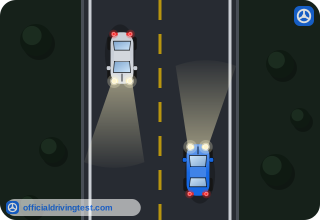
How far before meeting another vehicle must headlamps be dimmed?
- 100 feet
- 300 feet
- 500 feet
- 1,000 feet
Show answer
Correct answer: 500 feet
Headlamps must be dimmed 500 feet before meeting another vehicle.
Source: Idaho Driver's Handbook (July 2026), page 43 · Open this page in the manual (Manual page 43)
-
How far before overtaking another vehicle must headlamps be dimmed?
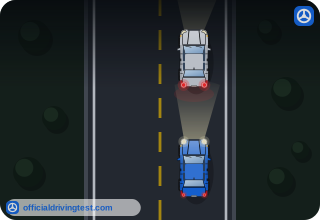
- 200 feet
- 50 feet
- 100 feet
- 300 feet
Show answer
Correct answer: 200 feet
Headlamps must be dimmed 200 feet before overtaking another vehicle.
Source: Idaho Driver's Handbook (July 2026), page 43 · Open this page in the manual (Manual page 43)
-
When lights are needed for driving, which should you use?
- Parking lights only
- Parking lights and fog lights
- Emergency flashers
- Headlamps, not parking lights
Show answer
Correct answer: Headlamps, not parking lights
When lights are needed for driving, use headlamps, not parking lights.
Source: Idaho Driver's Handbook (July 2026), page 43 · Open this page in the manual (Manual page 43)
-
What must you do before driving to ensure maximum visibility in all directions?
- Warm up the engine for five minutes
- Clean ice, snow, or dirt from the windows
- Turn on the emergency flashers
- Clear only the front windshield
Show answer
Correct answer: Clean ice, snow, or dirt from the windows
You must clean windows of ice, snow, or dirt before driving to ensure maximum visibility in all directions.
Source: Idaho Driver's Handbook (July 2026), page 43 · Open this page in the manual (Manual page 43)
-
Which signs, posters, and stickers may be on windows and windshields?
- Only those required by law
- Those under 6 inches square
- Those placed in the lower corners
- Only those on the rear window
Show answer
Correct answer: Only those required by law
Windows and windshields must be kept clean of signs, posters, and stickers except those required by law.
Source: Idaho Driver's Handbook (July 2026), page 43 · Open this page in the manual (Manual page 43)
-
What is illegal for passengers or freight to do?
- Weigh more than half the vehicle's weight when loaded
- Shift position slightly when the vehicle turns
- Obstruct the driver's view or interfere with operating it
- Block the view of the rear license plate
Show answer
Correct answer: Obstruct the driver's view or interfere with operating it
It is illegal for passengers or freight to obstruct a driver's view or interfere with the operation of a vehicle.
Source: Idaho Driver's Handbook (July 2026), page 43 · Open this page in the manual (Manual page 43)
-
When a load extends how far beyond the rear of a vehicle must a red flag be displayed at the end of the load?
- One foot or more
- Four feet or more
- Two feet or more
- Six feet or more
Show answer
Correct answer: Four feet or more
A red flag must be displayed when a load extends four feet or more beyond the rear of the vehicle.
Source: Idaho Driver's Handbook (July 2026), page 43 · Open this page in the manual (Manual page 43)
-
What is the minimum size of the red flag displayed on an overhanging load?
- 6 inches square
- 12 inches square
- 24 inches square
- 18 inches square
Show answer
Correct answer: 18 inches square
The red flag must be at least 18 inches square.
Source: Idaho Driver's Handbook (July 2026), page 43 · Open this page in the manual (Manual page 43)