Idaho: Signals and vehicle controls — Part 2 Practice Test
Questions in this part include: “A trailer must have at least how many red lights mounted on the rear?” · “Each tire should have at least how much tread?”
Independent educational site · not affiliated with any government agency or DMV
Ready? Test yourself
- Instant feedback with an explanation
- Every answer cites its source in the manual
- Your best score is saved on this device
Questions are original and based on the official manual "Idaho Driver's Handbook" (July 2026), Idaho Transportation Department.
All 20 questions in this practice test
Take the test above first, then use this list to study. Tap “Show answer” to see the correct answer and explanation.
Show the questions and answersHide the questions
-
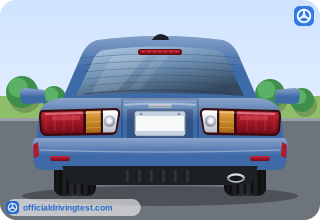
Brake lights must be designed to come on when you do what?
- Take your foot off the accelerator
- Turn on the headlights
- Shift the transmission into reverse
- Apply the foot brake
Show answer
Correct answer: Apply the foot brake
Brake lights must be designed to come on when you apply the foot brake.
Source: Idaho Driver's Handbook (July 2026), page 39 · Open this page in the manual (Manual page 39)
-
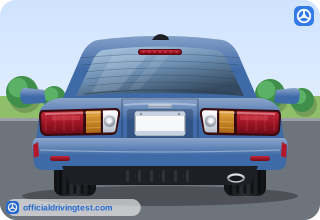
What does the handbook say about brake light lenses?
- Replace them every year
- Keep them clean
- Cover them when parked
- Tint them to reduce glare
Show answer
Correct answer: Keep them clean
The handbook tells drivers to keep the brake light lenses clean.
Source: Idaho Driver's Handbook (July 2026), page 39 · Open this page in the manual (Manual page 39)
-
A trailer must have at least how many red lights mounted on the rear?
- Two, on the left and right rear
- One, in the center of the rear
- Three, including one on top
- None, if it has reflectors
Show answer
Correct answer: Two, on the left and right rear
Trailers and semitrailers must have at least two red lights mounted on the left and right rear.
Source: Idaho Driver's Handbook (July 2026), page 39 · Open this page in the manual (Manual page 39)
-
Which vehicles need only one red light mounted on the rear?
- Motorcycles and all trailers and semitrailers
- All vehicles built before January 1, 1966
- Motorcycles and vehicles built before 1956
- Trailers, semitrailers and vehicles built after 1955
Show answer
Correct answer: Motorcycles and vehicles built before 1956
Vehicles built before January 1, 1956, and motorcycles need at least one red rear light.
Source: Idaho Driver's Handbook (July 2026), page 39 · Open this page in the manual (Manual page 39)
-
Taillights on a vehicle must be visible from how far to the rear?
- 100 feet
- 500 feet
- 200 feet
- 1,000 feet
Show answer
Correct answer: 500 feet
The two red taillights must be visible from 500 feet to the rear.
Source: Idaho Driver's Handbook (July 2026), page 39 · Open this page in the manual (Manual page 39)
-
What type of turn signals must motor vehicles built after January 1, 1955, have?
- Hand-operated signal arms on each side of the vehicle
- Flashing signals on the rear of the vehicle only
- A single steady amber warning light on the dash
- Flashing electric left and right signals, front and rear
Show answer
Correct answer: Flashing electric left and right signals, front and rear
Motor vehicles built after January 1, 1955, must have flashing electric left and right turn signals on the front and rear.
Source: Idaho Driver's Handbook (July 2026), page 39 · Open this page in the manual (Manual page 39)
-
Turn signals must be visible from what distance?
- 25 feet
- 200 feet
- 100 feet
- 500 feet
Show answer
Correct answer: 100 feet
Turn signals must have a driver-controlled switch and be visible from 100 feet.
Source: Idaho Driver's Handbook (July 2026), page 39 · Open this page in the manual (Manual page 39)
-
What color must a vehicle's front turn signals be?
- White or amber
- Red or white
- Red only
- Green or amber
Show answer
Correct answer: White or amber
The front signals must be white or amber.
Source: Idaho Driver's Handbook (July 2026), page 39 · Open this page in the manual (Manual page 39)
-
What color must a vehicle's rear turn signals be?
- White or red
- White only
- Amber or green
- Red or amber
Show answer
Correct answer: Red or amber
The rear signals must be red or amber.
Source: Idaho Driver's Handbook (July 2026), page 39 · Open this page in the manual (Manual page 39)
-
Each tire should have at least how much tread?
- 1/32 of an inch
- 2/32 of an inch
- 4/32 of an inch
- 1/4 of an inch
Show answer
Correct answer: 2/32 of an inch
Each tire should have at least 2/32 inch or more of tread.
Source: Idaho Driver's Handbook (July 2026), page 39 · Open this page in the manual (Manual page 39)
-
A motor vehicle's horn must be able to be heard from at least how far away?
- 200 feet
- 50 feet
- 100 feet
- 500 feet
Show answer
Correct answer: 200 feet
All motor vehicles must have a horn that can be heard at least 200 feet away.
Source: Idaho Driver's Handbook (July 2026), page 39 · Open this page in the manual (Manual page 39)
-
What kind of horn is prohibited?
- One that can be heard from 200 feet away
- One that is mounted near the steering wheel
- One with an unreasonably loud or harsh sound
- One that gives a single short, mild tone
Show answer
Correct answer: One with an unreasonably loud or harsh sound
Horns with unreasonably loud or harsh sounds are prohibited.
Source: Idaho Driver's Handbook (July 2026), page 39 · Open this page in the manual (Manual page 39)
-
What kind of glass must windows and windshields be made of?
- Tempered glass with a tint
- Approved safety glass
- Any clear glass
- Plastic or acrylic panels
Show answer
Correct answer: Approved safety glass
Windows and windshields must be made of approved safety glass.
Source: Idaho Driver's Handbook (July 2026), page 40 · Open this page in the manual (Manual page 40)
-
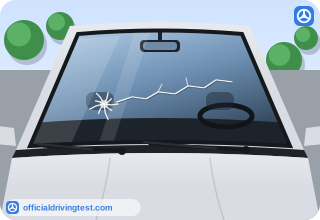
When must a windshield or window be replaced?
- When it has any chip or scratch at all
- When it is more than ten years old
- When someone has put a sticker on it
- When damage blocks the driver's view
Show answer
Correct answer: When damage blocks the driver's view
Glass must be replaced when damage to the glass obstructs the driver's view.
Source: Idaho Driver's Handbook (July 2026), page 40 · Open this page in the manual (Manual page 40)
-
What must you not do to the windows and windshield of your vehicle?
- Wash them with water and a soft cloth
- Keep wipers installed on the windshield
- Treat them with a mirror surface
- Make them from approved safety glass
Show answer
Correct answer: Treat them with a mirror surface
Windows and windshields must not be treated with a mirror surface or other substance that makes them difficult to see through, even from the outside.
Source: Idaho Driver's Handbook (July 2026), page 40 · Open this page in the manual (Manual page 40)
-
Windows and windshields must not be blocked by what?
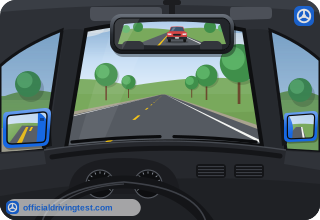
- Any object placed or hung in the vehicle
- Wipers in their rest position
- Only objects hung from the mirror
- The vehicle's required safety glass
Show answer
Correct answer: Any object placed or hung in the vehicle
Windows and windshields must not be blocked by any object placed or hung in the vehicle.
Source: Idaho Driver's Handbook (July 2026), page 40 · Open this page in the manual (Manual page 40)
-
What must all motor vehicles have to keep the windshield clear of rain, snow, or other moisture?
- A windshield visor
- Mud flaps
- Fog lights
- Windshield wipers
Show answer
Correct answer: Windshield wipers
All motor vehicles must be equipped with wipers to keep the windshield clear of rain, snow, or other moisture.
Source: Idaho Driver's Handbook (July 2026), page 40 · Open this page in the manual (Manual page 40)
-
A motor vehicle's rear view mirror must provide a view of the highway for at least how far to the rear?
- 50 feet
- 200 feet
- 100 feet
- 500 feet
Show answer
Correct answer: 200 feet
The rear view mirror must provide a view of the highway for at least 200 feet to the rear.
Source: Idaho Driver's Handbook (July 2026), page 40 · Open this page in the manual (Manual page 40)
-
What must a vehicle have if a load or trailer blocks the driver's normal view through the rear window?
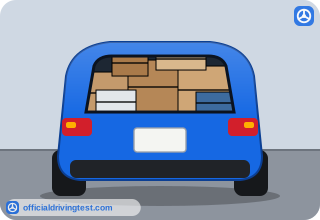
- Two additional mirrors, one on each side
- A single wide mirror on the left side
- A rear camera on the back of it
- A red flag displayed on the load
Show answer
Correct answer: Two additional mirrors, one on each side
If a load or trailer obscures the rear view, the vehicle must have two additional mirrors, one on each side.
Source: Idaho Driver's Handbook (July 2026), page 40 · Open this page in the manual (Manual page 40)
-
What must a vehicle have if it has no rear-view mirror?
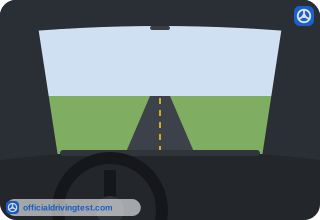
- One left side mirror only
- A convex mirror on the dashboard
- Two side mirrors, left and right
- No mirrors are required at all
Show answer
Correct answer: Two side mirrors, left and right
If no rear-view mirror is present, the vehicle must have 2 side mirrors (1 left, 1 right).
Source: Idaho Driver's Handbook (July 2026), page 40 · Open this page in the manual (Manual page 40)