Hawaii road sign library
Every sign, signal and marking the Hawaii driver manual shows or names, with its meaning in the manual's words and its page.
Independent educational site · not affiliated with any government agency or DMV
Regulatory signs - Hawaii
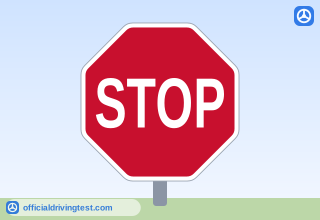
STOP
A STOP SIGN is an 8-sided white on red sign indicating that other traffic has the right-of-way. You must always bring your vehicle to a complete stop and yield to approaching traffic before proceeding. The stop must be made at the “stop line”. If there is no “stop line”, you must stop before crossing any marked or unmarked crosswalk. When you cannot see other traffic from the first stop, move ahead slowly and stop again where you can see approaching traffic.
Manual page 44 · Open this page in the manual (Manual page 44)
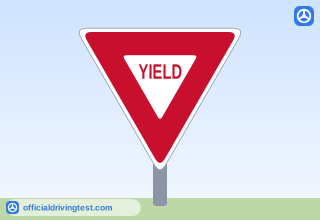
YIELD
A YIELD SIGN is a triangular red and white sign indicating that other traffic has the right-of-way. Be ready to stop when you approach a “YIELD SIGN”. You need to stop only when there is other traffic that has the right-of-way.
Manual page 44 · Open this page in the manual (Manual page 44)
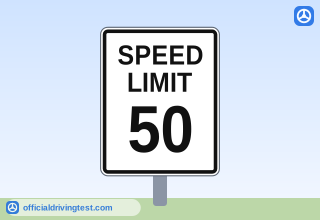
SPEED LIMIT 50
SPEED LIMIT SIGNS are rectangular black and white signs which are used to show the established maximum and minimum speed limits. These signs may indicate special speed limits which apply at certain times, or under certain conditions, or to certain kinds of vehicles. YOU MUST NOT DRIVE FASTER THAN THE POSTED MAXIMUM SPEED LIMIT NOR SLOWER THAN THE POSTED MINIMUM SPEED LIMIT.
Manual page 44 · Open this page in the manual (Manual page 44)
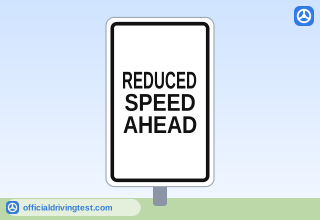
REDUCED SPEED AHEAD
REDUCED SPEED AHEAD SIGNS are the same color and shape as speed limit signs and give you advance notice to slow your vehicle to a lower speed limit posted ahead. These signs inform you that you should begin to reduce your speed. The new speed limit begins at the next speed limit sign.
Manual page 45 · Open this page in the manual (Manual page 45)
See them all (19) · Regulatory signs →
Warning and work zone signs - Hawaii
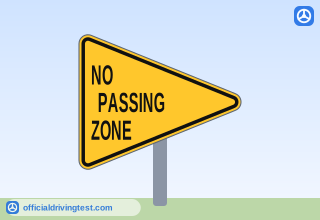
NO PASSING ZONE
NO PASSING ZONE SIGNS are pennant-shaped yellow and black signs that supplement the “Do Not Pass” signs. The pennant is located at the left side of the road and points to the beginning of the no-passing zone.
Manual page 45 · Open this page in the manual (Manual page 45)
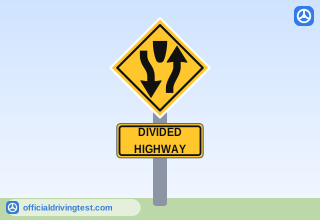
Divided Highway
These signs warn you of dangers that exist or may be found on or near the road. You should be prepared to take safe and proper action when you see these signs. Warning signs are usually diamond-shaped with a black legend and border on a yellow background.
Manual page 47 · Open this page in the manual (Manual page 47)
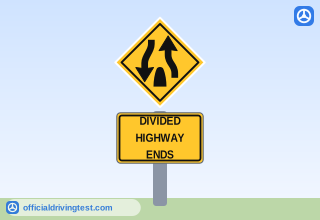
Divided Highway Ends
These signs warn you of dangers that exist or may be found on or near the road. You should be prepared to take safe and proper action when you see these signs. Warning signs are usually diamond-shaped with a black legend and border on a yellow background.
Manual page 47 · Open this page in the manual (Manual page 47)
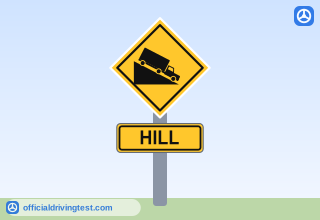
Hill
These signs warn you of dangers that exist or may be found on or near the road. You should be prepared to take safe and proper action when you see these signs. Warning signs are usually diamond-shaped with a black legend and border on a yellow background.
Manual page 47 · Open this page in the manual (Manual page 47)
See them all (28) · Warning and work zone signs →
Guide, railroad and other signs - Hawaii
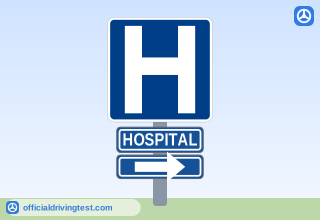
HOSPITAL
These signs include all signs containing information for you regarding your location and the location of places and services. Typical signs are: route markers, location and distance signs, park signs, recreation signs, and service information signs.
Manual page 48 · Open this page in the manual (Manual page 48)
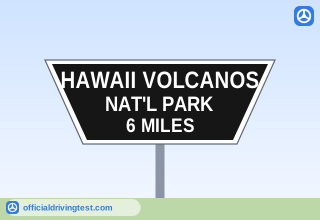
HAWAII VOLCANOS NAT'L PARK 6 MILES
These signs include all signs containing information for you regarding your location and the location of places and services. Typical signs are: route markers, location and distance signs, park signs, recreation signs, and service information signs.
Manual page 48 · Open this page in the manual (Manual page 48)
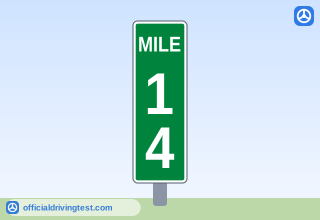
MILE 14
These signs include all signs containing information for you regarding your location and the location of places and services. Typical signs are: route markers, location and distance signs, park signs, recreation signs, and service information signs.
Manual page 48 · Open this page in the manual (Manual page 48)
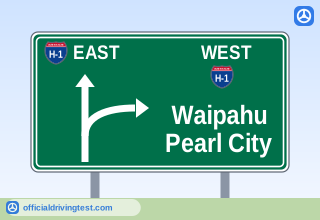
H-1 EAST / WEST: Waipahu, Pearl City
These signs include all signs containing information for you regarding your location and the location of places and services. Typical signs are: route markers, location and distance signs, park signs, recreation signs, and service information signs.
Manual page 48 · Open this page in the manual (Manual page 48)
See them all (10) · Guide, railroad and other signs →
Traffic signals - Hawaii
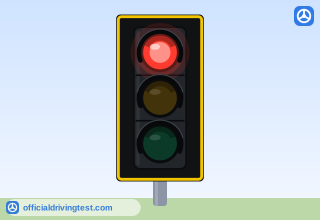
Red Light
A Red Light means that you must stop: 1. At the stop line; or 2. When there is no stop line, before entering any crosswalk, or 3. When there is no stop line or crosswalk before entering the intersection; and 4. Remain stopped until the signal changes to green. After stopping, you may turn right except when a sign prohibits such movement. You must yield to all pedestrians and all vehicles when making such a turn. After stopping you may also turn left on a red light from a one-way street into a one-way street where traffic is moving to the left, except when a sign prohibits such movement.
Manual page 39 · Open this page in the manual (Manual page 39)
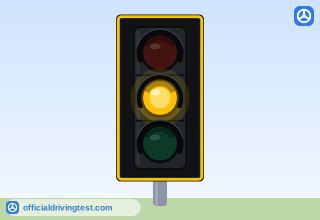
Yellow Light
A Yellow Light means that the red light is going to be shown immediately thereafter. You should avoid entering the intersection when the yellow light is shown. YOU MUST NOT ENTER THE INTERSECTION AFTER THE RED LIGHT IS SHOWN.
Manual page 39 · Open this page in the manual (Manual page 39)
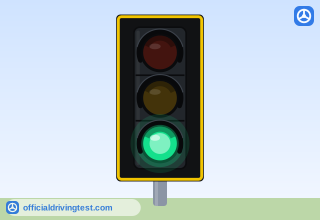
Green Light
A Green Light means go straight ahead or turn except when signs prohibit turns. You must yield to all pedestrians and vehicles already in the intersection.
Manual page 40 · Open this page in the manual (Manual page 40)
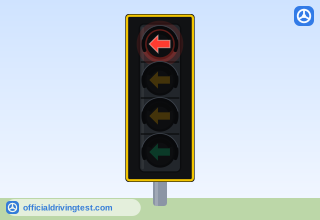
Red Arrow
Lighted arrows are sometimes used to control turns from a specific traffic lane. A Red Arrow has the same meaning as a red light for the indicated lane of traffic.
Manual page 40 · Open this page in the manual (Manual page 40)
See them all (16) · Traffic signals →
Pavement markings - Hawaii
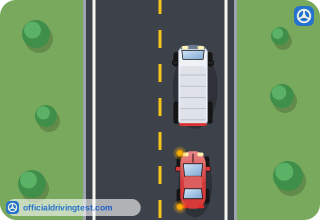
Single Broken Yellow Line
Single Broken Yellow Lines are used to mark the centerline when there are only two lanes of traffic. You must drive to the right of this centerline but when it is safe you may cross this line to pass another vehicle.
Manual page 33 · Open this page in the manual (Manual page 33)
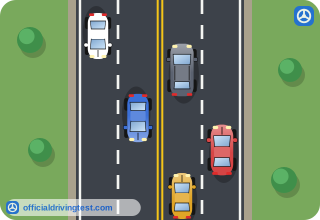
Double Solid Yellow Lines
Double Solid Yellow Lines are used to mark the center of the roadway where passing is prohibited in both directions. You may cross these lines ONLY TO MAKE A LEFT TURN INTO OR FROM AN ALLEY, PRIVATE ROAD OR DRIVEWAY.
Manual page 33 · Open this page in the manual (Manual page 33)
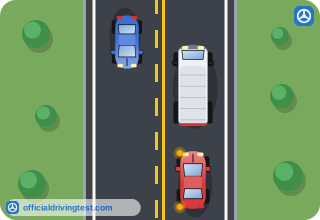
No Passing Lines
No Passing Lines are single solid yellow lines used on two-lane roads to indicate zones where passing is prohibited. You may cross the line ONLY to make a left turn into or from an alley, private road or a driveway.
Manual page 33 · Open this page in the manual (Manual page 33)
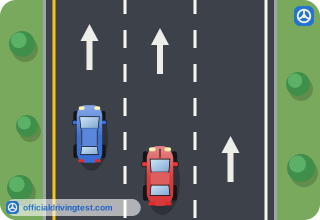
Single Dashed White Lane Lines
White lines separate lanes of traffic moving in the same direction. You are required to drive between these lane lines. Single Dashed White Lane Lines may be crossed when you can do so safely.
Manual page 34 · Open this page in the manual (Manual page 34)
See them all (17) · Pavement markings →
More signs from our practice questions
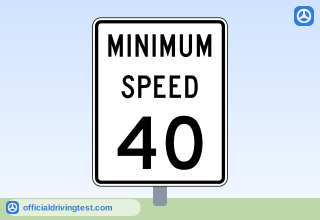
What is the lowest speed you may drive on a road with a posted minimum speed limit?
The posted minimum speed limit
Source: Hawaii Driver's Manual (2023), page 28 · Open this page in the manual (Manual page 28)
What do regulatory traffic control devices do?
They tell you to stop, go a certain way, or limit your speed
Source: Hawaii Driver's Manual (2023), page 33 · Open this page in the manual (Manual page 33)
What do the colors black and white on a traffic sign indicate?
A required action
Source: Hawaii Driver's Manual (2023), page 43 · Open this page in the manual (Manual page 43)
What do warning devices advise you of?
Hazardous conditions or the possibility of hazardous conditions
Source: Hawaii Driver's Manual (2023), page 33 · Open this page in the manual (Manual page 33)
What do guide and information signs do?
They help you find your way safely or give information for a comfortable trip
Source: Hawaii Driver's Manual (2023), page 33 · Open this page in the manual (Manual page 33)
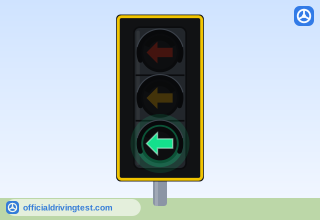
What are lighted arrows sometimes used to control?
Turns from a specific traffic lane
Source: Hawaii Driver's Manual (2023), page 40 · Open this page in the manual (Manual page 40)
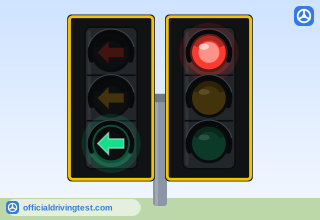
What must you do when a green arrow is shown for your lane?
Turn or proceed only in the direction indicated by the arrow
Source: Hawaii Driver's Manual (2023), page 40 · Open this page in the manual (Manual page 40)
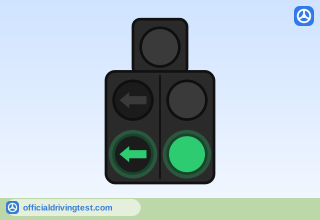
What do arrow signals combined with standard signals control?
The movement of vehicles in all traffic lanes
Source: Hawaii Driver's Manual (2023), page 41 · Open this page in the manual (Manual page 41)
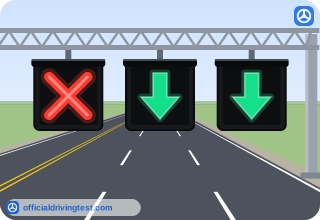
What are lane control signals used to control?
The direction of traffic movement in a lane
Source: Hawaii Driver's Manual (2023), page 41 · Open this page in the manual (Manual page 41)
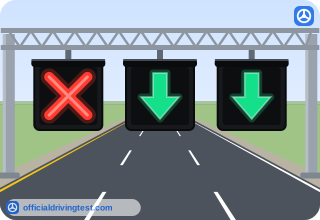
A lane-control signal shows a green arrow pointing down at your lane. What does it mean?
You may use that lane
Source: Hawaii Driver's Manual (2023), page 42 · Open this page in the manual (Manual page 42)
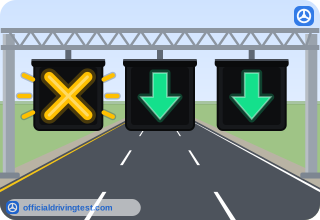
A yellow “X” signal over your lane is flashing. When may you use that lane?
Only when preparing to turn left
Source: Hawaii Driver's Manual (2023), page 42 · Open this page in the manual (Manual page 42)
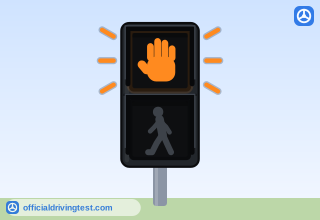
A DON’T WALK or upraised palm signal starts flashing while a pedestrian is already crossing. What may the pedestrian do?
Continue to the nearest sidewalk, traffic island or safety zone
Source: Hawaii Driver's Manual (2023), page 42 · Open this page in the manual (Manual page 42)
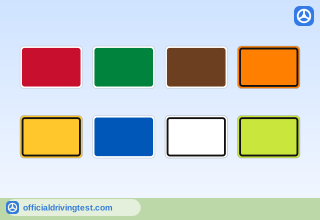
What does the color red on a traffic sign indicate?
That an action is prohibited
Source: Hawaii Driver's Manual (2023), page 43 · Open this page in the manual (Manual page 43)
What does the color yellow on a traffic sign indicate?
A warning of hazardous or dangerous conditions
Source: Hawaii Driver's Manual (2023), page 43 · Open this page in the manual (Manual page 43)
What does the color orange on a traffic sign indicate?
A warning concerning road work
Source: Hawaii Driver's Manual (2023), page 43 · Open this page in the manual (Manual page 43)
Which colors are used on guide and information signs?
Green, blue and brown
Source: Hawaii Driver's Manual (2023), page 43 · Open this page in the manual (Manual page 43)
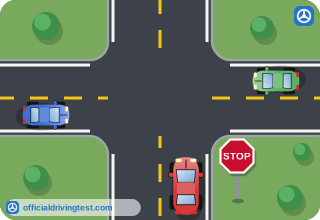
What does a STOP sign indicate about other traffic?
That other traffic has the right-of-way
Source: Hawaii Driver's Manual (2023), page 44 · Open this page in the manual (Manual page 44)
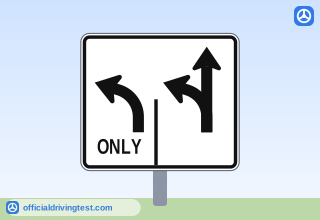
What do lane use control signs indicate?
Turning movements required or permitted from specific lanes
Source: Hawaii Driver's Manual (2023), page 45 · Open this page in the manual (Manual page 45)
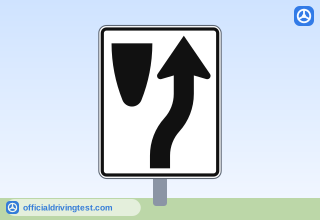
What do rectangular black-and-white alignment signs indicate?
Where you must drive to permit traffic to move safely and smoothly
Source: Hawaii Driver's Manual (2023), page 46 · Open this page in the manual (Manual page 46)
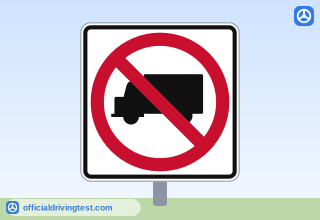
What do exclusion signs do?
Restrict or prohibit certain vehicles, vehicle movements or activities
Source: Hawaii Driver's Manual (2023), page 46 · Open this page in the manual (Manual page 46)
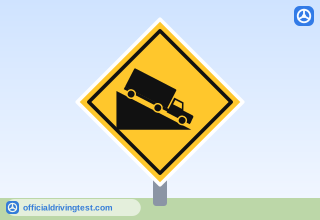
A yellow diamond sign shows a truck on a steep slope. What does it warn of?
A hill
Source: Hawaii Driver's Manual (2023), page 47 · Open this page in the manual (Manual page 47)
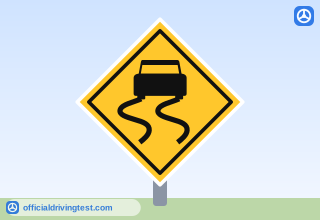
A yellow diamond sign shows a car with curving skid marks behind it. What does it warn of?
Slippery when wet
Source: Hawaii Driver's Manual (2023), page 47 · Open this page in the manual (Manual page 47)
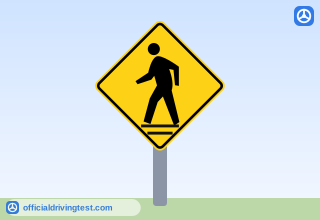
A yellow diamond sign shows a walking person above marked crosswalk lines. What does it warn of?
A pedestrian crossing
Source: Hawaii Driver's Manual (2023), page 47 · Open this page in the manual (Manual page 47)
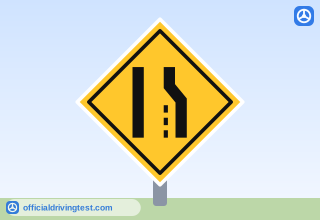
A yellow diamond sign shows two vertical lane lines, with the right-hand line bending inward toward the other. What does it warn of?
Lane ends or road narrows
Source: Hawaii Driver's Manual (2023), page 47 · Open this page in the manual (Manual page 47)