Pavement markings in Hawaii
The Hawaii Driver's Manual shows or names everything on this page: 17 in all, on pages 33–38, 65.
Independent educational site · not affiliated with any government agency or DMV
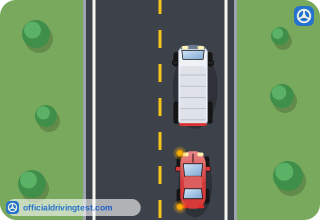
Single Broken Yellow Line
Single Broken Yellow Lines are used to mark the centerline when there are only two lanes of traffic. You must drive to the right of this centerline but when it is safe you may cross this line to pass another vehicle.
Manual page 33 · Open this page in the manual (Manual page 33)
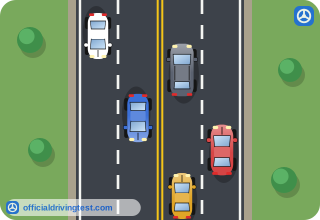
Double Solid Yellow Lines
Double Solid Yellow Lines are used to mark the center of the roadway where passing is prohibited in both directions. You may cross these lines ONLY TO MAKE A LEFT TURN INTO OR FROM AN ALLEY, PRIVATE ROAD OR DRIVEWAY.
Manual page 33 · Open this page in the manual (Manual page 33)
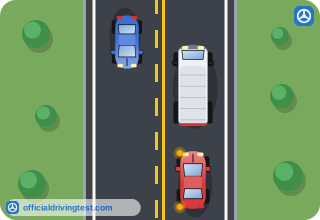
No Passing Lines
No Passing Lines are single solid yellow lines used on two-lane roads to indicate zones where passing is prohibited. You may cross the line ONLY to make a left turn into or from an alley, private road or a driveway.
Manual page 33 · Open this page in the manual (Manual page 33)
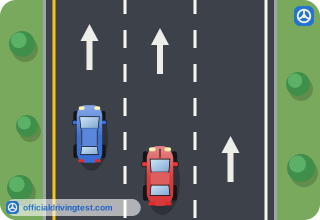
Single Dashed White Lane Lines
White lines separate lanes of traffic moving in the same direction. You are required to drive between these lane lines. Single Dashed White Lane Lines may be crossed when you can do so safely.
Manual page 34 · Open this page in the manual (Manual page 34)
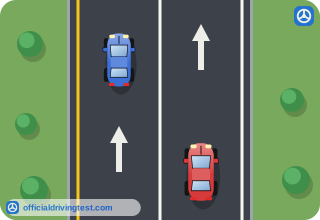
Single Solid White Lines
Single Solid White Lines indicate that movement from lane to lane is hazardous. The wider the line, the greater the hazard. You may cross a solid white line ONLY IN UNUSUAL CIRCUMSTANCES AND THEN ONLY WITH GREAT CARE.
Manual page 34 · Open this page in the manual (Manual page 34)
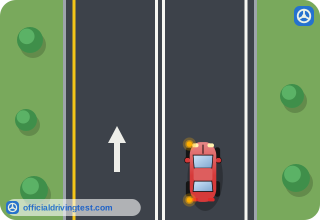
Double Solid White Lines
Double Solid White Lines indicate that movement from lane to lane is prohibited. You MUST NOT CROSS A DOUBLE SOLID WHITE LINE.
Manual page 35 · Open this page in the manual (Manual page 35)
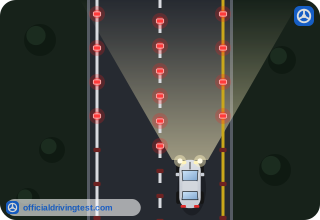
Red Pavement Markings
Red Pavement Markings or reflectors indicate a roadway that must not be entered or used. (p77: Recognize that red lane marking reflectors mean you are going the wrong direction in the traffic lane.)
Manual page 35 · Open this page in the manual (Manual page 35)
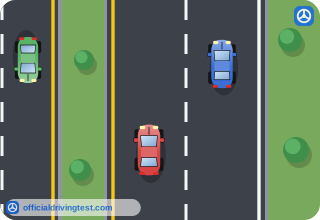
Edgelines (Divided Road)
Edgelines are solid white or yellow lines along the edge of the roadway to be used as a safety guide. White lines are used along the right edge of the roadway and yellow edge lines may be along the left edge of the roadway on divided streets and highways.
Manual page 35 · Open this page in the manual (Manual page 35)
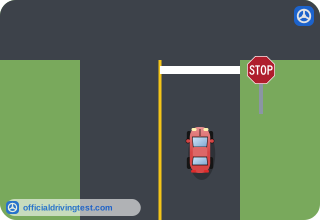
Stop Lines
Stop Lines are solid white lines painted across the traffic lanes at intersections and pedestrian crosswalks indicating the exact place at which to stop.
Manual page 36 · Open this page in the manual (Manual page 36)
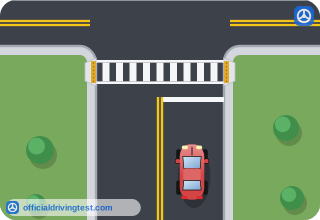
Crosswalk Lines
Crosswalk Lines show pedestrians where to safely cross the road or street, and they supplement signs to warn drivers of the possibility that pedestrians may be crossing at a specific location. YOU MUST STOP FOR PEDESTRIANS IN CROSSWALKS.
Manual page 36 · Open this page in the manual (Manual page 36)
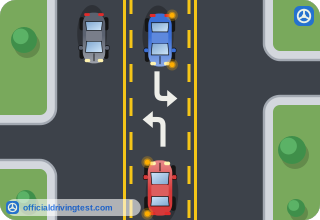
Two-Way Left Turn Channelization Markings
Two-Way Left Turn Channelization Markings are a combination of a yellow solid and dashed lines in the center of a roadway which mark a lane in the center of the roadway which may be used by vehicles travelling in either direction for left turn maneuvers ONLY. The lane must NEVER be used for passing.
Manual page 36 · Open this page in the manual (Manual page 36)
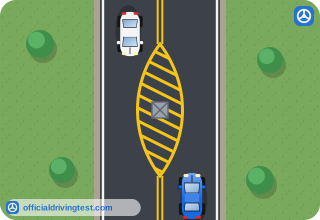
Obstruction Markings (Yellow, Center of Road)
Obstruction Markings are solid lines painted in the traffic lanes to guide you around obstructions, such as bridge supports, in the road. The markings may be yellow or white. You may pass to either side of white obstruction markings but you must pass only to the right of the yellow markings.
Manual page 37 · Open this page in the manual (Manual page 37)
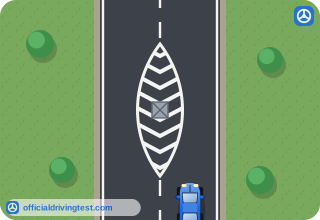
Obstruction Markings (White, Traffic Passing Both Sides)
Obstruction Markings are solid lines painted in the traffic lanes to guide you around obstructions, such as bridge supports, in the road. The markings may be yellow or white. You may pass to either side of white obstruction markings but you must pass only to the right of the yellow markings.
Manual page 37 · Open this page in the manual (Manual page 37)
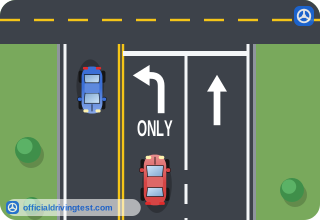
Directional Markings (Lane Arrows)
Directional Markings are white arrows or words painted in the traffic lane to indicate the direction in which you must go. You must move ONLY IN THE DIRECTION INDICATED BY THE ARROW. Where arrows indicate more than one direction, you may choose any direction indicated.
Manual page 37 · Open this page in the manual (Manual page 37)
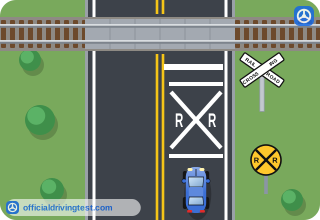
Railroad Crossing Markings
Railroad Crossing Markings are white markings painted in the traffic lane before railroad crossings. The pavement is marked with a large “X” and two “R’s”. A solid yellow centerline extends the entire distance to prevent passing, and a white stop line is painted across the traffic lane.
Manual page 38 · Open this page in the manual (Manual page 38)
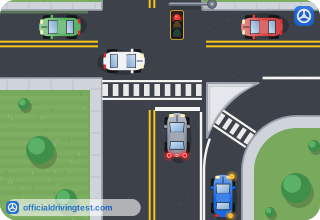
Traffic Island Markings
Traffic Island Markings are of many different designs. They may be only painted markings on the roadway or any combination of curbing, paving or landscaped areas. Traffic islands are used to direct you into separate traffic lanes. Traffic islands are called “Safety Islands” when they are used to protect pedestrians who may have to stand in the roadway. YOU SHOULD NEVER DRIVE INTO OR ACROSS A TRAFFIC ISLAND.
Manual page 38 · Open this page in the manual (Manual page 38)
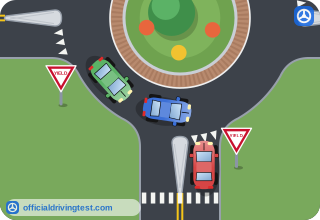
Roundabout Yield Line (Triangles)
A roundabout is a one-way circular intersection in which entering traffic must yield the right-of-way to circulating traffic. Each road approaching the roundabout is marked with a yield sign and may also have yield line markings on the pavement.
Manual page 65 · Open this page in the manual (Manual page 65)