Florida: Sharing the road
Safely sharing the road with motorcycles, bicycles, trucks, buses, and golf carts. Split into 4 shorter tests so you're not stuck in one long quiz.
Independent educational site · not affiliated with any government agency or DMV
Choose a part
Sharing the road — Part 1
Questions in this part include: “Besides a fine and points, what else must a driver do after being cited for passing a stopped school bus?”
Sharing the road — Part 2
Questions in this part include: “You must not pass within 100 feet of which of the following?”
Sharing the road — Part 3
Questions in this part include: “Who may drive a golf cart on a public road or street in Florida?”
Sharing the road — Part 4
Questions in this part include: “What else is required of a low-speed vehicle (LSV) in Florida besides equipment?”
Questions are original and based on the official manual "Florida Driver License Handbook" (Revised August 2023), Florida Department of Highway Safety and Motor Vehicles (FLHSMV).
All 69 Sharing the road questions with answers
Choose a part above to take a practice test, or study every question and answer here.
Show the questions and answersHide the questions
1Part 118 questions
-
What is the minimum fine for passing a stopped school bus, and how does it increase if you pass on the side where children enter and exit?
- $1,000 flat, no matter which side
- $100, or $200 on the children's side
- $500 flat, no matter which side
- $265, or $465 on the children's side
Show answer
Correct answer: $265, or $465 on the children's side
Passing a stopped school bus carries a minimum fine of $265; if you pass on the side where children enter and exit, the minimum fine is $465.
Source: Florida Driver License Handbook (Revised August 2023), page 27
-
Besides a fine and points, what else must a driver do after being cited for passing a stopped school bus?
- Automatically serve 10 days in jail
- Retake the full written knowledge exam
- Attend traffic court only, with no other requirement
- Complete a basic driver improvement course
Show answer
Correct answer: Complete a basic driver improvement course
Penalties for passing a stopped school bus include a moving violation citation, four points, a minimum fine, and completion of a basic driver improvement course.
Source: Florida Driver License Handbook (Revised August 2023), page 27
-
If passing a stopped school bus results in the serious injury or death of another person, how many hours of community service must be served in a trauma center or hospital?
- 50 hours
- 40 hours
- 200 hours
- 120 hours
Show answer
Correct answer: 120 hours
If passing results in serious injury or death, penalties include serving 120 community service hours in a trauma center or hospital, plus six points on your license.
Source: Florida Driver License Handbook (Revised August 2023), page 27
-
What must every truck carrying logs or pulpwood use to securely fasten the load?
- A tarp with no fasteners
- Lock chains
- Rubber bungee cords only
- Duct tape
Show answer
Correct answer: Lock chains
Every truck carrying logs or pulpwood must use lock chains to securely fasten the load.
Source: Florida Driver License Handbook (Revised August 2023), page 42
-
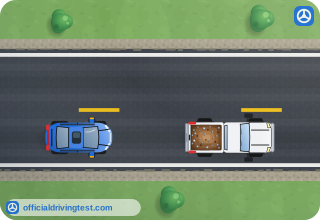
What must you use when hauling a load such as dirt, sand, or gravel that could fall or blow onto the roadway?
- A flashing amber light only
- No cover is required for these materials
- A single loose tarp draped over the top
- A close-fitting cover
Show answer
Correct answer: A close-fitting cover
You must use a close-fitting cover when hauling loads which could fall or blow onto the roadway, such as dirt, sand, or gravel; a load must never be able to drop, shift, leak, or otherwise escape.
Source: Florida Driver License Handbook (Revised August 2023), page 42
-
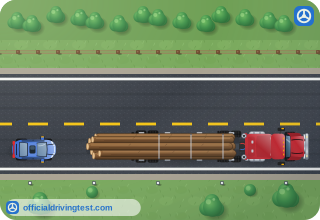
During the day, a load that extends beyond the sides of a vehicle and four feet or more beyond its rear must be marked with what?
- Nothing is required during the day
- A single small sticker
- White paint on the load itself
- Red flags at least 18 inches square
Show answer
Correct answer: Red flags at least 18 inches square
A load that extends beyond the sides of a vehicle, and four feet or more beyond its rear, must be clearly marked. During the day, red flags at least 18 inches square must mark the extremities of the load.
Source: Florida Driver License Handbook (Revised August 2023), page 42
-
From sunset to sunrise, or during rain, smoke, or fog, a projecting load must have two red lamps on the back that can be seen from at least how far to the rear?
- 300 feet
- 1,000 feet
- 100 feet
- 500 feet
Show answer
Correct answer: 500 feet
From sunset to sunrise, and during rain, smoke, or fog, a projecting load requires two red lamps on the back that can be seen from at least 500 feet to the rear, plus two red reflectors and a side lamp on each side.
Source: Florida Driver License Handbook (Revised August 2023), page 42
-
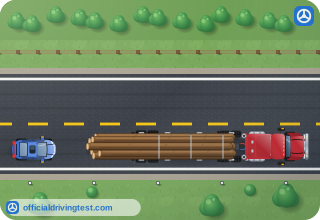
If a vehicle is transporting logs, pulpwood, poles, or posts that extend more than four feet beyond the rear of the load, what additional lamp is required?
- A blue rotating beacon
- One amber strobe-type lamp
- No additional lamp is required
- A second license plate light
Show answer
Correct answer: One amber strobe-type lamp
If the load of logs, pulpwood, poles, or posts extends more than four feet beyond the rear, you must have one amber strobe-type lamp, operational and visible from the rear and both sides of the projecting load at any time of day or night.
Source: Florida Driver License Handbook (Revised August 2023), page 42
-
On any Florida highway, a passenger vehicle's load must not extend beyond the fenders on the left side, or more than how many inches beyond the fenders on the right side?
- 18 inches
- 6 inches
- 12 inches
- 3 inches
Show answer
Correct answer: 6 inches
Passenger vehicles must not be driven on any highway with a load extending beyond the fenders on the left side, or extending more than 6 inches beyond the line of the fenders on the right side.
Source: Florida Driver License Handbook (Revised August 2023), page 42
-
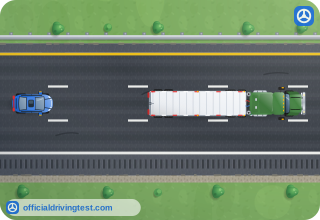
What must you do before moving into the left lane to pass another vehicle?
- Come to a complete stop
- Open your window and wave
- Activate your signal
- Turn off your headlights
Show answer
Correct answer: Activate your signal
You must activate your signal before moving into the left lane to let others know that you are about to change lanes to pass.
Source: Florida Driver License Handbook (Revised August 2023), page 67
-
Before you pass, why should you stay a safe distance behind the vehicle you want to pass?
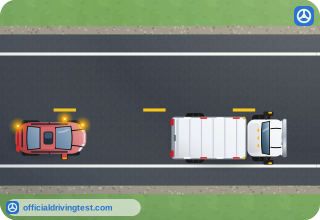
- It is required only on limited access highways
- The closer you get, the less you can see ahead
- It saves fuel
- It keeps your engine cooler
Show answer
Correct answer: The closer you get, the less you can see ahead
Stay a safe distance behind the vehicle you want to pass. The closer you get, the less you can see ahead.
Source: Florida Driver License Handbook (Revised August 2023), page 67
-
Before you pull out to pass another vehicle, what should you check?
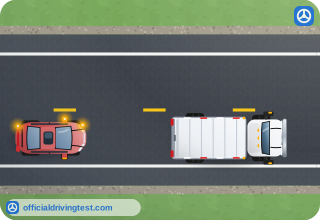
- Blind spots, and that you have plenty of time and room to pass
- Only your mirrors, since blind spots do not matter when you pass
- Only the speed of the vehicle you are about to pass
- Only your fuel gauge
Show answer
Correct answer: Blind spots, and that you have plenty of time and room to pass
Before you pull out to pass, check blind spots and make sure you have plenty of time and room to pass.
Source: Florida Driver License Handbook (Revised August 2023), page 67
-
How should you let another driver know you are passing them?
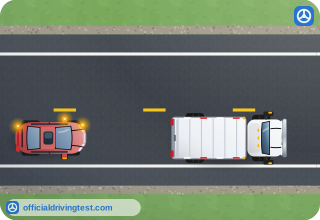
- Roll down the window and shout
- Tap your horn during the day or flash your headlights at night
- Nothing; no signal is needed
- Turn on your hazard lights
Show answer
Correct answer: Tap your horn during the day or flash your headlights at night
Tap your horn (day) or flash your headlights (night) to let the other driver know you are passing.
Source: Florida Driver License Handbook (Revised August 2023), page 67
-
After passing another vehicle, when should you return to the right side of the road?
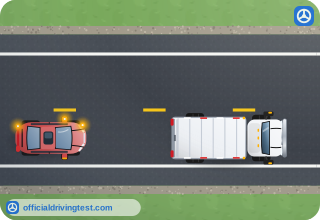
- Only when the other driver flashes their headlights
- Immediately after your front bumper passes the other vehicle
- Once you can see its tires in your rear-view mirror
- Whenever you feel like it, timing does not matter
Show answer
Correct answer: Once you can see its tires in your rear-view mirror
Do not return to the right side of the road until you can see the tires of the vehicle you passed in your rear-view mirror. Signal when you are about to return to your lane.
Source: Florida Driver License Handbook (Revised August 2023), page 67
-
You must return to the right side of the road before coming within how many feet of an approaching vehicle?
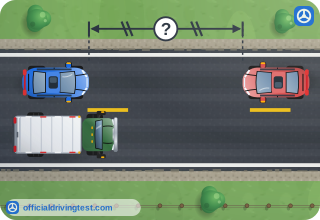
- 200 feet
- 50 feet
- 500 feet
- 100 feet
Show answer
Correct answer: 200 feet
You must return to the right side of the road before coming within 200 feet of any approaching vehicle.
Source: Florida Driver License Handbook (Revised August 2023), page 67
-
According to the handbook, how many vehicles should you attempt to pass at one time?
- Two vehicles at a time is always acceptable
- No more than one vehicle at a time
- As many as you can as long as you are on a limited access highway
- Up to three vehicles, if there is enough room
Show answer
Correct answer: No more than one vehicle at a time
Do not attempt to pass more than one vehicle at a time. Passing multiple vehicles is dangerous.
Source: Florida Driver License Handbook (Revised August 2023), page 67
-
Is it legal to exceed the speed limit while passing another vehicle?
- Only on limited access highways
- Yes, you may exceed it by up to 10 MPH while passing
- No, it's illegal to exceed the speed limit while passing
- Yes, any speed is allowed while passing
Show answer
Correct answer: No, it's illegal to exceed the speed limit while passing
Stay within the speed limit. It's illegal to exceed the speed limit while passing.
Source: Florida Driver License Handbook (Revised August 2023), page 67
-
You must not pass on a hill or curve unless you can see how far ahead?
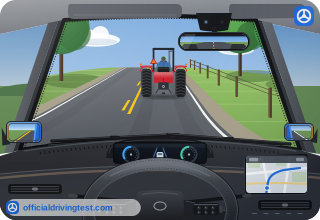
- At least 500 feet ahead
- At least 50 feet ahead
- At least 1,000 feet ahead
- At least 100 feet ahead
Show answer
Correct answer: At least 500 feet ahead
You must not pass where there is a single or double-sided solid line dividing lanes, in Do Not Pass zones, or on hills or curves where you can't see at least 500 feet ahead.
Source: Florida Driver License Handbook (Revised August 2023), page 67
2Part 217 questions
-
You must not pass within 100 feet of which of the following?
- A gas station or convenience store
- A residential driveway or mailbox
- An intersection or railroad crossing
- A shopping center
Show answer
Correct answer: An intersection or railroad crossing
You must not pass within 100 feet of an intersection, bridge, viaduct, tunnel, or railroad crossing.
Source: Florida Driver License Handbook (Revised August 2023), page 67
-
You must not pass when a school bus is stopped and has what activated?
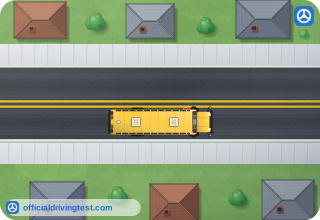
- Its radio playing
- Its headlights and windshield wipers
- Its warning flashers and stop sign
- Its air conditioning on
Show answer
Correct answer: Its warning flashers and stop sign
You must not pass when a school bus is stopped and has its warning flashers on and stop sign extended.
Source: Florida Driver License Handbook (Revised August 2023), page 67
-
You are driving in the left lane and a faster vehicle comes up behind you to overtake. What does Florida law require you to do?
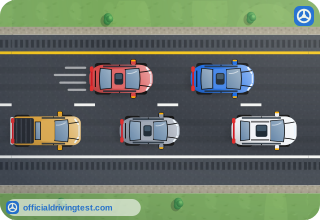
- Speed up to stay ahead of the faster vehicle behind you
- Move out of the left lane, and do not increase your speed
- Brake suddenly in your lane
- Move further left to block the pass
Show answer
Correct answer: Move out of the left lane, and do not increase your speed
Do not increase your speed when you are being passed; move to the right side of your lane. Florida law states that a driver must move out of the left lane when being overtaken from behind by another vehicle traveling at a faster speed.
Source: Florida Driver License Handbook (Revised August 2023), page 67
-
When is passing on the right legal?
- Only at night, when there is little traffic
- When two or more lanes are moving in the same direction
- Anytime you are in a hurry to reach your destination
- Only on a single-lane road
Show answer
Correct answer: When two or more lanes are moving in the same direction
Passing on the right is only legal when there are two or more traffic lanes moving in the same direction or the vehicle you are passing is making a left turn.
Source: Florida Driver License Handbook (Revised August 2023), page 67
-
In Florida, how is a bicycle legally defined, and where does this NOT apply?
- As a pedestrian device, with the same rights as someone walking, on all roads including interstates
- As a vehicle only on bike paths, with no rights on any public road
- As a vehicle, with the rights and duties of a motor vehicle operator on public roads, except limited access highways
- As a toy, with no legal rights or responsibilities on any road
Show answer
Correct answer: As a vehicle, with the rights and duties of a motor vehicle operator on public roads, except limited access highways
Florida law defines a bicycle as a vehicle with all the rights, privileges, and responsibilities of a motor vehicle operator on public roads, except on limited access highways (p. 81).
Source: Florida Driver License Handbook (Revised August 2023), page 81
-
Under what circumstances may a Florida bicyclist ride in the travel lane instead of a bike lane, or use the full lane even while traveling below the speed of traffic?
- Only on weekends and holidays, when there is less motor vehicle traffic
- Only when the bicyclist wants to ride faster than a car
- Never; bicyclists must always stay in the bike lane whenever one exists on the road
- Narrow roads, hazards, a left turn, or a lane too narrow for a car and bicycle to share
Show answer
Correct answer: Narrow roads, hazards, a left turn, or a lane too narrow for a car and bicycle to share
A bicyclist may leave the bike lane for narrow roads, to avoid obstacles or pavement hazards, to prepare for a left turn, or to use the full lane if it is too narrow for a car and bicycle to share (p. 81).
Source: Florida Driver License Handbook (Revised August 2023), page 81
-
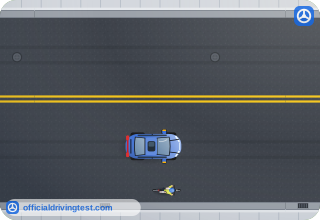
When passing a bicyclist, what clearance does Florida law require?
- A minimum of one foot of clearance
- Flash the headlights and pass at normal speed
- Sound the horn to alert the bicyclist instead of leaving extra space
- A minimum of three feet of clearance, using caution and slow speed
Show answer
Correct answer: A minimum of three feet of clearance, using caution and slow speed
Florida law requires giving bicyclists a minimum of three feet of clearance and using caution and slow speed when driving next to or passing them (p. 81).
Source: Florida Driver License Handbook (Revised August 2023), page 81
-
Between sunset and sunrise, what lighting must a bicycle have?
- A white light visible from 500 feet on the front, and a red reflector and red light visible from 600 feet on the rear
- A red light visible from 500 feet on the front, and a white reflector and white light visible from 600 feet on the rear
- Only reflectors; no lights are required
- A flashing yellow light visible from 100 feet in any direction
Show answer
Correct answer: A white light visible from 500 feet on the front, and a red reflector and red light visible from 600 feet on the rear
Between sunset and sunrise, bicyclists must have a white light visible from 500 feet on the front and a red reflector and red light visible from 600 feet on the rear (p. 82).
Source: Florida Driver License Handbook (Revised August 2023), page 82
-
What braking capability must a bicycle have under Florida law?
- Brakes that can stop the bicycle within 25 feet from a speed of 25 mph
- Brakes that can stop the bicycle within 25 feet from a speed of 10 mph
- Brakes that can stop the bicycle within 100 feet from a speed of 10 mph
- There is no specific braking requirement for bicycles
Show answer
Correct answer: Brakes that can stop the bicycle within 25 feet from a speed of 10 mph
A bicycle's brakes must be able to stop the bike within 25 feet from a speed of 10 mph (p. 82).
Source: Florida Driver License Handbook (Revised August 2023), page 82
-
Who is required to wear a helmet while riding a bicycle in Florida?
- Only bicyclists riding on public roads, not on sidewalks
- Only bicyclists under age 12, using helmets that meet federal safety standards
- All bicyclists and passengers under age 16, using helmets that meet federal safety standards
- Only bicyclists riding on sidewalks
Show answer
Correct answer: All bicyclists and passengers under age 16, using helmets that meet federal safety standards
All bicyclists and passengers under age 16 are required to wear helmets that meet federal safety standards (p. 82).
Source: Florida Driver License Handbook (Revised August 2023), page 82
-
If a bicyclist is transporting a child under age four or weighing 40 pounds or less, what must they use?
- The child must ride on the handlebars
- A back-pack/sling, child seat, or trailer designed to carry children
- A regular bicycle seat, with no other equipment needed
- A helmet for the bicyclist only, with no special carrier needed
Show answer
Correct answer: A back-pack/sling, child seat, or trailer designed to carry children
A bicyclist transporting a child under age four or weighing 40 pounds or less must use a back-pack/sling, child seat, or trailer designed to carry children (p. 82).
Source: Florida Driver License Handbook (Revised August 2023), page 82
-
How many bicyclists may ride side-by-side on a Florida roadway that is not a path or reserved bicycle lane?
- Bicyclists may never ride side-by-side under any circumstance
- No more than two side-by-side, and they must ride single file if impeding traffic
- Up to four side-by-side, and they must ride single file only at night
- An unlimited number, as long as they all stay to the right of the lane
Show answer
Correct answer: No more than two side-by-side, and they must ride single file if impeding traffic
Bicyclists riding together may not ride more than two side-by-side unless on a path or a part of a roadway reserved for bicycles; they must ride single file if impeding traffic (p. 82).
Source: Florida Driver License Handbook (Revised August 2023), page 82
-
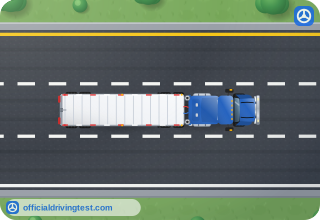
What is the "No Zone" when sharing the road with a commercial motor vehicle (CMV)?
- A designated parking area for trucks
- A no-passing zone marked by road signs
- The area where CMVs themselves are prohibited from driving
- The large blind spots in front, behind, and on both sides of the CMV
Show answer
Correct answer: The large blind spots in front, behind, and on both sides of the CMV
The "No Zone" refers to the large blind spots in front, behind, and on both sides of a CMV; other vehicles are hidden from the CMV driver's view within these zones (p. 82).
Source: Florida Driver License Handbook (Revised August 2023), page 82
-
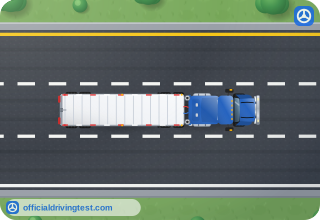
Why should you avoid tailgating a commercial motor vehicle (CMV)?
- Tailgating a CMV will trigger its backup alarm
- You will be in the CMV's rear blind spot and may collide with it if it stops unexpectedly
- It is illegal to drive behind any large vehicle at all
- CMVs are required to stop suddenly at random intervals
Show answer
Correct answer: You will be in the CMV's rear blind spot and may collide with it if it stops unexpectedly
Following too closely puts you in the CMV's rear blind spot, and you may collide with it if it stops unexpectedly (p. 82).
Source: Florida Driver License Handbook (Revised August 2023), page 82
-
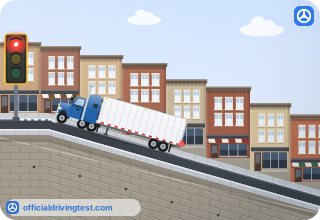
If you are stopped behind a commercial motor vehicle (CMV) on an upgrade (hill), what should you do?
- Pass the CMV immediately while it is stopped on the hill
- Leave space in case the CMV drifts back, and keep to the left in your lane
- Pull up as close as possible to the CMV, and keep to the right in your lane
- Honk your horn continuously until the CMV starts to move again
Show answer
Correct answer: Leave space in case the CMV drifts back, and keep to the left in your lane
Leave space in case the CMV drifts back when it starts to move, and keep to the left in your lane so the driver can see your vehicle (p. 82).
Source: Florida Driver License Handbook (Revised August 2023), page 82
-
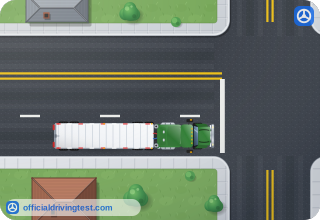
Why should you never drive between a commercial motor vehicle (CMV) and the curb when the CMV is preparing to make a right turn?
- CMVs always turn right without any warning, so you cannot predict them
- The area next to the curb is reserved exclusively for bicycles
- It is against the law for any car to drive next to a curb
- CMVs often swing wide to the left to turn right, and the driver cannot see you
Show answer
Correct answer: CMVs often swing wide to the left to turn right, and the driver cannot see you
CMVs often need to swing wide to the left in order to make a right turn, so a driver between the CMV and the curb will not be seen (p. 84).
Source: Florida Driver License Handbook (Revised August 2023), page 84
-
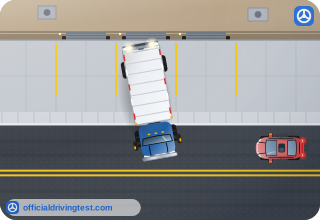
Why should you never cross behind a commercial motor vehicle (CMV) that is backing up or preparing to back up?
- It is illegal to walk or drive behind any vehicle at any time
- The size of most CMVs and trailers completely hides objects behind them
- Only pedestrians are at risk in this situation, not other vehicles
- CMVs backing up always sound a warning horn before moving
Show answer
Correct answer: The size of most CMVs and trailers completely hides objects behind them
The size of most CMVs and trailers completely hides objects behind them from the driver's view, so you should never cross behind one that is backing up (p. 84).
Source: Florida Driver License Handbook (Revised August 2023), page 84
3Part 317 questions
-
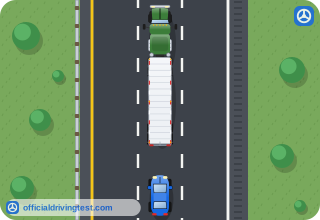
When passing a commercial motor vehicle (CMV) in Florida, what should you do?
- Pass on the right side for better visibility
- Pass without signaling or flashing your lights, to avoid distracting the driver
- Signal, blink your headlights to show you are passing, and pass on the left
- Tap your horn repeatedly while passing so the CMV driver knows you are there
Show answer
Correct answer: Signal, blink your headlights to show you are passing, and pass on the left
When passing a CMV, signal that you are changing lanes, let the driver know you are passing by blinking your headlights, and pass on the left side for maximum visibility (p. 84).
Source: Florida Driver License Handbook (Revised August 2023), page 84
-
Why should you avoid passing a commercial motor vehicle (CMV) on a downgrade (downhill slope)?
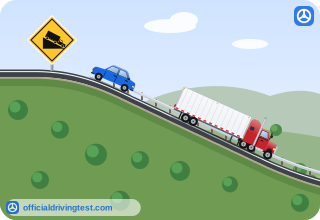
- Its weight and momentum will make it increase speed
- It is illegal to pass any vehicle on a downgrade
- CMVs are not allowed to drive on downgrades at all
- Downgrades have no real effect on passing a CMV
Show answer
Correct answer: Its weight and momentum will make it increase speed
On a downgrade, a CMV's weight and momentum will cause it to increase speed (p. 84).
Source: Florida Driver License Handbook (Revised August 2023), page 84
-
What must motorists, bicyclists, and pedestrians do regarding a funeral procession?
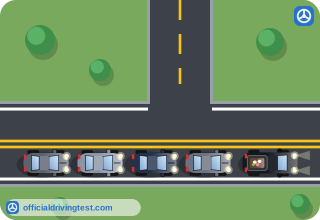
- Yield the right-of-way to the funeral procession
- There is no legal requirement to yield to funeral processions
- Only yield if the procession has a police escort
- Pass the procession as quickly as possible
Show answer
Correct answer: Yield the right-of-way to the funeral procession
Motorists, bicyclists, and pedestrians must yield the right-of-way to funeral processions (p. 84).
Source: Florida Driver License Handbook (Revised August 2023), page 84
-
When the lead vehicle of a funeral procession enters an intersection, what may the rest of the procession do?
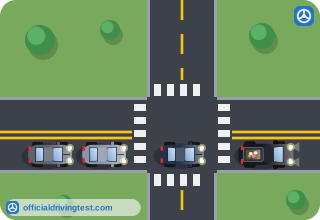
- They must stop and wait for a green light before proceeding
- Each vehicle must individually check for a break in traffic before proceeding
- They may follow through the intersection regardless of any traffic control devices
- Only the next two vehicles may follow; the rest must stop
Show answer
Correct answer: They may follow through the intersection regardless of any traffic control devices
When the funeral lead vehicle enters an intersection, the remaining vehicles in the procession may follow through regardless of any traffic control devices (p. 84).
Source: Florida Driver License Handbook (Revised August 2023), page 84
-
How do vehicles in a funeral procession signal to other drivers not to drive between them?
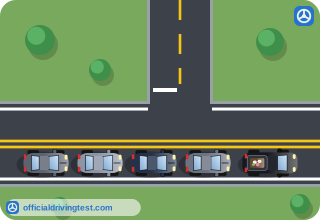
- By sounding their horns continuously
- By using their headlights on or flashing hazard lights
- By displaying a special funeral procession flag
- By driving with their trunk lids open
Show answer
Correct answer: By using their headlights on or flashing hazard lights
Vehicles in the procession should have their headlights on or may use flashing hazard lights as a signal to others not to drive between the funeral procession vehicles (p. 84).
Source: Florida Driver License Handbook (Revised August 2023), page 84
-
On which roadways may you drive a golf cart in Florida?
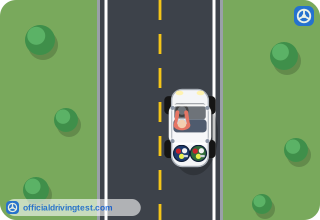
- Only on roadways designated for golf carts
- Only on limited access highways
- On any state road with a posted speed limit of 45 mph or less
- On any public road with a speed limit of 55 mph or less
Show answer
Correct answer: Only on roadways designated for golf carts
You may only drive a golf cart on golf courses or roadways that are designated for golf carts; these roads will be marked with appropriate signs (p. 85).
Source: Florida Driver License Handbook (Revised August 2023), page 85
-
Who may drive a golf cart on a public road or street in Florida?
- Anyone at all, regardless of age, license status, or identification
- Under 18: a learner's or driver license; 18 or older: a government-issued photo ID
- Under 18: no license is needed; 18 or older: a commercial driver license
- Anyone age 14 or older, with no license or identification needed
Show answer
Correct answer: Under 18: a learner's or driver license; 18 or older: a government-issued photo ID
A golf cart must not be driven on a public road by anyone under 18 unless they possess a valid learner's or driver license; drivers 18 or older must possess valid government-issued photo identification (p. 85).
Source: Florida Driver License Handbook (Revised August 2023), page 85
-
Are golf carts always allowed to be operated on Florida public roads?
- Yes, but only in Miami-Dade County
- Yes, golf carts may be driven anywhere in the state without restriction
- No, golf carts are completely banned from all public roads statewide
- No, golf carts may not be operated at all unless allowed by the county or city
Show answer
Correct answer: No, golf carts may not be operated at all unless allowed by the county or city
Golf carts may not be operated at all unless allowed by the specific county or city (p. 85).
Source: Florida Driver License Handbook (Revised August 2023), page 85
-
During what hours may a golf cart normally be operated in Florida?
- Only between 6 a.m. and 6 p.m., and local governments may not allow other hours
- Only at night, between sunset and sunrise, to avoid daytime traffic
- 24 hours a day with no restrictions at all
- Only between sunrise and sunset, unless the local government permits other hours
Show answer
Correct answer: Only between sunrise and sunset, unless the local government permits other hours
A golf cart must only be operated between sunrise and sunset, unless the local government permits driving outside those hours (additional equipment is required for night driving) (p. 85).
Source: Florida Driver License Handbook (Revised August 2023), page 85
-
Under what conditions may a golf cart cross a state road in Florida?
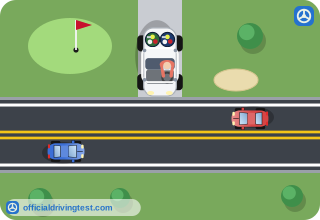
- If the posted speed limit is 45 mph or less, at an intersection with a traffic control device
- At any point along the state road, regardless of the posted speed limit
- Golf carts may never cross a state road, even at an intersection with a traffic signal
- Only if the golf cart has a horn and mirrors installed
Show answer
Correct answer: If the posted speed limit is 45 mph or less, at an intersection with a traffic control device
You may cross state roads with a golf cart if the posted speed limit is 45 mph or less and only at an intersection with a traffic control device (p. 85).
Source: Florida Driver License Handbook (Revised August 2023), page 85
-
When may a golf cart be driven on a sidewalk in Florida?
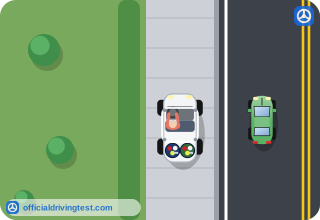
- Anytime, with no width requirement at all
- Never; golf carts are banned from all sidewalks
- Only if it is at least 5 feet wide, and you must yield to pedestrians
- Only if it is at least 10 feet wide, and pedestrians must yield to you
Show answer
Correct answer: Only if it is at least 5 feet wide, and you must yield to pedestrians
You can drive a golf cart on a sidewalk only if it is at least 5 feet wide; you must yield to pedestrians (p. 85).
Source: Florida Driver License Handbook (Revised August 2023), page 85
-
Which of the following is required equipment for a golf cart in Florida?

- A horn, a speedometer, and a backup camera
- A speedometer, an odometer, and a fuel gauge
- Efficient brakes, reliable steering, and safe tires
- Air conditioning, a radio, and power windows
Show answer
Correct answer: Efficient brakes, reliable steering, and safe tires
Required golf cart equipment includes efficient brakes, a rear-view mirror, reliable steering, front and rear red warning reflectors, and safe tires (p. 85).
Source: Florida Driver License Handbook (Revised August 2023), page 85
-
If a golf cart is permitted to be driven at night, what additional equipment is required?
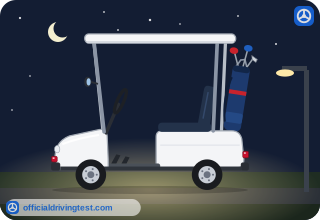
- A horn, a bell, a backup camera, and mud flaps
- A GPS tracking device, a radio, and a roll cage
- Snow tires, tire chains, a spoiler, and a tow hook
- Headlights, brake lights, turn signals, and a windshield
Show answer
Correct answer: Headlights, brake lights, turn signals, and a windshield
A golf cart operated at night requires headlights, brake lights, turn signals, and a windshield (p. 85).
Source: Florida Driver License Handbook (Revised August 2023), page 85
-
Why should child passenger safety seats not be used on golf carts or low-speed vehicles (LSVs)?
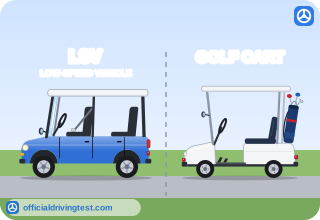
- Car seats are not crash tested for LSVs and may not perform as designed
- Golf carts and LSVs do not have any seats at all
- They are too heavy for golf carts and LSVs to carry
- It is simply more comfortable for children to sit without a car seat
Show answer
Correct answer: Car seats are not crash tested for LSVs and may not perform as designed
Car seats are not crash tested for LSVs and may not perform as designed; refer to the specific car seat manufacturer for more information (p. 85).
Source: Florida Driver License Handbook (Revised August 2023), page 85
-
How is a low-speed vehicle (LSV) defined in Florida?
- A four-wheeled vehicle with a top speed of 21-25 mph
- A three-wheeled vehicle with no speed limit
- Any vehicle with a top speed under 10 mph
- A two-wheeled vehicle with a top speed of 15 mph
Show answer
Correct answer: A four-wheeled vehicle with a top speed of 21-25 mph
Low-speed vehicles (LSV) are four-wheeled vehicles with top speeds of 21-25 mph; golf carts can be converted to LSVs (p. 85).
Source: Florida Driver License Handbook (Revised August 2023), page 85
-
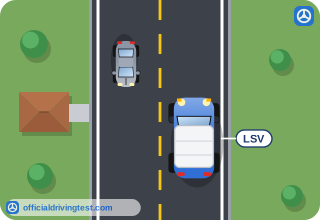
What is required to legally operate a low-speed vehicle (LSV) in Florida, and where may it be driven?
- A learner's license is sufficient, and it may be driven on any interstate
- No license is required, and it may be driven on any road including limited access highways
- A valid driver license is required, and it may only be driven on streets posted at 35 mph or less
- A commercial driver license is required, and it may only be driven on golf courses
Show answer
Correct answer: A valid driver license is required, and it may only be driven on streets posted at 35 mph or less
You must have a valid driver license to operate an LSV, and it may only be operated on streets with a posted speed limit of 35 mph or less (p. 85).
Source: Florida Driver License Handbook (Revised August 2023), page 85
-
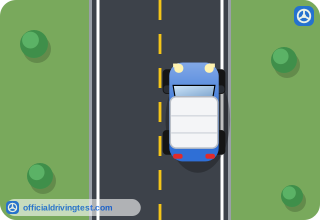
Which of the following must a low-speed vehicle (LSV) be equipped with?
- A commercial vehicle placard and a fire extinguisher
- Snow chains, a spare tire, and a trailer hitch
- Only a horn and headlights
- Headlamps, stop lamps, turn signals, and safety belts
Show answer
Correct answer: Headlamps, stop lamps, turn signals, and safety belts
An LSV must be equipped with headlamps, stop lamps, turn signals, tail lamps, reflectors, parking brakes, rear-view mirrors, a windshield, safety belts, and a vehicle identification number (p. 85).
Source: Florida Driver License Handbook (Revised August 2023), page 85
4Part 417 questions
-
What else is required of a low-speed vehicle (LSV) in Florida besides equipment?
- There are no additional requirements beyond equipment
- It must display a "Student Driver" sign
- It must be registered and properly insured
- It must be inspected monthly by a mechanic
Show answer
Correct answer: It must be registered and properly insured
An LSV must be registered and properly insured (p. 85).
Source: Florida Driver License Handbook (Revised August 2023), page 85
-
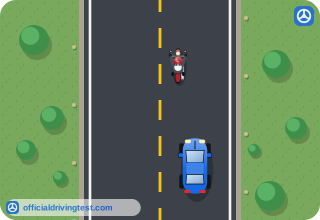
What must a motorist do about sharing a lane with a motorcycle?
- Never attempt to share it; the motorcyclist is entitled to the entire lane
- Share the lane only if the motorcycle is stopped or moving slowly
- Share the lane if the motorcyclist agrees to it
- Share the lane only during heavy traffic conditions
Show answer
Correct answer: Never attempt to share it; the motorcyclist is entitled to the entire lane
You must not attempt to share a lane with a motorcycle; the motorcyclist is entitled to the entire lane (p. 85).
Source: Florida Driver License Handbook (Revised August 2023), page 85
-
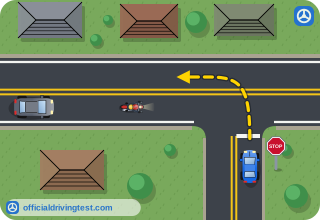
Why is it often difficult to gauge the speed and distance of an approaching motorcycle?
- Motorcycles always travel faster than the posted speed limit for the road
- Motorcycles take up less field of vision, which interferes with depth perception
- Motorcyclists intentionally try to hide from other drivers
- Motorcycles are required by law to use tinted headlights that are hard to see
Show answer
Correct answer: Motorcycles take up less field of vision, which interferes with depth perception
Motorcycles take up less field of vision, which interferes with depth perception; they may appear to be much farther away than they really are, so watch carefully before pulling into an intersection or changing lanes (p. 87).
Source: Florida Driver License Handbook (Revised August 2023), page 87
-
Why should you avoid following a motorcycle too closely?
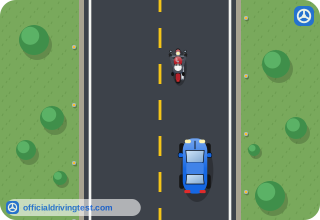
- It is only a matter of courtesy, not a real safety issue
- Motorcycles are required by law to stop every quarter mile
- Motorcycles cannot legally use brake lights
- Motorcycles have the ability to stop more quickly than other vehicles
Show answer
Correct answer: Motorcycles have the ability to stop more quickly than other vehicles
Do not follow too closely behind a motorcycle because motorcycles have the ability to stop more quickly than other vehicles (p. 87).
Source: Florida Driver License Handbook (Revised August 2023), page 87
-
Why should you never pass a motorcyclist with only a few feet of space?
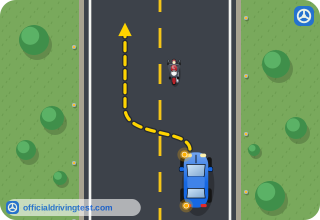
- The wind gust force from a close pass can cause the rider to lose control
- Passing closely will physically damage the motorcycle's mirrors
- Motorcyclists are legally required to pull over whenever they are passed
- It is only a minor courtesy issue with no real danger involved
Show answer
Correct answer: The wind gust force from a close pass can cause the rider to lose control
Never pass a motorcyclist with only a few feet of space; the wind gust force can cause the rider to lose control (p. 87).
Source: Florida Driver License Handbook (Revised August 2023), page 87
-
What following distance buffer should you maintain behind a motorcyclist, and when should you increase it?
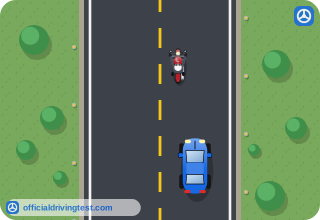
- A two-second buffer, increased only in heavy traffic on busy city streets
- No specific buffer distance is recommended for motorcycles
- A one-car-length buffer at all times, regardless of conditions
- More than a four-second buffer, increased in inclement weather or bad road conditions
Show answer
Correct answer: More than a four-second buffer, increased in inclement weather or bad road conditions
Maintain more than a four-second buffer zone between you and a motorcyclist, and increase space in inclement weather, gusty winds, wet or icy roads, bad road conditions such as potholes, gravel roads, and railroad crossings (p. 87).
Source: Florida Driver License Handbook (Revised August 2023), page 87
-
What is the minimum age to operate a motorcycle or moped on a public road in Florida?
- 14 years old
- 21 years old
- 18 years old
- 16 years old
Show answer
Correct answer: 16 years old
You must be 16 years of age or older to operate a motorcycle or moped on a public road (p. 87).
Source: Florida Driver License Handbook (Revised August 2023), page 87
-
If a person under 18 wants to obtain a Motorcycle Only license in Florida, what must they first do?
- Complete a commercial driving training program
- Pass a written test only, with no waiting period required
- Hold a learner's license for 30 days with no moving violation convictions
- Hold a learner's license for 12 months with no moving violation convictions
Show answer
Correct answer: Hold a learner's license for 12 months with no moving violation convictions
If under 18, you must hold a learner's license for 12 months with no moving violation convictions prior to the issuance of a Motorcycle Only license (p. 87).
Source: Florida Driver License Handbook (Revised August 2023), page 87
-
What must operators of motorcycles complete in order to get a motorcycle endorsement on their driver license?
- A commercial driver training program
- An approved motorcycle safety course
- A defensive driving course designed for cars
- Nothing at all; no training is required to ride a motorcycle
Show answer
Correct answer: An approved motorcycle safety course
Operators of motorcycles must complete an approved motorcycle safety course and get a motorcycle endorsement on their driver license or a Motorcycle Only license (p. 87).
Source: Florida Driver License Handbook (Revised August 2023), page 87
-
What license is required to operate a moped in Florida, and is a motorcycle endorsement required?
- A Class E driver license; a motorcycle endorsement is not required
- A commercial driver license; a motorcycle endorsement is required
- A learner's license only, valid for one year
- No license is required at all to operate a moped
Show answer
Correct answer: A Class E driver license; a motorcycle endorsement is not required
Operators of mopeds must have a Class E driver license; a motorcycle endorsement is not required (p. 87).
Source: Florida Driver License Handbook (Revised August 2023), page 87
-
When is a motorcycle operator NOT required to wear a helmet in Florida?
- If they are 18 or older and carry a policy with any amount of medical benefits
- If they are 21 or older and carry a policy with at least $10,000 in medical benefits
- If they only ride during daylight hours
- Never; helmets are always mandatory for all motorcycle operators
Show answer
Correct answer: If they are 21 or older and carry a policy with at least $10,000 in medical benefits
Operators of motorcycles must wear a helmet unless they are 21 or older AND carry a medical insurance policy providing for at least $10,000 in medical benefits for injuries (p. 87).
Source: Florida Driver License Handbook (Revised August 2023), page 87
-
When must a driver yield the right-of-way to a public transit bus?
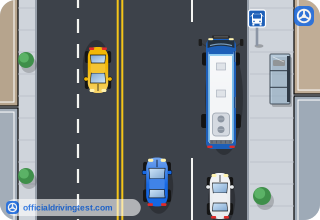
- When it has signaled to reenter traffic in your direction from a designated pullout bay
- Only when the bus displays a stop signal like a school bus
- Only on highways, not on city streets
- A public transit bus never has the right-of-way over other vehicles on the road
Show answer
Correct answer: When it has signaled to reenter traffic in your direction from a designated pullout bay
All drivers shall yield the right-of-way to public transit buses traveling in the same direction that have signaled and are reentering the traffic flow from a specifically designated pullout bay (p. 88).
Source: Florida Driver License Handbook (Revised August 2023), page 88
-
What is illegal for any driver to do in Florida regarding school buses?
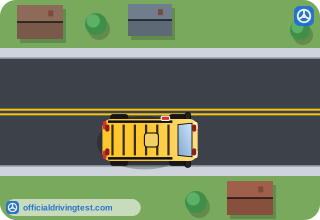
- Passing a school bus when it displays a stop signal
- Passing a school bus that has no children inside it
- Following a school bus at a safe distance
- Driving on the same road as a school bus
Show answer
Correct answer: Passing a school bus when it displays a stop signal
It is against the law for any driver to pass a school bus when the school bus displays a stop signal (p. 89).
Source: Florida Driver License Handbook (Revised August 2023), page 89
-
On a two-way street or highway, who must stop for a stopped school bus that is picking up or dropping off children?
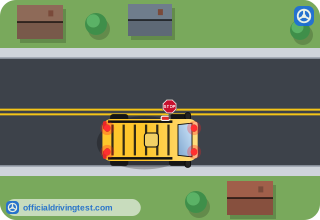
- Only drivers traveling in the same direction as the bus
- No one needs to stop if driving under 25 mph
- All drivers moving in either direction
- Only drivers approaching from behind the bus
Show answer
Correct answer: All drivers moving in either direction
On a two-way street or highway, all drivers moving in either direction must stop for a stopped school bus that is picking up or dropping off children, and must remain stopped until the stop signal is withdrawn and all children are clear of the roadway (p. 89).
Source: Florida Driver License Handbook (Revised August 2023), page 89
-
If a highway is divided by a raised barrier or unpaved median at least five feet wide, when do you NOT have to stop for a stopped school bus?
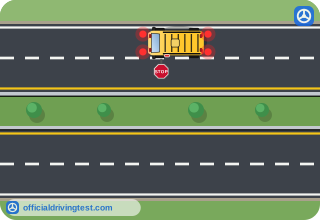
- Painted lines or pavement markings count as this kind of barrier, so you never have to stop
- If you are moving in the same direction as the bus
- If you are moving in the opposite direction of the bus
- You must always stop regardless of any median or barrier
Show answer
Correct answer: If you are moving in the opposite direction of the bus
If the highway is divided by a raised barrier or an unpaved median at least five feet wide, you do not have to stop if you are moving in the opposite direction of the bus. Painted lines or pavement markings are NOT considered barriers, and you must always stop if moving in the same direction as the bus (p. 89).
Source: Florida Driver License Handbook (Revised August 2023), page 89
-
What must a slow-moving farm vehicle designed for speeds less than 25 mph display on public highways (not including limited access highways/interstates)?
- A slow-moving vehicle sign on the rear
- A commercial vehicle license plate
- No special sign is required
- A red flag on the front only
Show answer
Correct answer: A slow-moving vehicle sign on the rear
Farm vehicles designed for operation at speeds less than 25 mph must display a slow-moving vehicle sign on the rear when using public highways (not limited access/interstates) (p. 89).
Source: Florida Driver License Handbook (Revised August 2023), page 89
-
When must a slow-moving vehicle displaying the slow-moving vehicle emblem be operated on public highways?
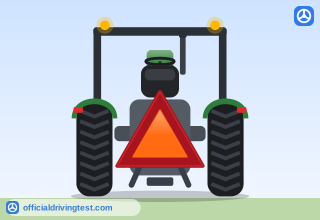
- Only at night, when there is less traffic, and never during daylight
- Only in daylight, unless equipped with lights/reflectors for night driving
- Only on Sundays and holidays, when traffic is lighter
- At any time, with no restriction whatsoever
Show answer
Correct answer: Only in daylight, unless equipped with lights/reflectors for night driving
Slow-moving vehicles must only be operated during daylight hours unless equipped with the proper lights/reflectors required for night driving (p. 89).
Source: Florida Driver License Handbook (Revised August 2023), page 89