Florida: Sharing the road — Part 3 Practice Test
Questions in this part include: “Who may drive a golf cart on a public road or street in Florida?” · “During what hours may a golf cart normally be operated in Florida?”
Independent educational site · not affiliated with any government agency or DMV
Ready? Test yourself
- Instant feedback with an explanation
- Every answer cites its source in the manual
- Your best score is saved on this device
Questions are original and based on the official manual "Florida Driver License Handbook" (Revised August 2023), Florida Department of Highway Safety and Motor Vehicles (FLHSMV).
Did you know?
- The Florida handbook has its own rules for golf carts and low-speed vehicles (LSVs) on public roads, and a golf cart can be converted into an LSV.
More background reading from the manual →
All 17 questions in this practice test
Take the test above first, then use this list to study. Tap “Show answer” to see the correct answer and explanation.
Show the questions and answersHide the questions
-
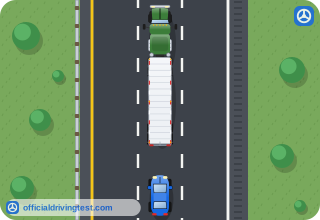
When passing a commercial motor vehicle (CMV) in Florida, what should you do?
- Pass on the right side for better visibility
- Pass without signaling or flashing your lights, to avoid distracting the driver
- Signal, blink your headlights to show you are passing, and pass on the left
- Tap your horn repeatedly while passing so the CMV driver knows you are there
Show answer
Correct answer: Signal, blink your headlights to show you are passing, and pass on the left
When passing a CMV, signal that you are changing lanes, let the driver know you are passing by blinking your headlights, and pass on the left side for maximum visibility (p. 84).
Source: Florida Driver License Handbook (Revised August 2023), page 84
-
Why should you avoid passing a commercial motor vehicle (CMV) on a downgrade (downhill slope)?
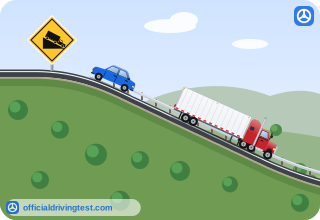
- Its weight and momentum will make it increase speed
- It is illegal to pass any vehicle on a downgrade
- CMVs are not allowed to drive on downgrades at all
- Downgrades have no real effect on passing a CMV
Show answer
Correct answer: Its weight and momentum will make it increase speed
On a downgrade, a CMV's weight and momentum will cause it to increase speed (p. 84).
Source: Florida Driver License Handbook (Revised August 2023), page 84
-
What must motorists, bicyclists, and pedestrians do regarding a funeral procession?
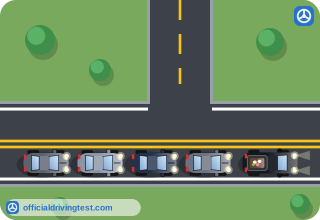
- Yield the right-of-way to the funeral procession
- There is no legal requirement to yield to funeral processions
- Only yield if the procession has a police escort
- Pass the procession as quickly as possible
Show answer
Correct answer: Yield the right-of-way to the funeral procession
Motorists, bicyclists, and pedestrians must yield the right-of-way to funeral processions (p. 84).
Source: Florida Driver License Handbook (Revised August 2023), page 84
-
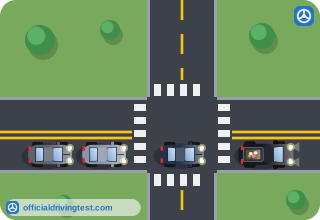
When the lead vehicle of a funeral procession enters an intersection, what may the rest of the procession do?
- They must stop and wait for a green light before proceeding
- Each vehicle must individually check for a break in traffic before proceeding
- They may follow through the intersection regardless of any traffic control devices
- Only the next two vehicles may follow; the rest must stop
Show answer
Correct answer: They may follow through the intersection regardless of any traffic control devices
When the funeral lead vehicle enters an intersection, the remaining vehicles in the procession may follow through regardless of any traffic control devices (p. 84).
Source: Florida Driver License Handbook (Revised August 2023), page 84
-
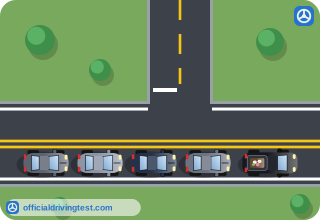
How do vehicles in a funeral procession signal to other drivers not to drive between them?
- By sounding their horns continuously
- By using their headlights on or flashing hazard lights
- By displaying a special funeral procession flag
- By driving with their trunk lids open
Show answer
Correct answer: By using their headlights on or flashing hazard lights
Vehicles in the procession should have their headlights on or may use flashing hazard lights as a signal to others not to drive between the funeral procession vehicles (p. 84).
Source: Florida Driver License Handbook (Revised August 2023), page 84
-
On which roadways may you drive a golf cart in Florida?
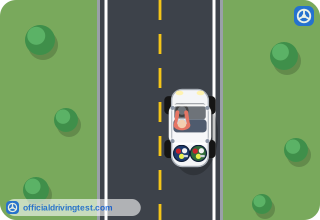
- Only on roadways designated for golf carts
- Only on limited access highways
- On any state road with a posted speed limit of 45 mph or less
- On any public road with a speed limit of 55 mph or less
Show answer
Correct answer: Only on roadways designated for golf carts
You may only drive a golf cart on golf courses or roadways that are designated for golf carts; these roads will be marked with appropriate signs (p. 85).
Source: Florida Driver License Handbook (Revised August 2023), page 85
-
Who may drive a golf cart on a public road or street in Florida?
- Anyone at all, regardless of age, license status, or identification
- Under 18: a learner's or driver license; 18 or older: a government-issued photo ID
- Under 18: no license is needed; 18 or older: a commercial driver license
- Anyone age 14 or older, with no license or identification needed
Show answer
Correct answer: Under 18: a learner's or driver license; 18 or older: a government-issued photo ID
A golf cart must not be driven on a public road by anyone under 18 unless they possess a valid learner's or driver license; drivers 18 or older must possess valid government-issued photo identification (p. 85).
Source: Florida Driver License Handbook (Revised August 2023), page 85
-
Are golf carts always allowed to be operated on Florida public roads?
- Yes, but only in Miami-Dade County
- Yes, golf carts may be driven anywhere in the state without restriction
- No, golf carts are completely banned from all public roads statewide
- No, golf carts may not be operated at all unless allowed by the county or city
Show answer
Correct answer: No, golf carts may not be operated at all unless allowed by the county or city
Golf carts may not be operated at all unless allowed by the specific county or city (p. 85).
Source: Florida Driver License Handbook (Revised August 2023), page 85
-
During what hours may a golf cart normally be operated in Florida?
- Only between 6 a.m. and 6 p.m., and local governments may not allow other hours
- Only at night, between sunset and sunrise, to avoid daytime traffic
- 24 hours a day with no restrictions at all
- Only between sunrise and sunset, unless the local government permits other hours
Show answer
Correct answer: Only between sunrise and sunset, unless the local government permits other hours
A golf cart must only be operated between sunrise and sunset, unless the local government permits driving outside those hours (additional equipment is required for night driving) (p. 85).
Source: Florida Driver License Handbook (Revised August 2023), page 85
-
Under what conditions may a golf cart cross a state road in Florida?
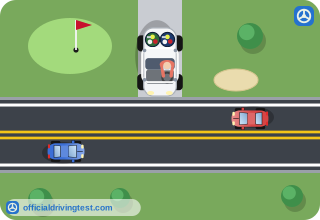
- If the posted speed limit is 45 mph or less, at an intersection with a traffic control device
- At any point along the state road, regardless of the posted speed limit
- Golf carts may never cross a state road, even at an intersection with a traffic signal
- Only if the golf cart has a horn and mirrors installed
Show answer
Correct answer: If the posted speed limit is 45 mph or less, at an intersection with a traffic control device
You may cross state roads with a golf cart if the posted speed limit is 45 mph or less and only at an intersection with a traffic control device (p. 85).
Source: Florida Driver License Handbook (Revised August 2023), page 85
-
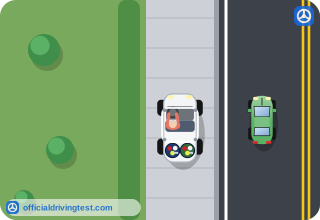
When may a golf cart be driven on a sidewalk in Florida?
- Anytime, with no width requirement at all
- Never; golf carts are banned from all sidewalks
- Only if it is at least 5 feet wide, and you must yield to pedestrians
- Only if it is at least 10 feet wide, and pedestrians must yield to you
Show answer
Correct answer: Only if it is at least 5 feet wide, and you must yield to pedestrians
You can drive a golf cart on a sidewalk only if it is at least 5 feet wide; you must yield to pedestrians (p. 85).
Source: Florida Driver License Handbook (Revised August 2023), page 85
-
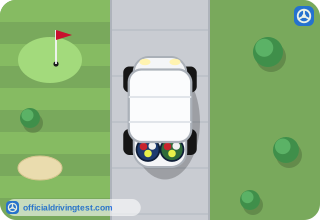
Which of the following is required equipment for a golf cart in Florida?
- A horn, a speedometer, and a backup camera
- A speedometer, an odometer, and a fuel gauge
- Efficient brakes, reliable steering, and safe tires
- Air conditioning, a radio, and power windows
Show answer
Correct answer: Efficient brakes, reliable steering, and safe tires
Required golf cart equipment includes efficient brakes, a rear-view mirror, reliable steering, front and rear red warning reflectors, and safe tires (p. 85).
Source: Florida Driver License Handbook (Revised August 2023), page 85
-
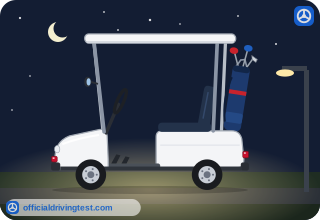
If a golf cart is permitted to be driven at night, what additional equipment is required?
- A horn, a bell, a backup camera, and mud flaps
- A GPS tracking device, a radio, and a roll cage
- Snow tires, tire chains, a spoiler, and a tow hook
- Headlights, brake lights, turn signals, and a windshield
Show answer
Correct answer: Headlights, brake lights, turn signals, and a windshield
A golf cart operated at night requires headlights, brake lights, turn signals, and a windshield (p. 85).
Source: Florida Driver License Handbook (Revised August 2023), page 85
-
Why should child passenger safety seats not be used on golf carts or low-speed vehicles (LSVs)?
- Car seats are not crash tested for LSVs and may not perform as designed
- Golf carts and LSVs do not have any seats at all
- They are too heavy for golf carts and LSVs to carry
- It is simply more comfortable for children to sit without a car seat
Show answer
Correct answer: Car seats are not crash tested for LSVs and may not perform as designed
Car seats are not crash tested for LSVs and may not perform as designed; refer to the specific car seat manufacturer for more information (p. 85).
Source: Florida Driver License Handbook (Revised August 2023), page 85
-
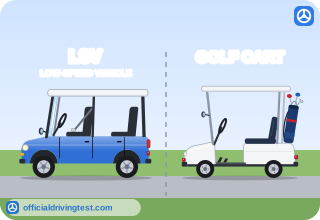
How is a low-speed vehicle (LSV) defined in Florida?
- A four-wheeled vehicle with a top speed of 21-25 mph
- A three-wheeled vehicle with no speed limit
- Any vehicle with a top speed under 10 mph
- A two-wheeled vehicle with a top speed of 15 mph
Show answer
Correct answer: A four-wheeled vehicle with a top speed of 21-25 mph
Low-speed vehicles (LSV) are four-wheeled vehicles with top speeds of 21-25 mph; golf carts can be converted to LSVs (p. 85).
Source: Florida Driver License Handbook (Revised August 2023), page 85
-
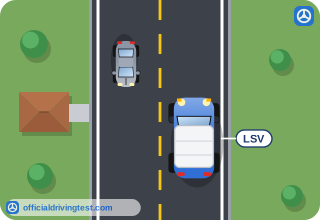
What is required to legally operate a low-speed vehicle (LSV) in Florida, and where may it be driven?
- A learner's license is sufficient, and it may be driven on any interstate
- No license is required, and it may be driven on any road including limited access highways
- A valid driver license is required, and it may only be driven on streets posted at 35 mph or less
- A commercial driver license is required, and it may only be driven on golf courses
Show answer
Correct answer: A valid driver license is required, and it may only be driven on streets posted at 35 mph or less
You must have a valid driver license to operate an LSV, and it may only be operated on streets with a posted speed limit of 35 mph or less (p. 85).
Source: Florida Driver License Handbook (Revised August 2023), page 85
-
Which of the following must a low-speed vehicle (LSV) be equipped with?
- A commercial vehicle placard and a fire extinguisher
- Snow chains, a spare tire, and a trailer hitch
- Only a horn and headlights
- Headlamps, stop lamps, turn signals, and safety belts
Show answer
Correct answer: Headlamps, stop lamps, turn signals, and safety belts
An LSV must be equipped with headlamps, stop lamps, turn signals, tail lamps, reflectors, parking brakes, rear-view mirrors, a windshield, safety belts, and a vehicle identification number (p. 85).
Source: Florida Driver License Handbook (Revised August 2023), page 85