Florida: Sharing the road — Part 4 Practice Test
Questions in this part include: “What else is required of a low-speed vehicle (LSV) in Florida besides equipment?” · “What must operators of motorcycles complete in order to get a motorcycle endorsement on their driver license?”
Independent educational site · not affiliated with any government agency or DMV
Ready? Test yourself
- Instant feedback with an explanation
- Every answer cites its source in the manual
- Your best score is saved on this device
Questions are original and based on the official manual "Florida Driver License Handbook" (Revised August 2023), Florida Department of Highway Safety and Motor Vehicles (FLHSMV).
Did you know?
- The Florida handbook has its own rules for golf carts and low-speed vehicles (LSVs) on public roads, and a golf cart can be converted into an LSV.
More background reading from the manual →
All 17 questions in this practice test
Take the test above first, then use this list to study. Tap “Show answer” to see the correct answer and explanation.
Show the questions and answersHide the questions
-
What else is required of a low-speed vehicle (LSV) in Florida besides equipment?
- There are no additional requirements beyond equipment
- It must display a "Student Driver" sign
- It must be registered and properly insured
- It must be inspected monthly by a mechanic
Show answer
Correct answer: It must be registered and properly insured
An LSV must be registered and properly insured (p. 85).
Source: Florida Driver License Handbook (Revised August 2023), page 85
-
What must a motorist do about sharing a lane with a motorcycle?
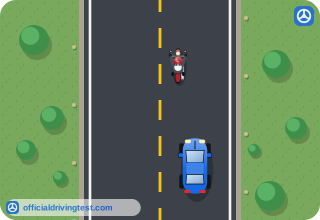
- Never attempt to share it; the motorcyclist is entitled to the entire lane
- Share the lane only if the motorcycle is stopped or moving slowly
- Share the lane if the motorcyclist agrees to it
- Share the lane only during heavy traffic conditions
Show answer
Correct answer: Never attempt to share it; the motorcyclist is entitled to the entire lane
You must not attempt to share a lane with a motorcycle; the motorcyclist is entitled to the entire lane (p. 85).
Source: Florida Driver License Handbook (Revised August 2023), page 85
-
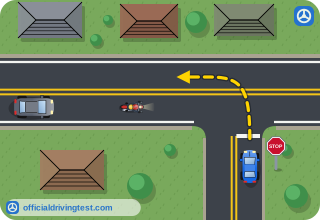
Why is it often difficult to gauge the speed and distance of an approaching motorcycle?
- Motorcycles always travel faster than the posted speed limit for the road
- Motorcycles take up less field of vision, which interferes with depth perception
- Motorcyclists intentionally try to hide from other drivers
- Motorcycles are required by law to use tinted headlights that are hard to see
Show answer
Correct answer: Motorcycles take up less field of vision, which interferes with depth perception
Motorcycles take up less field of vision, which interferes with depth perception; they may appear to be much farther away than they really are, so watch carefully before pulling into an intersection or changing lanes (p. 87).
Source: Florida Driver License Handbook (Revised August 2023), page 87
-
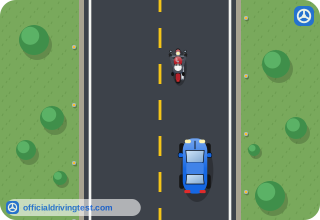
Why should you avoid following a motorcycle too closely?
- It is only a matter of courtesy, not a real safety issue
- Motorcycles are required by law to stop every quarter mile
- Motorcycles cannot legally use brake lights
- Motorcycles have the ability to stop more quickly than other vehicles
Show answer
Correct answer: Motorcycles have the ability to stop more quickly than other vehicles
Do not follow too closely behind a motorcycle because motorcycles have the ability to stop more quickly than other vehicles (p. 87).
Source: Florida Driver License Handbook (Revised August 2023), page 87
-
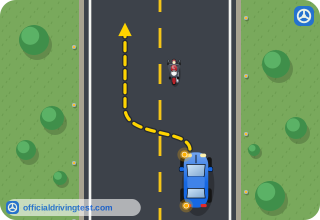
Why should you never pass a motorcyclist with only a few feet of space?
- The wind gust force from a close pass can cause the rider to lose control
- Passing closely will physically damage the motorcycle's mirrors
- Motorcyclists are legally required to pull over whenever they are passed
- It is only a minor courtesy issue with no real danger involved
Show answer
Correct answer: The wind gust force from a close pass can cause the rider to lose control
Never pass a motorcyclist with only a few feet of space; the wind gust force can cause the rider to lose control (p. 87).
Source: Florida Driver License Handbook (Revised August 2023), page 87
-
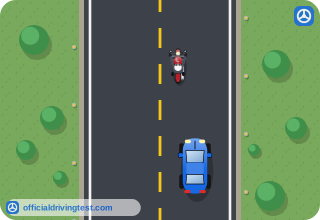
What following distance buffer should you maintain behind a motorcyclist, and when should you increase it?
- A two-second buffer, increased only in heavy traffic on busy city streets
- No specific buffer distance is recommended for motorcycles
- A one-car-length buffer at all times, regardless of conditions
- More than a four-second buffer, increased in inclement weather or bad road conditions
Show answer
Correct answer: More than a four-second buffer, increased in inclement weather or bad road conditions
Maintain more than a four-second buffer zone between you and a motorcyclist, and increase space in inclement weather, gusty winds, wet or icy roads, bad road conditions such as potholes, gravel roads, and railroad crossings (p. 87).
Source: Florida Driver License Handbook (Revised August 2023), page 87
-
What is the minimum age to operate a motorcycle or moped on a public road in Florida?
- 14 years old
- 21 years old
- 18 years old
- 16 years old
Show answer
Correct answer: 16 years old
You must be 16 years of age or older to operate a motorcycle or moped on a public road (p. 87).
Source: Florida Driver License Handbook (Revised August 2023), page 87
-
If a person under 18 wants to obtain a Motorcycle Only license in Florida, what must they first do?
- Complete a commercial driving training program
- Pass a written test only, with no waiting period required
- Hold a learner's license for 30 days with no moving violation convictions
- Hold a learner's license for 12 months with no moving violation convictions
Show answer
Correct answer: Hold a learner's license for 12 months with no moving violation convictions
If under 18, you must hold a learner's license for 12 months with no moving violation convictions prior to the issuance of a Motorcycle Only license (p. 87).
Source: Florida Driver License Handbook (Revised August 2023), page 87
-
What must operators of motorcycles complete in order to get a motorcycle endorsement on their driver license?
- A commercial driver training program
- An approved motorcycle safety course
- A defensive driving course designed for cars
- Nothing at all; no training is required to ride a motorcycle
Show answer
Correct answer: An approved motorcycle safety course
Operators of motorcycles must complete an approved motorcycle safety course and get a motorcycle endorsement on their driver license or a Motorcycle Only license (p. 87).
Source: Florida Driver License Handbook (Revised August 2023), page 87
-
What license is required to operate a moped in Florida, and is a motorcycle endorsement required?
- A Class E driver license; a motorcycle endorsement is not required
- A commercial driver license; a motorcycle endorsement is required
- A learner's license only, valid for one year
- No license is required at all to operate a moped
Show answer
Correct answer: A Class E driver license; a motorcycle endorsement is not required
Operators of mopeds must have a Class E driver license; a motorcycle endorsement is not required (p. 87).
Source: Florida Driver License Handbook (Revised August 2023), page 87
-
When is a motorcycle operator NOT required to wear a helmet in Florida?
- If they are 18 or older and carry a policy with any amount of medical benefits
- If they are 21 or older and carry a policy with at least $10,000 in medical benefits
- If they only ride during daylight hours
- Never; helmets are always mandatory for all motorcycle operators
Show answer
Correct answer: If they are 21 or older and carry a policy with at least $10,000 in medical benefits
Operators of motorcycles must wear a helmet unless they are 21 or older AND carry a medical insurance policy providing for at least $10,000 in medical benefits for injuries (p. 87).
Source: Florida Driver License Handbook (Revised August 2023), page 87
-
When must a driver yield the right-of-way to a public transit bus?
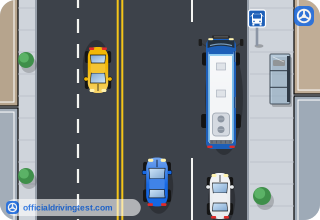
- When it has signaled to reenter traffic in your direction from a designated pullout bay
- Only when the bus displays a stop signal like a school bus
- Only on highways, not on city streets
- A public transit bus never has the right-of-way over other vehicles on the road
Show answer
Correct answer: When it has signaled to reenter traffic in your direction from a designated pullout bay
All drivers shall yield the right-of-way to public transit buses traveling in the same direction that have signaled and are reentering the traffic flow from a specifically designated pullout bay (p. 88).
Source: Florida Driver License Handbook (Revised August 2023), page 88
-
What is illegal for any driver to do in Florida regarding school buses?
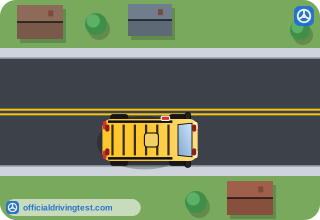
- Passing a school bus when it displays a stop signal
- Passing a school bus that has no children inside it
- Following a school bus at a safe distance
- Driving on the same road as a school bus
Show answer
Correct answer: Passing a school bus when it displays a stop signal
It is against the law for any driver to pass a school bus when the school bus displays a stop signal (p. 89).
Source: Florida Driver License Handbook (Revised August 2023), page 89
-
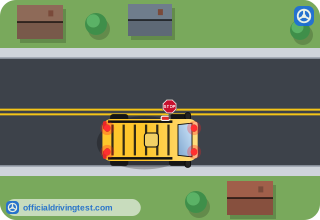
On a two-way street or highway, who must stop for a stopped school bus that is picking up or dropping off children?
- Only drivers traveling in the same direction as the bus
- No one needs to stop if driving under 25 mph
- All drivers moving in either direction
- Only drivers approaching from behind the bus
Show answer
Correct answer: All drivers moving in either direction
On a two-way street or highway, all drivers moving in either direction must stop for a stopped school bus that is picking up or dropping off children, and must remain stopped until the stop signal is withdrawn and all children are clear of the roadway (p. 89).
Source: Florida Driver License Handbook (Revised August 2023), page 89
-
If a highway is divided by a raised barrier or unpaved median at least five feet wide, when do you NOT have to stop for a stopped school bus?
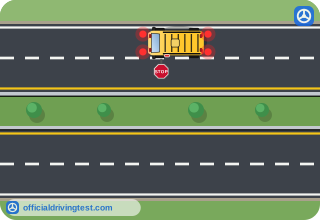
- Painted lines or pavement markings count as this kind of barrier, so you never have to stop
- If you are moving in the same direction as the bus
- If you are moving in the opposite direction of the bus
- You must always stop regardless of any median or barrier
Show answer
Correct answer: If you are moving in the opposite direction of the bus
If the highway is divided by a raised barrier or an unpaved median at least five feet wide, you do not have to stop if you are moving in the opposite direction of the bus. Painted lines or pavement markings are NOT considered barriers, and you must always stop if moving in the same direction as the bus (p. 89).
Source: Florida Driver License Handbook (Revised August 2023), page 89
-
What must a slow-moving farm vehicle designed for speeds less than 25 mph display on public highways (not including limited access highways/interstates)?
- A slow-moving vehicle sign on the rear
- A commercial vehicle license plate
- No special sign is required
- A red flag on the front only
Show answer
Correct answer: A slow-moving vehicle sign on the rear
Farm vehicles designed for operation at speeds less than 25 mph must display a slow-moving vehicle sign on the rear when using public highways (not limited access/interstates) (p. 89).
Source: Florida Driver License Handbook (Revised August 2023), page 89
-
When must a slow-moving vehicle displaying the slow-moving vehicle emblem be operated on public highways?
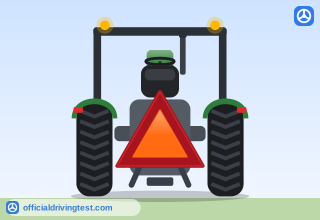
- Only at night, when there is less traffic, and never during daylight
- Only in daylight, unless equipped with lights/reflectors for night driving
- Only on Sundays and holidays, when traffic is lighter
- At any time, with no restriction whatsoever
Show answer
Correct answer: Only in daylight, unless equipped with lights/reflectors for night driving
Slow-moving vehicles must only be operated during daylight hours unless equipped with the proper lights/reflectors required for night driving (p. 89).
Source: Florida Driver License Handbook (Revised August 2023), page 89