Florida: Sharing the road — Part 2 Practice Test
Questions in this part include: “You must not pass within 100 feet of which of the following?” · “What braking capability must a bicycle have under Florida law?”
Independent educational site · not affiliated with any government agency or DMV
Ready? Test yourself
Answer to start, or tap Start below:
You must not pass within 100 feet of which of the following?
- Instant feedback with an explanation
- Every answer cites its source in the manual
- Your best score is saved on this device
- Keyboard: press 1 to 4 to answer and Enter for the next question
Questions are original and based on the official manual "Florida Driver License Handbook" (Revised August 2023), Florida Department of Highway Safety and Motor Vehicles (FLHSMV).
Did you know?
- The Florida handbook has its own rules for golf carts and low-speed vehicles (LSVs) on public roads, and a golf cart can be converted into an LSV.
More background reading from the manual →
All 17 questions in this practice test
Take the test above first, then use this list to study. Tap “Show answer” to see the correct answer and explanation.
Show the questions and answersHide the questions
-
You must not pass within 100 feet of which of the following?
- A gas station or convenience store
- A residential driveway or mailbox
- An intersection or railroad crossing
- A shopping center
Show answer
Correct answer: An intersection or railroad crossing
You must not pass within 100 feet of an intersection, bridge, viaduct, tunnel, or railroad crossing.
Source: Florida Driver License Handbook (Revised August 2023), page 67
-
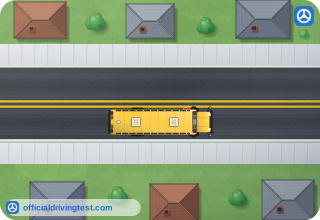
You must not pass when a school bus is stopped and has what activated?
- Its radio playing
- Its headlights and windshield wipers
- Its warning flashers and stop sign
- Its air conditioning on
Show answer
Correct answer: Its warning flashers and stop sign
You must not pass when a school bus is stopped and has its warning flashers on and stop sign extended.
Source: Florida Driver License Handbook (Revised August 2023), page 67
-
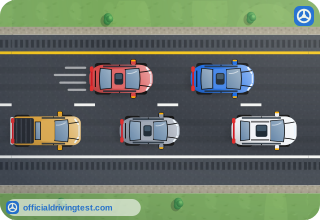
You are driving in the left lane and a faster vehicle comes up behind you to overtake. What does Florida law require you to do?
- Speed up to stay ahead of the faster vehicle behind you
- Move out of the left lane, and do not increase your speed
- Brake suddenly in your lane
- Move further left to block the pass
Show answer
Correct answer: Move out of the left lane, and do not increase your speed
Do not increase your speed when you are being passed; move to the right side of your lane. Florida law states that a driver must move out of the left lane when being overtaken from behind by another vehicle traveling at a faster speed.
Source: Florida Driver License Handbook (Revised August 2023), page 67
-
When is passing on the right legal?
- Only at night, when there is little traffic
- When two or more lanes are moving in the same direction
- Anytime you are in a hurry to reach your destination
- Only on a single-lane road
Show answer
Correct answer: When two or more lanes are moving in the same direction
Passing on the right is only legal when there are two or more traffic lanes moving in the same direction or the vehicle you are passing is making a left turn.
Source: Florida Driver License Handbook (Revised August 2023), page 67
-
In Florida, how is a bicycle legally defined, and where does this NOT apply?
- As a pedestrian device, with the same rights as someone walking, on all roads including interstates
- As a vehicle only on bike paths, with no rights on any public road
- As a vehicle, with the rights and duties of a motor vehicle operator on public roads, except limited access highways
- As a toy, with no legal rights or responsibilities on any road
Show answer
Correct answer: As a vehicle, with the rights and duties of a motor vehicle operator on public roads, except limited access highways
Florida law defines a bicycle as a vehicle with all the rights, privileges, and responsibilities of a motor vehicle operator on public roads, except on limited access highways (p. 81).
Source: Florida Driver License Handbook (Revised August 2023), page 81
-
Under what circumstances may a Florida bicyclist ride in the travel lane instead of a bike lane, or use the full lane even while traveling below the speed of traffic?
- Only on weekends and holidays, when there is less motor vehicle traffic
- Only when the bicyclist wants to ride faster than a car
- Never; bicyclists must always stay in the bike lane whenever one exists on the road
- Narrow roads, hazards, a left turn, or a lane too narrow for a car and bicycle to share
Show answer
Correct answer: Narrow roads, hazards, a left turn, or a lane too narrow for a car and bicycle to share
A bicyclist may leave the bike lane for narrow roads, to avoid obstacles or pavement hazards, to prepare for a left turn, or to use the full lane if it is too narrow for a car and bicycle to share (p. 81).
Source: Florida Driver License Handbook (Revised August 2023), page 81
-
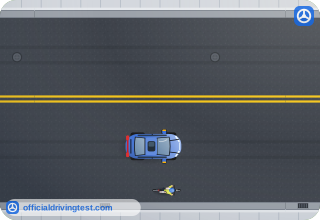
When passing a bicyclist, what clearance does Florida law require?
- A minimum of one foot of clearance
- Flash the headlights and pass at normal speed
- Sound the horn to alert the bicyclist instead of leaving extra space
- A minimum of three feet of clearance, using caution and slow speed
Show answer
Correct answer: A minimum of three feet of clearance, using caution and slow speed
Florida law requires giving bicyclists a minimum of three feet of clearance and using caution and slow speed when driving next to or passing them (p. 81).
Source: Florida Driver License Handbook (Revised August 2023), page 81
-
Between sunset and sunrise, what lighting must a bicycle have?
- A white light visible from 500 feet on the front, and a red reflector and red light visible from 600 feet on the rear
- A red light visible from 500 feet on the front, and a white reflector and white light visible from 600 feet on the rear
- Only reflectors; no lights are required
- A flashing yellow light visible from 100 feet in any direction
Show answer
Correct answer: A white light visible from 500 feet on the front, and a red reflector and red light visible from 600 feet on the rear
Between sunset and sunrise, bicyclists must have a white light visible from 500 feet on the front and a red reflector and red light visible from 600 feet on the rear (p. 82).
Source: Florida Driver License Handbook (Revised August 2023), page 82
-
What braking capability must a bicycle have under Florida law?
- Brakes that can stop the bicycle within 25 feet from a speed of 25 mph
- Brakes that can stop the bicycle within 25 feet from a speed of 10 mph
- Brakes that can stop the bicycle within 100 feet from a speed of 10 mph
- There is no specific braking requirement for bicycles
Show answer
Correct answer: Brakes that can stop the bicycle within 25 feet from a speed of 10 mph
A bicycle's brakes must be able to stop the bike within 25 feet from a speed of 10 mph (p. 82).
Source: Florida Driver License Handbook (Revised August 2023), page 82
-
Who is required to wear a helmet while riding a bicycle in Florida?
- Only bicyclists riding on public roads, not on sidewalks
- Only bicyclists under age 12, using helmets that meet federal safety standards
- All bicyclists and passengers under age 16, using helmets that meet federal safety standards
- Only bicyclists riding on sidewalks
Show answer
Correct answer: All bicyclists and passengers under age 16, using helmets that meet federal safety standards
All bicyclists and passengers under age 16 are required to wear helmets that meet federal safety standards (p. 82).
Source: Florida Driver License Handbook (Revised August 2023), page 82
-
If a bicyclist is transporting a child under age four or weighing 40 pounds or less, what must they use?
- The child must ride on the handlebars
- A back-pack/sling, child seat, or trailer designed to carry children
- A regular bicycle seat, with no other equipment needed
- A helmet for the bicyclist only, with no special carrier needed
Show answer
Correct answer: A back-pack/sling, child seat, or trailer designed to carry children
A bicyclist transporting a child under age four or weighing 40 pounds or less must use a back-pack/sling, child seat, or trailer designed to carry children (p. 82).
Source: Florida Driver License Handbook (Revised August 2023), page 82
-
How many bicyclists may ride side-by-side on a Florida roadway that is not a path or reserved bicycle lane?
- Bicyclists may never ride side-by-side under any circumstance
- No more than two side-by-side, and they must ride single file if impeding traffic
- Up to four side-by-side, and they must ride single file only at night
- An unlimited number, as long as they all stay to the right of the lane
Show answer
Correct answer: No more than two side-by-side, and they must ride single file if impeding traffic
Bicyclists riding together may not ride more than two side-by-side unless on a path or a part of a roadway reserved for bicycles; they must ride single file if impeding traffic (p. 82).
Source: Florida Driver License Handbook (Revised August 2023), page 82
-
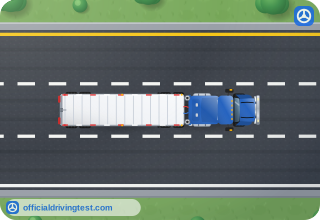
What is the "No Zone" when sharing the road with a commercial motor vehicle (CMV)?
- A designated parking area for trucks
- A no-passing zone marked by road signs
- The area where CMVs themselves are prohibited from driving
- The large blind spots in front, behind, and on both sides of the CMV
Show answer
Correct answer: The large blind spots in front, behind, and on both sides of the CMV
The "No Zone" refers to the large blind spots in front, behind, and on both sides of a CMV; other vehicles are hidden from the CMV driver's view within these zones (p. 82).
Source: Florida Driver License Handbook (Revised August 2023), page 82
-
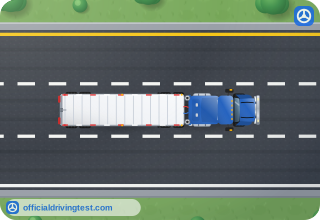
Why should you avoid tailgating a commercial motor vehicle (CMV)?
- Tailgating a CMV will trigger its backup alarm
- You will be in the CMV's rear blind spot and may collide with it if it stops unexpectedly
- It is illegal to drive behind any large vehicle at all
- CMVs are required to stop suddenly at random intervals
Show answer
Correct answer: You will be in the CMV's rear blind spot and may collide with it if it stops unexpectedly
Following too closely puts you in the CMV's rear blind spot, and you may collide with it if it stops unexpectedly (p. 82).
Source: Florida Driver License Handbook (Revised August 2023), page 82
-
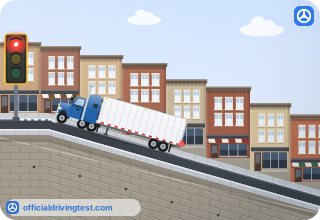
If you are stopped behind a commercial motor vehicle (CMV) on an upgrade (hill), what should you do?
- Pass the CMV immediately while it is stopped on the hill
- Leave space in case the CMV drifts back, and keep to the left in your lane
- Pull up as close as possible to the CMV, and keep to the right in your lane
- Honk your horn continuously until the CMV starts to move again
Show answer
Correct answer: Leave space in case the CMV drifts back, and keep to the left in your lane
Leave space in case the CMV drifts back when it starts to move, and keep to the left in your lane so the driver can see your vehicle (p. 82).
Source: Florida Driver License Handbook (Revised August 2023), page 82
-
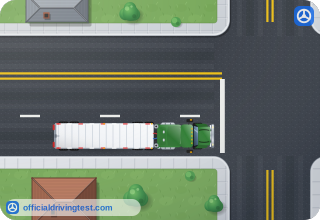
Why should you never drive between a commercial motor vehicle (CMV) and the curb when the CMV is preparing to make a right turn?
- CMVs always turn right without any warning, so you cannot predict them
- The area next to the curb is reserved exclusively for bicycles
- It is against the law for any car to drive next to a curb
- CMVs often swing wide to the left to turn right, and the driver cannot see you
Show answer
Correct answer: CMVs often swing wide to the left to turn right, and the driver cannot see you
CMVs often need to swing wide to the left in order to make a right turn, so a driver between the CMV and the curb will not be seen (p. 84).
Source: Florida Driver License Handbook (Revised August 2023), page 84
-
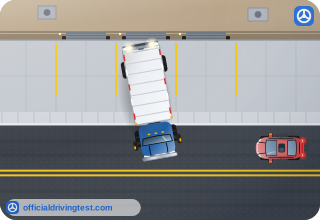
Why should you never cross behind a commercial motor vehicle (CMV) that is backing up or preparing to back up?
- It is illegal to walk or drive behind any vehicle at any time
- The size of most CMVs and trailers completely hides objects behind them
- Only pedestrians are at risk in this situation, not other vehicles
- CMVs backing up always sound a warning horn before moving
Show answer
Correct answer: The size of most CMVs and trailers completely hides objects behind them
The size of most CMVs and trailers completely hides objects behind them from the driver's view, so you should never cross behind one that is backing up (p. 84).
Source: Florida Driver License Handbook (Revised August 2023), page 84