Florida: Exam Simulator
50 random questions from every topic, like a mini exam.
Independent educational site · not affiliated with any government agency or DMV
Ready? Test yourself
Like the real test: 50 questions; pass with 40 correct.
- Instant feedback with an explanation
- Every answer cites its source in the manual
- Your best score is saved on this device
- Keyboard: press 1 to 4 to answer and Enter for the next question
Questions are original and based on the official manual "Florida Driver License Handbook" (Revised August 2023), Florida Department of Highway Safety and Motor Vehicles (FLHSMV).
Sample questions
The exam simulator picks 50 random questions from every topic each time you start. Here are a few examples.
Show the questions and answersHide the questions
-
According to the handbook, one way to be considered a Florida resident is to have your principal place of domicile in Florida for how long?
- At least 30 days
- At least one full year
- More than six consecutive months
- At least 90 days
Show answer
Correct answer: More than six consecutive months
The handbook defines a resident as a person who has their principal place of domicile in Florida for a period of more than six consecutive months (or who has registered to vote, filed a statement of domicile, or claimed homestead exemption).
Source: Florida Driver License Handbook (Revised August 2023), page 3
-
According to Florida's equipment standards, how many separate braking systems must a car have, each capable of stopping the car alone?
- Two
- One
- Three
- Four
Show answer
Correct answer: Two
A car must have two braking systems, each able to stop the car alone; the parking or emergency brake should be strong enough to hold the car on any hill.
Source: Florida Driver License Handbook (Revised August 2023), page 38
-
What is the purpose of pavement markings, such as lines, symbols, and words painted on roadways?
- To show the speed limit in construction zones
- To help direct drivers and control traffic flow
- To mark areas of historical significance
- To indicate the location of gas stations and restaurants
Show answer
Correct answer: To help direct drivers and control traffic flow
Pavement markings—lines, symbols, and words painted on the road—are used to help direct drivers and control the flow of traffic.
Source: Florida Driver License Handbook (Revised August 2023), page 43
-
When entering a limited access highway, what should you do on the entrance ramp?
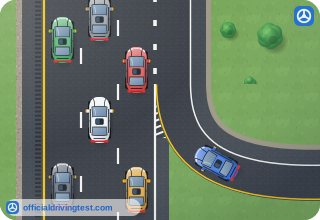
- Begin checking for an opening in traffic and signal your intent to merge
- Turn on your hazard lights and drive slowly on the shoulder
- Reverse back onto the surface street if traffic looks heavy
- Come to a complete stop and wait for a police officer to wave you on
Show answer
Correct answer: Begin checking for an opening in traffic and signal your intent to merge
On the entrance ramp, begin checking for an opening in traffic and signal your intent to merge onto the highway.
Source: Florida Driver License Handbook (Revised August 2023), page 63
-
When parking on a public road, on which side should you park (unless it is a one-way street), and how close to the curb?
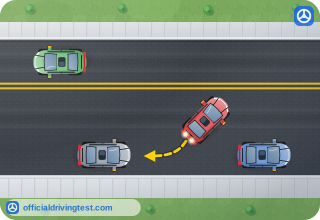
- On the left side, perpendicular to the curb, with front wheels touching it
- On the right side, parallel to the curb, with right-hand wheels within 12 inches of it
- Anywhere, as long as the hazard lights are on
- On either side, parallel to the curb, with wheels within 24 inches of it
Show answer
Correct answer: On the right side, parallel to the curb, with right-hand wheels within 12 inches of it
Always park on the right side of the road, unless it is a one-way street. Park parallel to the curb in the direction of traffic, with right-hand wheels parallel to and within 12 inches of the curb or side of roadway.
Source: Florida Driver License Handbook (Revised August 2023), page 65
-
What does the color red on a traffic sign indicate?
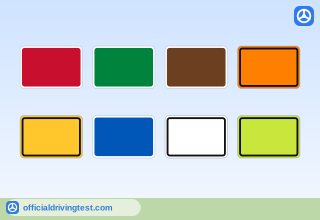
- Stop, do not enter, wrong way, or yield
- Construction and maintenance warning
- Guide or directional information
- General warning of unexpected roadway conditions
Show answer
Correct answer: Stop, do not enter, wrong way, or yield
Red traffic signs mean stop, do not enter, wrong way, or yield.
Source: Florida Driver License Handbook (Revised August 2023), page 46
-
On Green Guide Signs, how are highway route numbers typically assigned?
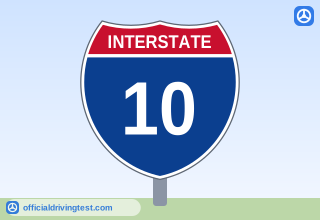
- Route numbers indicate the posted speed limit
- All routes are numbered sequentially regardless of direction
- East-West routes have even numbers, and North-South routes have odd numbers
- East-West routes have odd numbers, and North-South routes have even numbers
Show answer
Correct answer: East-West routes have even numbers, and North-South routes have odd numbers
Green Guide Signs give information about directions and distances; East-West routes have even numbers and North-South routes have odd numbers.
Source: Florida Driver License Handbook (Revised August 2023), page 46
-
If a traffic signal is out of order and no law enforcement officer is present, how should you treat the intersection?
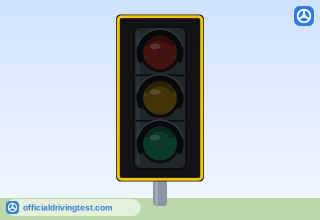
- Treat it as a four-way stop sign
- Proceed through without stopping because the signal is broken
- Treat it as a yield sign
- Wait until the signal starts working again before proceeding
Show answer
Correct answer: Treat it as a four-way stop sign
Drivers, pedestrians, and bicycle riders must obey traffic signals except when an officer is directing traffic. If a signal is out of order and no law enforcement is present, treat the intersection as a four-way stop sign.
Source: Florida Driver License Handbook (Revised August 2023), page 51
-
At an intersection marked with a stop line, after coming to a complete stop, who must you yield the right-of-way to?
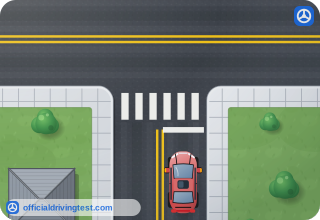
- No one; you may proceed immediately after a complete stop
- Only vehicles turning left
- Only vehicles with their headlights on
- Traffic already in the intersection, and pedestrians and bicyclists
Show answer
Correct answer: Traffic already in the intersection, and pedestrians and bicyclists
After a complete stop, you must yield the right-of-way to traffic already in the intersection and to pedestrians and bicyclists, moving forward only when the road is clear.
Source: Florida Driver License Handbook (Revised August 2023), page 62
-
When approaching a highway-railroad crossing, you should slow down, be ready to stop, and avoid stopping on the tracks or within how many feet of the crossing?
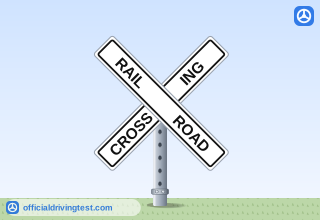
- 15 feet
- 10 feet
- 50 feet
- 30 feet
Show answer
Correct answer: 15 feet
When approaching a highway-railroad crossing, slow down and be ready to stop; do not stop on the tracks or within 15 feet of the crossing.
Source: Florida Driver License Handbook (Revised August 2023), page 56