Florida: Sharing the road — Part 1 Practice Test
Questions in this part include: “Besides a fine and points, what else must a driver do after being cited for passing a stopped school bus?” · “According to the handbook, how many vehicles should you attempt to pass at one time?”
Independent educational site · not affiliated with any government agency or DMV
Ready? Test yourself
Answer to start, or tap Start below:
What is the minimum fine for passing a stopped school bus, and how does it increase if you pass on the side where children enter and exit?
- Instant feedback with an explanation
- Every answer cites its source in the manual
- Your best score is saved on this device
- Keyboard: press 1 to 4 to answer and Enter for the next question
Questions are original and based on the official manual "Florida Driver License Handbook" (Revised August 2023), Florida Department of Highway Safety and Motor Vehicles (FLHSMV).
All 18 questions in this practice test
Take the test above first, then use this list to study. Tap “Show answer” to see the correct answer and explanation.
Show the questions and answersHide the questions
-
What is the minimum fine for passing a stopped school bus, and how does it increase if you pass on the side where children enter and exit?
- $1,000 flat, no matter which side
- $100, or $200 on the children's side
- $500 flat, no matter which side
- $265, or $465 on the children's side
Show answer
Correct answer: $265, or $465 on the children's side
Passing a stopped school bus carries a minimum fine of $265; if you pass on the side where children enter and exit, the minimum fine is $465.
Source: Florida Driver License Handbook (Revised August 2023), page 27
-
Besides a fine and points, what else must a driver do after being cited for passing a stopped school bus?
- Automatically serve 10 days in jail
- Retake the full written knowledge exam
- Attend traffic court only, with no other requirement
- Complete a basic driver improvement course
Show answer
Correct answer: Complete a basic driver improvement course
Penalties for passing a stopped school bus include a moving violation citation, four points, a minimum fine, and completion of a basic driver improvement course.
Source: Florida Driver License Handbook (Revised August 2023), page 27
-
If passing a stopped school bus results in the serious injury or death of another person, how many hours of community service must be served in a trauma center or hospital?
- 50 hours
- 40 hours
- 200 hours
- 120 hours
Show answer
Correct answer: 120 hours
If passing results in serious injury or death, penalties include serving 120 community service hours in a trauma center or hospital, plus six points on your license.
Source: Florida Driver License Handbook (Revised August 2023), page 27
-
What must every truck carrying logs or pulpwood use to securely fasten the load?
- A tarp with no fasteners
- Lock chains
- Rubber bungee cords only
- Duct tape
Show answer
Correct answer: Lock chains
Every truck carrying logs or pulpwood must use lock chains to securely fasten the load.
Source: Florida Driver License Handbook (Revised August 2023), page 42
-
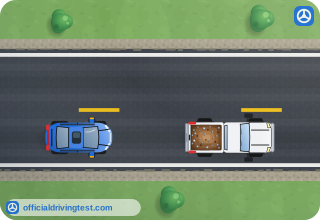
What must you use when hauling a load such as dirt, sand, or gravel that could fall or blow onto the roadway?
- A flashing amber light only
- No cover is required for these materials
- A single loose tarp draped over the top
- A close-fitting cover
Show answer
Correct answer: A close-fitting cover
You must use a close-fitting cover when hauling loads which could fall or blow onto the roadway, such as dirt, sand, or gravel; a load must never be able to drop, shift, leak, or otherwise escape.
Source: Florida Driver License Handbook (Revised August 2023), page 42
-
During the day, a load that extends beyond the sides of a vehicle and four feet or more beyond its rear must be marked with what?
- Nothing is required during the day
- A single small sticker
- White paint on the load itself
- Red flags at least 18 inches square
Show answer
Correct answer: Red flags at least 18 inches square
A load that extends beyond the sides of a vehicle, and four feet or more beyond its rear, must be clearly marked. During the day, red flags at least 18 inches square must mark the extremities of the load.
Source: Florida Driver License Handbook (Revised August 2023), page 42
-
From sunset to sunrise, or during rain, smoke, or fog, a projecting load must have two red lamps on the back that can be seen from at least how far to the rear?
- 300 feet
- 1,000 feet
- 100 feet
- 500 feet
Show answer
Correct answer: 500 feet
From sunset to sunrise, and during rain, smoke, or fog, a projecting load requires two red lamps on the back that can be seen from at least 500 feet to the rear, plus two red reflectors and a side lamp on each side.
Source: Florida Driver License Handbook (Revised August 2023), page 42
-
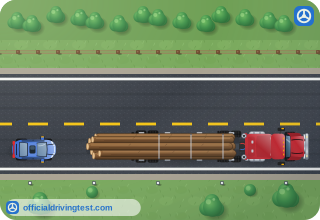
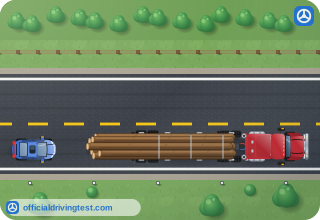
If a vehicle is transporting logs, pulpwood, poles, or posts that extend more than four feet beyond the rear of the load, what additional lamp is required?
- A blue rotating beacon
- One amber strobe-type lamp
- No additional lamp is required
- A second license plate light
Show answer
Correct answer: One amber strobe-type lamp
If the load of logs, pulpwood, poles, or posts extends more than four feet beyond the rear, you must have one amber strobe-type lamp, operational and visible from the rear and both sides of the projecting load at any time of day or night.
Source: Florida Driver License Handbook (Revised August 2023), page 42
-
On any Florida highway, a passenger vehicle's load must not extend beyond the fenders on the left side, or more than how many inches beyond the fenders on the right side?
- 18 inches
- 6 inches
- 12 inches
- 3 inches
Show answer
Correct answer: 6 inches
Passenger vehicles must not be driven on any highway with a load extending beyond the fenders on the left side, or extending more than 6 inches beyond the line of the fenders on the right side.
Source: Florida Driver License Handbook (Revised August 2023), page 42
-
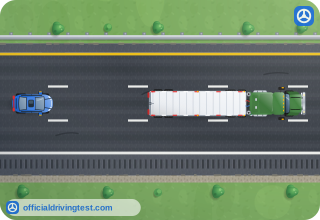
What must you do before moving into the left lane to pass another vehicle?
- Come to a complete stop
- Open your window and wave
- Activate your signal
- Turn off your headlights
Show answer
Correct answer: Activate your signal
You must activate your signal before moving into the left lane to let others know that you are about to change lanes to pass.
Source: Florida Driver License Handbook (Revised August 2023), page 67
-
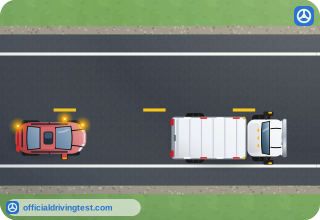
Before you pass, why should you stay a safe distance behind the vehicle you want to pass?
- It is required only on limited access highways
- The closer you get, the less you can see ahead
- It saves fuel
- It keeps your engine cooler
Show answer
Correct answer: The closer you get, the less you can see ahead
Stay a safe distance behind the vehicle you want to pass. The closer you get, the less you can see ahead.
Source: Florida Driver License Handbook (Revised August 2023), page 67
-
Before you pull out to pass another vehicle, what should you check?
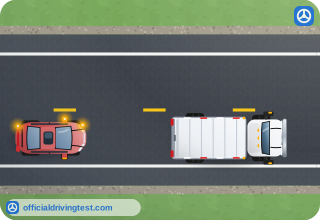
- Blind spots, and that you have plenty of time and room to pass
- Only your mirrors, since blind spots do not matter when you pass
- Only the speed of the vehicle you are about to pass
- Only your fuel gauge
Show answer
Correct answer: Blind spots, and that you have plenty of time and room to pass
Before you pull out to pass, check blind spots and make sure you have plenty of time and room to pass.
Source: Florida Driver License Handbook (Revised August 2023), page 67
-
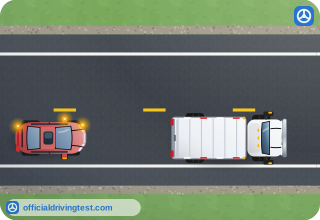
How should you let another driver know you are passing them?
- Roll down the window and shout
- Tap your horn during the day or flash your headlights at night
- Nothing; no signal is needed
- Turn on your hazard lights
Show answer
Correct answer: Tap your horn during the day or flash your headlights at night
Tap your horn (day) or flash your headlights (night) to let the other driver know you are passing.
Source: Florida Driver License Handbook (Revised August 2023), page 67
-
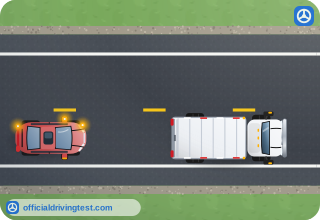
After passing another vehicle, when should you return to the right side of the road?
- Only when the other driver flashes their headlights
- Immediately after your front bumper passes the other vehicle
- Once you can see its tires in your rear-view mirror
- Whenever you feel like it, timing does not matter
Show answer
Correct answer: Once you can see its tires in your rear-view mirror
Do not return to the right side of the road until you can see the tires of the vehicle you passed in your rear-view mirror. Signal when you are about to return to your lane.
Source: Florida Driver License Handbook (Revised August 2023), page 67
-
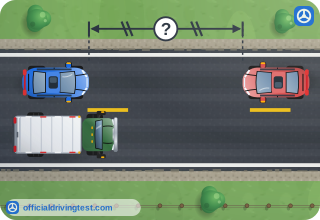
You must return to the right side of the road before coming within how many feet of an approaching vehicle?
- 200 feet
- 50 feet
- 500 feet
- 100 feet
Show answer
Correct answer: 200 feet
You must return to the right side of the road before coming within 200 feet of any approaching vehicle.
Source: Florida Driver License Handbook (Revised August 2023), page 67
-
According to the handbook, how many vehicles should you attempt to pass at one time?
- Two vehicles at a time is always acceptable
- No more than one vehicle at a time
- As many as you can as long as you are on a limited access highway
- Up to three vehicles, if there is enough room
Show answer
Correct answer: No more than one vehicle at a time
Do not attempt to pass more than one vehicle at a time. Passing multiple vehicles is dangerous.
Source: Florida Driver License Handbook (Revised August 2023), page 67
-
Is it legal to exceed the speed limit while passing another vehicle?
- Only on limited access highways
- Yes, you may exceed it by up to 10 MPH while passing
- No, it's illegal to exceed the speed limit while passing
- Yes, any speed is allowed while passing
Show answer
Correct answer: No, it's illegal to exceed the speed limit while passing
Stay within the speed limit. It's illegal to exceed the speed limit while passing.
Source: Florida Driver License Handbook (Revised August 2023), page 67
-
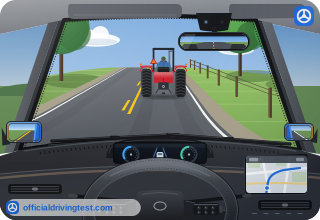
You must not pass on a hill or curve unless you can see how far ahead?
- At least 500 feet ahead
- At least 50 feet ahead
- At least 1,000 feet ahead
- At least 100 feet ahead
Show answer
Correct answer: At least 500 feet ahead
You must not pass where there is a single or double-sided solid line dividing lanes, in Do Not Pass zones, or on hills or curves where you can't see at least 500 feet ahead.
Source: Florida Driver License Handbook (Revised August 2023), page 67