Florida: Speed & following distance Practice Test
The basic speed law and how to judge a safe following distance.
Independent educational site · not affiliated with any government agency or DMV
Ready? Test yourself
Answer to start, or tap Start below:
In Florida, the speed limit will never be higher than what?
- Instant feedback with an explanation
- Every answer cites its source in the manual
- Your best score is saved on this device
- Keyboard: press 1 to 4 to answer and Enter for the next question
Questions are original and based on the official manual "Florida Driver License Handbook" (Revised August 2023), Florida Department of Highway Safety and Motor Vehicles (FLHSMV).
All 28 questions in this practice test
Take the test above first, then use this list to study. Tap “Show answer” to see the correct answer and explanation.
Show the questions and answersHide the questions
-
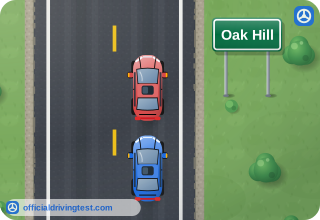
During the Florida driving skills test, what is the minimum following distance you must maintain behind other vehicles?
- One to two seconds
- Five to six seconds
- Ten seconds
- Three to four seconds
Show answer
Correct answer: Three to four seconds
The driving skills test requires maintaining a minimum following distance of three to four seconds behind other vehicles.
Source: Florida Driver License Handbook (Revised August 2023), page 20
-
In Florida, the speed limit will never be higher than what?
- 80 mph
- 65 mph
- 70 mph
- 75 mph
Show answer
Correct answer: 70 mph
In Florida, the speed limit will never be higher than 70 mph.
Source: Florida Driver License Handbook (Revised August 2023), page 28
-
What is the fine for exceeding the speed limit by more than 50 mph on a first offense?
- $2,500
- $250
- $1,000
- $500
Show answer
Correct answer: $1,000
The fine for exceeding the speed limit by more than 50 mph is $1,000 for the first offense.
Source: Florida Driver License Handbook (Revised August 2023), page 29
-
What is the fine for exceeding the speed limit by more than 50 mph on a second offense?
- $2,500
- $1,000
- $1,500
- $5,000
Show answer
Correct answer: $2,500
The fine for exceeding the speed limit by more than 50 mph is $2,500 for the second offense.
Source: Florida Driver License Handbook (Revised August 2023), page 29
-
What happens to speeding fines when the infraction occurs within a school zone or construction zone?
- No special penalty applies in these zones
- The fines stay the same, but the points are doubled instead
- The fines are doubled, with possible civil penalties up to $1,000
- The fines are cut in half as a courtesy
Show answer
Correct answer: The fines are doubled, with possible civil penalties up to $1,000
Fines are doubled when speeding infractions occur within a school zone or construction zone, with possible civil penalties up to $1,000, and you can be required to complete a driving course.
Source: Florida Driver License Handbook (Revised August 2023), page 29
-
What is the average perception time for an alert driver, according to the handbook?
- 10 to 15 seconds
- 5 to 6 seconds
- ¾ second to 1 second
- Less than 0.1 second
Show answer
Correct answer: ¾ second to 1 second
Perception distance is how far your vehicle travels from the time your eyes see a hazard until your brain recognizes it. The average perception time for an alert driver is ¾ second to 1 second.
Source: Florida Driver License Handbook (Revised August 2023), page 60
-
At 50 MPH, how many feet does the average driver's reaction distance account for?
- 268 feet
- 55 feet
- 15 feet
- 100 feet
Show answer
Correct answer: 55 feet
The average driver has a reaction time of ¾ second to 1 second. At 50 MPH, this accounts for 55 feet traveled.
Source: Florida Driver License Handbook (Revised August 2023), page 60
-
At 50 MPH, on dry pavement and with good brakes, about how far can braking distance take?
- About 25 feet
- About 500 feet
- About 55 feet
- About 158 feet
Show answer
Correct answer: About 158 feet
Braking distance is how far your vehicle travels while you are braking. At 50 MPH, on dry pavement and with good brakes, it can take about 158 feet.
Source: Florida Driver License Handbook (Revised August 2023), page 60
-
According to the handbook, what happens to braking distance and impact when you double your speed?
- They become 9 times greater
- They become 2 times greater
- They stay the same
- They become 4 times greater
Show answer
Correct answer: They become 4 times greater
Doubling the speed means the braking distance and impact are 4 times greater.
Source: Florida Driver License Handbook (Revised August 2023), page 60
-
According to the handbook, what happens to braking distance and impact when you triple your speed?
- They become 9 times greater
- They become 4 times greater
- They become 16 times greater
- They become 3 times greater
Show answer
Correct answer: They become 9 times greater
Tripling the speed means the braking distance and impact are 9 times greater.
Source: Florida Driver License Handbook (Revised August 2023), page 60
-
According to the handbook, what happens to braking distance and impact when you quadruple your speed?
- They become 9 times greater
- They become 4 times greater
- They become 8 times greater
- They become 16 times greater
Show answer
Correct answer: They become 16 times greater
Quadrupling the speed means the braking distance and impact are 16 times greater.
Source: Florida Driver License Handbook (Revised August 2023), page 60
-
At 50 MPH, what is the total minimum stopping distance for your vehicle?
- 100 feet
- 55 feet
- 158 feet
- 268 feet
Show answer
Correct answer: 268 feet
Total stopping distance includes perception distance, reaction distance, and braking distance. At 50 MPH, you will travel a minimum of 268 feet, nearly the length of a football field.
Source: Florida Driver License Handbook (Revised August 2023), page 60
-
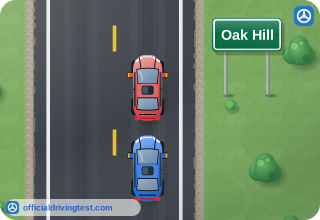
What is the minimum following distance you should keep during favorable weather and traffic conditions?
- Four seconds
- Two car lengths, regardless of speed
- Ten seconds
- One second
Show answer
Correct answer: Four seconds
Keep a minimum following distance of four seconds during favorable weather and traffic conditions, and increase it during unfavorable conditions.
Source: Florida Driver License Handbook (Revised August 2023), page 61
-
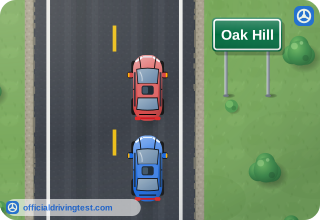
How do you determine a safe following distance using a stationary marker?
- Measure the distance in car lengths using a tape measure while driving
- Count how many other vehicles pass you in one minute
- Estimate it based on your speedometer reading alone
- Count the seconds from when the vehicle ahead passes it until you reach it
Show answer
Correct answer: Count the seconds from when the vehicle ahead passes it until you reach it
Watch when the rear of the vehicle ahead passes a stationary marker such as a sign or light pole, then count the seconds it takes you to reach the same marker: "one-thousand-one, one-thousand-two, one-thousand-three, one-thousand-four."
Source: Florida Driver License Handbook (Revised August 2023), page 61
-
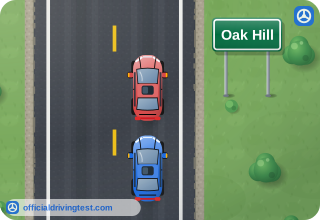
If you pass a stationary marker before counting to one-thousand-four, what should you do?
- You are following too closely; reduce speed and count again
- It means nothing; the count is only for wet roads
- You are following at a safe distance and can speed up
- You should turn on your hazard lights immediately
Show answer
Correct answer: You are following too closely; reduce speed and count again
If you pass the stationary marker before counting to one-thousand-four, you are following too closely. Reduce speed and count again at another stationary point, repeating until you are following no closer than four seconds.
Source: Florida Driver License Handbook (Revised August 2023), page 61
-
According to the handbook, in which of these situations should you increase your following distance beyond four seconds?
- Only when driving a brand-new vehicle
- Only when driving on a limited access highway
- Only when the road is dry and traffic is light
- When it is raining or when visibility is low
Show answer
Correct answer: When it is raining or when visibility is low
Increase your following distance in rain or wet roads, low visibility (dusk, dawn, nighttime, fog), when being passed, when carrying a heavy load or pulling a trailer, and when stopped behind another vehicle on an incline.
Source: Florida Driver License Handbook (Revised August 2023), page 61
-
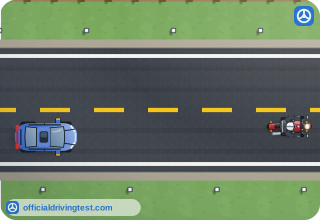
Why do you need extra stopping and steering distance when following a motorcycle?
- Motorcycles are required by law to stop suddenly at every intersection
- Motorcycles have no brake lights
- Motorcycles always travel faster than the posted speed limit
- Motorcyclists are more likely to fall on wet or gravel roads or metal surfaces
Show answer
Correct answer: Motorcyclists are more likely to fall on wet or gravel roads or metal surfaces
The chances of a motorcyclist falling are greater on wet or gravel roads, or metal surfaces such as bridges. You will need extra stopping and steering distance to avoid hitting the motorcycle or rider.
Source: Florida Driver License Handbook (Revised August 2023), page 62
-
How closely may you legally follow a fire truck that is responding to an emergency?
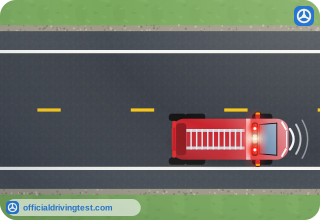
- It's against the law to follow closer than 500 feet
- There is no legal minimum distance
- It's against the law to follow closer than 50 feet
- It's against the law to follow closer than 1,000 feet
Show answer
Correct answer: It's against the law to follow closer than 500 feet
It's against the law to follow a fire truck responding to an emergency closer than 500 feet.
Source: Florida Driver License Handbook (Revised August 2023), page 62
-
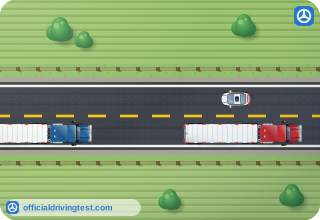
A truck or any vehicle towing another vehicle must not follow within how many feet of another truck or vehicle in tow?
- 50 feet, but only on limited access highways
- 500 feet, at all times
- 100 feet, with no exceptions
- 300 feet, except when passing or in cities or towns
Show answer
Correct answer: 300 feet, except when passing or in cities or towns
A truck or any vehicle towing another vehicle must not follow within 300 feet of another truck or another vehicle in tow. This law does not apply to overtaking and passing or within cities or towns.
Source: Florida Driver License Handbook (Revised August 2023), page 62
-
What do speed limits show, and who is responsible for adjusting driving speed to weather, roadway, and traffic conditions?
- Speed limits apply only to commercial trucks
- Speed limits show the fastest speed you may drive under favorable conditions; you are responsible for adjusting your speed
- Speed limits are only suggestions and can be ignored in light traffic
- Speed limits show the slowest speed you must drive at all times; the state is responsible for your speed
Show answer
Correct answer: Speed limits show the fastest speed you may drive under favorable conditions; you are responsible for adjusting your speed
Speed limits show the fastest speed you may drive under favorable conditions. You are responsible for adjusting your driving speed to the weather, roadway, and traffic conditions.
Source: Florida Driver License Handbook (Revised August 2023), page 68
-
What is Florida's standard speed limit in a school zone?
- 15 MPH
- 35 MPH
- 20 MPH
- 30 MPH
Show answer
Correct answer: 20 MPH
Florida's standard speed limit in school zones is 20 MPH.
Source: Florida Driver License Handbook (Revised August 2023), page 68
-
What is Florida's standard maximum speed limit in a municipal, business, or residential area?
- 55 MPH
- 45 MPH
- 20 MPH
- 30 MPH
Show answer
Correct answer: 30 MPH
Florida's standard maximum speed limit in a municipal, business, or residential area is 30 MPH, except where otherwise posted.
Source: Florida Driver License Handbook (Revised August 2023), page 68
-
What is Florida's standard maximum speed limit on streets and highways?
- 65 MPH
- 70 MPH
- 45 MPH
- 55 MPH
Show answer
Correct answer: 55 MPH
Florida's standard maximum speed limit on streets and highways is 55 MPH, except where otherwise posted.
Source: Florida Driver License Handbook (Revised August 2023), page 68
-
What is Florida's standard speed limit on limited access highways?
- 70 MPH
- 60 MPH
- 80 MPH
- 55 MPH
Show answer
Correct answer: 70 MPH
Florida's standard speed limit on limited access highways is 70 MPH.
Source: Florida Driver License Handbook (Revised August 2023), page 68
-
On highways where the posted speed limit is 70 MPH, what is the minimum speed limit?
- 40 MPH
- 30 MPH
- 60 MPH
- 50 MPH
Show answer
Correct answer: 50 MPH
On highways, when the posted speed limit is 70 MPH, the minimum speed limit is 50 MPH.
Source: Florida Driver License Handbook (Revised August 2023), page 68
-
According to the handbook, is driving too slowly against Florida law?
- Yes, but only on limited access highways
- No; there is no law against driving too slowly in Florida
- No, as long as your hazard lights are on
- Yes, if you block or delay traffic moving at normal, safe speeds
Show answer
Correct answer: Yes, if you block or delay traffic moving at normal, safe speeds
Driving too slowly is also against Florida law. You must not drive so slowly that you block or delay traffic moving at normal, safe speeds. When driving slower than the flow of traffic, keep right so others may safely pass.
Source: Florida Driver License Handbook (Revised August 2023), page 68
-
According to the handbook, is there a "speeding buffer" that allows you to drive up to 10 MPH over the speed limit?
- Yes, but only for the first offense
- Yes, but only on limited access highways
- No, the "speeding buffer" is a myth; you may be cited for speeding
- Yes, all drivers may legally drive up to 10 MPH over the limit
Show answer
Correct answer: No, the "speeding buffer" is a myth; you may be cited for speeding
The "speeding buffer" is a myth. You are not allowed to drive up to 10 MPH over the speed limit and may receive a citation for speeding.
Source: Florida Driver License Handbook (Revised August 2023), page 68
-
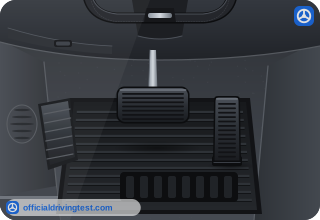
To ensure you are stopping smoothly, what should you do?
- Look only at the vehicle in front of you and brake at the last moment
- Check mirrors and blind spots, release the accelerator, and brake steadily
- Turn the steering wheel sharply while braking
- Slam on the brakes as hard as possible every time you stop
Show answer
Correct answer: Check mirrors and blind spots, release the accelerator, and brake steadily
To ensure you are stopping smoothly, check all mirrors and blind spots for traffic to the rear, release the accelerator to allow the vehicle to slow, and press the brake pedal to activate brake lights using a steady pressure.
Source: Florida Driver License Handbook (Revised August 2023), page 68