Florida: Emergencies and special situations — Part 3 Practice Test
Questions in this part include: “If an officer approaching your vehicle is not in uniform, what should they show you?” · “If you disagree with an officer's decision during a traffic stop, what should you do?”
Independent educational site · not affiliated with any government agency or DMV
Ready? Test yourself
Answer to start, or tap Start below:
If an officer approaching your vehicle is not in uniform, what should they show you?
- Instant feedback with an explanation
- Every answer cites its source in the manual
- Your best score is saved on this device
- Keyboard: press 1 to 4 to answer and Enter for the next question
Questions are original and based on the official manual "Florida Driver License Handbook" (Revised August 2023), Florida Department of Highway Safety and Motor Vehicles (FLHSMV).
All 18 questions in this practice test
Take the test above first, then use this list to study. Tap “Show answer” to see the correct answer and explanation.
Show the questions and answersHide the questions
-
If a crash is unavoidable, which is the better choice?
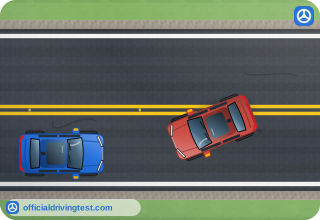
- Skidding off the road rather than driving off it
- Swerving off the road rather than into oncoming traffic
- Swerving into oncoming traffic rather than off the road
- Speeding up to pass through the danger quickly
Show answer
Correct answer: Swerving off the road rather than into oncoming traffic
The handbook states it's better to swerve off the road than into oncoming traffic.
Source: Florida Driver License Handbook (Revised August 2023), page 75
-
If a crash is unavoidable and you must hit something, which is the better choice?
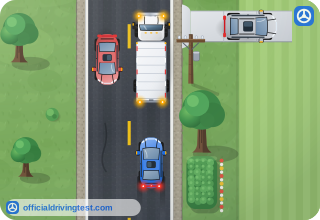
- A parked vehicle, rather than an empty field
- Whichever object is closest, regardless of type
- A soft object like a hedge, rather than a solid object like a tree
- A solid object like a tree, rather than a soft object like a hedge
Show answer
Correct answer: A soft object like a hedge, rather than a solid object like a tree
Hitting a "soft object" like a garden hedge is better than hitting a solid object like a tree or post.
Source: Florida Driver License Handbook (Revised August 2023), page 75
-
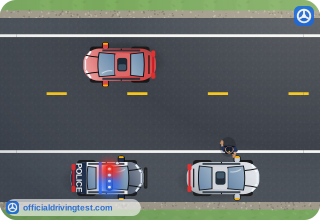
When you see emergency lights behind you, what should you do?
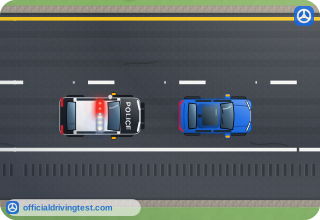
- Stay calm, signal, and pull to the side of the road as soon as it is safe
- Stop immediately in your current lane
- Slow down gradually but keep driving until you find a police station
- Continue at the same speed until the officer turns off the lights
Show answer
Correct answer: Stay calm, signal, and pull to the side of the road as soon as it is safe
You should stay calm and cooperate, activating your turn signal and pulling over as soon as it is safe to do so.
Source: Florida Driver License Handbook (Revised August 2023), page 75
-
After pulling over for a traffic stop, what should you do with your engine and audio devices?
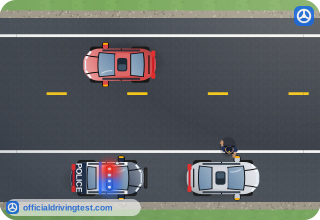
- Turn off your engine and any audio devices
- Leave everything as it is until the officer asks
- Turn up the radio so you can hear the officer's announcement
- Leave the engine running but turn off the radio
Show answer
Correct answer: Turn off your engine and any audio devices
After pulling over, you should turn off your engine and any audio devices.
Source: Florida Driver License Handbook (Revised August 2023), page 75
-
During a traffic stop, should you exit your vehicle?
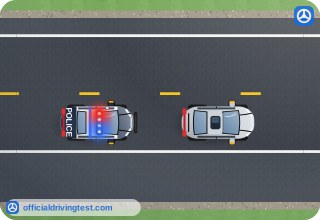
- Yes, but only if it is raining
- No, stay inside unless the officer directs you to exit
- Yes, always exit immediately to show cooperation
- It does not matter either way
Show answer
Correct answer: No, stay inside unless the officer directs you to exit
You should stay in your vehicle unless the officer directs you to exit.
Source: Florida Driver License Handbook (Revised August 2023), page 75
-
Where should you keep your hands during a traffic stop?
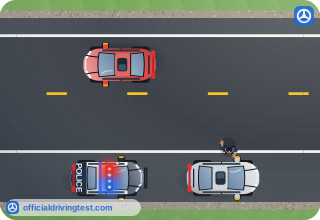
- Behind your back
- In your pockets to keep warm
- On the steering wheel or in a visible location
- On your phone to record the interaction
Show answer
Correct answer: On the steering wheel or in a visible location
You should keep your hands on the steering wheel or in a visible location so the officer can easily see them.
Source: Florida Driver License Handbook (Revised August 2023), page 75
-
If you are pulled over at night, what should you do to help with visibility? And if you have tinted windows during the day?
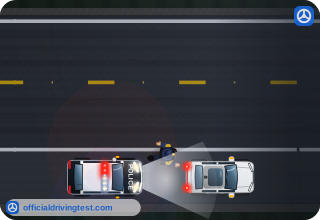
- Turn on your interior lights at night; roll down all windows by day
- Use your high beams to light up the interior
- Keep tinted windows up at all times for privacy
- Turn off all your lights at night to avoid blinding the officer
Show answer
Correct answer: Turn on your interior lights at night; roll down all windows by day
Turn on your interior lights if pulled over at night; if you have tinted windows during the day, roll down all your windows.
Source: Florida Driver License Handbook (Revised August 2023), page 76
-
Before reaching for your driver's license or vehicle documents during a stop, what should you do?
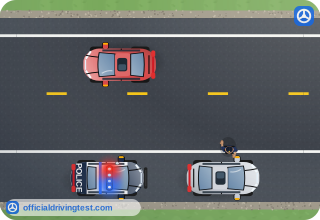
- Hand them to a passenger to give to the officer
- Reach for them immediately so the officer does not have to wait
- Wait for the officer's instructions before reaching for them
- Place them on the roof of the car
Show answer
Correct answer: Wait for the officer's instructions before reaching for them
You should wait for the officer's instructions before reaching for your driver's license or vehicle documents.
Source: Florida Driver License Handbook (Revised August 2023), page 76
-
What should you tell the officer upon first contact if it applies to you?
- Let the officer know if you have a weapon in the vehicle
- Let the officer know if you have been in prior accidents
- Let the officer know your travel plans for the day
- Let the officer know your insurance company's name
Show answer
Correct answer: Let the officer know if you have a weapon in the vehicle
You should let the officer know if you have a weapon in the vehicle upon first contact.
Source: Florida Driver License Handbook (Revised August 2023), page 76
-
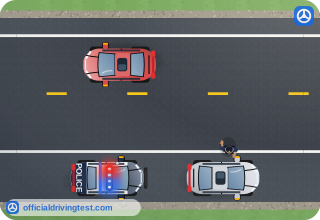
If an officer approaching your vehicle is not in uniform, what should they show you?
- Their law enforcement credentials
- Nothing; plain-clothes officers are not required to identify themselves
- A copy of the traffic law you allegedly violated
- Their personal identification card
Show answer
Correct answer: Their law enforcement credentials
If officers are not in uniform, they should show their law enforcement credentials; if they do not, you may ask to see them.
Source: Florida Driver License Handbook (Revised August 2023), page 76
-
If your driver's license, insurance, or registration are out of reach during a stop, what should you do?
- Ignore the request until you get home
- Get out of the car to retrieve them from the trunk yourself
- Tell the officer where they are and wait for their acknowledgment
- Reach for them right away without saying anything
Show answer
Correct answer: Tell the officer where they are and wait for their acknowledgment
If documents are out of reach, tell the officer where they are and wait for the officer's acknowledgment before reaching to retrieve them.
Source: Florida Driver License Handbook (Revised August 2023), page 76
-
What sanctions might an officer impose after a traffic stop?
- Immediate suspension of your driver license in all cases
- Only a verbal warning; officers cannot issue tickets on the spot
- Community service hours assigned on the spot
- A warning, a traffic ticket which may include a fine, or arrest
Show answer
Correct answer: A warning, a traffic ticket which may include a fine, or arrest
The officer may impose a sanction such as a warning, a traffic ticket which may include a fine, or arrest.
Source: Florida Driver License Handbook (Revised August 2023), page 76
-
If you disagree with an officer's decision during a traffic stop, what should you do?
- Argue with the officer until they change their decision
- Drive away once you have your documents back
- Avoid arguing; you may contest the decision in court
- Refuse to provide any further identification
Show answer
Correct answer: Avoid arguing; you may contest the decision in court
If you disagree with the officer's decision, you should not prolong the contact by arguing; you may contest it in court through established legal channels.
Source: Florida Driver License Handbook (Revised August 2023), page 76
-
Does signing a traffic ticket mean you are admitting guilt?
- Signing is optional and has no legal meaning either way
- No, and refusing to sign has no consequences
- Yes, signing is a legal admission of guilt
- No, but refusing to sign a ticket may result in your arrest
Show answer
Correct answer: No, but refusing to sign a ticket may result in your arrest
Acceptance and signature on a traffic ticket is not an admission of guilt; however, refusal to sign a traffic ticket may result in arrest.
Source: Florida Driver License Handbook (Revised August 2023), page 76
-
If you are involved in a crash resulting in death, injury, or property damage, what is your legal duty?
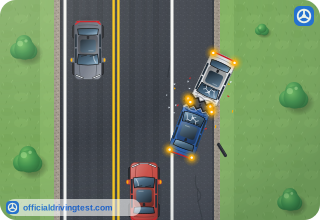
- To give information and render aid, while remaining calm
- To contact your insurance company before anyone else
- To wait for a tow truck before doing anything else
- To leave the scene quickly to avoid traffic congestion
Show answer
Correct answer: To give information and render aid, while remaining calm
It's your duty, required by law, to give information and render aid if you're involved in a crash resulting in death, injury, or property damage.
Source: Florida Driver License Handbook (Revised August 2023), page 77
-
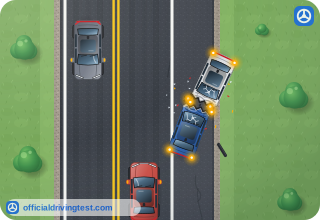
What is the first thing you should do after a crash?
- Move all vehicles before calling anyone
- Stop and call 911, *FHP (*347), or local law enforcement
- Drive to the nearest police station to report it
- Exchange insurance information before calling for help
Show answer
Correct answer: Stop and call 911, *FHP (*347), or local law enforcement
The first step after a crash is to stop and call 911, *FHP (*347), or local law enforcement.
Source: Florida Driver License Handbook (Revised August 2023), page 77
-
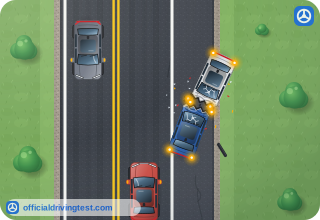
If your crash is minor and your vehicle is blocking the flow of traffic, what must you do?
- Push it into the nearest ditch
- Leave it exactly where it is until police arrive
- Wait for a tow truck no matter how long it takes
- Move it or have it moved
Show answer
Correct answer: Move it or have it moved
If the crash is minor and your vehicle is blocking traffic, you must move it or have it moved.
Source: Florida Driver License Handbook (Revised August 2023), page 77
-
What information should you exchange with the other driver after a crash?
- Only insurance company names, not any personal information
- Name, address, phone, plate number, driver license, and insurance
- Only vehicle make and model
- Only your names
Show answer
Correct answer: Name, address, phone, plate number, driver license, and insurance
You should exchange vehicle, witness, and driver information, including name, address, phone number, license plate number, driver license, and insurance.
Source: Florida Driver License Handbook (Revised August 2023), page 77