Florida: Emergencies and special situations — Part 2 Practice Test
Questions in this part include: “Florida law requires you to use your headlights during which hours?” · “What is "defensive driving," according to the Florida Driver License Handbook?”
Independent educational site · not affiliated with any government agency or DMV
Ready? Test yourself
Answer to start, or tap Start below:
Florida law requires you to use your headlights during which hours?
- Instant feedback with an explanation
- Every answer cites its source in the manual
- Your best score is saved on this device
- Keyboard: press 1 to 4 to answer and Enter for the next question
Questions are original and based on the official manual "Florida Driver License Handbook" (Revised August 2023), Florida Department of Highway Safety and Motor Vehicles (FLHSMV).
All 18 questions in this practice test
Take the test above first, then use this list to study. Tap “Show answer” to see the correct answer and explanation.
Show the questions and answersHide the questions
-
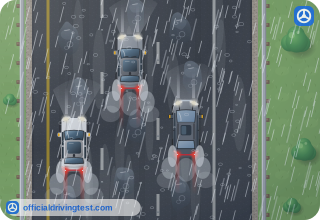
What is hydroplaning?
- When your windshield wipers freeze in place
- When your brakes overheat during a rainstorm
- When your vehicle slides on a thin layer of water
- When your headlights fog up on the inside
Show answer
Correct answer: When your vehicle slides on a thin layer of water
Hydroplaning happens when your vehicle slides on top of a thin layer of water between your tires and the road; when your tires are not touching the road, you can easily lose control and skid.
Source: Florida Driver License Handbook (Revised August 2023), page 72
-
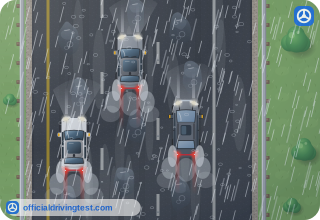
Which of the following increases the risk of hydroplaning?
- Driving slower than the speed limit
- Keeping a greater following distance
- Using low-beam headlights
- Low tire pressure, bad tread, and speeding
Show answer
Correct answer: Low tire pressure, bad tread, and speeding
Tires with low air pressure or bad tread increase the risk of hydroplaning, and so does speeding.
Source: Florida Driver License Handbook (Revised August 2023), page 72
-
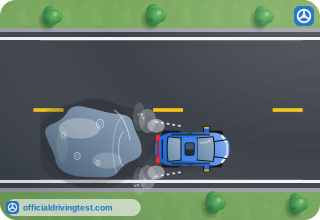
If your brakes become wet after driving in heavy rain and pull to one side or fail to hold, what should you do?
- Continue at the same speed; wet brakes correct themselves
- Pull the parking brake immediately at full force
- Slow down and gently push on the brake pedal until they work again
- Pump the accelerator rapidly to dry the brakes
Show answer
Correct answer: Slow down and gently push on the brake pedal until they work again
Brakes often become wet after driving in heavy rain and may pull to one side or not hold at all; if this happens, slow down and gently push on the brake pedal until your brakes are working again.
Source: Florida Driver License Handbook (Revised August 2023), page 72
-
If you come to a flooded roadway while driving, what should you do?
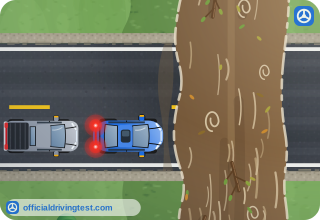
- Turn around and find another route
- Drive through slowly in a low gear
- Wait in the floodwater for it to recede
- Drive through quickly to avoid stalling
Show answer
Correct answer: Turn around and find another route
If you come to a flooded roadway, turn around and find another route. Do not attempt to drive through the water; it's impossible to determine the depth or current and your vehicle could become submerged or swept away.
Source: Florida Driver License Handbook (Revised August 2023), page 72
-
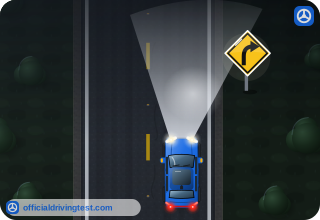
How far can high-beam headlights reveal objects, and at what speed are they most effective?
- Up to 200 feet, most effective at any speed
- At least 450 feet, most effective faster than 25 MPH
- Up to 100 feet, most effective under 15 MPH
- Up to 1,000 feet, most effective over 55 MPH
Show answer
Correct answer: At least 450 feet, most effective faster than 25 MPH
High beam headlights can reveal objects up to a distance of at least 450 feet and are most effective for speeds faster than 25 MPH.
Source: Florida Driver License Handbook (Revised August 2023), page 72
-
Florida law requires you to use your headlights during which hours?
- Only when it is raining
- Only between midnight and 5 a.m.
- Only on highways
- Between sunset and sunrise
Show answer
Correct answer: Between sunset and sunrise
Florida law says you must use headlights between the hours of sunset and sunrise.
Source: Florida Driver License Handbook (Revised August 2023), page 73
-
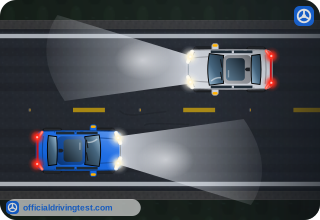
Florida law says you must not use high-beam headlights within how many feet of an oncoming vehicle?
- 500 feet
- 1,000 feet
- 100 feet
- 50 feet
Show answer
Correct answer: 500 feet
Florida law says you must not use high beam headlights within 500 feet of an oncoming vehicle; use low beam headlights instead.
Source: Florida Driver License Handbook (Revised August 2023), page 73
-
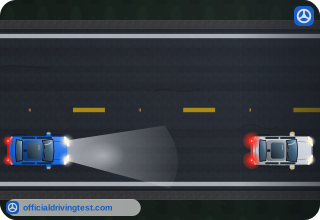
Florida law says you must not use high-beam headlights within how many feet of the vehicle ahead of you?
- 300 feet
- 600 feet
- 50 feet
- 900 feet
Show answer
Correct answer: 300 feet
Florida law says you must not use high beam headlights within 300 feet of the vehicle ahead of you; use low beam headlights instead.
Source: Florida Driver License Handbook (Revised August 2023), page 73
-
Which of the following is prohibited under Florida law at night?
- Driving using only your parking lights in place of headlights
- Driving with your headlights on low beam
- Turning on your parking lights while legally parked on a roadway shoulder
- Driving with your headlights on between sunset and sunrise
Show answer
Correct answer: Driving using only your parking lights in place of headlights
Florida law says you must not drive using only parking lights in place of headlights.
Source: Florida Driver License Handbook (Revised August 2023), page 73
-
When parking on a roadway or shoulder at night outside of cities and towns, what does Florida law require?
- Activate your hazard lights only during the day
- Turn on your parking lights
- Leave your high beams on
- Turn off all exterior lights to avoid blinding other drivers
Show answer
Correct answer: Turn on your parking lights
Turn on your parking lights at night when parking on a roadway or shoulder outside of cities and towns.
Source: Florida Driver License Handbook (Revised August 2023), page 73
-
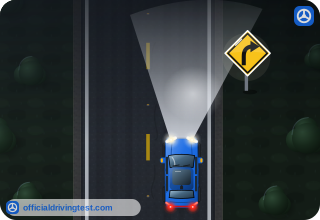
What does the handbook mean by "overdriving" your headlights?
- Using high beams in a well-lit city
- Driving with a burned-out headlight
- Leaving your headlights on after parking
- Driving too fast for what you can see
Show answer
Correct answer: Driving too fast for what you can see
Avoid "over driving" your lights, which means driving too fast for what you can see.
Source: Florida Driver License Handbook (Revised August 2023), page 73
-
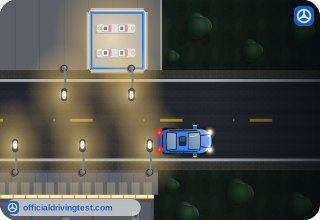
When you leave a brightly lit area and enter darkness, what should you do?
- Come to a complete stop until your eyes adjust
- Close one eye to preserve night vision
- Drive slowly until your eyes adjust to the darkness
- Turn on your high beams immediately
Show answer
Correct answer: Drive slowly until your eyes adjust to the darkness
When leaving a brightly lit area, drive slowly until your eyes adjust to the darkness.
Source: Florida Driver License Handbook (Revised August 2023), page 73
-
What should you do instead of looking directly at oncoming headlights at night?
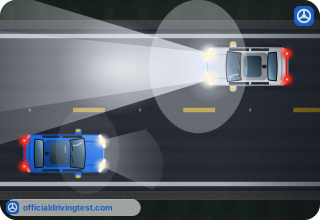
- Use lane lines as guides and glance at the other car every few seconds
- Stare at the oncoming headlights to track the vehicle's speed
- Flash your high beams repeatedly at the oncoming driver
- Close your eyes briefly until the vehicle passes
Show answer
Correct answer: Use lane lines as guides and glance at the other car every few seconds
Don't look directly at oncoming headlights. Use lane lines as visual guides and look quickly to check the other vehicle's position every few seconds.
Source: Florida Driver License Handbook (Revised August 2023), page 73
-
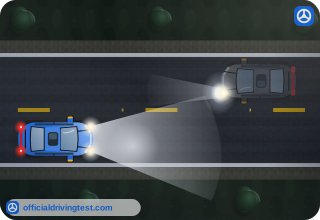
If you see a vehicle approaching at night with only one headlight visible, what should you do?
- Flash your high beams to warn them their headlight is out
- Move toward the center line to get a better look
- Drive as far to the right as you can
- Assume it's a motorcycle and ignore it
Show answer
Correct answer: Drive as far to the right as you can
Drive as far to the right as you can if a vehicle with one light comes toward you; it could be a vehicle with a missing headlight.
Source: Florida Driver License Handbook (Revised August 2023), page 73
-
What is "defensive driving," according to the Florida Driver License Handbook?
- Following other vehicles as closely as possible to react faster
- Using safe driving strategies to prevent crashes, adjusting to conditions
- Driving only during daylight hours to avoid hazards
- Driving at the posted speed limit at all times regardless of conditions
Show answer
Correct answer: Using safe driving strategies to prevent crashes, adjusting to conditions
Defensive driving means altering your driving to fit weather conditions, how you feel, and the actions of other motorists, bicyclists, and pedestrians.
Source: Florida Driver License Handbook (Revised August 2023), page 75
-
To avoid crashes, the first step is to look for possible danger. Which example does the handbook give?
- Checking your mirrors every time you change lanes
- Planning for a child running out near school zone signs
- Watching for deer crossing signs on rural highways
- Slowing down near construction barrels
Show answer
Correct answer: Planning for a child running out near school zone signs
The handbook gives the example of seeing school zone signs and planning what you will do if a child runs or rides into the street.
Source: Florida Driver License Handbook (Revised August 2023), page 75
-
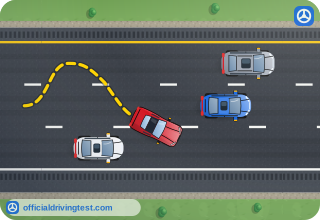
If you notice a driver aggressively changing lanes as they approach you from the rear, what should you do?
- Move into the next lane immediately
- Slow down and be ready to brake
- Flash your high beams to warn them
- Speed up so they cannot pass you
Show answer
Correct answer: Slow down and be ready to brake
The handbook advises anticipating that an aggressive driver behind you will likely pass and cut you off, so you should slow down and be ready to brake.
Source: Florida Driver License Handbook (Revised August 2023), page 75
-
Where do crashes happen more than any other place?
- Parking lots
- Intersections
- Bridges
- Highway on-ramps
Show answer
Correct answer: Intersections
Crashes happen at intersections more than any other place, so extra caution is needed there.
Source: Florida Driver License Handbook (Revised August 2023), page 75