Florida: Emergencies and special situations
Breakdowns, hazardous conditions, and other special driving situations. Split into 5 shorter tests so you're not stuck in one long quiz.
Independent educational site · not affiliated with any government agency or DMV
Choose a part
Emergencies and special situations — Part 1
Questions in this part include: “According to the handbook, drowsy driving can be just as dangerous as what?”
Emergencies and special situations — Part 2
Questions in this part include: “Florida law requires you to use your headlights during which hours?”
Emergencies and special situations — Part 3
Questions in this part include: “If an officer approaching your vehicle is not in uniform, what should they show you?”
Emergencies and special situations — Part 4
Questions in this part include: “How should you position and care for a person being treated for shock?”
Emergencies and special situations — Part 5
Questions in this part include: “What is "overcorrection," and what can it result in?”
Questions are original and based on the official manual "Florida Driver License Handbook" (Revised August 2023), Florida Department of Highway Safety and Motor Vehicles (FLHSMV).
All 90 Emergencies and special situations questions with answers
Choose a part above to take a practice test, or study every question and answer here.
Show the questions and answersHide the questions
1Part 118 questions
-
According to the handbook, drowsy driving can be just as dangerous as what?
- Driving in light rain
- Speeding on a highway
- Driving without a seatbelt
- Drunk driving
Show answer
Correct answer: Drunk driving
The handbook states that drowsy driving can be just as dangerous as drunk driving.
Source: Florida Driver License Handbook (Revised August 2023), page 35
-
According to the handbook, what are the two main causes of drowsy driving?
- Cold weather and heavy traffic
- Lack of sleep and driving when you'd normally be asleep
- Driving alone and driving with music on
- Eating a large meal and drinking a lot of caffeine
Show answer
Correct answer: Lack of sleep and driving when you'd normally be asleep
The handbook lists the two main causes of drowsy driving as lack of quality or quantity of sleep and driving at times of day when you would normally be sleeping.
Source: Florida Driver License Handbook (Revised August 2023), page 35
-
According to the handbook, on long trips, how often should you take a break to help avoid drowsy driving?
- Every 500 miles or 8 hours
- Every 25 miles or 15 minutes
- Only when you reach your destination
- Every 100 miles or 2 hours
Show answer
Correct answer: Every 100 miles or 2 hours
The handbook recommends taking a break every 100 miles or 2 hours on long trips to help avoid drowsy driving.
Source: Florida Driver License Handbook (Revised August 2023), page 35
-
According to the handbook, what is "micro-sleeping"?
- A type of sleep medication
- Sleeping fewer than 8 hours the night before driving
- Taking a scheduled 20-minute nap before a trip
- Briefly "nodding off" while driving
Show answer
Correct answer: Briefly "nodding off" while driving
The handbook describes fatigue as being able to cause micro-sleeping ("nodding off") or falling completely asleep while driving.
Source: Florida Driver License Handbook (Revised August 2023), page 35
-
If a collision with an animal on the road seems unavoidable, what should you do?
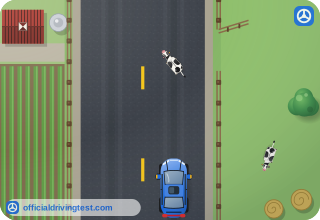
- Keep your vehicle under control and stay on the roadway; do not swerve
- Accelerate to pass the animal before it moves
- Swerve sharply into the oncoming lane to avoid the animal
- Swerve off the roadway onto the shoulder to avoid the animal
Show answer
Correct answer: Keep your vehicle under control and stay on the roadway; do not swerve
The handbook warns that swerving to avoid an animal can cause a more serious crash than colliding with it; keep your vehicle under control and on the roadway.
Source: Florida Driver License Handbook (Revised August 2023), page 71
-
According to the handbook, when are animals most active on or near roadways, requiring extra caution?
- Only on weekends
- Dawn and dusk
- Only during thunderstorms
- Midday
Show answer
Correct answer: Dawn and dusk
Use caution when driving at dawn and dusk; this is when animals are most active.
Source: Florida Driver License Handbook (Revised August 2023), page 71
-
Deer/vehicle crashes occur most often during which months?
- October to December
- June to August
- April to May
- January to March
Show answer
Correct answer: October to December
The handbook states that deer/vehicle crashes occur most often from October to December.
Source: Florida Driver License Handbook (Revised August 2023), page 71
-
At night, what should you watch for on the sides of the road to help spot animals before they enter your path?
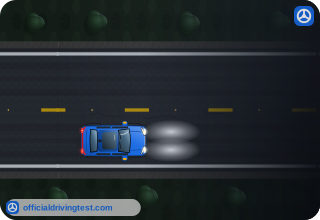
- Painted animal-crossing symbols on the pavement
- The reflection of your headlights in animals' eyes
- Movement in your rearview mirror
- Shadows cast by streetlights
Show answer
Correct answer: The reflection of your headlights in animals' eyes
Scan the sides of the road and watch for the reflection of your headlights in the eyes of animals.
Source: Florida Driver License Handbook (Revised August 2023), page 71
-
Why should you flash your headlights when you spot an animal on or near the road?
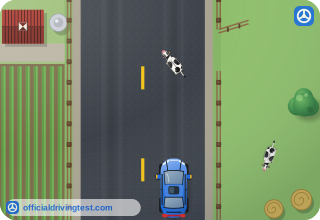
- To signal that you are about to pass another vehicle
- To permanently scare the animal away from roads
- It is required only at railroad crossings
- To warn other drivers that an animal has been spotted
Show answer
Correct answer: To warn other drivers that an animal has been spotted
Flash your headlights to warn other drivers when animals are spotted on or near the road.
Source: Florida Driver License Handbook (Revised August 2023), page 71
-
Deer tend to fixate on headlights and may freeze in place. If you have time to avoid hitting one, what should you do?
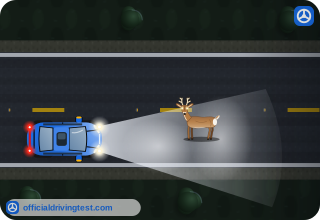
- Speed up to get past it quickly
- Turn off your headlights so the deer is not blinded
- Reduce your speed, tap your brakes, and sound your horn
- Swerve immediately into another lane
Show answer
Correct answer: Reduce your speed, tap your brakes, and sound your horn
If you have time to avoid hitting an animal, reduce your speed, tap your brakes, and sound your horn; deer tend to fixate on headlights so flashing them may cause the animal to freeze.
Source: Florida Driver License Handbook (Revised August 2023), page 71
-
If a crash involves a large animal such as a bear, deer, or farm animal, what should you do?
- Report the crash to law enforcement
- Only report it if the vehicle is undrivable
- No report is required for animal collisions
- Report it to the Department of Agriculture instead
Show answer
Correct answer: Report the crash to law enforcement
Report the crash to law enforcement if it involves a large animal such as a bear, deer, or farm animal.
Source: Florida Driver License Handbook (Revised August 2023), page 71
-
In low-visibility conditions such as fog or smoke, what does the handbook say about your headlights?
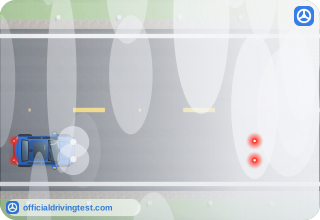
- You must turn them on; parking lights are not a substitute
- Headlights are optional if there is some daylight
- Parking lights alone are sufficient
- Only taillights are required
Show answer
Correct answer: You must turn them on; parking lights are not a substitute
When driving in low-visibility conditions, you must turn on your headlights. Parking lights are not a substitute.
Source: Florida Driver License Handbook (Revised August 2023), page 71
-
When driving in fog, why should you use low-beam headlights instead of high beams?
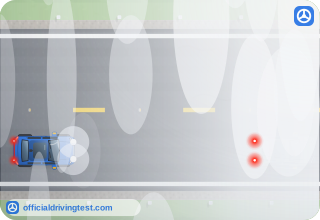
- High beams reflect off the fog and impair visibility even more
- Low beams automatically turn on the windshield wipers
- High beams are illegal to use at any time
- Low beams are brighter than high beams
Show answer
Correct answer: High beams reflect off the fog and impair visibility even more
Drive with lights on low beam; high beams will reflect off the fog and impair visibility even more.
Source: Florida Driver License Handbook (Revised August 2023), page 71
-
In low-visibility conditions, what can help guide you along the road?
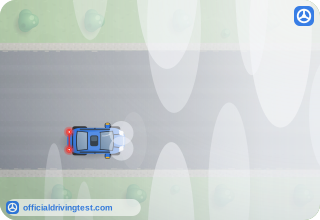
- The taillights of the vehicle directly ahead only
- Your GPS screen exclusively
- Painted animal-crossing signs
- The right edge of the road, edge lines, and center lines
Show answer
Correct answer: The right edge of the road, edge lines, and center lines
Use the right edge of the road or edge lines and center lines as visual guides.
Source: Florida Driver License Handbook (Revised August 2023), page 71
-
What does the handbook recommend eliminating from your vehicle while driving in low-visibility conditions?
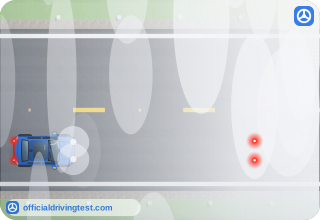
- All dashboard warning lights
- Distractions such as the radio or phone
- Passengers riding in the back seat
- Cruise control
Show answer
Correct answer: Distractions such as the radio or phone
Eliminate all distractions in your vehicle. Turn off the radio, cell phone, etc.
Source: Florida Driver License Handbook (Revised August 2023), page 72
-
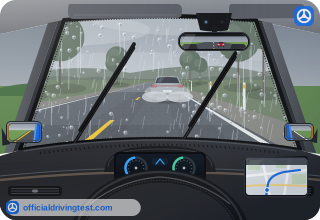
What should you do with your headlights whenever you turn on your windshield wipers?
- Turn on your hazard lights instead
- Turn your headlights off to reduce glare
- Turn your headlights on
- Switch to high beams
Show answer
Correct answer: Turn your headlights on
When you turn on your windshield wipers, turn on your headlights.
Source: Florida Driver License Handbook (Revised August 2023), page 72
-
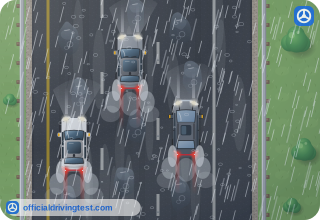
According to the handbook, roads can be especially slick during a rainstorm if it has not rained in a while. Why?
- Increased tire pressure
- Excess sand left from winter road treatment
- Oil build-up on the highway
- Fresh asphalt sealant
Show answer
Correct answer: Oil build-up on the highway
Roads become slick during rainstorms, especially if it has not rained in a while, due to oil build-up on the highway.
Source: Florida Driver License Handbook (Revised August 2023), page 72
-
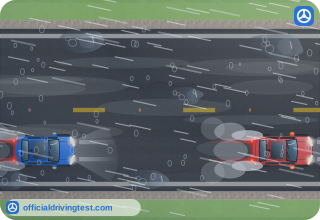
Because wet roads increase your vehicle's braking and stopping distance, what should you do?
- Decrease your following distance to see the road better
- Tailgate the vehicle ahead to use its wake
- Drive with your parking lights only
- Increase your following distance
Show answer
Correct answer: Increase your following distance
Wet road conditions will increase your braking/stopping distance, so be sure to increase your following distance.
Source: Florida Driver License Handbook (Revised August 2023), page 72
2Part 218 questions
-
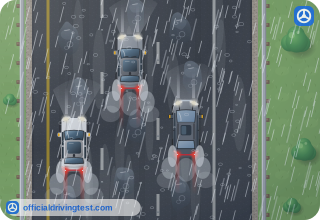
What is hydroplaning?
- When your windshield wipers freeze in place
- When your brakes overheat during a rainstorm
- When your vehicle slides on a thin layer of water
- When your headlights fog up on the inside
Show answer
Correct answer: When your vehicle slides on a thin layer of water
Hydroplaning happens when your vehicle slides on top of a thin layer of water between your tires and the road; when your tires are not touching the road, you can easily lose control and skid.
Source: Florida Driver License Handbook (Revised August 2023), page 72
-
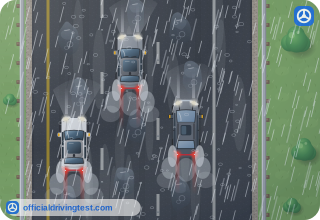
Which of the following increases the risk of hydroplaning?
- Driving slower than the speed limit
- Keeping a greater following distance
- Using low-beam headlights
- Low tire pressure, bad tread, and speeding
Show answer
Correct answer: Low tire pressure, bad tread, and speeding
Tires with low air pressure or bad tread increase the risk of hydroplaning, and so does speeding.
Source: Florida Driver License Handbook (Revised August 2023), page 72
-
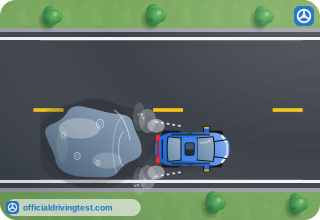
If your brakes become wet after driving in heavy rain and pull to one side or fail to hold, what should you do?
- Continue at the same speed; wet brakes correct themselves
- Pull the parking brake immediately at full force
- Slow down and gently push on the brake pedal until they work again
- Pump the accelerator rapidly to dry the brakes
Show answer
Correct answer: Slow down and gently push on the brake pedal until they work again
Brakes often become wet after driving in heavy rain and may pull to one side or not hold at all; if this happens, slow down and gently push on the brake pedal until your brakes are working again.
Source: Florida Driver License Handbook (Revised August 2023), page 72
-
If you come to a flooded roadway while driving, what should you do?
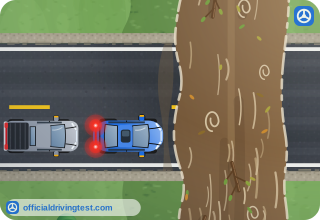
- Turn around and find another route
- Drive through slowly in a low gear
- Wait in the floodwater for it to recede
- Drive through quickly to avoid stalling
Show answer
Correct answer: Turn around and find another route
If you come to a flooded roadway, turn around and find another route. Do not attempt to drive through the water; it's impossible to determine the depth or current and your vehicle could become submerged or swept away.
Source: Florida Driver License Handbook (Revised August 2023), page 72
-
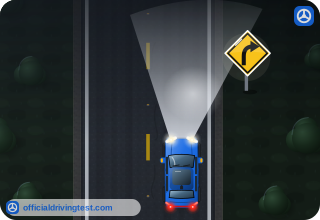
How far can high-beam headlights reveal objects, and at what speed are they most effective?
- Up to 200 feet, most effective at any speed
- At least 450 feet, most effective faster than 25 MPH
- Up to 100 feet, most effective under 15 MPH
- Up to 1,000 feet, most effective over 55 MPH
Show answer
Correct answer: At least 450 feet, most effective faster than 25 MPH
High beam headlights can reveal objects up to a distance of at least 450 feet and are most effective for speeds faster than 25 MPH.
Source: Florida Driver License Handbook (Revised August 2023), page 72
-
Florida law requires you to use your headlights during which hours?
- Only when it is raining
- Only between midnight and 5 a.m.
- Only on highways
- Between sunset and sunrise
Show answer
Correct answer: Between sunset and sunrise
Florida law says you must use headlights between the hours of sunset and sunrise.
Source: Florida Driver License Handbook (Revised August 2023), page 73
-
Florida law says you must not use high-beam headlights within how many feet of an oncoming vehicle?
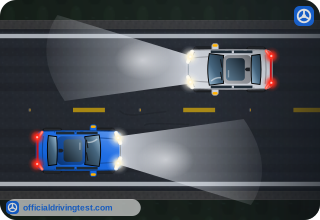
- 500 feet
- 1,000 feet
- 100 feet
- 50 feet
Show answer
Correct answer: 500 feet
Florida law says you must not use high beam headlights within 500 feet of an oncoming vehicle; use low beam headlights instead.
Source: Florida Driver License Handbook (Revised August 2023), page 73
-
Florida law says you must not use high-beam headlights within how many feet of the vehicle ahead of you?
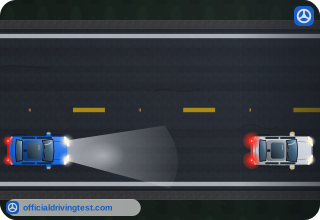
- 300 feet
- 600 feet
- 50 feet
- 900 feet
Show answer
Correct answer: 300 feet
Florida law says you must not use high beam headlights within 300 feet of the vehicle ahead of you; use low beam headlights instead.
Source: Florida Driver License Handbook (Revised August 2023), page 73
-
Which of the following is prohibited under Florida law at night?
- Driving using only your parking lights in place of headlights
- Driving with your headlights on low beam
- Turning on your parking lights while legally parked on a roadway shoulder
- Driving with your headlights on between sunset and sunrise
Show answer
Correct answer: Driving using only your parking lights in place of headlights
Florida law says you must not drive using only parking lights in place of headlights.
Source: Florida Driver License Handbook (Revised August 2023), page 73
-
When parking on a roadway or shoulder at night outside of cities and towns, what does Florida law require?
- Activate your hazard lights only during the day
- Turn on your parking lights
- Leave your high beams on
- Turn off all exterior lights to avoid blinding other drivers
Show answer
Correct answer: Turn on your parking lights
Turn on your parking lights at night when parking on a roadway or shoulder outside of cities and towns.
Source: Florida Driver License Handbook (Revised August 2023), page 73
-
What does the handbook mean by "overdriving" your headlights?
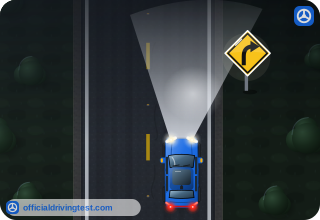
- Using high beams in a well-lit city
- Driving with a burned-out headlight
- Leaving your headlights on after parking
- Driving too fast for what you can see
Show answer
Correct answer: Driving too fast for what you can see
Avoid "over driving" your lights, which means driving too fast for what you can see.
Source: Florida Driver License Handbook (Revised August 2023), page 73
-
When you leave a brightly lit area and enter darkness, what should you do?
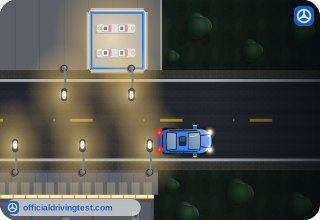
- Come to a complete stop until your eyes adjust
- Close one eye to preserve night vision
- Drive slowly until your eyes adjust to the darkness
- Turn on your high beams immediately
Show answer
Correct answer: Drive slowly until your eyes adjust to the darkness
When leaving a brightly lit area, drive slowly until your eyes adjust to the darkness.
Source: Florida Driver License Handbook (Revised August 2023), page 73
-
What should you do instead of looking directly at oncoming headlights at night?
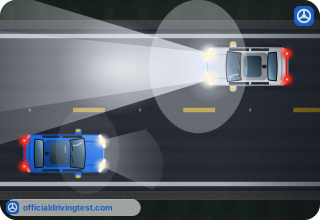
- Use lane lines as guides and glance at the other car every few seconds
- Stare at the oncoming headlights to track the vehicle's speed
- Flash your high beams repeatedly at the oncoming driver
- Close your eyes briefly until the vehicle passes
Show answer
Correct answer: Use lane lines as guides and glance at the other car every few seconds
Don't look directly at oncoming headlights. Use lane lines as visual guides and look quickly to check the other vehicle's position every few seconds.
Source: Florida Driver License Handbook (Revised August 2023), page 73
-
If you see a vehicle approaching at night with only one headlight visible, what should you do?
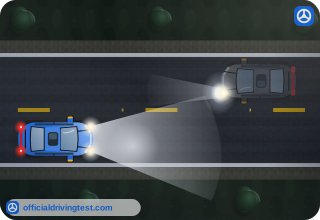
- Flash your high beams to warn them their headlight is out
- Move toward the center line to get a better look
- Drive as far to the right as you can
- Assume it's a motorcycle and ignore it
Show answer
Correct answer: Drive as far to the right as you can
Drive as far to the right as you can if a vehicle with one light comes toward you; it could be a vehicle with a missing headlight.
Source: Florida Driver License Handbook (Revised August 2023), page 73
-
What is "defensive driving," according to the Florida Driver License Handbook?
- Following other vehicles as closely as possible to react faster
- Using safe driving strategies to prevent crashes, adjusting to conditions
- Driving only during daylight hours to avoid hazards
- Driving at the posted speed limit at all times regardless of conditions
Show answer
Correct answer: Using safe driving strategies to prevent crashes, adjusting to conditions
Defensive driving means altering your driving to fit weather conditions, how you feel, and the actions of other motorists, bicyclists, and pedestrians.
Source: Florida Driver License Handbook (Revised August 2023), page 75
-
To avoid crashes, the first step is to look for possible danger. Which example does the handbook give?
- Checking your mirrors every time you change lanes
- Planning for a child running out near school zone signs
- Watching for deer crossing signs on rural highways
- Slowing down near construction barrels
Show answer
Correct answer: Planning for a child running out near school zone signs
The handbook gives the example of seeing school zone signs and planning what you will do if a child runs or rides into the street.
Source: Florida Driver License Handbook (Revised August 2023), page 75
-
If you notice a driver aggressively changing lanes as they approach you from the rear, what should you do?
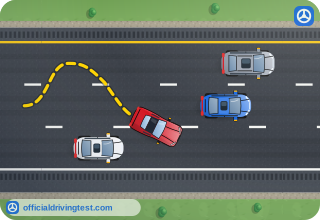
- Move into the next lane immediately
- Slow down and be ready to brake
- Flash your high beams to warn them
- Speed up so they cannot pass you
Show answer
Correct answer: Slow down and be ready to brake
The handbook advises anticipating that an aggressive driver behind you will likely pass and cut you off, so you should slow down and be ready to brake.
Source: Florida Driver License Handbook (Revised August 2023), page 75
-
Where do crashes happen more than any other place?
- Parking lots
- Intersections
- Bridges
- Highway on-ramps
Show answer
Correct answer: Intersections
Crashes happen at intersections more than any other place, so extra caution is needed there.
Source: Florida Driver License Handbook (Revised August 2023), page 75
3Part 318 questions
-
If a crash is unavoidable, which is the better choice?
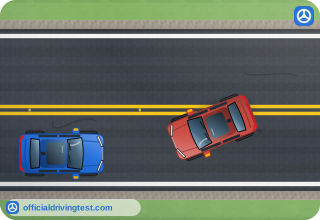
- Skidding off the road rather than driving off it
- Swerving off the road rather than into oncoming traffic
- Swerving into oncoming traffic rather than off the road
- Speeding up to pass through the danger quickly
Show answer
Correct answer: Swerving off the road rather than into oncoming traffic
The handbook states it's better to swerve off the road than into oncoming traffic.
Source: Florida Driver License Handbook (Revised August 2023), page 75
-
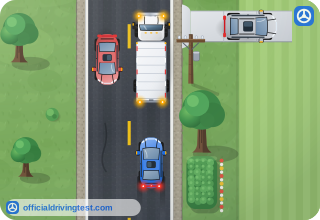
If a crash is unavoidable and you must hit something, which is the better choice?
- A parked vehicle, rather than an empty field
- Whichever object is closest, regardless of type
- A soft object like a hedge, rather than a solid object like a tree
- A solid object like a tree, rather than a soft object like a hedge
Show answer
Correct answer: A soft object like a hedge, rather than a solid object like a tree
Hitting a "soft object" like a garden hedge is better than hitting a solid object like a tree or post.
Source: Florida Driver License Handbook (Revised August 2023), page 75
-
When you see emergency lights behind you, what should you do?
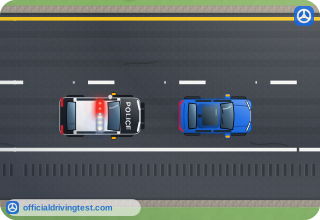
- Stay calm, signal, and pull to the side of the road as soon as it is safe
- Stop immediately in your current lane
- Slow down gradually but keep driving until you find a police station
- Continue at the same speed until the officer turns off the lights
Show answer
Correct answer: Stay calm, signal, and pull to the side of the road as soon as it is safe
You should stay calm and cooperate, activating your turn signal and pulling over as soon as it is safe to do so.
Source: Florida Driver License Handbook (Revised August 2023), page 75
-
After pulling over for a traffic stop, what should you do with your engine and audio devices?
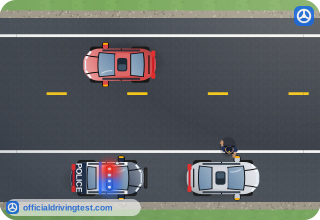
- Turn off your engine and any audio devices
- Leave everything as it is until the officer asks
- Turn up the radio so you can hear the officer's announcement
- Leave the engine running but turn off the radio
Show answer
Correct answer: Turn off your engine and any audio devices
After pulling over, you should turn off your engine and any audio devices.
Source: Florida Driver License Handbook (Revised August 2023), page 75
-
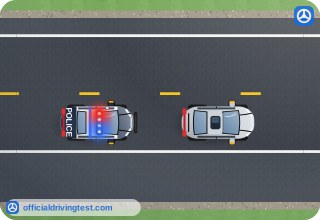
During a traffic stop, should you exit your vehicle?
- Yes, but only if it is raining
- No, stay inside unless the officer directs you to exit
- Yes, always exit immediately to show cooperation
- It does not matter either way
Show answer
Correct answer: No, stay inside unless the officer directs you to exit
You should stay in your vehicle unless the officer directs you to exit.
Source: Florida Driver License Handbook (Revised August 2023), page 75
-
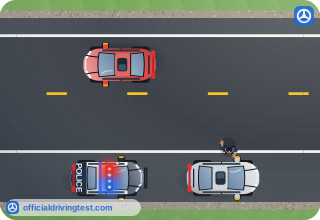
Where should you keep your hands during a traffic stop?
- Behind your back
- In your pockets to keep warm
- On the steering wheel or in a visible location
- On your phone to record the interaction
Show answer
Correct answer: On the steering wheel or in a visible location
You should keep your hands on the steering wheel or in a visible location so the officer can easily see them.
Source: Florida Driver License Handbook (Revised August 2023), page 75
-
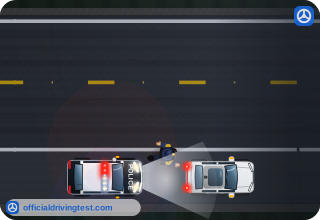
If you are pulled over at night, what should you do to help with visibility? And if you have tinted windows during the day?
- Turn on your interior lights at night; roll down all windows by day
- Use your high beams to light up the interior
- Keep tinted windows up at all times for privacy
- Turn off all your lights at night to avoid blinding the officer
Show answer
Correct answer: Turn on your interior lights at night; roll down all windows by day
Turn on your interior lights if pulled over at night; if you have tinted windows during the day, roll down all your windows.
Source: Florida Driver License Handbook (Revised August 2023), page 76
-
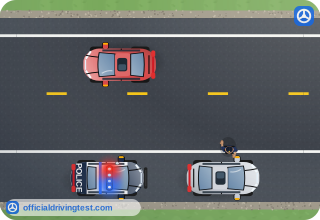
Before reaching for your driver's license or vehicle documents during a stop, what should you do?
- Hand them to a passenger to give to the officer
- Reach for them immediately so the officer does not have to wait
- Wait for the officer's instructions before reaching for them
- Place them on the roof of the car
Show answer
Correct answer: Wait for the officer's instructions before reaching for them
You should wait for the officer's instructions before reaching for your driver's license or vehicle documents.
Source: Florida Driver License Handbook (Revised August 2023), page 76
-
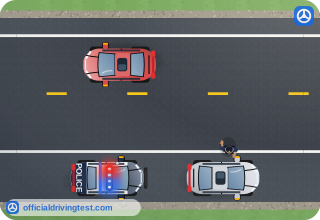
What should you tell the officer upon first contact if it applies to you?
- Let the officer know if you have a weapon in the vehicle
- Let the officer know if you have been in prior accidents
- Let the officer know your travel plans for the day
- Let the officer know your insurance company's name
Show answer
Correct answer: Let the officer know if you have a weapon in the vehicle
You should let the officer know if you have a weapon in the vehicle upon first contact.
Source: Florida Driver License Handbook (Revised August 2023), page 76
-
If an officer approaching your vehicle is not in uniform, what should they show you?
- Their law enforcement credentials
- Nothing; plain-clothes officers are not required to identify themselves
- A copy of the traffic law you allegedly violated
- Their personal identification card
Show answer
Correct answer: Their law enforcement credentials
If officers are not in uniform, they should show their law enforcement credentials; if they do not, you may ask to see them.
Source: Florida Driver License Handbook (Revised August 2023), page 76
-
If your driver's license, insurance, or registration are out of reach during a stop, what should you do?
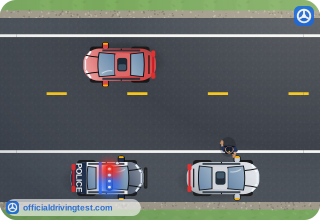
- Ignore the request until you get home
- Get out of the car to retrieve them from the trunk yourself
- Tell the officer where they are and wait for their acknowledgment
- Reach for them right away without saying anything
Show answer
Correct answer: Tell the officer where they are and wait for their acknowledgment
If documents are out of reach, tell the officer where they are and wait for the officer's acknowledgment before reaching to retrieve them.
Source: Florida Driver License Handbook (Revised August 2023), page 76
-
What sanctions might an officer impose after a traffic stop?
- Immediate suspension of your driver license in all cases
- Only a verbal warning; officers cannot issue tickets on the spot
- Community service hours assigned on the spot
- A warning, a traffic ticket which may include a fine, or arrest
Show answer
Correct answer: A warning, a traffic ticket which may include a fine, or arrest
The officer may impose a sanction such as a warning, a traffic ticket which may include a fine, or arrest.
Source: Florida Driver License Handbook (Revised August 2023), page 76
-
If you disagree with an officer's decision during a traffic stop, what should you do?
- Argue with the officer until they change their decision
- Drive away once you have your documents back
- Avoid arguing; you may contest the decision in court
- Refuse to provide any further identification
Show answer
Correct answer: Avoid arguing; you may contest the decision in court
If you disagree with the officer's decision, you should not prolong the contact by arguing; you may contest it in court through established legal channels.
Source: Florida Driver License Handbook (Revised August 2023), page 76
-
Does signing a traffic ticket mean you are admitting guilt?
- Signing is optional and has no legal meaning either way
- No, and refusing to sign has no consequences
- Yes, signing is a legal admission of guilt
- No, but refusing to sign a ticket may result in your arrest
Show answer
Correct answer: No, but refusing to sign a ticket may result in your arrest
Acceptance and signature on a traffic ticket is not an admission of guilt; however, refusal to sign a traffic ticket may result in arrest.
Source: Florida Driver License Handbook (Revised August 2023), page 76
-
If you are involved in a crash resulting in death, injury, or property damage, what is your legal duty?
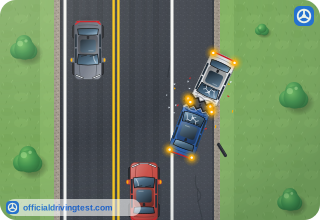
- To give information and render aid, while remaining calm
- To contact your insurance company before anyone else
- To wait for a tow truck before doing anything else
- To leave the scene quickly to avoid traffic congestion
Show answer
Correct answer: To give information and render aid, while remaining calm
It's your duty, required by law, to give information and render aid if you're involved in a crash resulting in death, injury, or property damage.
Source: Florida Driver License Handbook (Revised August 2023), page 77
-
What is the first thing you should do after a crash?
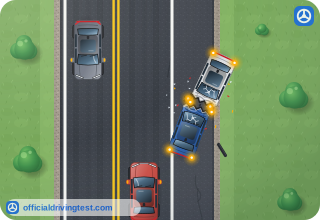
- Move all vehicles before calling anyone
- Stop and call 911, *FHP (*347), or local law enforcement
- Drive to the nearest police station to report it
- Exchange insurance information before calling for help
Show answer
Correct answer: Stop and call 911, *FHP (*347), or local law enforcement
The first step after a crash is to stop and call 911, *FHP (*347), or local law enforcement.
Source: Florida Driver License Handbook (Revised August 2023), page 77
-
If your crash is minor and your vehicle is blocking the flow of traffic, what must you do?
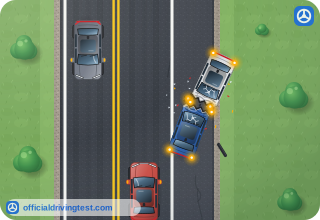
- Push it into the nearest ditch
- Leave it exactly where it is until police arrive
- Wait for a tow truck no matter how long it takes
- Move it or have it moved
Show answer
Correct answer: Move it or have it moved
If the crash is minor and your vehicle is blocking traffic, you must move it or have it moved.
Source: Florida Driver License Handbook (Revised August 2023), page 77
-
What information should you exchange with the other driver after a crash?
- Only insurance company names, not any personal information
- Name, address, phone, plate number, driver license, and insurance
- Only vehicle make and model
- Only your names
Show answer
Correct answer: Name, address, phone, plate number, driver license, and insurance
You should exchange vehicle, witness, and driver information, including name, address, phone number, license plate number, driver license, and insurance.
Source: Florida Driver License Handbook (Revised August 2023), page 77
4Part 418 questions
-
What should you do to document a crash scene?
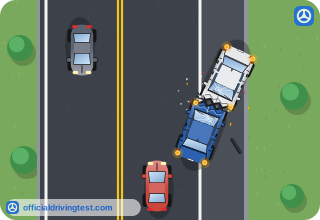
- Rely only on your memory when you report to your insurer
- Take photos or sketch the scene, showing vehicle crash locations
- Wait for the officer to take all photos
- Move the vehicles first so photos look cleaner
Show answer
Correct answer: Take photos or sketch the scene, showing vehicle crash locations
You should take photos or sketch the scene, showing where the vehicles were located during the crash.
Source: Florida Driver License Handbook (Revised August 2023), page 77
-
If you come upon a crash, what should you do?
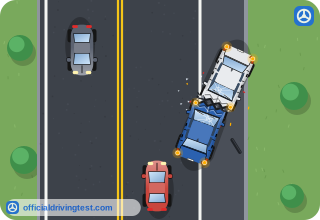
- Call 911 or *FHP (*347), even if others may have already called
- Only call for help if there are visible injuries
- Assume someone else has already called and continue driving
- Wait for a police officer to arrive before doing anything
Show answer
Correct answer: Call 911 or *FHP (*347), even if others may have already called
If you come upon a crash, call 911 or *FHP (*347) and/or send someone for help; don't assume someone else has called, since it's better for emergency services to get multiple calls than none at all.
Source: Florida Driver License Handbook (Revised August 2023), page 77
-
When stopping to help at a crash scene, what should you do to stay safe?
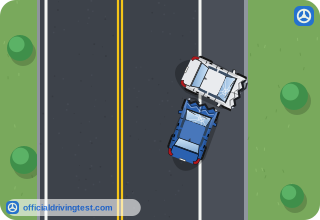
- Stand in the traffic lane to direct other drivers
- Park in the middle of the road to block other vehicles
- Leave your hazard lights off to avoid draining your battery
- Pull far off the road, turn on hazard lights, and stay out of traffic
Show answer
Correct answer: Pull far off the road, turn on hazard lights, and stay out of traffic
Do not put yourself in danger; pull as far off the road as possible, turn on your hazard lights, and stay out of traffic.
Source: Florida Driver License Handbook (Revised August 2023), page 77
-
If an injured person may have a neck or spinal injury, what should you do?
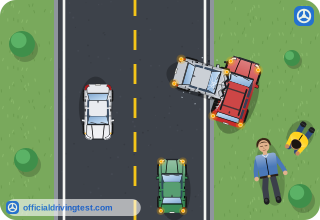
- Have them stand up to check for injuries
- Move them to a more comfortable position
- Do not move them
- Sit them up immediately
Show answer
Correct answer: Do not move them
Don't move an injured person who may have a neck or spinal injury.
Source: Florida Driver License Handbook (Revised August 2023), page 78
-
If a motorcycle or bicycle rider is injured and wearing a helmet, what should you do?
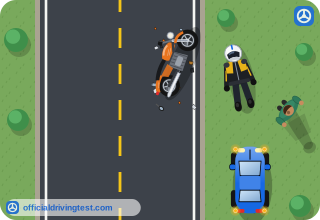
- Remove the helmet only if they ask you to
- Do not attempt to remove the helmet
- Remove the helmet immediately so they can breathe
- Loosen the strap but leave the helmet on the ground beside them
Show answer
Correct answer: Do not attempt to remove the helmet
Don't attempt to remove the helmet of an injured motorcycle or bicycle rider.
Source: Florida Driver License Handbook (Revised August 2023), page 78
-
When should you treat an injured person for shock?
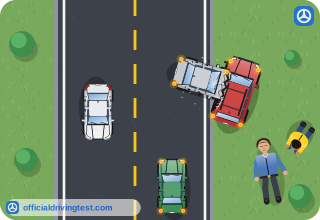
- Only if they specifically ask for help
- Only if they are unconscious
- Only after a doctor confirms they are in shock
- Whether or not they appear to be in shock
Show answer
Correct answer: Whether or not they appear to be in shock
Treat the injured for shock regardless of whether or not they appear to be in shock, and don't give them anything to drink.
Source: Florida Driver License Handbook (Revised August 2023), page 78
-
How should you position and care for a person being treated for shock?
- Have them stand and walk around to keep circulation going
- Have them sit upright with their head between their knees
- Leave them exactly as you found them and do not touch them
- Have them lie flat, elevate their legs, and cover them with blankets
Show answer
Correct answer: Have them lie flat, elevate their legs, and cover them with blankets
To treat for shock, keep the person calm, have them lie flat and elevate their legs, cover them with blankets to hold body heat, and maintain an open airway.
Source: Florida Driver License Handbook (Revised August 2023), page 78
-
To avoid striking the vehicle in front of you, how much following distance should you keep, and when should you increase it?
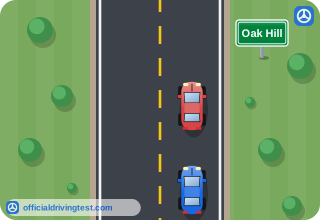
- As close as possible so other drivers cannot merge in front of you
- At least four seconds, increasing it during unfavorable weather or heavy traffic
- At least one second, and there is no need to increase it in bad weather
- Exactly two car lengths at all times, regardless of speed
Show answer
Correct answer: At least four seconds, increasing it during unfavorable weather or heavy traffic
Keep at least four seconds following distance and increase it during unfavorable weather or heavy traffic to lower the risk of a rear-end collision.
Source: Florida Driver License Handbook (Revised August 2023), page 78
-
To lower the risk of someone running into the rear of your vehicle, what should you avoid?
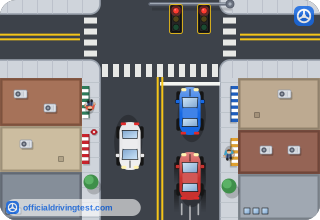
- Using your turn signals before changing lanes
- Checking your mirrors regularly
- Making sudden stops instead of slowing down gradually
- Keeping your brake lights clean and working
Show answer
Correct answer: Making sudden stops instead of slowing down gradually
Avoid sudden stops; slow down gradually and smoothly, and drive with the flow of traffic since driving too slowly can also be dangerous.
Source: Florida Driver License Handbook (Revised August 2023), page 78
-
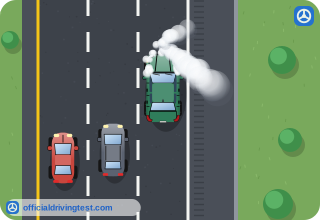
If your vehicle breaks down, what must you do as soon as possible?
- Leave it exactly where it stopped, even if it blocks a traffic lane
- Wait inside the vehicle in the traffic lane until help arrives
- Push it to the nearest exit ramp, no matter how far
- Move it so all four wheels are out of traffic lanes, or have it moved
Show answer
Correct answer: Move it so all four wheels are out of traffic lanes, or have it moved
You must move the vehicle so all four wheels are out of the traffic lanes as soon as possible; if you can't move it, you must have it moved.
Source: Florida Driver License Handbook (Revised August 2023), page 78
-
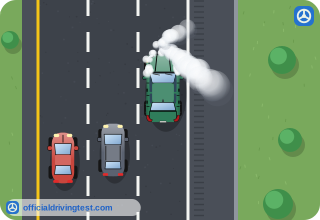
If possible, where should you park a disabled vehicle, and what should you turn on?
- In the nearest travel lane, and turn on your high beams
- Behind a curve where it cannot be seen, and turn off all lights
- Where it can be seen 200 feet in each direction, and turn on hazard lights
- As close to other vehicles as possible, and turn on your radio
Show answer
Correct answer: Where it can be seen 200 feet in each direction, and turn on hazard lights
If possible, park where the disabled vehicle can be seen for 200 feet in each direction, and turn on your hazard lights.
Source: Florida Driver License Handbook (Revised August 2023), page 78
-
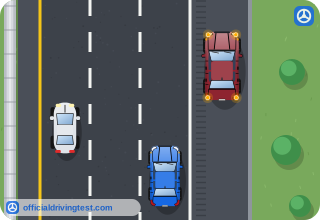
If your vehicle breaks down, where should passengers get out, and who should you call for assistance?
- Keep all passengers inside the vehicle with seatbelts on
- Have passengers stand behind the vehicle to warn other drivers
- Get all passengers out on the side away from traffic, and call *FHP (*347) or law enforcement
- Get all passengers out on the side facing traffic, and call your mechanic first
Show answer
Correct answer: Get all passengers out on the side away from traffic, and call *FHP (*347) or law enforcement
Get all passengers out of the car on the side away from traffic, and call *FHP (*347) or law enforcement for assistance.
Source: Florida Driver License Handbook (Revised August 2023), page 78
-
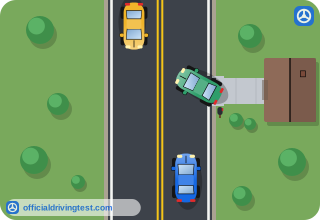
In an emergency braking situation where traction is lost, what should drivers with conventional brakes do, versus drivers with anti-lock brakes (ABS)?
- Conventional brakes: press hard and hold. ABS: pump the brakes rapidly
- Neither type of brake should be used; only steering should be used to stop
- Both types should be pumped rapidly in the same way
- Conventional brakes: pump them. ABS: press hard, hold it, and steer out of danger
Show answer
Correct answer: Conventional brakes: pump them. ABS: press hard, hold it, and steer out of danger
Drivers with conventional brakes should pump the brakes, while drivers with ABS must press down hard on the brake pedal, hold it, and steer out of danger. Releasing pressure or pumping ABS brakes causes the ABS to disengage.
Source: Florida Driver License Handbook (Revised August 2023), page 78
-
On a vehicle with rear-wheel ABS, if the front wheels lock up and the driver starts to lose steering control, what should the driver do?
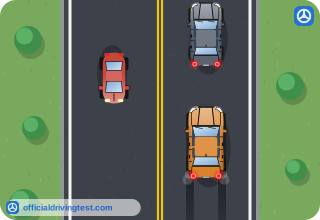
- Take your foot off the brake completely and accelerate
- Press the brake pedal even harder until the vehicle stops completely
- Let up on the brake just enough for the front wheels to start rolling again
- Turn the steering wheel sharply in the opposite direction
Show answer
Correct answer: Let up on the brake just enough for the front wheels to start rolling again
Rear-wheel ABS prevents the rear wheels from locking, but the front wheels can still lock up. If this happens, let up on the brake pedal just enough to allow the front wheels to start rolling again to regain control.
Source: Florida Driver License Handbook (Revised August 2023), page 78
-
If your vehicle catches fire, what is the first thing you should do, and who should you call?
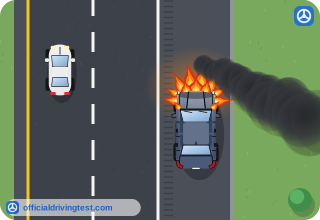
- Exit the vehicle and call 911 for assistance
- Try to drive the vehicle to the nearest fire station
- Stay inside the vehicle with the windows up and wait
- Open the hood first to assess the damage before doing anything else
Show answer
Correct answer: Exit the vehicle and call 911 for assistance
If your vehicle is on fire, exit the vehicle and call 911 for assistance.
Source: Florida Driver License Handbook (Revised August 2023), page 79
-
When should you attempt to extinguish a vehicle fire yourself, and what should you never do?
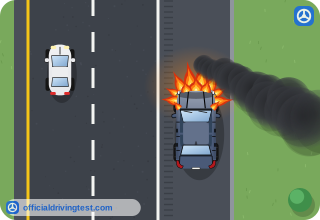
- Never; you should always wait for firefighters no matter what
- Always, no matter the size of the fire, using any liquid available including water
- Only with a portable extinguisher on a small fire; never put water on a gasoline or diesel fire
- Only if the fire is large, since small fires will go out on their own
Show answer
Correct answer: Only with a portable extinguisher on a small fire; never put water on a gasoline or diesel fire
Attempt to extinguish the fire only if you have a portable extinguisher and the fire is small; never apply water to a gasoline or diesel fire.
Source: Florida Driver License Handbook (Revised August 2023), page 79
-
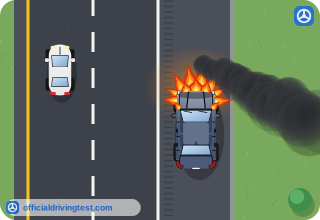
If you can't extinguish a vehicle fire, what should you do, and why?
- Sit in the driver's seat with the doors locked
- Stay near the vehicle to keep watching the fire
- Try harder to put it out using your bare hands
- Get away, since the fumes are toxic and it may explode
Show answer
Correct answer: Get away, since the fumes are toxic and it may explode
If you can't extinguish the fire, get away from the vehicle; the fumes are toxic and an explosion is possible.
Source: Florida Driver License Handbook (Revised August 2023), page 79
-
If your gas pedal becomes jammed, what should you do first and second?
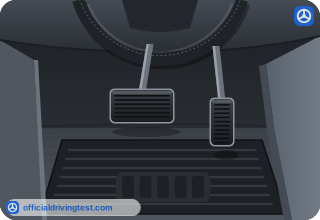
- Accelerate to pass other vehicles quickly, then brake hard
- Turn off the engine immediately, then apply the parking brake
- Take your foot off the gas, then press the clutch or shift into neutral
- Open the door and jump out of the vehicle
Show answer
Correct answer: Take your foot off the gas, then press the clutch or shift into neutral
If your gas pedal jams, first take your foot off the gas pedal, then press the clutch (manual transmission) or shift into neutral (automatic transmission).
Source: Florida Driver License Handbook (Revised August 2023), page 79
5Part 518 questions
-
If your gas pedal jams, should you shut off the engine?
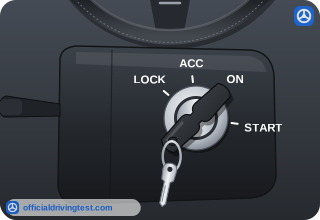
- No, you should never shut off the engine under any circumstance
- Only as a last resort, since you will lose the ability to steer
- Yes, always shut off the engine immediately as the very first step
- It makes no difference whether you shut off the engine or not
Show answer
Correct answer: Only as a last resort, since you will lose the ability to steer
Do not shut off the engine unless taking your foot off the gas and shifting to neutral/clutch do not work to slow the vehicle, since shutting off the engine causes you to lose the ability to steer the car.
Source: Florida Driver License Handbook (Revised August 2023), page 79
-
What is "overcorrection," and what can it result in?
- Correctly adjusting your mirrors before driving, which prevents crashes
- Signaling too early before a turn, which can confuse other drivers
- Driving too slowly on the highway, which can result in a rear-end collision
- Excessive steering in reaction to an event or loss of control, which can result in a rollover crash or steering into oncoming traffic
Show answer
Correct answer: Excessive steering in reaction to an event or loss of control, which can result in a rollover crash or steering into oncoming traffic
Overcorrection is excessive steering in reaction to an event or loss of control of a vehicle, typically when a motorist steers too sharply to avoid a collision or driving off the roadway; it can result in a rollover crash or steering into oncoming traffic.
Source: Florida Driver License Handbook (Revised August 2023), page 79
-
If you find yourself unintentionally leaving the roadway, what is the correct response?
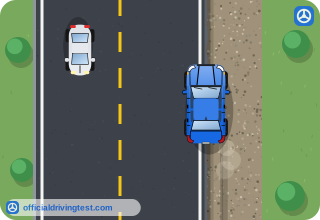
- Accelerate to regain control faster
- Slam on the brakes immediately and let go of the wheel
- Stay calm, hold the wheel firmly, release the gas, and don't slam on the brakes
- Turn the wheel as sharply as possible to get back on the road immediately
Show answer
Correct answer: Stay calm, hold the wheel firmly, release the gas, and don't slam on the brakes
If you find yourself unintentionally leaving the roadway, stay calm, hold the wheel firmly, take your foot off the gas without slamming the brakes, and steer the car where desired.
Source: Florida Driver License Handbook (Revised August 2023), page 79
-
If the power goes out and traffic signals are not active, how should you treat the intersection, and who goes first if two vehicles arrive at the same time?
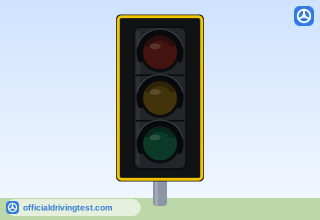
- Drive through without stopping since there are no signals
- Wait for a police officer to arrive and direct traffic before proceeding
- Treat it as a four-way stop; the driver on the left yields to the one on the right
- Treat it as a yield sign for everyone, and whoever is fastest goes first
Show answer
Correct answer: Treat it as a four-way stop; the driver on the left yields to the one on the right
When the power is out and traffic signals are not active, treat intersections as a four-way stop: vehicles move through in the order they arrived, and if multiple vehicles arrive at the same time, the driver on the left yields to the driver on the right.
Source: Florida Driver License Handbook (Revised August 2023), page 79
-
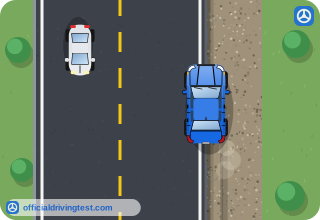
If your right wheels drop off the edge of the pavement, what should you do first?
- Slam on the brakes and come to a complete stop immediately
- Release the gas, hold the wheel firmly, steer straight, and brake lightly
- Accelerate to build enough speed to jump back onto the pavement
- Turn the wheel sharply to get back on the pavement immediately
Show answer
Correct answer: Release the gas, hold the wheel firmly, steer straight, and brake lightly
If your right wheels go off the pavement, take your foot off the gas pedal, hold the wheel firmly and steer in a straight line, and brake lightly.
Source: Florida Driver License Handbook (Revised August 2023), page 79
-
When returning your right wheels to the pavement after they've gone off the edge, what should you do?
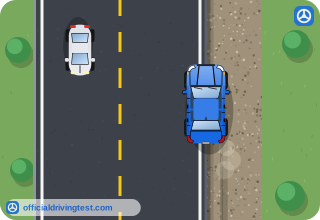
- Wait until the road is clear, then signal and turn back onto the pavement slowly
- Turn back onto the pavement as quickly as possible without signaling
- Stop completely on the shoulder and wait for a tow truck no matter what
- Continue driving on the shoulder indefinitely instead of returning to the pavement
Show answer
Correct answer: Wait until the road is clear, then signal and turn back onto the pavement slowly
Wait until the road is clear, then turn back onto the pavement at a slow speed, signaling your intention.
Source: Florida Driver License Handbook (Revised August 2023), page 79
-
If your vehicle starts skidding or hydroplaning, what should you do with the brakes and steering?
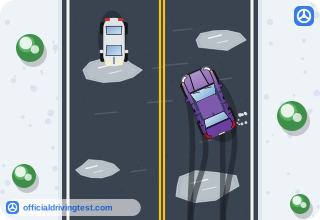
- Release the gas, avoid braking, and steer in the direction of the skid
- Accelerate to power through the skid
- Slam on the brakes immediately and steer opposite to the skid
- Take your hands off the wheel and let the vehicle correct itself
Show answer
Correct answer: Release the gas, avoid braking, and steer in the direction of the skid
If skidding or hydroplaning, take your foot off the gas pedal, do not use your brakes if possible, and turn the vehicle's front tires in the direction you want to go, which means steering in the direction of the skid.
Source: Florida Driver License Handbook (Revised August 2023), page 79
-
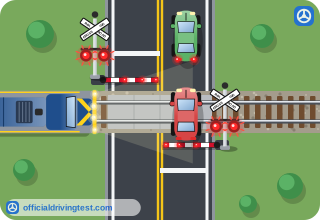
If your car stalls on railroad tracks, what should you and any passengers do?
- Push the car off the tracks by yourself before doing anything else
- Wait inside the car for a train to pass before getting out
- Stay inside the car and try to restart the engine repeatedly
- Get everyone out immediately and get away from the car
Show answer
Correct answer: Get everyone out immediately and get away from the car
If your car stalls on the railroad tracks, get everyone out immediately and get away from the car.
Source: Florida Driver License Handbook (Revised August 2023), page 79
-
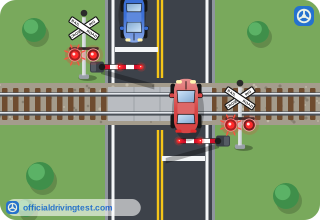
If you are stalled at a railroad crossing and the warning lights begin to flash, what is the minimum amount of time it takes a train to reach the crossing?
- 60 seconds
- There is no minimum; trains arrive at random intervals
- 20 seconds
- 5 seconds
Show answer
Correct answer: 20 seconds
If you are stalled at a railroad crossing and the warning lights begin to flash, 20 seconds is the minimal amount of time it takes a train to reach the grade crossing after the warning lights begin flashing.
Source: Florida Driver License Handbook (Revised August 2023), page 79
-
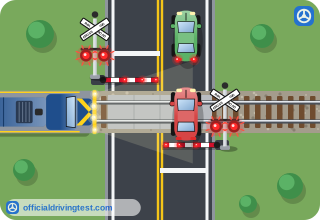
If your car is stalled on the tracks and a train is coming, in which direction should you run?
- At a 45-degree angle away from the tracks, but toward the oncoming train
- Along the tracks in either direction until you find a safe crossing
- Back toward the car to try to move it one more time
- Directly away from the tracks in the same direction the train is traveling
Show answer
Correct answer: At a 45-degree angle away from the tracks, but toward the oncoming train
If a train is coming, run at a 45-degree angle away from the tracks, but toward the train, since you will be less likely to be hit by your vehicle or debris from the collision.
Source: Florida Driver License Handbook (Revised August 2023), page 80
-
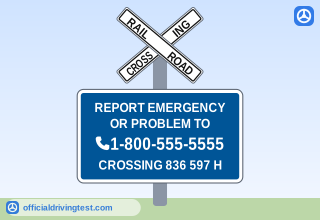
What is the purpose of the blue Emergency Notification System (ENS) sign found at highway-rail grade crossings?
- It gives emergency contact information to reach the railroad
- It shows the current train schedule for that crossing
- It automatically stops any train approaching the crossing
- It displays the speed limit for vehicles crossing the tracks
Show answer
Correct answer: It gives emergency contact information to reach the railroad
There is a blue ENS sign installed at every highway-rail grade crossing that provides critical emergency contact information to reach the railroad responsible if there is a problem at the crossing or if something is blocking the tracks.
Source: Florida Driver License Handbook (Revised August 2023), page 80
-
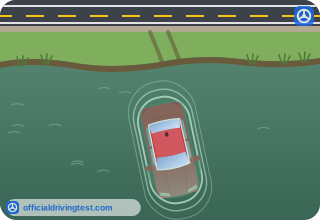
If you crash into a pond, river, or other body of water, how long will your vehicle float, and when should you call 911?
- It will float indefinitely, so you can call 911 first and take your time getting out
- It will float for about an hour, giving you plenty of time to plan your exit
- It will only float for 30-60 seconds; get out immediately and do NOT call 911 until you are out
- It will sink within 5 seconds, so there is no time to do anything
Show answer
Correct answer: It will only float for 30-60 seconds; get out immediately and do NOT call 911 until you are out
If you crash into a pond, river, or other body of water, your vehicle will only float on the surface for 30-60 seconds. Get out of the vehicle immediately; do NOT call 911 until you are out of the vehicle.
Source: Florida Driver License Handbook (Revised August 2023), page 80
-
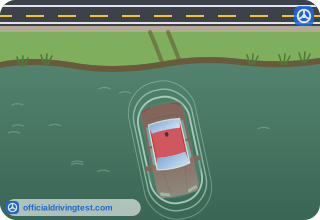
If your vehicle is sinking in water, why should you roll the window down before the car sinks, rather than opening the door?
- Because the doors automatically lock underwater and cannot be opened at all
- There is no difference; either method works equally well
- Because opening the door will make the car float longer
- Because if you are able to open the door, the car will immediately fill with water
Show answer
Correct answer: Because if you are able to open the door, the car will immediately fill with water
Roll the window down before the car sinks; if you are able to open the door instead, be aware that the car will immediately fill with water.
Source: Florida Driver License Handbook (Revised August 2023), page 80
-
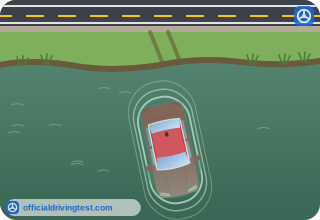
If you are unable to roll down the window of a sinking vehicle, what should you try to do?
- Honk the horn continuously and stay seated with your seatbelt on
- Try to kick out a side window
- Try to open the sunroof and climb through it while the car is still moving
- Wait calmly for rescuers to arrive before doing anything
Show answer
Correct answer: Try to kick out a side window
If you are unable to roll the window down, try to kick out a side window.
Source: Florida Driver License Handbook (Revised August 2023), page 80
-
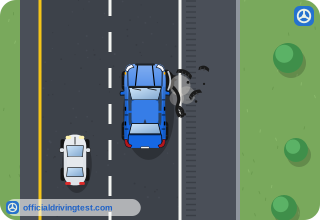
If you experience a tire blowout, what should you do with the gas pedal and brakes at first, and what should you concentrate on?
- Turn off the engine right away and coast to a stop
- Keep your foot steady on the gas and brake at the same time
- Slam on the brakes immediately and accelerate afterward
- Release the gas, do not use the brakes, and concentrate on steering
Show answer
Correct answer: Release the gas, do not use the brakes, and concentrate on steering
If you have a tire blowout, take your foot off the gas, do not use the brakes, and concentrate on steering.
Source: Florida Driver License Handbook (Revised August 2023), page 80
-
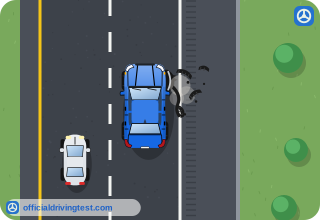
After a tire blowout, once you have slowed down gradually, what should you do next?
- Brake softly once the car is under control, then pull fully off the road
- Turn the steering wheel sharply to change lanes right away
- Speed back up immediately to get away from traffic
- Stop the car in the travel lane and turn on the radio for updates
Show answer
Correct answer: Brake softly once the car is under control, then pull fully off the road
After a tire blowout, slow down gradually, brake softly once the car is under control, and pull completely off the pavement/roadway.
Source: Florida Driver License Handbook (Revised August 2023), page 80
-
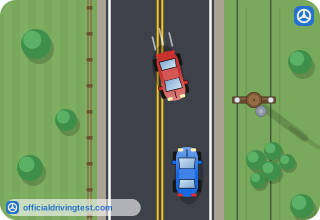
If a vehicle is approaching in your lane, what should you do, in order?
- Accelerate past the oncoming vehicle as quickly as possible
- Flash your low beams only and continue in your lane
- Steer to the side of the road first, then sound the horn afterward
- Sound your horn and flash your high beams, brake hard, then steer to the side of the road
Show answer
Correct answer: Sound your horn and flash your high beams, brake hard, then steer to the side of the road
If a vehicle is approaching in your lane, sound your horn and flash your high beams, brake hard, and steer to the side of the road.
Source: Florida Driver License Handbook (Revised August 2023), page 80
-
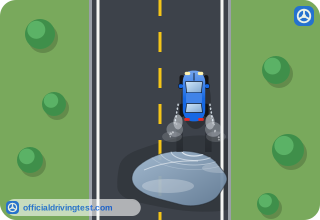
If your brakes are wet, what should you do, and what might happen when you test them?
- Test the brakes by slamming on them hard immediately
- Do not test the brakes at all; simply continue driving normally
- Test them lightly, as they may pull or not hold; dry them by driving slowly in low gear and braking
- Pull over and wait several hours for the brakes to dry on their own before driving again
Show answer
Correct answer: Test them lightly, as they may pull or not hold; dry them by driving slowly in low gear and braking
Test brakes lightly; they may pull to one side or may not hold at all. Dry brakes by driving slowly in low gear and applying the brakes.
Source: Florida Driver License Handbook (Revised August 2023), page 80