Florida: Emergencies and special situations — Part 5 Practice Test
Questions in this part include: “What is "overcorrection," and what can it result in?”
Independent educational site · not affiliated with any government agency or DMV
Ready? Test yourself
- Instant feedback with an explanation
- Every answer cites its source in the manual
- Your best score is saved on this device
Questions are original and based on the official manual "Florida Driver License Handbook" (Revised August 2023), Florida Department of Highway Safety and Motor Vehicles (FLHSMV).
All 18 questions in this practice test
Take the test above first, then use this list to study. Tap “Show answer” to see the correct answer and explanation.
Show the questions and answersHide the questions
-
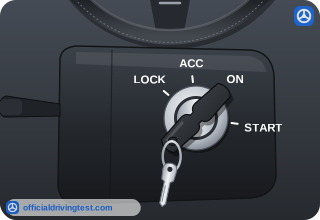
If your gas pedal jams, should you shut off the engine?
- No, you should never shut off the engine under any circumstance
- Only as a last resort, since you will lose the ability to steer
- Yes, always shut off the engine immediately as the very first step
- It makes no difference whether you shut off the engine or not
Show answer
Correct answer: Only as a last resort, since you will lose the ability to steer
Do not shut off the engine unless taking your foot off the gas and shifting to neutral/clutch do not work to slow the vehicle, since shutting off the engine causes you to lose the ability to steer the car.
Source: Florida Driver License Handbook (Revised August 2023), page 79
-
What is "overcorrection," and what can it result in?
- Correctly adjusting your mirrors before driving, which prevents crashes
- Signaling too early before a turn, which can confuse other drivers
- Driving too slowly on the highway, which can result in a rear-end collision
- Excessive steering in reaction to an event or loss of control, which can result in a rollover crash or steering into oncoming traffic
Show answer
Correct answer: Excessive steering in reaction to an event or loss of control, which can result in a rollover crash or steering into oncoming traffic
Overcorrection is excessive steering in reaction to an event or loss of control of a vehicle, typically when a motorist steers too sharply to avoid a collision or driving off the roadway; it can result in a rollover crash or steering into oncoming traffic.
Source: Florida Driver License Handbook (Revised August 2023), page 79
-
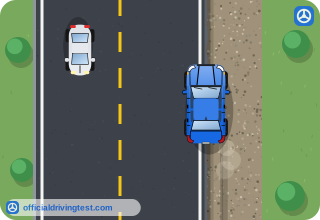
If you find yourself unintentionally leaving the roadway, what is the correct response?
- Accelerate to regain control faster
- Slam on the brakes immediately and let go of the wheel
- Stay calm, hold the wheel firmly, release the gas, and don't slam on the brakes
- Turn the wheel as sharply as possible to get back on the road immediately
Show answer
Correct answer: Stay calm, hold the wheel firmly, release the gas, and don't slam on the brakes
If you find yourself unintentionally leaving the roadway, stay calm, hold the wheel firmly, take your foot off the gas without slamming the brakes, and steer the car where desired.
Source: Florida Driver License Handbook (Revised August 2023), page 79
-
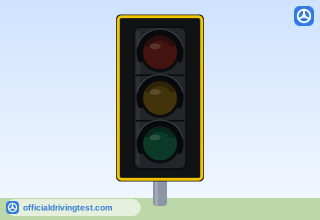
If the power goes out and traffic signals are not active, how should you treat the intersection, and who goes first if two vehicles arrive at the same time?
- Drive through without stopping since there are no signals
- Wait for a police officer to arrive and direct traffic before proceeding
- Treat it as a four-way stop; the driver on the left yields to the one on the right
- Treat it as a yield sign for everyone, and whoever is fastest goes first
Show answer
Correct answer: Treat it as a four-way stop; the driver on the left yields to the one on the right
When the power is out and traffic signals are not active, treat intersections as a four-way stop: vehicles move through in the order they arrived, and if multiple vehicles arrive at the same time, the driver on the left yields to the driver on the right.
Source: Florida Driver License Handbook (Revised August 2023), page 79
-
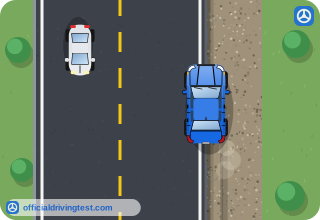
If your right wheels drop off the edge of the pavement, what should you do first?
- Slam on the brakes and come to a complete stop immediately
- Release the gas, hold the wheel firmly, steer straight, and brake lightly
- Accelerate to build enough speed to jump back onto the pavement
- Turn the wheel sharply to get back on the pavement immediately
Show answer
Correct answer: Release the gas, hold the wheel firmly, steer straight, and brake lightly
If your right wheels go off the pavement, take your foot off the gas pedal, hold the wheel firmly and steer in a straight line, and brake lightly.
Source: Florida Driver License Handbook (Revised August 2023), page 79
-
When returning your right wheels to the pavement after they've gone off the edge, what should you do?
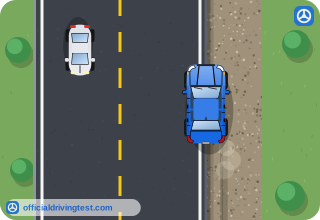
- Wait until the road is clear, then signal and turn back onto the pavement slowly
- Turn back onto the pavement as quickly as possible without signaling
- Stop completely on the shoulder and wait for a tow truck no matter what
- Continue driving on the shoulder indefinitely instead of returning to the pavement
Show answer
Correct answer: Wait until the road is clear, then signal and turn back onto the pavement slowly
Wait until the road is clear, then turn back onto the pavement at a slow speed, signaling your intention.
Source: Florida Driver License Handbook (Revised August 2023), page 79
-
If your vehicle starts skidding or hydroplaning, what should you do with the brakes and steering?
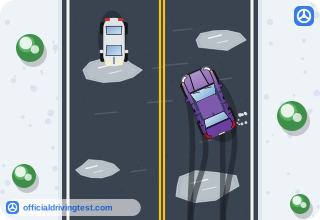
- Release the gas, avoid braking, and steer in the direction of the skid
- Accelerate to power through the skid
- Slam on the brakes immediately and steer opposite to the skid
- Take your hands off the wheel and let the vehicle correct itself
Show answer
Correct answer: Release the gas, avoid braking, and steer in the direction of the skid
If skidding or hydroplaning, take your foot off the gas pedal, do not use your brakes if possible, and turn the vehicle's front tires in the direction you want to go, which means steering in the direction of the skid.
Source: Florida Driver License Handbook (Revised August 2023), page 79
-
If your car stalls on railroad tracks, what should you and any passengers do?
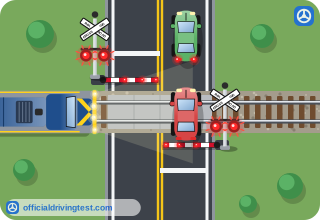
- Push the car off the tracks by yourself before doing anything else
- Wait inside the car for a train to pass before getting out
- Stay inside the car and try to restart the engine repeatedly
- Get everyone out immediately and get away from the car
Show answer
Correct answer: Get everyone out immediately and get away from the car
If your car stalls on the railroad tracks, get everyone out immediately and get away from the car.
Source: Florida Driver License Handbook (Revised August 2023), page 79
-
If you are stalled at a railroad crossing and the warning lights begin to flash, what is the minimum amount of time it takes a train to reach the crossing?
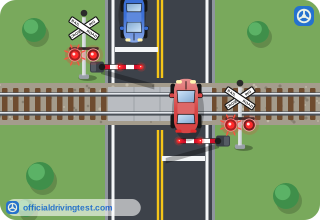
- 60 seconds
- There is no minimum; trains arrive at random intervals
- 20 seconds
- 5 seconds
Show answer
Correct answer: 20 seconds
If you are stalled at a railroad crossing and the warning lights begin to flash, 20 seconds is the minimal amount of time it takes a train to reach the grade crossing after the warning lights begin flashing.
Source: Florida Driver License Handbook (Revised August 2023), page 79
-
If your car is stalled on the tracks and a train is coming, in which direction should you run?
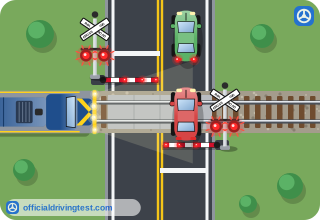
- At a 45-degree angle away from the tracks, but toward the oncoming train
- Along the tracks in either direction until you find a safe crossing
- Back toward the car to try to move it one more time
- Directly away from the tracks in the same direction the train is traveling
Show answer
Correct answer: At a 45-degree angle away from the tracks, but toward the oncoming train
If a train is coming, run at a 45-degree angle away from the tracks, but toward the train, since you will be less likely to be hit by your vehicle or debris from the collision.
Source: Florida Driver License Handbook (Revised August 2023), page 80
-
What is the purpose of the blue Emergency Notification System (ENS) sign found at highway-rail grade crossings?
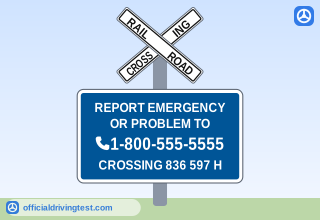
- It gives emergency contact information to reach the railroad
- It shows the current train schedule for that crossing
- It automatically stops any train approaching the crossing
- It displays the speed limit for vehicles crossing the tracks
Show answer
Correct answer: It gives emergency contact information to reach the railroad
There is a blue ENS sign installed at every highway-rail grade crossing that provides critical emergency contact information to reach the railroad responsible if there is a problem at the crossing or if something is blocking the tracks.
Source: Florida Driver License Handbook (Revised August 2023), page 80
-
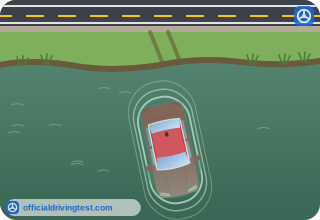
If you crash into a pond, river, or other body of water, how long will your vehicle float, and when should you call 911?
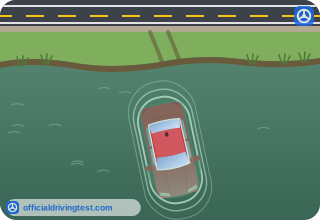
- It will float indefinitely, so you can call 911 first and take your time getting out
- It will float for about an hour, giving you plenty of time to plan your exit
- It will only float for 30-60 seconds; get out immediately and do NOT call 911 until you are out
- It will sink within 5 seconds, so there is no time to do anything
Show answer
Correct answer: It will only float for 30-60 seconds; get out immediately and do NOT call 911 until you are out
If you crash into a pond, river, or other body of water, your vehicle will only float on the surface for 30-60 seconds. Get out of the vehicle immediately; do NOT call 911 until you are out of the vehicle.
Source: Florida Driver License Handbook (Revised August 2023), page 80
-
If your vehicle is sinking in water, why should you roll the window down before the car sinks, rather than opening the door?
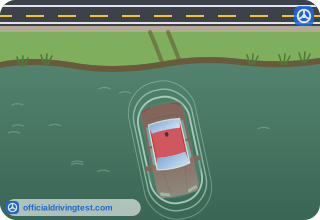
- Because the doors automatically lock underwater and cannot be opened at all
- There is no difference; either method works equally well
- Because opening the door will make the car float longer
- Because if you are able to open the door, the car will immediately fill with water
Show answer
Correct answer: Because if you are able to open the door, the car will immediately fill with water
Roll the window down before the car sinks; if you are able to open the door instead, be aware that the car will immediately fill with water.
Source: Florida Driver License Handbook (Revised August 2023), page 80
-
If you are unable to roll down the window of a sinking vehicle, what should you try to do?
- Honk the horn continuously and stay seated with your seatbelt on
- Try to kick out a side window
- Try to open the sunroof and climb through it while the car is still moving
- Wait calmly for rescuers to arrive before doing anything
Show answer
Correct answer: Try to kick out a side window
If you are unable to roll the window down, try to kick out a side window.
Source: Florida Driver License Handbook (Revised August 2023), page 80
-
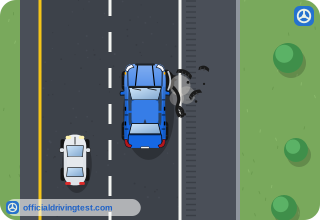
If you experience a tire blowout, what should you do with the gas pedal and brakes at first, and what should you concentrate on?
- Turn off the engine right away and coast to a stop
- Keep your foot steady on the gas and brake at the same time
- Slam on the brakes immediately and accelerate afterward
- Release the gas, do not use the brakes, and concentrate on steering
Show answer
Correct answer: Release the gas, do not use the brakes, and concentrate on steering
If you have a tire blowout, take your foot off the gas, do not use the brakes, and concentrate on steering.
Source: Florida Driver License Handbook (Revised August 2023), page 80
-
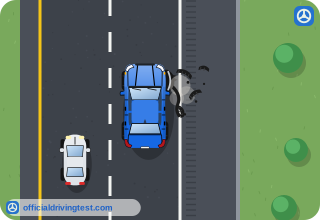
After a tire blowout, once you have slowed down gradually, what should you do next?
- Brake softly once the car is under control, then pull fully off the road
- Turn the steering wheel sharply to change lanes right away
- Speed back up immediately to get away from traffic
- Stop the car in the travel lane and turn on the radio for updates
Show answer
Correct answer: Brake softly once the car is under control, then pull fully off the road
After a tire blowout, slow down gradually, brake softly once the car is under control, and pull completely off the pavement/roadway.
Source: Florida Driver License Handbook (Revised August 2023), page 80
-
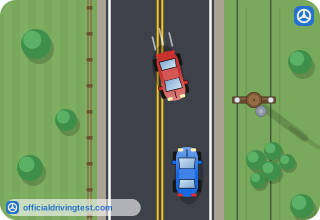
If a vehicle is approaching in your lane, what should you do, in order?
- Accelerate past the oncoming vehicle as quickly as possible
- Flash your low beams only and continue in your lane
- Steer to the side of the road first, then sound the horn afterward
- Sound your horn and flash your high beams, brake hard, then steer to the side of the road
Show answer
Correct answer: Sound your horn and flash your high beams, brake hard, then steer to the side of the road
If a vehicle is approaching in your lane, sound your horn and flash your high beams, brake hard, and steer to the side of the road.
Source: Florida Driver License Handbook (Revised August 2023), page 80
-
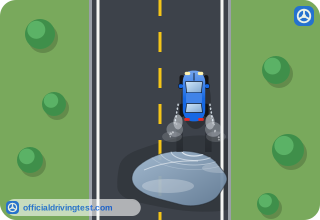
If your brakes are wet, what should you do, and what might happen when you test them?
- Test the brakes by slamming on them hard immediately
- Do not test the brakes at all; simply continue driving normally
- Test them lightly, as they may pull or not hold; dry them by driving slowly in low gear and braking
- Pull over and wait several hours for the brakes to dry on their own before driving again
Show answer
Correct answer: Test them lightly, as they may pull or not hold; dry them by driving slowly in low gear and braking
Test brakes lightly; they may pull to one side or may not hold at all. Dry brakes by driving slowly in low gear and applying the brakes.
Source: Florida Driver License Handbook (Revised August 2023), page 80