Florida: Emergencies and special situations — Part 1 Practice Test
Questions in this part include: “According to the handbook, drowsy driving can be just as dangerous as what?” · “According to the handbook, what is "micro-sleeping"?”
Independent educational site · not affiliated with any government agency or DMV
Ready? Test yourself
Answer to start, or tap Start below:
According to the handbook, drowsy driving can be just as dangerous as what?
- Instant feedback with an explanation
- Every answer cites its source in the manual
- Your best score is saved on this device
- Keyboard: press 1 to 4 to answer and Enter for the next question
Questions are original and based on the official manual "Florida Driver License Handbook" (Revised August 2023), Florida Department of Highway Safety and Motor Vehicles (FLHSMV).
All 18 questions in this practice test
Take the test above first, then use this list to study. Tap “Show answer” to see the correct answer and explanation.
Show the questions and answersHide the questions
-
According to the handbook, drowsy driving can be just as dangerous as what?
- Driving in light rain
- Speeding on a highway
- Driving without a seatbelt
- Drunk driving
Show answer
Correct answer: Drunk driving
The handbook states that drowsy driving can be just as dangerous as drunk driving.
Source: Florida Driver License Handbook (Revised August 2023), page 35
-
According to the handbook, what are the two main causes of drowsy driving?
- Cold weather and heavy traffic
- Lack of sleep and driving when you'd normally be asleep
- Driving alone and driving with music on
- Eating a large meal and drinking a lot of caffeine
Show answer
Correct answer: Lack of sleep and driving when you'd normally be asleep
The handbook lists the two main causes of drowsy driving as lack of quality or quantity of sleep and driving at times of day when you would normally be sleeping.
Source: Florida Driver License Handbook (Revised August 2023), page 35
-
According to the handbook, on long trips, how often should you take a break to help avoid drowsy driving?
- Every 500 miles or 8 hours
- Every 25 miles or 15 minutes
- Only when you reach your destination
- Every 100 miles or 2 hours
Show answer
Correct answer: Every 100 miles or 2 hours
The handbook recommends taking a break every 100 miles or 2 hours on long trips to help avoid drowsy driving.
Source: Florida Driver License Handbook (Revised August 2023), page 35
-
According to the handbook, what is "micro-sleeping"?
- A type of sleep medication
- Sleeping fewer than 8 hours the night before driving
- Taking a scheduled 20-minute nap before a trip
- Briefly "nodding off" while driving
Show answer
Correct answer: Briefly "nodding off" while driving
The handbook describes fatigue as being able to cause micro-sleeping ("nodding off") or falling completely asleep while driving.
Source: Florida Driver License Handbook (Revised August 2023), page 35
-
If a collision with an animal on the road seems unavoidable, what should you do?
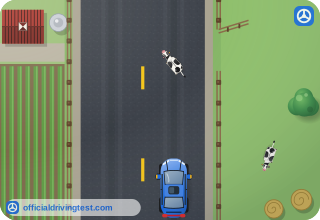
- Keep your vehicle under control and stay on the roadway; do not swerve
- Accelerate to pass the animal before it moves
- Swerve sharply into the oncoming lane to avoid the animal
- Swerve off the roadway onto the shoulder to avoid the animal
Show answer
Correct answer: Keep your vehicle under control and stay on the roadway; do not swerve
The handbook warns that swerving to avoid an animal can cause a more serious crash than colliding with it; keep your vehicle under control and on the roadway.
Source: Florida Driver License Handbook (Revised August 2023), page 71
-
According to the handbook, when are animals most active on or near roadways, requiring extra caution?
- Only on weekends
- Dawn and dusk
- Only during thunderstorms
- Midday
Show answer
Correct answer: Dawn and dusk
Use caution when driving at dawn and dusk; this is when animals are most active.
Source: Florida Driver License Handbook (Revised August 2023), page 71
-
Deer/vehicle crashes occur most often during which months?
- October to December
- June to August
- April to May
- January to March
Show answer
Correct answer: October to December
The handbook states that deer/vehicle crashes occur most often from October to December.
Source: Florida Driver License Handbook (Revised August 2023), page 71
-
At night, what should you watch for on the sides of the road to help spot animals before they enter your path?
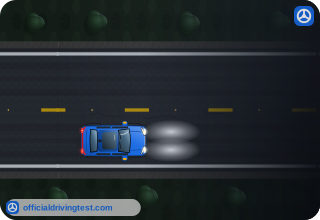
- Painted animal-crossing symbols on the pavement
- The reflection of your headlights in animals' eyes
- Movement in your rearview mirror
- Shadows cast by streetlights
Show answer
Correct answer: The reflection of your headlights in animals' eyes
Scan the sides of the road and watch for the reflection of your headlights in the eyes of animals.
Source: Florida Driver License Handbook (Revised August 2023), page 71
-
Why should you flash your headlights when you spot an animal on or near the road?
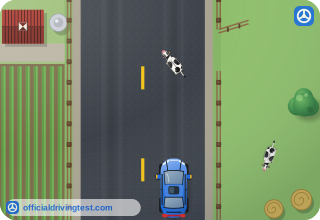
- To signal that you are about to pass another vehicle
- To permanently scare the animal away from roads
- It is required only at railroad crossings
- To warn other drivers that an animal has been spotted
Show answer
Correct answer: To warn other drivers that an animal has been spotted
Flash your headlights to warn other drivers when animals are spotted on or near the road.
Source: Florida Driver License Handbook (Revised August 2023), page 71
-
Deer tend to fixate on headlights and may freeze in place. If you have time to avoid hitting one, what should you do?
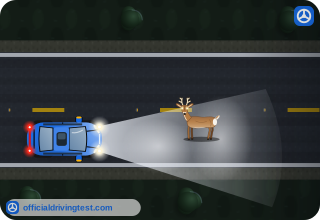
- Speed up to get past it quickly
- Turn off your headlights so the deer is not blinded
- Reduce your speed, tap your brakes, and sound your horn
- Swerve immediately into another lane
Show answer
Correct answer: Reduce your speed, tap your brakes, and sound your horn
If you have time to avoid hitting an animal, reduce your speed, tap your brakes, and sound your horn; deer tend to fixate on headlights so flashing them may cause the animal to freeze.
Source: Florida Driver License Handbook (Revised August 2023), page 71
-
If a crash involves a large animal such as a bear, deer, or farm animal, what should you do?
- Report the crash to law enforcement
- Only report it if the vehicle is undrivable
- No report is required for animal collisions
- Report it to the Department of Agriculture instead
Show answer
Correct answer: Report the crash to law enforcement
Report the crash to law enforcement if it involves a large animal such as a bear, deer, or farm animal.
Source: Florida Driver License Handbook (Revised August 2023), page 71
-
In low-visibility conditions such as fog or smoke, what does the handbook say about your headlights?
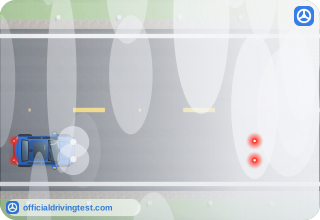
- You must turn them on; parking lights are not a substitute
- Headlights are optional if there is some daylight
- Parking lights alone are sufficient
- Only taillights are required
Show answer
Correct answer: You must turn them on; parking lights are not a substitute
When driving in low-visibility conditions, you must turn on your headlights. Parking lights are not a substitute.
Source: Florida Driver License Handbook (Revised August 2023), page 71
-
When driving in fog, why should you use low-beam headlights instead of high beams?
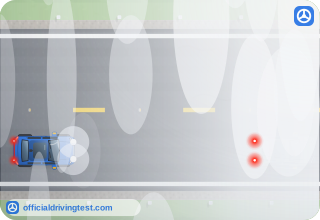
- High beams reflect off the fog and impair visibility even more
- Low beams automatically turn on the windshield wipers
- High beams are illegal to use at any time
- Low beams are brighter than high beams
Show answer
Correct answer: High beams reflect off the fog and impair visibility even more
Drive with lights on low beam; high beams will reflect off the fog and impair visibility even more.
Source: Florida Driver License Handbook (Revised August 2023), page 71
-
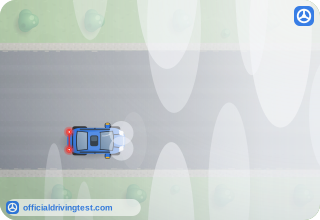
In low-visibility conditions, what can help guide you along the road?
- The taillights of the vehicle directly ahead only
- Your GPS screen exclusively
- Painted animal-crossing signs
- The right edge of the road, edge lines, and center lines
Show answer
Correct answer: The right edge of the road, edge lines, and center lines
Use the right edge of the road or edge lines and center lines as visual guides.
Source: Florida Driver License Handbook (Revised August 2023), page 71
-
What does the handbook recommend eliminating from your vehicle while driving in low-visibility conditions?
- All dashboard warning lights
- Distractions such as the radio or phone
- Passengers riding in the back seat
- Cruise control
Show answer
Correct answer: Distractions such as the radio or phone
Eliminate all distractions in your vehicle. Turn off the radio, cell phone, etc.
Source: Florida Driver License Handbook (Revised August 2023), page 72
-
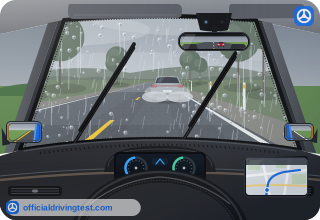
What should you do with your headlights whenever you turn on your windshield wipers?
- Turn on your hazard lights instead
- Turn your headlights off to reduce glare
- Turn your headlights on
- Switch to high beams
Show answer
Correct answer: Turn your headlights on
When you turn on your windshield wipers, turn on your headlights.
Source: Florida Driver License Handbook (Revised August 2023), page 72
-
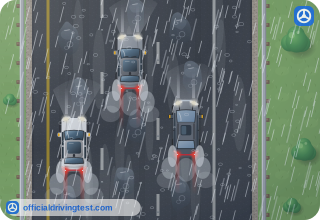
According to the handbook, roads can be especially slick during a rainstorm if it has not rained in a while. Why?
- Increased tire pressure
- Excess sand left from winter road treatment
- Oil build-up on the highway
- Fresh asphalt sealant
Show answer
Correct answer: Oil build-up on the highway
Roads become slick during rainstorms, especially if it has not rained in a while, due to oil build-up on the highway.
Source: Florida Driver License Handbook (Revised August 2023), page 72
-
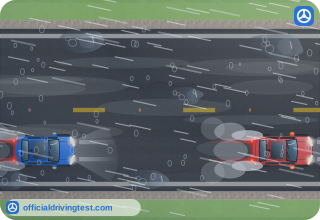
Because wet roads increase your vehicle's braking and stopping distance, what should you do?
- Decrease your following distance to see the road better
- Tailgate the vehicle ahead to use its wake
- Drive with your parking lights only
- Increase your following distance
Show answer
Correct answer: Increase your following distance
Wet road conditions will increase your braking/stopping distance, so be sure to increase your following distance.
Source: Florida Driver License Handbook (Revised August 2023), page 72