Washington, D.C.: Traffic signals — Part 3 Practice Test
Questions in this part include: “What are multiple signals used to allow?”
Independent educational site · not affiliated with any government agency or DMV
Ready? Test yourself
Answer to start, or tap Start below:
What are multiple signals used to allow?
- Instant feedback with an explanation
- Every answer cites its source in the manual
- Your best score is saved on this device
- Keyboard: press 1 to 4 to answer and Enter for the next question
Questions are original and based on the official manual "District of Columbia Driver Manual" (Updated January 2024), District of Columbia Department of Motor Vehicles (DC DMV).
All 17 questions in this practice test
Take the test above first, then use this list to study. Tap “Show answer” to see the correct answer and explanation.
Show the questions and answersHide the questions
-
When turning right on a red signal, to whom must you yield the right-of-way?
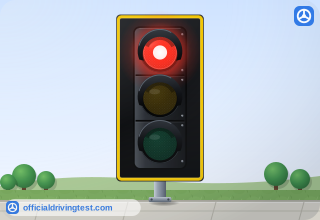
- Only pedestrians in the crosswalk
- Pedestrians, bicyclists, and all other traffic
- Only vehicles coming from the left
- Only vehicles already in the intersection
Show answer
Correct answer: Pedestrians, bicyclists, and all other traffic
When turning on red you yield to pedestrians, bicyclists, and all other traffic.
Source: District of Columbia Driver Manual (Updated January 2024), page 50
-
What is the purpose of a steady yellow signal?
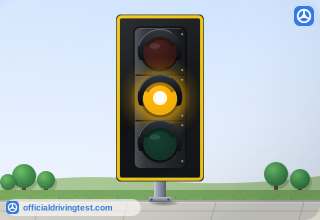
- To tell drivers to speed up and cross the intersection quickly
- To signal that pedestrians must wait for the next green
- To give traffic time to stop safely and clear the intersection
- To warn that the signal has stopped working properly
Show answer
Correct answer: To give traffic time to stop safely and clear the intersection
The yellow gives approaching traffic time to stop safely and clear other vehicles from the intersection before the light turns red.
Source: District of Columbia Driver Manual (Updated January 2024), page 50
-
What should you do before entering the intersection on a steady green signal?
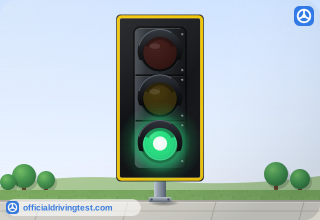
- Come to a brief stop at the stop line first
- Check that other vehicles have cleared the intersection
- Sound your horn to warn cross traffic of your entry
- Wait for the signal to turn yellow before you enter
Show answer
Correct answer: Check that other vehicles have cleared the intersection
On green you proceed with caution after checking that other vehicles have cleared the intersection.
Source: District of Columbia Driver Manual (Updated January 2024), page 50
-
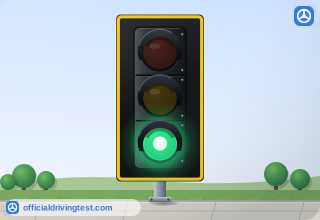
At a steady green signal, to whom must you yield?
- Only vehicles turning left from the opposite direction
- Only vehicles approaching from your right
- No one, because green gives you the right-of-way
- Pedestrians and vehicles already in the intersection
Show answer
Correct answer: Pedestrians and vehicles already in the intersection
Even on green you must yield to pedestrians and vehicles already in the intersection.
Source: District of Columbia Driver Manual (Updated January 2024), page 50
-
At a steady green signal, when may you turn?
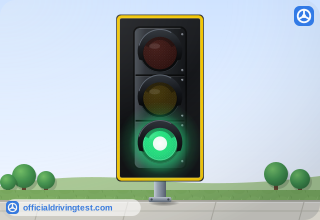
- Never, because every turn needs a green arrow signal
- Only at intersections that have a left-turn lane marked
- Only to the right, never to the left, at any intersection
- When it is safe, unless a sign or signal prohibits the turn
Show answer
Correct answer: When it is safe, unless a sign or signal prohibits the turn
When it is safe, you may go straight or turn on a steady green unless a sign or additional signal prohibits the turn.
Source: District of Columbia Driver Manual (Updated January 2024), page 50
-
How long must you remain stopped at a steady red arrow signal?
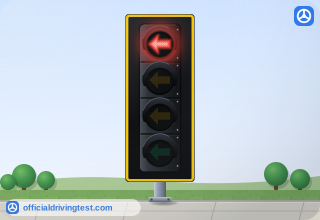
- For three seconds
- As long as the arrow signal is red
- Until the vehicle ahead moves
- Until cross traffic has cleared
Show answer
Correct answer: As long as the arrow signal is red
You stay stopped for as long as the red arrow is showing.
Source: District of Columbia Driver Manual (Updated January 2024), page 51
-
What does a steady yellow arrow signal mean?
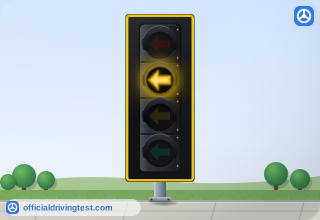
- The signal is about to turn green again
- You may turn only after you have yielded
- The signal is changing from green to red
- The arrow signal is out of order and unsafe
Show answer
Correct answer: The signal is changing from green to red
Like a steady yellow signal, a yellow arrow means the signal is changing from green to red.
Source: District of Columbia Driver Manual (Updated January 2024), page 51
-
At a steady green arrow signal, how may you proceed?
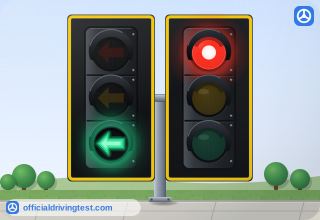
- Where the arrow points, with caution
- Straight ahead only, whatever way it points
- In any direction you choose to go
- Left or right, but never straight ahead
Show answer
Correct answer: Where the arrow points, with caution
A green arrow lets you proceed with caution in the direction the arrow points.
Source: District of Columbia Driver Manual (Updated January 2024), page 51
-
What must you do at a flashing red signal?
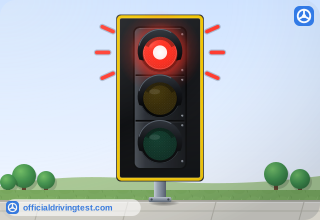
- Slow down and proceed with caution through it
- Stop completely, yield, then go when the way is clear
- Stop only if other traffic is present nearby
- Slow down and stop only for pedestrians crossing
Show answer
Correct answer: Stop completely, yield, then go when the way is clear
A flashing red signal requires a complete stop and yielding to all other traffic and pedestrians; you go when the way is clear.
Source: District of Columbia Driver Manual (Updated January 2024), page 51
-
What must you do at a flashing yellow signal?
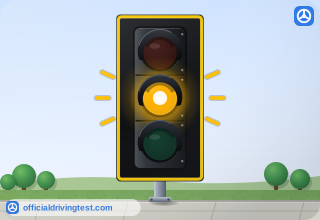
- Come to a complete stop
- Stop only if pedestrians are present
- Stop and wait for a green signal
- Slow down and proceed with caution
Show answer
Correct answer: Slow down and proceed with caution
A flashing yellow signal means slow down and proceed with caution.
Source: District of Columbia Driver Manual (Updated January 2024), page 51
-
What are multiple signals used to allow?
- Pedestrians to cross while traffic is stopped
- Traffic to make left turns with a green light
- Traffic to reverse lane direction
- Buses to enter the intersection first
Show answer
Correct answer: Traffic to make left turns with a green light
Multiple signals are used to allow traffic to make left turns with a green light.
Source: District of Columbia Driver Manual (Updated January 2024), page 51
-
What are lane use signals used for?
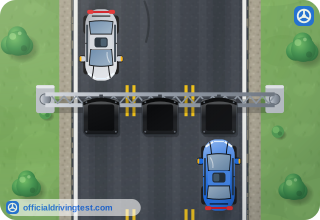
- Controlling traffic flow by reversing lane direction at set hours
- Marking lanes that are reserved only for buses at all times
- Showing drivers the speed limit that applies in each lane
- Warning drivers that a lane is closed for road work ahead
Show answer
Correct answer: Controlling traffic flow by reversing lane direction at set hours
Lane use signals control traffic flow by reversing the direction of lanes during different hours of the day.
Source: District of Columbia Driver Manual (Updated January 2024), page 51
-
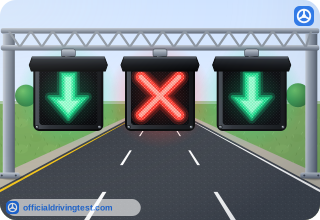
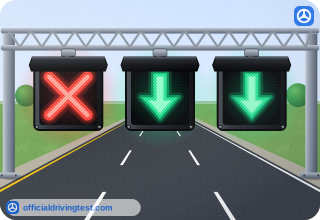
What does a red “X” signal over a lane mean?
- You may use the lane for a left turn
- You may drive in the lane with caution
- You must never drive in that lane
- You should move out of the lane when safe
Show answer
Correct answer: You must never drive in that lane
You must never drive in a lane that is under a red X signal.
Source: District of Columbia Driver Manual (Updated January 2024), page 51
-
What does a green arrow signal over a lane mean?
- The lane is reserved for left turns
- You are permitted to drive in that lane
- The lane ends just ahead
- You must exit the highway
Show answer
Correct answer: You are permitted to drive in that lane
A green arrow over a lane means you are permitted to drive in it.
Source: District of Columbia Driver Manual (Updated January 2024), page 51
-
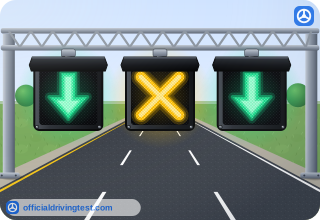
What does a steady yellow “X” signal over a lane mean?
- A driver may use the lane for making a left turn
- A driver must stop and wait in the lane until it is green
- A driver may keep on using the lane all day long
- A driver should leave the lane as soon as safely possible
Show answer
Correct answer: A driver should leave the lane as soon as safely possible
A steady yellow X warns you to leave the lane as soon as it is safe to do so.
Source: District of Columbia Driver Manual (Updated January 2024), page 51
-
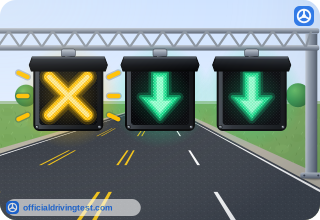
What does a flashing yellow “X” signal over a lane mean?
- A driver must never use the lane at any time
- A driver must leave the lane at once
- Traffic in that lane is now reversing direction
- A driver may use the lane for a left turn
Show answer
Correct answer: A driver may use the lane for a left turn
A flashing yellow X lets a driver use that lane for a left turn.
Source: District of Columbia Driver Manual (Updated January 2024), page 51
-
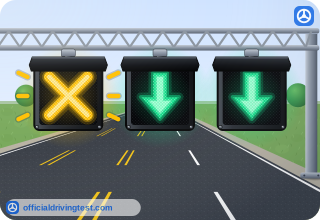
When you use a lane under a flashing yellow “X” signal, whom are you likely to share the lane with?
- Buses and carpools that are traveling the same way
- Left-turning vehicles from the opposite direction
- Bicyclists who are riding in the same direction
- Vehicles that are traveling in the same direction only
Show answer
Correct answer: Left-turning vehicles from the opposite direction
You are likely to share that lane with left-turning vehicles coming from the opposite direction.
Source: District of Columbia Driver Manual (Updated January 2024), page 51