Washington, D.C.: Traffic signals
Steady and flashing lights and arrows, lane use signals, the HAWK pedestrian signal and rapid flashing beacons. Split into 3 shorter tests so you're not stuck in one long quiz.
Independent educational site · not affiliated with any government agency or DMV
Choose a part
Traffic signals — Part 1
Questions in this part include: “What does HAWK stand for?”
Traffic signals — Part 2
Questions in this part include: “What color are the lights of an RRFB when it is activated?”
Traffic signals — Part 3
Questions in this part include: “What are multiple signals used to allow?”
Questions are original and based on the official manual "District of Columbia Driver Manual" (Updated January 2024), District of Columbia Department of Motor Vehicles (DC DMV).
All 53 Traffic signals questions with answers
Choose a part above to take a practice test, or study every question and answer here.
Show the questions and answersHide the questions
1Part 118 questions
-
What does HAWK stand for?
- Highway Activated Walkway Key
- High-Intensity Activated crossWalk
- Heavy-Traffic Alert for Walkers
- Hazard Alert for Walking Kids
Show answer
Correct answer: High-Intensity Activated crossWalk
HAWK stands for High-Intensity Activated crossWalk.
Source: District of Columbia Driver Manual (Updated January 2024), page 7
-
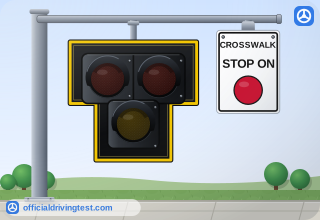
What is a HAWK signal designed to do?
- Control traffic at freeway on-ramps
- Slow traffic in school zones
- Warn drivers of a railroad crossing
- Help pedestrians safely cross busy streets
Show answer
Correct answer: Help pedestrians safely cross busy streets
A HAWK signal is a signal-beacon designed to help pedestrians safely cross busy streets.
Source: District of Columbia Driver Manual (Updated January 2024), page 7
-
What is another name for the HAWK signal?
- Pedestrian Hybrid Beacon
- Pedestrian Warning Beacon
- Rectangular Rapid Flashing Beacon
- Crosswalk Alert Beacon
Show answer
Correct answer: Pedestrian Hybrid Beacon
The manual says the HAWK signal is also known as a Pedestrian Hybrid Beacon.
Source: District of Columbia Driver Manual (Updated January 2024), page 7
-
Which agency has approved the HAWK signal for use?
- The Metropolitan Police Department
- The Department of Motor Vehicles
- The Federal Highway Administration
- The National Safety Council
Show answer
Correct answer: The Federal Highway Administration
The HAWK signal has been approved for use by the Federal Highway Administration.
Source: District of Columbia Driver Manual (Updated January 2024), page 7
-
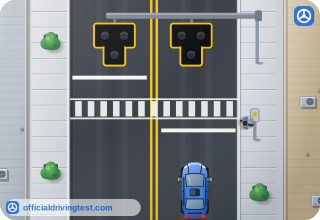
What does a HAWK signal use to stop traffic so pedestrians can cross?
- A stop sign
- A red signal
- A railroad gate
- A flashing white light
Show answer
Correct answer: A red signal
A HAWK signal stops traffic with a red signal and lets pedestrians cross with a WALK signal.
Source: District of Columbia Driver Manual (Updated January 2024), page 7
-
At certain locations, how can a HAWK signal be activated besides a push button?
- By a sensor that detects approaching vehicles at speed
- By a timer set to run every minute
- By a remote carried by police officers
- By automatically detecting pedestrians waiting to cross
Show answer
Correct answer: By automatically detecting pedestrians waiting to cross
At certain locations the signal detects pedestrians waiting to cross and activates itself.
Source: District of Columbia Driver Manual (Updated January 2024), page 7
-
How do HAWK signals with Accessible Pedestrian Signal (APS) equipment announce that the WALK signal is on?
- An audible message and a vibrating arrow button
- A siren and a vibrating strip in the crosswalk
- A recorded message and a flashing white lamp
- A bell tone and a flashing yellow arrow light
Show answer
Correct answer: An audible message and a vibrating arrow button
An audible message and a vibrating arrow button tell disabled pedestrians that the WALK signal is on.
Source: District of Columbia Driver Manual (Updated January 2024), page 7
-
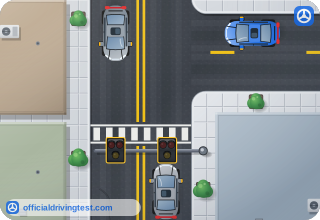
If a side street meets a HAWK signal, what controls the side street traffic?
- A traffic signal
- A yield sign
- A stop sign
- A flashing beacon
Show answer
Correct answer: A stop sign
A side street at a HAWK signal continues to be controlled by a stop sign.
Source: District of Columbia Driver Manual (Updated January 2024), page 7
-
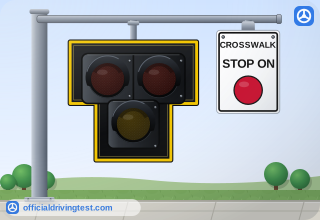
A HAWK signal has all of its lights dark (off). What should a motorist do?
- Stop and wait
- Slow down and prepare to stop
- Stop, then proceed if clear
- Proceed
Show answer
Correct answer: Proceed
With all lights dark the motorist-side instruction is to proceed.
Source: District of Columbia Driver Manual (Updated January 2024), page 8
-
A HAWK signal shows a flashing yellow light after a pedestrian has activated it. What should a motorist do?
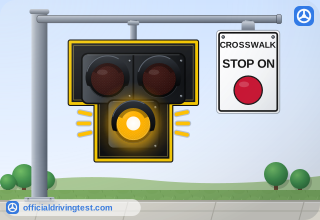
- Proceed with caution
- Stop and wait
- Slow down and prepare to stop
- Stop, then proceed with caution if clear
Show answer
Correct answer: Proceed with caution
A flashing yellow means the signal has been activated, and motorists proceed with caution.
Source: District of Columbia Driver Manual (Updated January 2024), page 8
-
A HAWK signal shows a steady yellow light. What should a motorist do?
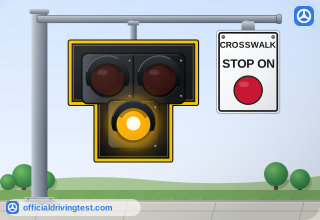
- Proceed with caution
- Stop, then proceed with caution if clear
- Slow down and prepare to stop
- Proceed
Show answer
Correct answer: Slow down and prepare to stop
A steady yellow on a HAWK signal means slow down and prepare to stop.
Source: District of Columbia Driver Manual (Updated January 2024), page 8
-
A HAWK signal shows two steady (not flashing) red lights. What should a motorist do?
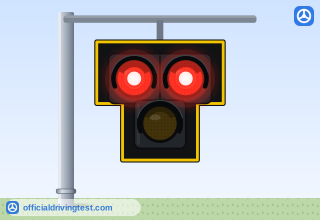
- Proceed with caution
- Stop
- Slow down and prepare to stop
- Stop, then proceed with caution if clear
Show answer
Correct answer: Stop
Two steady red lights on a HAWK signal mean stop.
Source: District of Columbia Driver Manual (Updated January 2024), page 8
-
A HAWK signal shows two flashing red lights. What should a motorist do?
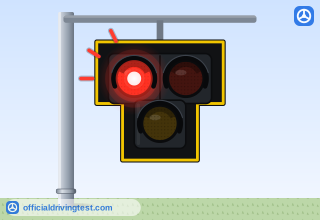
- Proceed with caution without stopping
- Stop and wait until the signal goes dark
- Slow down and prepare to stop
- Stop, then proceed with caution if clear
Show answer
Correct answer: Stop, then proceed with caution if clear
Flashing red lights on a HAWK signal mean stop, then proceed with caution if the crosswalk is clear.
Source: District of Columbia Driver Manual (Updated January 2024), page 8
-
After a pedestrian pushes the button at a HAWK signal, how long may it take for the signal to change?
- Up to one minute
- Up to ten seconds
- Up to five minutes
- Up to thirty minutes
Show answer
Correct answer: Up to one minute
The pedestrian instructions say it may take up to one minute for the signal to change.
Source: District of Columbia Driver Manual (Updated January 2024), page 8
-
What is a Rectangular Rapid Flashing Beacon (RRFB)?
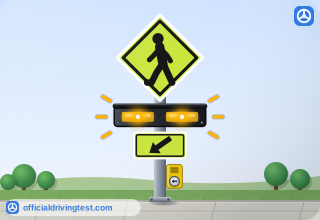
- A flashing red signal that closes lanes ahead of road work zones
- A beacon on school buses that shows children are boarding or leaving
- A control device used only at railroad crossings with gates
- A pedestrian-activated control device used with marked crosswalks
Show answer
Correct answer: A pedestrian-activated control device used with marked crosswalks
An RRFB is a pedestrian-activated traffic control device used with marked crosswalks.
Source: District of Columbia Driver Manual (Updated January 2024), page 10
-
Where is an RRFB placed relative to the pedestrian crossing sign and the arrow?
- Below the pedestrian crossing sign and above the arrow
- Above the pedestrian crossing sign and below the arrow
- Below both the sign and the arrow
- Above both the sign and the arrow
Show answer
Correct answer: Below the pedestrian crossing sign and above the arrow
RRFBs sit below the pedestrian crossing sign and above the arrow indication pointing at the crossing.
Source: District of Columbia Driver Manual (Updated January 2024), page 10
-
On which sides of a crosswalk are RRFBs placed?
- Only the side nearest oncoming traffic
- Only the side where pedestrians start
- Both sides
- Only the far side of the roadway
Show answer
Correct answer: Both sides
RRFBs are placed on both sides of a crosswalk.
Source: District of Columbia Driver Manual (Updated January 2024), page 10
-
How can pedestrians activate an RRFB?
- Only by a push button pressed by the pedestrian
- By push button or by automated pedestrian detection
- Only by an automatic vehicle detector
- By a signal button pressed by the driver
Show answer
Correct answer: By push button or by automated pedestrian detection
Pedestrians can activate it manually by push button or passively through an automated detection system.
Source: District of Columbia Driver Manual (Updated January 2024), page 10
2Part 218 questions
-
What color are the lights of an RRFB when it is activated?
- Red
- White
- Green
- Yellow
Show answer
Correct answer: Yellow
An activated RRFB has yellow lights that flash with high frequency.
Source: District of Columbia Driver Manual (Updated January 2024), page 10
-
What are an RRFB’s flashing lights intended to help drivers do?
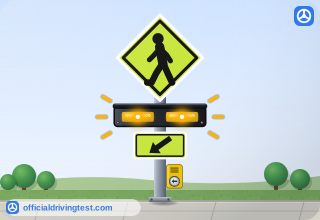
- More easily see pedestrians who are crossing
- Judge the speed of traffic on the cross street
- Find the nearest marked crosswalk at night
- Know when the signal ahead will turn red
Show answer
Correct answer: More easily see pedestrians who are crossing
The flashing lights are intended to help drivers more easily see pedestrians who are crossing.
Source: District of Columbia Driver Manual (Updated January 2024), page 10
-
How long do an RRFB’s flashing yellow lights flash?
- A fixed ten seconds every time
- Only until the first driver stops
- Long enough for pedestrians to cross safely
- Until the pedestrian leaves the sidewalk
Show answer
Correct answer: Long enough for pedestrians to cross safely
The lights flash long enough to allow pedestrians to cross the street safely.
Source: District of Columbia Driver Manual (Updated January 2024), page 10
-
A traffic signal is green, but a police officer signals you to stop. What should you do?
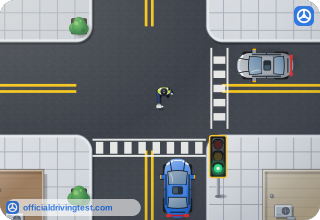
- Obey the traffic signal
- Do what the vehicle in front of you does
- Slow down and proceed through if the way is clear
- Obey the traffic officer
Show answer
Correct answer: Obey the traffic officer
The manual’s sample question states that when the signal is green and an officer signals you to stop, you obey the officer.
Source: District of Columbia Driver Manual (Updated January 2024), page 11
-
At a busy intersection with pedestrian signals together with normal traffic signals, which must drivers obey?
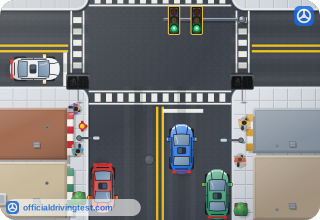
- The WALK and DON’T WALK signals
- Whichever signal changes first
- Neither, if no pedestrian is present
- The normal traffic signals
Show answer
Correct answer: The normal traffic signals
Drivers obey the normal traffic signals, while pedestrians obey the WALK and DON’T WALK signals.
Source: District of Columbia Driver Manual (Updated January 2024), page 35
-
What does a “Bus Only” signal allow buses to do?
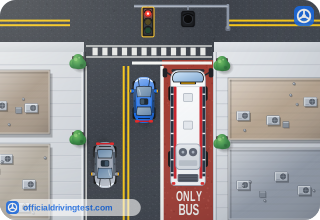
- Proceed through an intersection before the light turns green
- Pass through a red light after stopping for three seconds
- Stop in the intersection to pick up passengers
- Turn left from any lane
Show answer
Correct answer: Proceed through an intersection before the light turns green
Bus Only signals give buses a head start before the light turns green for other traffic.
Source: District of Columbia Driver Manual (Updated January 2024), page 39
-
On a bus-only traffic signal, what does a vertical bar mean?
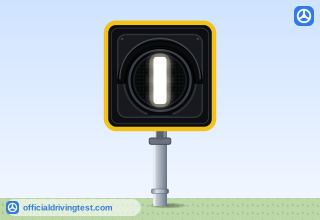
- It tells all of the other vehicles in the intersection to stop
- It shows that the priority signal is about to end
- When the bus should proceed; it serves as the green light for the bus
- It tells the bus to yield to cars
Show answer
Correct answer: When the bus should proceed; it serves as the green light for the bus
A vertical bar is the green light for a bus that is stopped at the intersection.
Source: District of Columbia Driver Manual (Updated January 2024), page 39
-
On a bus-only traffic signal, what does a flashing triangle show?
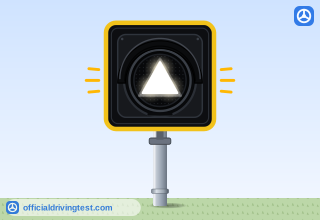
- The bus must stop where it is right now
- The priority signal is about to end
- The bus lane is closed
- Other traffic may go first
Show answer
Correct answer: The priority signal is about to end
After three seconds of the vertical bar, a flashing triangle warns that the priority signal is about to end.
Source: District of Columbia Driver Manual (Updated January 2024), page 39
-
On a bus-only traffic signal, what does a horizontal bar mean?
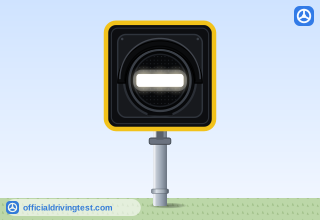
- Buses may continue through the red light while still having priority
- Buses must stop in the lane for three seconds
- Buses are allowed to proceed first
- Buses no longer have priority and must obey normal traffic signals
Show answer
Correct answer: Buses no longer have priority and must obey normal traffic signals
The horizontal bar ends the bus priority, so buses follow the normal traffic signals.
Source: District of Columbia Driver Manual (Updated January 2024), page 39
-
What must you do where there is a flashing red traffic signal?
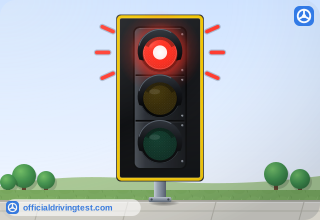
- Slow down and proceed with caution
- Yield to cross traffic only
- Make a full stop
- Stop only if other vehicles are approaching
Show answer
Correct answer: Make a full stop
A flashing red signal requires a full stop.
Source: District of Columbia Driver Manual (Updated January 2024), page 44
-
At a steady red signal, what must you do before turning right, unless a sign prohibits the turn?
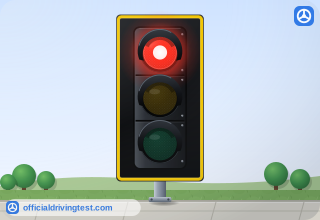
- Slow down and yield only to pedestrians
- Make a full stop and yield the right-of-way
- Wait for a police officer to wave you through
- Stop only if traffic is approaching
Show answer
Correct answer: Make a full stop and yield the right-of-way
You may turn right on red only after a full stop and yielding to pedestrians, bicyclists, and other traffic.
Source: District of Columbia Driver Manual (Updated January 2024), page 44
-
Who must obey traffic signals?
- Only people who are driving motor vehicles on public streets
- Everyone walking, driving, or riding a bicycle on a street or highway
- Drivers and pedestrians, but not people riding bicycles
- Only drivers, whenever a traffic officer is present
Show answer
Correct answer: Everyone walking, driving, or riding a bicycle on a street or highway
Traffic signals apply to pedestrians, drivers, and bicyclists alike.
Source: District of Columbia Driver Manual (Updated January 2024), page 50
-
Approaching an intersection controlled by a traffic control device, what may a driver NOT do?
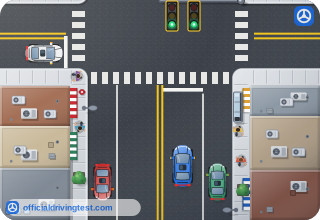
- Stop at the stop line and wait there while the signal is red
- Turn right after a complete stop at a red signal where allowed
- Wait for pedestrians who are in the crosswalk to clear it completely
- Drive across private property, such as a gas station lot, to avoid the signal
Show answer
Correct answer: Drive across private property, such as a gas station lot, to avoid the signal
A driver may not cut across private property, such as gas stations or store parking lots, or leave the roadway to avoid a traffic control device.
Source: District of Columbia Driver Manual (Updated January 2024), page 50
-
In what order are traffic signals usually arranged?
- Red, yellow, and green from top to bottom, or left to right
- Green, yellow, and red from top to bottom or left to right
- Yellow, red, and green from left to right only
- Red, green, and yellow from top to bottom only
Show answer
Correct answer: Red, yellow, and green from top to bottom, or left to right
Signals are usually red, yellow, and green from top to bottom or from left to right.
Source: District of Columbia Driver Manual (Updated January 2024), page 50
-
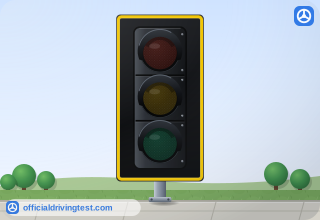
What must you do when you approach an intersection where the traffic lights are out of service or malfunctioning?
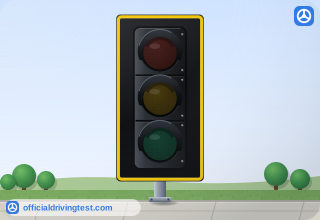
- Slow down and go through if no cars are visible
- Treat it as a yield sign and go when clear
- Come to a stop as you would for a stop sign
- Stop only if other vehicles are waiting
Show answer
Correct answer: Come to a stop as you would for a stop sign
The law treats a dark or malfunctioning signal like a stop sign: you stop first.
Source: District of Columbia Driver Manual (Updated January 2024), page 50
-
After you stop at an intersection where the signals are out of service, how must you proceed?
- Right away, since the signals no longer apply to you at all
- Only when the signals come back into service again later
- By the rules of right of way, unless a traffic officer directs you
- By following the vehicle that is in front of you at the time
Show answer
Correct answer: By the rules of right of way, unless a traffic officer directs you
After stopping, you follow the rules of right of way unless a traffic officer directs you to proceed.
Source: District of Columbia Driver Manual (Updated January 2024), page 50
-
At a steady red signal with no stop line, where must you stop?
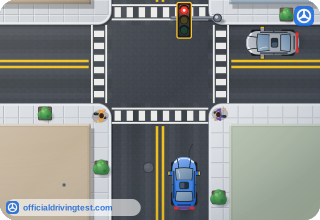
- Before entering the crosswalk
- Halfway across the crosswalk
- Just past the crosswalk
- In the middle of the intersection
Show answer
Correct answer: Before entering the crosswalk
If there is no stop line, you must stop before entering the crosswalk and stay stopped while the signal is red.
Source: District of Columbia Driver Manual (Updated January 2024), page 50
-
When may you turn right at a red signal?
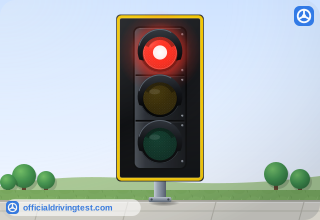
- Whenever no other vehicle is in sight at the intersection
- Only after the signal has turned yellow for a moment
- Only when a police officer waves you on to turn
- After a complete stop, unless a No Turn on Red sign is posted
Show answer
Correct answer: After a complete stop, unless a No Turn on Red sign is posted
A right turn on red is allowed after a complete stop unless signs at the intersection prohibit it.
Source: District of Columbia Driver Manual (Updated January 2024), page 50
3Part 317 questions
-
When turning right on a red signal, to whom must you yield the right-of-way?
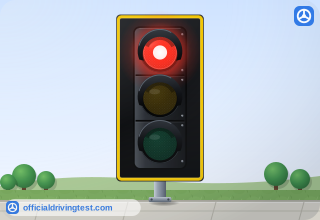
- Only pedestrians in the crosswalk
- Pedestrians, bicyclists, and all other traffic
- Only vehicles coming from the left
- Only vehicles already in the intersection
Show answer
Correct answer: Pedestrians, bicyclists, and all other traffic
When turning on red you yield to pedestrians, bicyclists, and all other traffic.
Source: District of Columbia Driver Manual (Updated January 2024), page 50
-
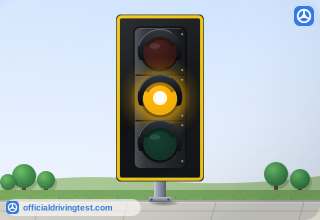
What is the purpose of a steady yellow signal?
- To tell drivers to speed up and cross the intersection quickly
- To signal that pedestrians must wait for the next green
- To give traffic time to stop safely and clear the intersection
- To warn that the signal has stopped working properly
Show answer
Correct answer: To give traffic time to stop safely and clear the intersection
The yellow gives approaching traffic time to stop safely and clear other vehicles from the intersection before the light turns red.
Source: District of Columbia Driver Manual (Updated January 2024), page 50
-
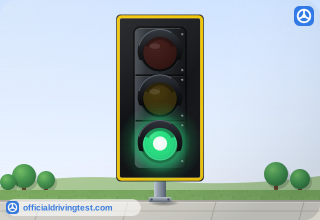
What should you do before entering the intersection on a steady green signal?
- Come to a brief stop at the stop line first
- Check that other vehicles have cleared the intersection
- Sound your horn to warn cross traffic of your entry
- Wait for the signal to turn yellow before you enter
Show answer
Correct answer: Check that other vehicles have cleared the intersection
On green you proceed with caution after checking that other vehicles have cleared the intersection.
Source: District of Columbia Driver Manual (Updated January 2024), page 50
-
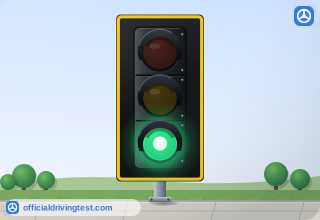
At a steady green signal, to whom must you yield?
- Only vehicles turning left from the opposite direction
- Only vehicles approaching from your right
- No one, because green gives you the right-of-way
- Pedestrians and vehicles already in the intersection
Show answer
Correct answer: Pedestrians and vehicles already in the intersection
Even on green you must yield to pedestrians and vehicles already in the intersection.
Source: District of Columbia Driver Manual (Updated January 2024), page 50
-
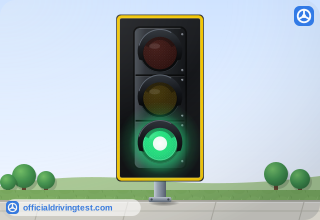
At a steady green signal, when may you turn?
- Never, because every turn needs a green arrow signal
- Only at intersections that have a left-turn lane marked
- Only to the right, never to the left, at any intersection
- When it is safe, unless a sign or signal prohibits the turn
Show answer
Correct answer: When it is safe, unless a sign or signal prohibits the turn
When it is safe, you may go straight or turn on a steady green unless a sign or additional signal prohibits the turn.
Source: District of Columbia Driver Manual (Updated January 2024), page 50
-
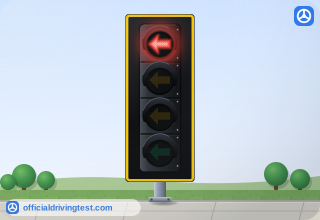
How long must you remain stopped at a steady red arrow signal?
- For three seconds
- As long as the arrow signal is red
- Until the vehicle ahead moves
- Until cross traffic has cleared
Show answer
Correct answer: As long as the arrow signal is red
You stay stopped for as long as the red arrow is showing.
Source: District of Columbia Driver Manual (Updated January 2024), page 51
-
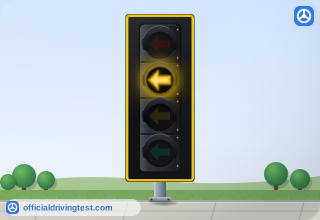
What does a steady yellow arrow signal mean?
- The signal is about to turn green again
- You may turn only after you have yielded
- The signal is changing from green to red
- The arrow signal is out of order and unsafe
Show answer
Correct answer: The signal is changing from green to red
Like a steady yellow signal, a yellow arrow means the signal is changing from green to red.
Source: District of Columbia Driver Manual (Updated January 2024), page 51
-
At a steady green arrow signal, how may you proceed?
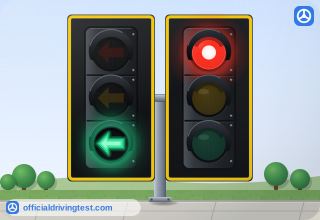
- Where the arrow points, with caution
- Straight ahead only, whatever way it points
- In any direction you choose to go
- Left or right, but never straight ahead
Show answer
Correct answer: Where the arrow points, with caution
A green arrow lets you proceed with caution in the direction the arrow points.
Source: District of Columbia Driver Manual (Updated January 2024), page 51
-
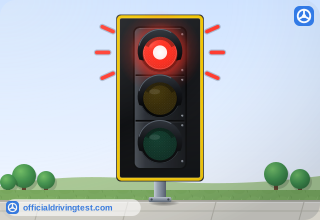
What must you do at a flashing red signal?
- Slow down and proceed with caution through it
- Stop completely, yield, then go when the way is clear
- Stop only if other traffic is present nearby
- Slow down and stop only for pedestrians crossing
Show answer
Correct answer: Stop completely, yield, then go when the way is clear
A flashing red signal requires a complete stop and yielding to all other traffic and pedestrians; you go when the way is clear.
Source: District of Columbia Driver Manual (Updated January 2024), page 51
-
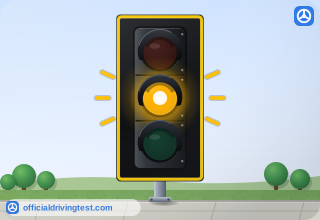
What must you do at a flashing yellow signal?
- Come to a complete stop
- Stop only if pedestrians are present
- Stop and wait for a green signal
- Slow down and proceed with caution
Show answer
Correct answer: Slow down and proceed with caution
A flashing yellow signal means slow down and proceed with caution.
Source: District of Columbia Driver Manual (Updated January 2024), page 51
-
What are multiple signals used to allow?
- Pedestrians to cross while traffic is stopped
- Traffic to make left turns with a green light
- Traffic to reverse lane direction
- Buses to enter the intersection first
Show answer
Correct answer: Traffic to make left turns with a green light
Multiple signals are used to allow traffic to make left turns with a green light.
Source: District of Columbia Driver Manual (Updated January 2024), page 51
-
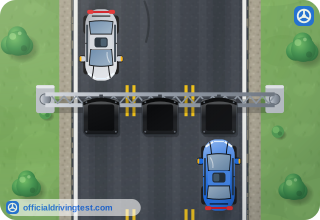
What are lane use signals used for?
- Controlling traffic flow by reversing lane direction at set hours
- Marking lanes that are reserved only for buses at all times
- Showing drivers the speed limit that applies in each lane
- Warning drivers that a lane is closed for road work ahead
Show answer
Correct answer: Controlling traffic flow by reversing lane direction at set hours
Lane use signals control traffic flow by reversing the direction of lanes during different hours of the day.
Source: District of Columbia Driver Manual (Updated January 2024), page 51
-
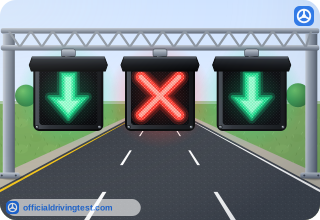
What does a red “X” signal over a lane mean?
- You may use the lane for a left turn
- You may drive in the lane with caution
- You must never drive in that lane
- You should move out of the lane when safe
Show answer
Correct answer: You must never drive in that lane
You must never drive in a lane that is under a red X signal.
Source: District of Columbia Driver Manual (Updated January 2024), page 51
-
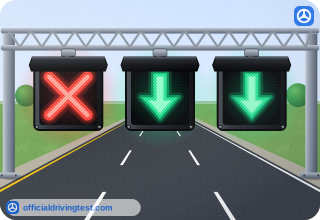
What does a green arrow signal over a lane mean?
- The lane is reserved for left turns
- You are permitted to drive in that lane
- The lane ends just ahead
- You must exit the highway
Show answer
Correct answer: You are permitted to drive in that lane
A green arrow over a lane means you are permitted to drive in it.
Source: District of Columbia Driver Manual (Updated January 2024), page 51
-
What does a steady yellow “X” signal over a lane mean?
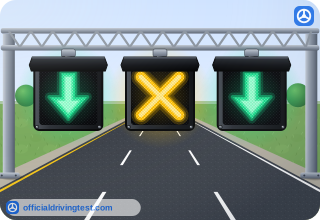
- A driver may use the lane for making a left turn
- A driver must stop and wait in the lane until it is green
- A driver may keep on using the lane all day long
- A driver should leave the lane as soon as safely possible
Show answer
Correct answer: A driver should leave the lane as soon as safely possible
A steady yellow X warns you to leave the lane as soon as it is safe to do so.
Source: District of Columbia Driver Manual (Updated January 2024), page 51
-
What does a flashing yellow “X” signal over a lane mean?
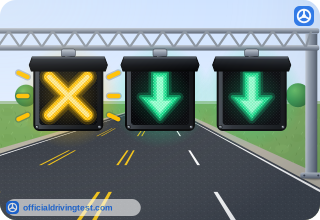
- A driver must never use the lane at any time
- A driver must leave the lane at once
- Traffic in that lane is now reversing direction
- A driver may use the lane for a left turn
Show answer
Correct answer: A driver may use the lane for a left turn
A flashing yellow X lets a driver use that lane for a left turn.
Source: District of Columbia Driver Manual (Updated January 2024), page 51
-
When you use a lane under a flashing yellow “X” signal, whom are you likely to share the lane with?
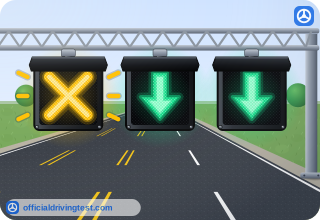
- Buses and carpools that are traveling the same way
- Left-turning vehicles from the opposite direction
- Bicyclists who are riding in the same direction
- Vehicles that are traveling in the same direction only
Show answer
Correct answer: Left-turning vehicles from the opposite direction
You are likely to share that lane with left-turning vehicles coming from the opposite direction.
Source: District of Columbia Driver Manual (Updated January 2024), page 51